 By
By 
Register your photographs with the U.S. Copyright Office within three months of publication to qualify for statutory damages up to $150,000 per infringement and attorney’s fees in litigation. This single action transforms your copyright from a basic protection into a powerful legal tool that makes pursuing infringers economically viable.
Apply visible watermarks and embed metadata containing your copyright notice, contact information, and licensing terms into every digital file you distribute. When a commercial blog used a wedding photographer’s image without permission in 2019, the embedded metadata proved ownership instantly, leading to a $4,500 settlement within two weeks.
Document every instance of unauthorized use with screenshots, URLs, and dates before sending a formal DMCA takedown notice or cease-and-desist letter. Courts favor photographers who demonstrate they’ve taken reasonable steps to protect their work, and this paper trail becomes essential evidence if disputes escalate to litigation.
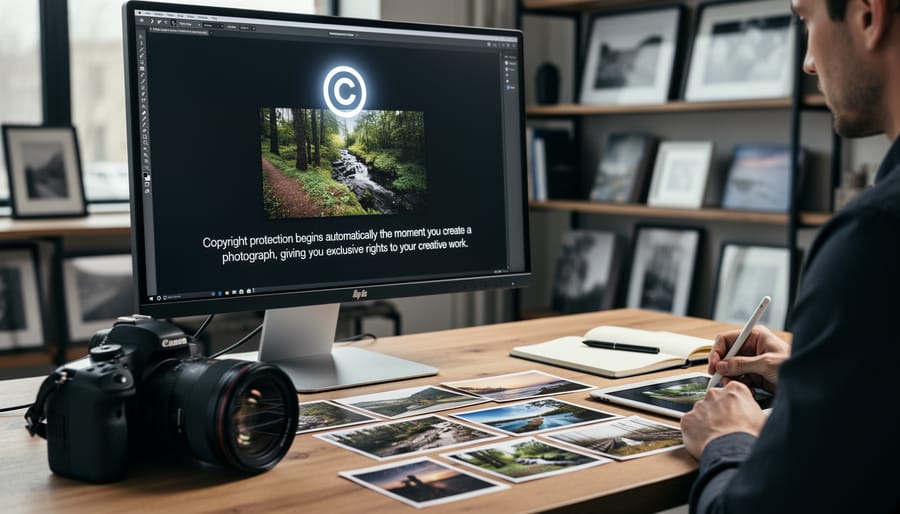
Understand that copyright protection begins the moment you press the shutter, granting you exclusive rights to reproduce, distribute, display, and create derivative works from your images for your lifetime plus 70 years. You don’t need to register immediately to own copyright, but registration creates a public record and enables you to sue infringers in federal court. Many photographers discover their work circulating online without permission, from social media accounts to commercial websites, often generating revenue for others while the creator receives nothing. Knowing how U.S. copyright law specifically protects photographic works empowers you to monetize your creativity, prevent unauthorized exploitation, and take swift action when violations occur.
What Copyright Actually Means for Your Photos
The Bundle of Rights You Own
When you snap a photograph, you’re not just creating an image—you’re creating a bundle of exclusive rights that belong to you as the creator. Think of copyright as a toolbox with five distinct tools, each giving you control over different aspects of how your work can be used.
The first right is reproduction, which means only you can make copies of your photograph. This applies whether someone wants to print your image on coffee mugs, duplicate it digitally for a website, or scan it from a magazine. For example, if a local business owner loves the sunset photo you posted on Instagram and wants to print it for their office, they need your permission first—even if they plan to give you credit.
Next is the distribution right, which controls how copies of your work are sold, rented, or given away. When you license your images through stock photography sites or sell prints at art fairs, you’re exercising this right. You decide whether your work reaches audiences through exclusive galleries or mass-market retailers.
The derivative works right lets you control adaptations of your original photograph. If someone wants to create a painting based on your photo, crop it significantly, add filters that transform its character, or incorporate it into a collage, they need your authorization. This right becomes increasingly relevant when considering AI-generated imagery rights and how your work might be used to train artificial intelligence systems.
Public display covers showing your photograph in places accessible to the public—galleries, websites, social media, or storefront windows. Finally, public performance applies less commonly to photography but becomes relevant for slideshows or multimedia presentations featuring your images with accompanying audio.
Understanding these five rights empowers you to protect your creative work effectively.
When Copyright Protection Starts (And Ends)
Here’s the good news: copyright protection for your photographs begins the instant you press the shutter button. No paperwork, no registration, no copyright notice required. The moment your image is “fixed in a tangible medium” (legal speak for captured on your camera’s memory card or film), it’s protected under U.S. copyright law. This automatic protection applies whether you’re shooting with a professional DSLR or just snapping pics with your smartphone.
But how long does this protection last? For photographs created after January 1, 1978, copyright protection extends for the life of the photographer plus 70 years. So if you capture an amazing landscape photo today, your heirs will control the rights to that image for seven decades after you’re gone. For work-for-hire situations, like when you’re employed by a company to take photos, the duration is either 95 years from publication or 120 years from creation, whichever is shorter.
What happens when copyright expires? The photograph enters the public domain, meaning anyone can use it freely without permission or payment. You’ll find countless historic photographs in the public domain, which is why you can freely download and use images from the Civil War era or early 20th century photography pioneers.
Understanding this timeline helps you plan for both protecting your current work and potentially using older photographs legally. While copyright is automatic, remember that formal registration with the U.S. Copyright Office strengthens your legal standing if you ever need to enforce your rights.
Registration: Why This Extra Step Matters
How to Register Your Work (The Practical Steps)
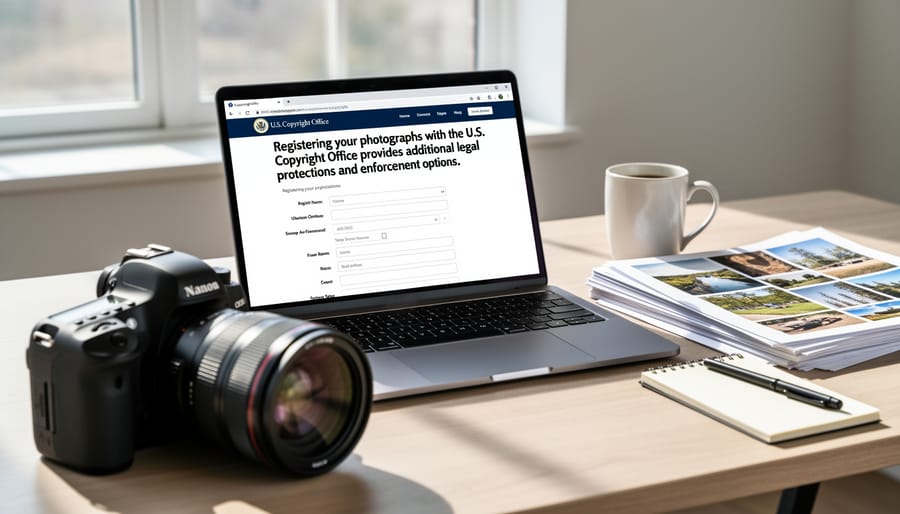
Registering your photographs with the U.S. Copyright Office strengthens your legal position significantly, even though copyright exists automatically from the moment you click the shutter. The good news? The process is more straightforward than you might think, especially with the electronic Copyright Office (eCO) system.
Start by visiting copyright.gov and creating an account in the eCO system. You’ll click “Register a New Claim” and select “Work of the Visual Arts” as your application type. The system will guide you through several screens where you’ll provide basic information about yourself as the author and copyright claimant, along with details about your work including title, year of creation, and publication status.
Here’s where it gets interesting for photographers with extensive portfolios: the Copyright Office allows you to register multiple unpublished photographs as a single collection for one fee. This bulk registration option is a game-changer if you’re sitting on hundreds of images from a single shoot or project. The key requirement is that all photos must be by the same photographer and remain unpublished. You’ll upload these as a single digital file, which can be a PDF, ZIP folder, or other acceptable format containing your images.
The standard filing fee runs $65 for a single online application, though this can change periodically. While it might seem tempting to skip registration to save money, remember that you cannot sue for infringement or collect statutory damages without it.
After completing the application and payment, you’ll upload digital copies of your work. Processing typically takes several months, but your copyright is effective as of the date the Copyright Office receives your complete application. Keep your registration certificate in a safe place—you’ll need it if you ever pursue legal action.
When Registration Is Worth the Investment
Not every photograph needs formal registration, so let’s talk about when that $65 fee makes strategic sense for your work.
If you’re making money from your photography, registration becomes essential. Commercial work—whether that’s client shoots, stock photography, or images you license to publications—should be registered before you deliver the files or shortly after creation. Here’s why: if someone infringes on registered work, you can pursue statutory damages of up to $150,000 per image, plus attorney’s fees. Without registration, you’re limited to proving actual damages, which can be nearly impossible and rarely worth the legal costs.
Portfolio pieces that define your style or could generate future income also deserve protection. That award-winning landscape or the fashion editorial that’s getting industry attention? Register them. These images represent your professional reputation and are more likely to be copied or misused.
For hobbyists shooting family snapshots or personal documentation, individual registration probably isn’t necessary. However, if you share images widely on social media or your website starts attracting commercial interest, consider registering your best work in groups—you can register multiple unpublished images together for a single fee.
Wedding and event photographers face an interesting calculation. While you might not register every ceremony, protecting the signature shots you use for marketing makes sense. Many photographers register entire events as collections when clients have high profiles or when images will be published.
The cost-benefit formula is simple: if losing control of an image or being unable to stop infringement would cost you more than $65 in lost income, reputation damage, or peace of mind, register it.
Fair Use: The Gray Area Every Photographer Should Understand
Real Photography Scenarios: Fair Use or Infringement?
Understanding fair use in real-world photography situations can feel like navigating a legal minefield, but examining actual cases helps clarify where the boundaries lie.
Let’s start with thumbnail images, which generally receive strong fair use protection. In Kelly v. Arriba Soft (2003), a search engine displayed thumbnail versions of photographer Leslie Kelly’s images. The court ruled this was fair use because the thumbnails were transformative—they served a different purpose (helping users find images) rather than replacing the original’s aesthetic function. This precedent has been crucial for photography websites, educational platforms, and review sites.
Educational use offers photographers some freedom, but it’s not a blanket exemption. If you’re creating a tutorial on composition techniques and include examples from famous photographers, you’ll want to keep several factors in mind. Use only what’s necessary to illustrate your point, add meaningful commentary or instruction, and consider the market impact. A photography instructor who reproduces entire portfolios in course materials crosses into infringement territory, while showing brief excerpts with critical analysis typically qualifies as fair use.
Transformative art presents fascinating gray areas. Richard Prince’s controversial “Canal Zone” series, which appropriated Patrick Cariou’s photographs of Jamaican Rastafarians, initially lost in court but won on appeal in Cariou v. Prince (2013). The appeals court found Prince’s alterations created new meaning and aesthetic. However, this doesn’t give carte blanche—the degree of transformation matters significantly.
News reporting provides robust protection when photography documents current events. Using someone’s photograph to illustrate breaking news generally qualifies as fair use, especially when the image itself is newsworthy. However, using a news photo simply because it looks nice in an unrelated article doesn’t receive the same protection.
Remember, fair use determinations consider four factors together: purpose, nature of the work, amount used, and market effect. Courts weigh these holistically rather than applying rigid formulas.
Work-for-Hire and Who Actually Owns Your Photos
Freelance vs. Employee: The Critical Distinction
Understanding whether you’re a freelancer or an employee makes all the difference in who owns your photographs. Under U.S. copyright law, this distinction determines whether you automatically own your work or if your employer does through work-for-hire provisions.
As an employee photographer working on staff for a magazine, newspaper, or corporation, your employer typically owns the copyright to images you create within your job duties. This means the wedding photographer employed full-time by a photography studio doesn’t own the ceremony photos they capture during work hours. The studio does. Your employment agreement and the scope of your duties determine this relationship, which connects to broader property rights in photography.
Freelance photographers operate differently. When you’re hired as an independent contractor to shoot a commercial project, you retain copyright ownership unless you’ve signed a written agreement transferring those rights. For example, if a restaurant hires you for menu photography, you own those images unless your contract explicitly states otherwise through a work-for-hire clause or copyright transfer.
The wedding photography industry illustrates this beautifully. Independent wedding photographers who contract directly with couples typically own the copyright, granting clients usage rights through their packages. However, photographers working as employees for wedding photography companies often don’t own their work.
Always clarify this relationship before accepting any photography assignment. Review contracts carefully and understand that without written agreements specifying work-for-hire arrangements, freelance photographers maintain ownership of their creative work.
Licensing Your Work: Keeping Copyright While Making Money

Common License Types and What They Mean
Understanding how to license your photographs is just as important as knowing your copyright protections. Different licensing arrangements give you flexibility in how you monetize your work while maintaining control over how it’s used.
Stock photo licenses are perhaps the most common arrangement for photographers looking to generate passive income. These come in two main flavors: royalty-free and rights-managed. Royalty-free doesn’t mean free—buyers pay once and can use the image multiple times within the license terms, but you retain copyright and can sell the same image to others. Rights-managed licenses are more restrictive and typically more expensive, with fees based on specific usage parameters like duration, geographic region, and medium. For example, a magazine might pay more for exclusive use in their industry for six months than for one-time use on a blog.
Editorial versus commercial licenses represent another critical distinction. Editorial licenses permit use in news reporting, journalism, or educational contexts—think newspaper articles or documentary films. These generally don’t require model or property releases. Commercial licenses, however, cover advertising, marketing, or promotional purposes where someone profits directly from the image. If a company wants your street photography for a billboard campaign, that’s commercial use and commands higher fees.
Creative Commons licenses offer an alternative for photographers who want wider distribution while maintaining some rights. These range from CC BY (attribution only required) to CC BY-NC-ND (attribution required, no commercial use, no modifications). They’re excellent for building recognition when you’re establishing yourself, for personal projects where maximum reach matters more than revenue, or for contributing to educational resources.
Choosing the right license depends on your goals. Passive income seekers often prefer stock licensing, while established professionals typically negotiate custom commercial licenses for higher-value clients. Understanding these options helps you protect your interests while making your work accessible to appropriate buyers.
When Someone Steals Your Work: Practical Enforcement

The DMCA Takedown Process That Actually Works
When your photograph appears online without permission, filing a DMCA takedown notice is often your fastest path to resolution. Think of it as sending an official cease-and-desist letter, but one that platforms are legally obligated to take seriously.
Here’s how to make it work. First, gather your evidence. Take screenshots showing your stolen image, note the URL where it appears, and have proof you own the copyright (your original file with metadata works perfectly). Most platforms have dedicated DMCA forms in their help centers—search for “copyright infringement” or “DMCA” on the site where your photo appears.
Your notice needs six specific elements to be legally valid: your contact information, identification of your copyrighted work (link to your portfolio or original posting), the exact URL of the infringing content, a statement that you believe the use is unauthorized, a declaration under penalty of perjury that your information is accurate, and your physical or electronic signature.
For example, you might write: “I am the copyright owner of the photograph located at [your website]. This work is being used without permission at [infringing URL]. I have a good faith belief this use is not authorized. Under penalty of perjury, I declare this information is accurate.”
Most platforms respond within 24-72 hours for straightforward cases. Search engines like Google typically process removals within a week. Social media platforms often act fastest—sometimes within hours—because they want to avoid liability under the DMCA’s safe harbor provisions.
If a platform doesn’t respond within two weeks, follow up. Keep records of all correspondence, as this documentation proves you’re actively protecting your copyright.
Protecting Yourself: Smart Practices Every Photographer Should Adopt
Now that you understand your copyright protections, let’s talk about practical steps to safeguard your work. Think of these strategies as your first line of defense in a digital world where images travel faster than we can track them.
Watermarking remains one of the most visible deterrents, though it’s not without trade-offs. A well-placed watermark can discourage casual theft and ensure your name travels with your image across social media. However, heavy watermarks can diminish the viewing experience and won’t stop determined infringers who possess basic editing skills. My recommendation? Use subtle watermarks for web galleries and save pristine versions for serious clients and print sales. Consider placing them strategically where they’re difficult to crop out without ruining the composition.
Metadata preservation is your invisible shield. Every time you press the shutter, your camera embeds information into the file, including copyright details you can customize in your camera settings. Add your name, copyright notice, and contact information directly in your camera’s copyright settings. When exporting images, use software that preserves this data rather than stripping it away. This embedded information can prove ownership if disputes arise.
Maintain meticulous archives of your original RAW files. These unprocessed originals serve as definitive proof of authorship. Store them on multiple drives with clear naming conventions and backup regularly. I learned this lesson the hard way when a hard drive crash nearly cost me evidence in a copyright dispute.
Written contracts for every client engagement protect both parties. Include clear usage rights, delivery timelines, and ownership terms. Even for friend-and-family shoots, a simple agreement prevents misunderstandings. Just as drone photography legal requirements protect everyone’s safety and privacy, contracts establish clear boundaries for your creative work.
Document everything. Keep copies of published work, licensing agreements, and correspondence about image usage. Screenshot social media posts featuring your work. This paper trail becomes invaluable if you need to demonstrate infringement patterns or enforce your rights.
Here’s the essential truth: your photographs are protected by copyright the moment you press the shutter button. That automatic protection is powerful, but it’s not a magic shield. Understanding your rights is only the first step—enforcing them requires knowledge, preparation, and sometimes action.
Think of copyright protection as a two-part process. The law gives you the foundation, but you build the structure through smart practices. Register your most important work with the U.S. Copyright Office before issues arise. Use clear, written contracts for every commercial project, no matter how small. Keep organized records of your work, including creation dates and metadata. These simple steps transform your automatic rights into enforceable protections.
The digital world presents unique challenges for photographers. Images spread quickly online, and infringement happens constantly. But this same connectivity also creates opportunities to share your vision with audiences worldwide. The key is finding your balance—protecting your work while still participating in the creative ecosystem that makes photography so rewarding.
Navigating copyright in the digital age requires vigilance, but don’t let fear stop you from sharing your art. Informed photographers who understand their rights and take proactive steps can confidently create, share, and monetize their work while maintaining control over how their images are used.




 By
By