 By
By 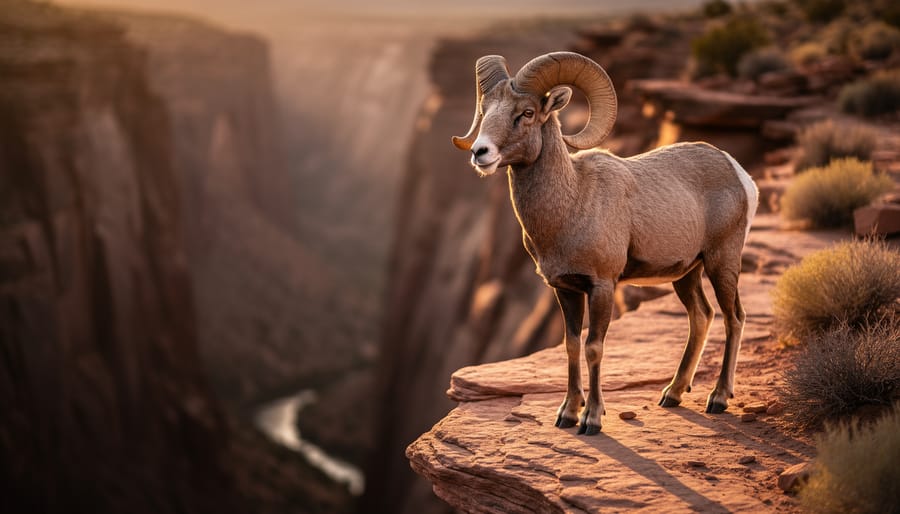
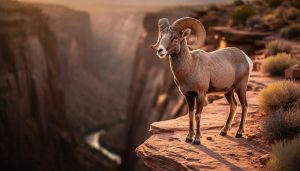
Position yourself downwind before dawn with a 400mm or longer telephoto lens to capture bighorn sheep navigating rocky terrain—their golden-hour silhouettes against rust-colored canyon walls create portfolio-defining images. Switch to a 70-200mm with fast shutter speeds (minimum 1/1000s) for roadrunners, whose unpredictable sprints and ground-level hunting behavior demand quick reflexes and continuous autofocus tracking. Reserve twilight hours for kit foxes emerging from dens, where ISO 3200-6400 and wide apertures (f/2.8-f/4) become essential for freezing their curious expressions in fading light.
Desert wildlife photography demands different wildlife photography techniques than you’d use in forests or grasslands. The harsh contrast between blazing sand and deep shadows tests your camera’s dynamic range, while extreme temperatures affect both equipment performance and animal activity patterns. Understanding when and where these three species appear—and matching your gear to their specific behaviors—transforms challenging conditions into creative opportunities.
Each animal presents distinct photographic rewards. Bighorn sheep require patience and hiking stamina but reward you with dramatic landscape integration. Roadrunners offer dynamic action shots that showcase your technical skills with motion capture. Kit foxes provide intimate behavioral moments that connect viewers emotionally to desert ecosystems. Master these three subjects, and you’ll return from arid environments with images that stand apart from typical desert photography—pictures that reveal the surprising vitality thriving in seemingly barren landscapes.
Why Desert Wildlife Photography Demands Different Gear and Techniques
Desert environments present a perfect storm of challenges that can humble even experienced photographers. The combination of extreme temperatures, relentless dust, blinding midday light, and vast open spaces creates conditions that demand different approaches than what works in temperate forests or coastal wetlands.
Let’s start with the heat. When your camera body becomes too hot to touch comfortably, sensors can struggle with thermal noise, LCD screens become difficult to read, and battery life drains faster than you’d expect. I’ve watched photographers discover this the hard way when their equipment starts throwing error messages at precisely the wrong moment. The animals you’re trying to photograph have adapted to these conditions over millennia, but your gear hasn’t.
Dust is equally unforgiving. Fine desert particles infiltrate every crevice, working their way past weather sealing and coating lens elements. A single lens change in windy conditions can introduce enough grit to affect image quality. Protecting camera equipment becomes not just good practice but essential for completing your shoot.
Then there’s the lighting challenge. Desert light at midday is harsh and flat, washing out textures and creating unflattering shadows. Yet dawn and dusk, when lighting is ideal, often coincides with peak animal activity, creating a narrow window where everything must come together perfectly.
Distance compounds these issues. Desert wildlife has adapted to open terrain by developing keen eyesight and wariness. That roadrunner you spotted might be 50 yards away before you even raise your camera. That desert bighorn could be perched on a ridge 200 yards distant. Suddenly, that standard zoom lens feels inadequate.
Understanding these environmental realities helps you prepare properly, choose appropriate gear, and adjust your techniques before you arrive. The following sections will show you exactly how to tackle three distinctive desert species, each presenting its own photographic puzzle.
The Desert Bighorn Sheep: Mastering Distance and Rocky Terrain
Where and When to Find Them
Timing and location can make or break your desert wildlife photography expedition. Understanding the activity patterns of your subjects dramatically increases your chances of capturing compelling images rather than spending hours staring at empty landscapes.
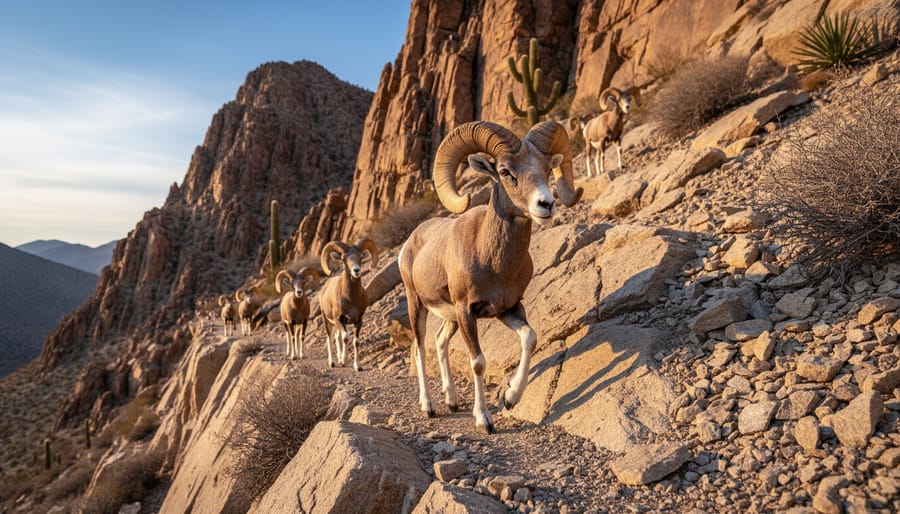
For bighorn sheep, your best opportunities come during early morning hours, typically between dawn and 9 AM, when these animals descend from rocky perches to forage. In North America, prime locations include Joshua Tree National Park, Death Valley, and Arizona’s Kofa National Wildlife Refuge. The fall rutting season from October through December offers exceptional action shots as rams compete for dominance. Position yourself near water sources during summer months, especially in the two hours following sunrise.
Roadrunners are most active during cooler parts of the day, making dawn and late afternoon your golden windows. These birds adapt to moderate temperatures, so spring and fall provide longer shooting opportunities throughout the day. Scout desert roadsides, dry washes, and areas with scattered vegetation in the Sonoran and Mojave deserts. Watch for their distinctive hunting behavior—they’ll pause motionless before sudden bursts of speed, giving you a brief moment to prepare your shot.
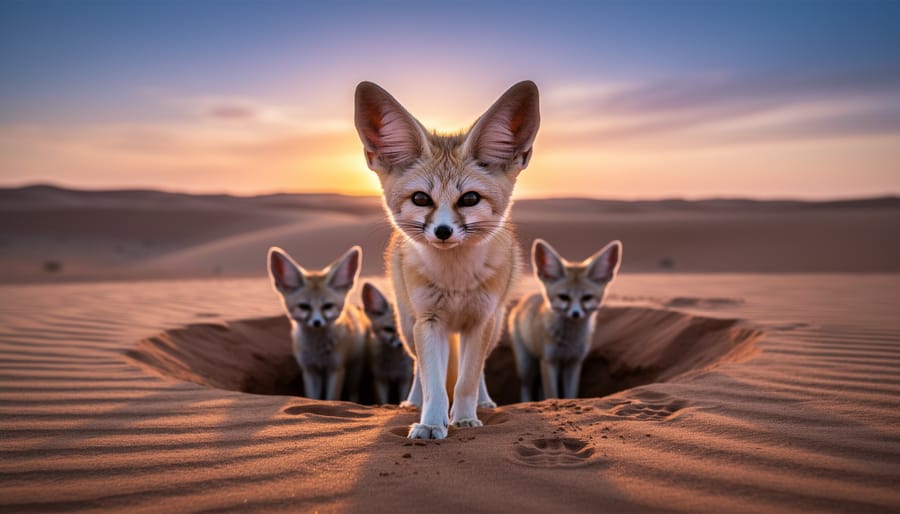
Kit foxes present the greatest challenge as primarily nocturnal hunters. Your best chances occur during the first and last hour of daylight, particularly in winter when they’re more active during twilight. Look for them in sandy areas with sparse vegetation across the Great Basin and Sonoran deserts. Areas near human activity, like campgrounds in places such as Death Valley, sometimes yield unexpected opportunities as these foxes have become somewhat habituated to people, though maintaining respectful distance remains essential for both ethical reasons and natural behavior documentation.
Essential Gear for Capturing Distant Subjects
Photographing desert wildlife demands specialized gear that can handle both the extreme conditions and the significant distances you’ll be working with. Let’s talk about what actually works in the field.
For lenses, a telephoto zoom in the 100-400mm or 150-600mm range gives you the versatility desert photography demands. I’ve found the 150-600mm lenses particularly valuable when photographing bighorn sheep on distant cliff faces or tracking roadrunners through scrub. Prime lenses like a 500mm or 600mm offer superior image quality and low-light performance, which becomes crucial during golden hour when desert animals are most active. However, they’re heavy and less adaptable when animals move unpredictably.
Your tripod needs to be robust enough for heavy telephoto lenses yet practical for hiking rocky terrain. Carbon fiber models offer the best weight-to-stability ratio. Look for tripods with spiked feet that can grip sandstone and loose gravel, and consider ones with leg angles that allow low positioning for ground-level subjects like sidewinders or kit foxes.
Heat presents serious challenges to camera equipment. Desert temperatures regularly exceed 110 degrees Fahrenheit, which can cause lens expansion, sensor overheating, and battery drain. I always carry reflective wraps for my gear during midday and keep spare batteries in a cooler. One photographer I know successfully shoots Mojave desert wildlife using a white towel draped over his camera body between shots, which drops the surface temperature by 20-30 degrees.
A successful setup I’ve witnessed combined a 500mm prime on a Wimberley gimbal head with a sturdy tripod, allowing smooth tracking of a desert tortoise across varied terrain while maintaining sharpness.
Camera Settings That Work in Harsh Desert Light
Desert photography presents unique exposure challenges, but with the right settings, you can capture sharp, well-exposed images of your subjects. Let’s break down the camera settings that consistently deliver results when photographing wildlife in harsh desert light.
Start with your ISO at 400-800 during peak sunlight hours. While this might seem counterintuitive in bright conditions, you need that extra sensitivity to maintain fast shutter speeds for moving animals. Desert light is deceptive—what appears blindingly bright to your eyes may not always translate to perfectly exposed images, especially when animals move through shadowed areas.
For shutter speed, think 1/1000th second minimum for most desert wildlife. Roadrunners and lizards move explosively, and anything slower will result in motion blur. When photographing bighorn sheep navigating rocky terrain, I’ve found 1/1250th to 1/2000th second ideal for freezing movement while maintaining image sharpness.
Aperture selection depends on your creative intent. Use f/5.6 to f/8 for individual animals to achieve pleasant background separation while keeping the entire subject sharp. If you’re documenting behavioral scenes or need maximum depth of field across uneven desert terrain, stop down to f/11.
The extreme contrast between sunlit sand and shadowed rocks requires careful metering. Use spot metering on your subject rather than evaluative metering, which can be fooled by expansive bright backgrounds. Expose for your subject and let the background go slightly overexposed—recovering detail from blown highlights is easier than lifting severely underexposed shadows.
The Sidewinder Rattlesnake: Low-Angle Drama and Precision Timing
Safe Approach and Ethical Considerations
Desert wildlife photography demands respect, preparation, and a commitment to safety—both yours and the animal’s. When photographing venomous snakes like sidewinders or rattlesnakes, maintain a minimum distance of 10 feet and use a telephoto lens in the 200-400mm range. Never attempt to reposition a snake for a better shot, and always know your escape route before setting up. Watch for defensive postures: coiling, rattling, or an S-shaped neck position all signal you’re too close.
For ground-dwelling subjects like roadrunners and lizards, approach slowly at an angle rather than head-on, which animals perceive as predatory. If the creature freezes or changes its activity, you’ve crossed its comfort threshold—back away immediately. Early morning shoots are ideal because animals are less skittish during cooler temperatures when they’re warming up.
Understanding animal body language prevents stress and dangerous encounters. Dilated pupils, flattened bodies, rapid tongue flicking in reptiles, or agitated tail movements indicate distress. Similarly, a roadrunner that stops foraging to watch you continuously is signaling discomfort.
Practice ethical wildlife photography by limiting your time with each subject to 10-15 minutes maximum. Never block access to shade, water sources, or burrows, especially during extreme heat. Carry a snake bite kit if photographing reptiles, inform someone of your location, and consider working with a local guide who knows species-specific behaviors. Remember, no photograph is worth compromising an animal’s well-being or your safety.
Capturing the Signature Sidewinding Motion
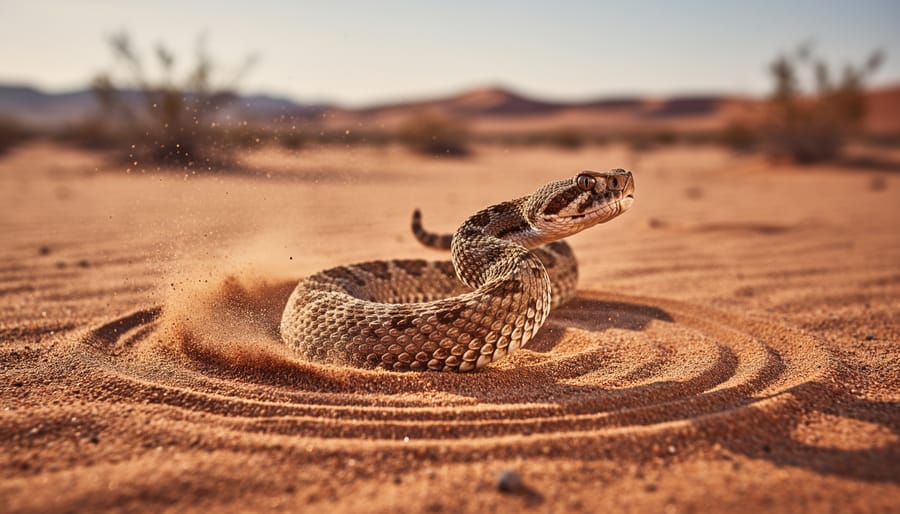
Sidewinding rattlesnakes create one of nature’s most distinctive movement patterns, and capturing this serpentine locomotion requires a different approach than traditional wildlife photography. The key challenge is deciding whether you want to freeze the motion completely or show the graceful flow of their movement across the sand.
For freezing action, you’ll need shutter speeds of at least 1/1000th of a second, though 1/2000th or faster works better when the snake is moving quickly across hot sand. Enable continuous autofocus and high-speed burst mode, typically 8-10 frames per second if your camera supports it. This gives you multiple options to choose from, ensuring you capture the perfect moment when the snake’s body forms that characteristic S-shape with portions lifted off the ground.
If you want to convey motion instead, try slower shutter speeds around 1/250th to 1/500th of a second. This creates slight blur in the moving portions while keeping the stationary parts sharp, which effectively communicates the dynamic nature of sidewinding.
Positioning is crucial for this subject. Get down to ground level, ideally with your camera just inches above the sand. This low angle emphasizes the snake’s movement pattern and creates dramatic perspective against the sky or distant dunes. A beanbag or low-profile tripod works wonderfully here.
Composition-wise, leave space in the frame showing the direction of travel. Those distinctive J-shaped tracks in the sand tell an incredible story, so include them when possible. Early morning or late afternoon provides the best side-lighting to reveal both the texture of scales and the subtle impressions left in the sand, adding context and visual interest to your images.
Gear Protection in Sand and Dust
Desert sand is the nemesis of camera gear, and when you’re photographing low-dwelling creatures like scorpions or reptiles, you’re working right where the dust is thickest. Let me share some hard-earned lessons about keeping your equipment functioning in these challenging conditions.
Weather sealing is your first line of defense, though it’s important to understand what it actually means. Weather-sealed cameras and lenses have gaskets and seals at joints and buttons that resist moisture and dust intrusion, but they’re not completely impervious. Think of weather sealing as protection against incidental exposure, not a guarantee against full submersion in sand. If you’re shooting animals at ground level, you’ll want bodies and lenses with at least basic weather resistance.
For maximum protection, consider using a camera rain sleeve or specialized desert cover even on sealed equipment. These lightweight fabric covers slip over your camera and lens, creating a barrier against blowing sand while still allowing access to controls. They’re particularly valuable during windy conditions when fine particles become airborne and work their way into every crevice.
When working close to the ground, a microfiber towel or changing mat underneath your camera bag creates a clean zone for lens changes. Never change lenses when it’s windy, and always point the camera body downward during swaps to prevent dust from settling on the sensor.
After each shooting session, use a rocket blower to remove loose particles before brushing or wiping anything. Skipping this step means you’ll grind sand across your lens surfaces when cleaning. Keep lens caps and body caps tethered and immediately accessible, minimizing the time your equipment sits exposed.
The Fennec Fox: Patience and Low-Light Expertise
Working with Crepuscular and Nocturnal Behavior
Desert wildlife follows nature’s smartest survival strategy—avoiding the scorching midday sun by becoming active during the cooler hours of dawn, dusk, and nighttime. This crepuscular and nocturnal behavior presents both challenges and extraordinary opportunities for photographers willing to adjust their schedules.
The golden hours take on enhanced meaning in desert environments. Plan to be in position at least 45 minutes before sunrise and remain until full light, then return 90 minutes before sunset. These transitional periods offer the perfect combination of animal activity and usable natural light. Desert bighorn sheep often graze on hillsides during early morning, while kit foxes emerge from their dens as temperatures drop in the evening.
Locating elusive nocturnal animals requires detective work. During daylight hours, scout for tracks, scat, and burrow entrances to identify high-activity zones. Water sources become wildlife magnets during dry seasons, making them excellent stakeout locations. Fresh tracks in the sand tell you which animals visited recently and from which direction they approached.
For night photography, familiarize yourself with your camera’s manual focus and settings before darkness falls. Use red-filtered flashlights to preserve your night vision while adjusting equipment. Consider camera traps with motion sensors for truly nocturnal species that appear only in complete darkness.
Pack layers—desert temperatures can plummet 40 degrees after sunset. Bring a headlamp with red-light mode, extra batteries that perform poorly in cold, and patience. Many photographers find that spending multiple evenings at the same location yields better results than constantly moving, as animals grow accustomed to your stationary presence.
Low-Light Camera Settings and Noise Management
Desert twilight presents unique challenges that push your camera’s capabilities to their limits. When photographing nocturnal animals like kit foxes or nighttime reptile activity, mastering low-light photography becomes essential for capturing sharp, detailed images without disturbing your subjects.
Start with ISO settings between 3200 and 6400 as your baseline. Modern cameras like the Sony A7 IV or Canon R6 handle these ranges remarkably well, maintaining acceptable noise levels. During the blue hour when golden light fades, I’ve successfully shot at ISO 6400 with f/2.8 at 1/320s to freeze a fennec fox mid-stride. The key is finding your camera’s sweet spot through testing before your trip.
Wide apertures are your friend here. A lens with f/2.8 or wider allows significantly more light to reach the sensor. If you’re shooting with an f/4 lens, compensate by increasing ISO to 8000 or reducing shutter speed, though anything slower than 1/250s risks motion blur with active animals.
Balance your exposure triangle carefully. Underexposing by one-third to two-thirds of a stop helps preserve highlight detail in residual sky glow and reduces visible noise. You can recover shadow detail in post-processing more easily than salvaging blown highlights.
Enable your camera’s high ISO noise reduction set to low or standard. Aggressive noise reduction destroys fine detail like fur texture. Apply additional noise reduction selectively during editing using tools like Topaz DeNoise AI or Lightroom’s AI-powered denoise feature for cleaner final results.
Using Natural and Supplemental Lighting
Desert light transforms throughout the day, giving you distinct opportunities to capture your subjects in dramatically different ways. The golden hours—that magical first hour after sunrise and last hour before sunset—are absolute game-changers for desert wildlife photography. The warm, directional light during these times adds dimension to your subjects, reduces harsh shadows, and creates that coveted rim lighting effect on animal fur and feathers. I’ve found that positioning yourself so the low sun backlights a roadrunner’s crest or illuminates dust particles around a coyote creates images with real emotional impact.
Don’t pack up when the sun sets, though. Desert nights offer exceptional moonlight photography opportunities, especially during full moon phases. Moonlit scenes of kit foxes or nightjars require patience and high ISO capabilities (think 6400-12800), but the ethereal quality is worth it. Use longer exposures—anywhere from 1 to 4 seconds—and a sturdy tripod to capture these nocturnal moments without disturbing your subjects.
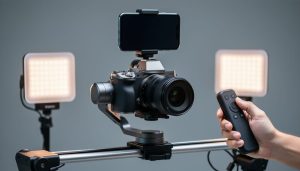
When natural light falls short, supplemental lighting becomes necessary, but ethics must guide your approach. Flash photography can temporarily disorient nocturnal animals, so use it sparingly and never repeatedly on the same individual. A better approach involves using continuous LED panels with red filters, which are less disruptive to wildlife adapted to darkness. Position any artificial light source at least 45 degrees off-axis to avoid the dreaded direct-flash look and maintain natural shadows.
Remember that your subject’s welfare always trumps getting the shot. If an animal shows signs of stress or altered behavior due to your lighting setup, switch it off immediately and reassess your approach.
Universal Desert Photography Tips Across All Three Species
Whether you’re photographing roadrunners at ground level, bighorn sheep on distant ridgelines, or kit foxes in twilight conditions, certain principles remain constant in desert environments. Let me share some universal lessons that apply across all three species and will help keep you safe while maximizing your photographic opportunities.
Hydration isn’t negotiable in desert photography. I learned this the hard way during a summer shoot in Death Valley when focusing so intently on a bighorn sheep that I forgot to drink for three hours. The resulting headache and disorientation taught me to set hourly phone alarms. Carry at least twice the water you think you’ll need, typically one gallon per person for every four hours in the field. Remember that your excitement over wildlife encounters can make you forget basic needs.
Desert weather demands respect and planning. Morning golden hour, roughly 30 minutes after sunrise, offers the best combination of soft light and animal activity across all species. Evening sessions work equally well, but afternoon temperatures between May and September regularly exceed 110°F in many locations, making photography uncomfortable and potentially dangerous. The sweet spot for desert photography runs from October through April when daytime temperatures hover between 60-80°F and wildlife activity peaks.
Safety considerations extend beyond personal hydration. Always inform someone of your location and expected return time. Desert cell coverage remains spotty at best, so consider carrying a satellite communicator, particularly when photographing bighorn sheep in remote backcountry. Watch for rattlesnakes during warmer months, especially when setting up low for ground-level roadrunner shots.
Transportation accessibility varies significantly. Roadrunners often appear near established trails and campgrounds, making them accessible with standard vehicles. Kit foxes frequent similar areas but require patience after dark. Bighorn sheep, however, often necessitate high-clearance or four-wheel-drive vehicles to reach prime locations, followed by substantial hiking. Research your target location’s access requirements beforehand and ensure your vehicle insurance covers off-road travel if needed.
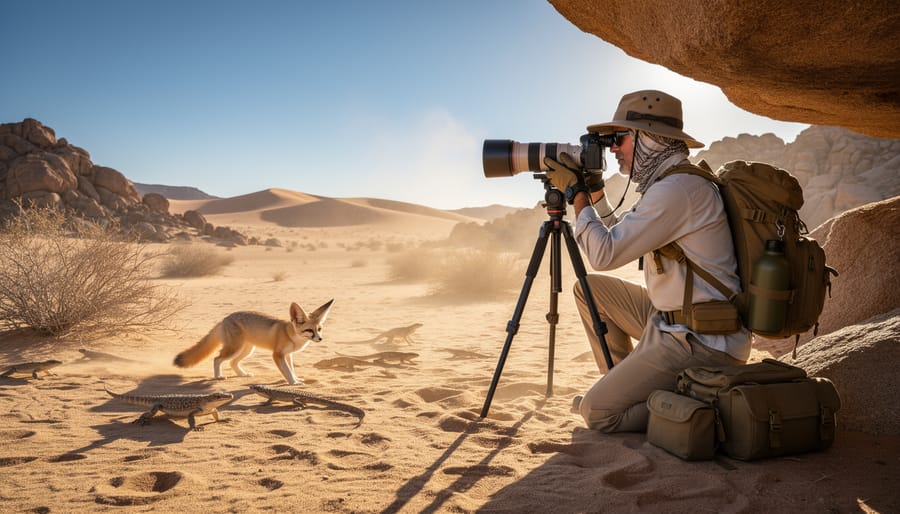
Desert wildlife photography offers rewards unlike any other genre. The stark landscapes, dramatic lighting, and resilient creatures create opportunities for truly breathtaking images that tell powerful stories of adaptation and survival. Whether you’re drawn to the majestic bighorn sheep scaling impossible terrain, the lightning-fast roadrunner darting across hardpan, or the elusive kit fox emerging at twilight, each subject presents unique challenges that will sharpen your technical skills and creative vision.
Before heading into arid environments, preparation is essential. Research your target species, scout locations when possible, and ensure you have the right gear for extreme conditions. A telephoto lens with image stabilization, weather-sealed camera bodies, and plenty of memory cards and batteries are non-negotiable. Don’t forget the basics: navigation tools, sun protection, and significantly more water than you think you’ll need. Desert conditions can deteriorate quickly, and your safety always comes first.
Remember that patience is your greatest asset in wildlife photography. Desert animals operate on their own schedules, often dictated by temperature and prey availability. You might wait hours for a single frame, but that moment when everything aligns—the light, the behavior, the composition—makes every uncomfortable minute worthwhile. Equally important is maintaining respect for your subjects. Keep appropriate distances, never bait or harass wildlife, and prioritize their wellbeing over any photograph.
The desert holds unforgettable images for those willing to embrace its challenges. With proper preparation, technical knowledge, and genuine respect for these remarkable animals, you’ll return with photographs that capture the raw beauty of life in Earth’s most unforgiving environments.

 By
By