 By
By 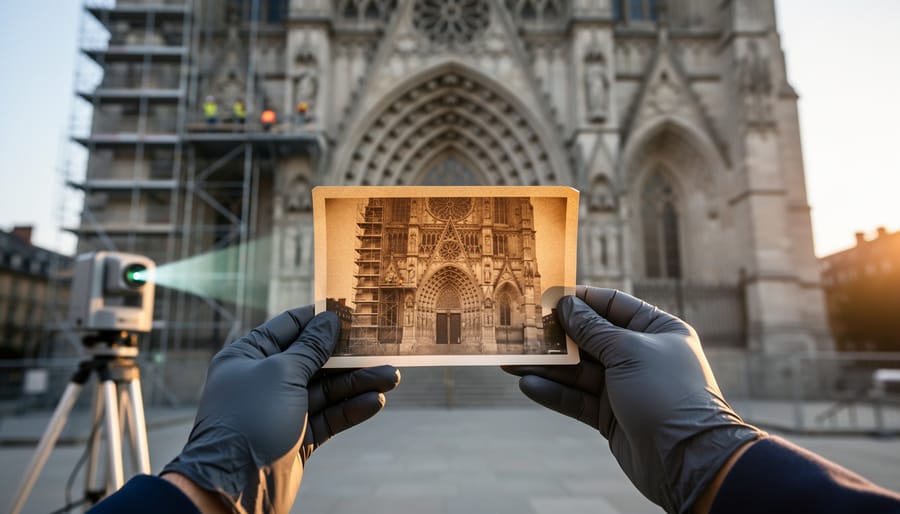
Every photograph holds a piece of history frozen in time, and when it comes to reconstructing heritage sites, these old images become invaluable blueprints for restoring what’s been lost. Historical photograph duplication for reconstruction projects involves far more than simply making copies—it’s a sophisticated process that transforms faded snapshots into detailed architectural references, enabling historians and architects to rebuild monuments, buildings, and cultural landmarks with remarkable accuracy.
The destruction of Notre-Dame Cathedral in 2019 showcased this perfectly. Thousands of historical photographs, some dating back to the 1850s, provided crucial details about Gothic architectural elements that guided the restoration team. Similarly, when Warsaw’s Old Town was rebuilt after World War II, archival photographs served as the primary reference, earning the reconstructed area UNESCO World Heritage status despite being largely new construction.
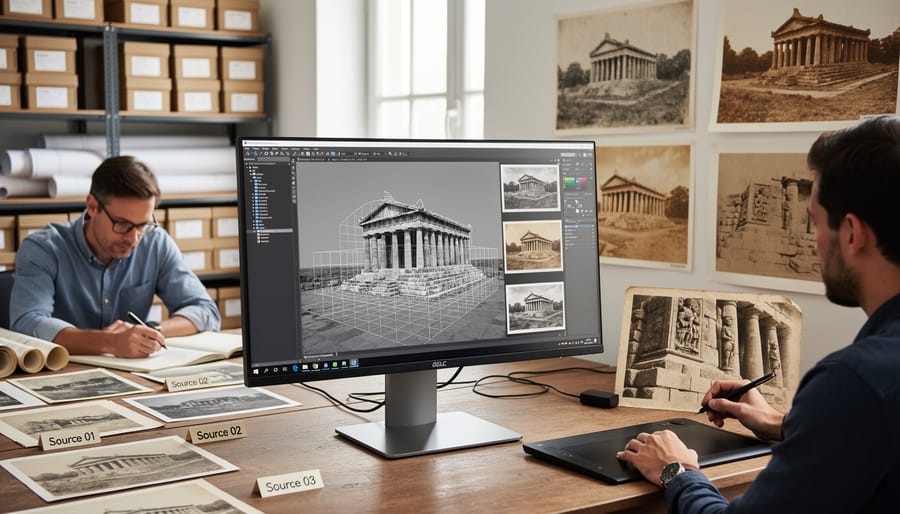
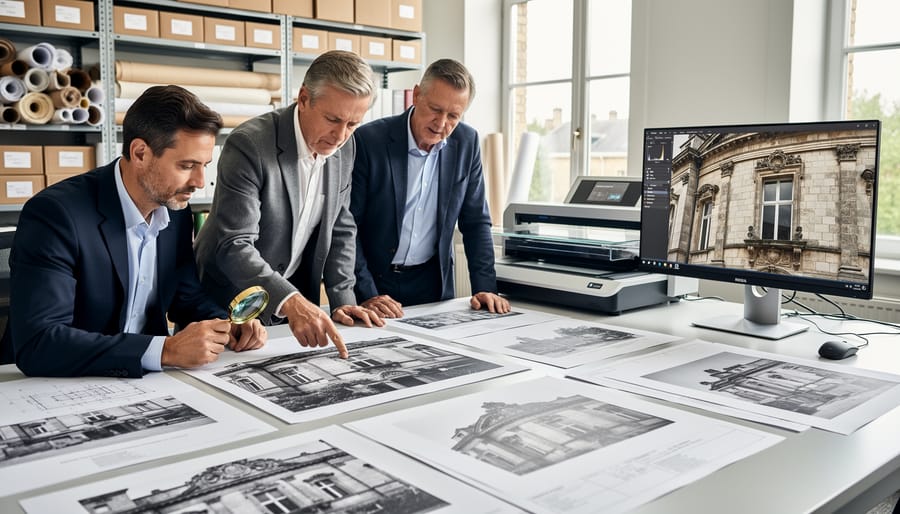
The technical process begins with high-resolution scanning of original photographs, often followed by digital enhancement to reveal details invisible to the naked eye. Photogrammetry software then extracts three-dimensional measurements from multiple angles, creating precise architectural drawings. When original prints are fragile, specialized duplication techniques preserve the information while protecting the source material—a critical step since many heritage photographs exist as single copies in private collections or underfunded archives.
For photographers and history enthusiasts, this field offers unexpected opportunities. Your grandmother’s vacation photos from the 1960s or your father’s architectural documentation might contain the only remaining visual record of a building’s original features. Contributing such images to heritage organizations or local historical societies transforms personal memories into valuable reconstruction resources, ensuring that even demolished or damaged sites can someday be accurately restored for future generations to experience and appreciate.
What Is Photographic Reconstruction?
From Dusty Albums to Digital Blueprints
Every reconstruction project begins with a simple question: what did this place actually look like? The answer often lies tucked away in unexpected places. Those faded family vacation snapshots gathering dust in your attic might show architectural details of a building that no longer exists. That postcard collection from your grandmother’s travels could reveal the original colors of a monument before pollution took its toll. Even tourist photos from decades past become invaluable when they capture angles and details that professional photographers overlooked.
Historic photo archives serve as the primary foundation for reconstruction work, but crowdsourcing personal photographs has revolutionized the field. Consider the Notre-Dame Cathedral restoration project following the 2019 fire. Researchers put out a global call for photos, receiving thousands of images from tourists and amateur photographers who had visited over the years. These submissions provided multiple perspectives of architectural elements, helping experts create detailed three-dimensional models for the rebuilding effort.
The beauty of this approach is that virtually anyone can contribute. Your vacation photos might seem ordinary to you, but they could contain crucial information about window placements, decorative elements, or structural features. Each image, when combined with others, helps fill gaps in the historical record. This collaborative effort transforms casual photography into documentary evidence, proving that every snapshot has potential value beyond personal memories.
The Photography Techniques Behind Reconstruction
Photogrammetry: Measuring History Through Images
Imagine taking a collection of old photographs of a historic building and transforming them into a complete 3D model you can rotate, measure, and explore from any angle. That’s the magic of photogrammetry—a technique that’s revolutionizing how we preserve and reconstruct heritage sites.
At its core, photogrammetry works by analyzing multiple images of the same subject taken from different positions. The software identifies common points across these images, calculating the spatial relationships between them. Think of it like how your eyes work together to perceive depth, except photogrammetry can use dozens or even hundreds of images to achieve incredible accuracy.
The process begins with careful image selection. For historical reconstruction, archivists search for photographs showing various angles of a structure. Even tourist snapshots from different decades can contribute valuable data. The more overlap between images and the more varied the angles, the better the results.
Several accessible software options make photogrammetry achievable for enthusiasts. Agisoft Metashape remains the industry standard, offering professional-grade results with a relatively intuitive interface. For those starting out, Meshroom provides free, open-source processing capabilities, while RealityCapture excels at handling large datasets quickly.
A compelling example comes from the reconstruction of Palmyra’s Temple of Bel, damaged in 2015. Researchers compiled tourist photographs spanning decades, processing them through photogrammetry software to create detailed 3D models. These models now serve as precise references for potential restoration work.
The technique also helps analyze structural changes over time. By processing photographs from different eras, historians can track deterioration, identify lost architectural details, and understand construction methods—all without physical access to the structure. This becomes especially valuable when original sites face threats from natural disasters, conflict, or simple decay.
Digital Restoration and Enhancement
When working with historical photographs for heritage reconstruction, the quality of your digital copy can make or break the entire project. Many vintage photos have endured decades of fading, water damage, or physical deterioration, but modern digital restoration techniques can recover details you might think are lost forever.
The process begins with high-resolution scanning. For architectural reconstruction purposes, you’ll need at least 600 dpi (dots per inch), though 1200 dpi or higher is ideal for severely damaged photographs. A flatbed scanner with a transparency adapter works well for most prints, while drum scanners deliver the absolute best quality for critical projects. The key is capturing every bit of information available in the original, even if it looks terrible at first glance.
Once scanned, specialized software becomes your restoration toolkit. Adobe Photoshop remains the industry standard, offering powerful tools like Content-Aware Fill and the Clone Stamp for removing scratches and tears. For more serious damage, dedicated photo restoration software like AKVIS Retoucher can automatically detect and repair common defects.
Real-world example: During the restoration of Warsaw’s Royal Castle, conservators worked with badly faded 1930s photographs. By carefully adjusting curves and levels, they recovered architectural details invisible to the naked eye, including ornamental moldings and window proportions that were crucial for accurate reconstruction.
The enhancement phase involves adjusting contrast, sharpening edges, and sometimes colorizing if reliable color references exist. However, restraint matters here. The goal isn’t creating a pristine modern image but extracting authentic historical information while documenting what’s restored versus original content for future researchers.
Color Reconstruction from Black and White Images
One of the most fascinating challenges in old photo duplication is determining what colors existed in black and white photographs. When you’re holding a century-old monochrome image of a cathedral’s interior, how do you know whether those columns were limestone white, sandstone beige, or marble gray?
The process combines detective work with modern technology. Historians start by examining written records, period descriptions, and contemporaneous color photographs if they exist. For instance, when reconstructing Chicago’s original colors after the Great Fire, researchers cross-referenced black and white photos with painters’ descriptions and surviving artifacts. Material science plays a crucial role too. By identifying the building materials visible in photographs through texture analysis and architectural records, experts can determine likely original colors. Limestone has characteristic properties that differ from brick or wood, even in grayscale.
Today, artificial intelligence has revolutionized this process. Machine learning algorithms trained on vast databases of historical color photography can make educated predictions about original hues. These AI tools analyze tonal values, shadows, and highlights to suggest probable color schemes. However, they’re not perfect. An AI might correctly identify red brick but miss regional variations in clay composition that affected actual shades.
The key is combining all approaches. When the Palace of Westminster was documented for future restoration work, teams used historical paint samples, archival research, and AI colorization together. This multi-layered methodology ensures the most accurate color reconstruction possible, preserving both visual authenticity and historical integrity for future generations.
Real-World Success Stories
The Citadel of Aleppo: Piecing Together a War-Torn Icon
When conflict devastated Syria’s ancient Citadel of Aleppo between 2012 and 2016, archaeologists and preservationists faced a monumental challenge: how do you rebuild a UNESCO World Heritage Site when much of it lies in ruins? The answer lay partly in dusty archives and family albums scattered across the globe.
Historical photographs became crucial blueprints for reconstruction. Images taken by tourists, archaeologists, and local residents over the past century provided invaluable reference points for understanding the citadel’s original architecture. Teams from organizations like the Aga Khan Trust for Culture meticulously gathered and duplicated thousands of photographs, creating a comprehensive visual database that documented everything from stonework details to structural configurations.
The technical process of working with these historical images required careful attention. Many photographs were faded, damaged, or existed only as small prints. Conservators used high-resolution scanning and digital restoration techniques to extract maximum detail from each image. They cross-referenced multiple photographs taken from different angles to verify architectural elements and create accurate 3D models.
What makes this project particularly compelling is how everyday photographs became archaeological evidence. That vacation snapshot from 1970 showing a detailed view of the entrance gate? It helped engineers understand load-bearing structures. A black-and-white image from the 1920s revealed original masonry patterns that had been modified over time.
The Aleppo Citadel project demonstrates how photograph duplication serves purposes far beyond simple reproduction. Each duplicated image becomes a piece of historical testimony, helping ensure that cultural heritage survives even the most devastating circumstances.
Crowdsourced Memory: When Tourist Photos Saved the Day
When disaster struck Nepal in 2015, centuries-old temples and monuments crumbled in moments. The tragedy seemed compounded by a daunting question: how do you rebuild intricate structures when original blueprints don’t exist? The answer came from an unexpected source—thousands of tourist snapshots.
Project Mosul (later renamed Rekrei) pioneered this crowdsourced approach to cultural preservation. The initiative collected amateur photographs taken by travelers who had visited these sites, often without realizing their casual vacation shots would become crucial historical documents. These everyday images, snapped from different angles with various cameras and phones, contained enough visual information to digitally reconstruct what was lost.
The process works through photogrammetry software that analyzes multiple photographs of the same object or structure. When you have enough overlapping images taken from different perspectives, algorithms can calculate depth, dimensions, and surface textures with remarkable accuracy. What might seem like redundant tourist photos—everyone photographing the same temple from slightly different positions—becomes the perfect dataset for 3D modeling.
Durbar Square’s temples benefited significantly from this effort. Architects and engineers used the resulting 3D models as references for physical reconstruction, ensuring historical accuracy down to carved details that might otherwise have been guessed at or simplified. The project demonstrated that millions of amateur photographs collectively possess immense archival value, transforming casual photography into an unintentional but powerful form of cultural documentation that serves future generations.
Virtual Reconstruction: Experiencing What’s Lost Forever
When physical reconstruction isn’t feasible due to cost, political instability, or complete destruction, old photographs become gateways to virtual experiences of lost heritage. Organizations like CyArk and Rekrei are digitizing historical photographs to create immersive VR and AR reconstructions of demolished sites. The Palmyra project in Syria stands as a powerful example, where researchers compiled thousands of tourist photos taken before ISIS destroyed the ancient temple in 2015, building a detailed 3D model that allows people worldwide to experience the site as it once stood.
These virtual reconstructions serve multiple purposes beyond tourism. They become educational tools for students who’ll never see these places physically, research resources for archaeologists studying architectural techniques, and emotional touchstones for communities displaced from their cultural homes. The Notre-Dame Cathedral project similarly relied heavily on historical photographs following the 2019 fire, with millions of tourist snapshots providing crucial reference points for both physical restoration and virtual preservation efforts. This democratization of preservation means your grandmother’s vacation photos from decades ago might someday contribute to keeping cultural memory alive.
The Challenges Photographers and Researchers Face
Working with Incomplete Photo Archives
Here’s the reality that every heritage reconstruction photographer faces: most historical sites weren’t comprehensively documented. While grand facades might have multiple photographic records from different eras, interior spaces, side angles, and architectural details often went unphotographed or those images have been lost to time.
This presents a fascinating challenge. When working on projects like the reconstruction of Warsaw’s Old Town or Notre-Dame Cathedral, researchers discovered significant gaps in their photographic archives. Back staircases, servant quarters, and everyday spaces rarely made it in front of the camera lens. Historical photographers favored impressive exteriors and formal interiors, leaving modern reconstructionists to piece together missing elements through indirect evidence.
The solution often involves creative detective work. Photographers and historians cross-reference shadow patterns in existing photos to determine architectural proportions, study reflections in mirrors or windows to glimpse unphotographed areas, and compare similar buildings from the same period and architect. Sometimes a single photograph taken from an unusual angle becomes invaluable, even if it’s technically imperfect or partially obscured.
This incompleteness actually highlights why continued documentation matters today. Every photograph you take of historical spaces, from unconventional angles and of mundane details, could become tomorrow’s crucial reconstruction reference.
Dating and Verifying Historical Accuracy
Before reconstructing a heritage site from old photographs, experts must first confirm the images are genuine and determine their precise age. This authentication process combines detective work with scientific analysis.
Photo historians begin by examining physical characteristics like paper type, printing processes, and mounting methods. An albumen print from the 1860s, for example, has a distinctive glossy, egg-based surface that differs markedly from later gelatin silver prints. Similarly, the presence of a studio stamp or photographer’s mark provides valuable clues about origin and date.
Clothing styles, architectural details, and even vehicles visible in photographs help pinpoint timeframes. When restoring Prague’s Old Town Square, researchers used fashion elements and storefronts to date undocumented images within five-year windows.
Advanced authentication now employs digital forensics too. Experts analyze shadow angles to verify time of day and season, while comparing image grain patterns against known camera technologies of different eras. Provenance research—tracing ownership history through auction records, family archives, and museum collections—adds another verification layer.
This rigorous dating process ensures reconstruction teams work from accurate visual records rather than misattributed or manipulated images, preserving historical integrity throughout the project.
Technical Limitations of Vintage Photography
Vintage photographs present unique challenges for heritage reconstruction due to the inherent limitations of early photographic technology. Older cameras, particularly those from the late 1800s and early 1900s, suffered from significant lens distortion, especially at the frame edges where buildings and structures appear warped or stretched. This optical imperfection makes it difficult to extract precise measurements or angles needed for accurate architectural reconstruction.
Film quality also plays a crucial role. Early photographic emulsions had limited resolution compared to modern standards, meaning fine architectural details like ornamental work or specific material textures often appear soft or unclear. Additionally, the silver-based films used historically degrade over time, introducing scratches, fading, and chemical deterioration that further obscure important details.
For reconstruction teams, these limitations mean working with imperfect source material. A practical approach involves cross-referencing multiple photographs from different angles and eras, compensating for individual image shortcomings. Understanding these technical constraints helps set realistic expectations about what can be accurately reproduced versus what requires educated interpretation based on period-appropriate architectural practices.
How Modern Photographers Can Contribute
The Documentation Mindset: Shooting for Posterity
When you’re documenting cultural heritage sites, think like a detective leaving clues for future investigators. The goal isn’t just capturing pretty pictures—it’s creating a comprehensive visual record that could guide reconstruction efforts decades or even centuries from now.
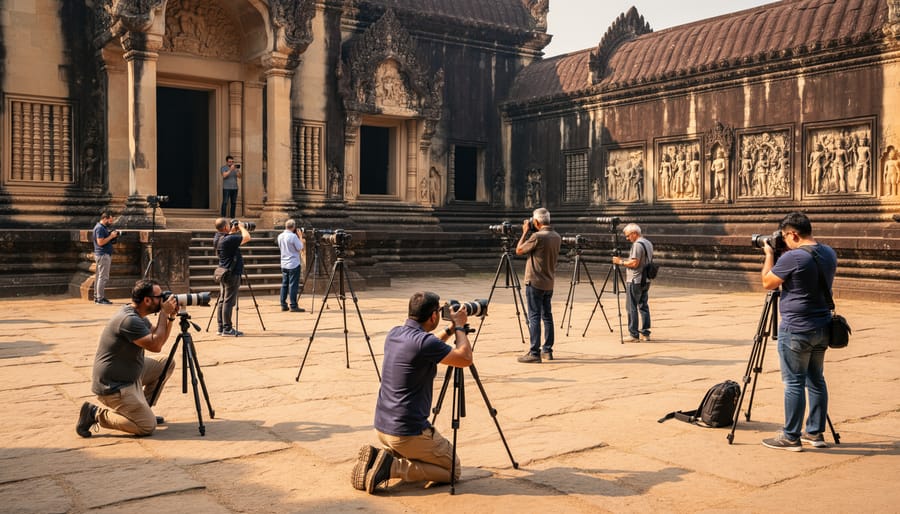
Start by shooting every structure from multiple angles. Walk completely around buildings when possible, capturing all four elevations plus corner perspectives. These varied viewpoints provide context that a single frontal shot never could. Include wide establishing shots that show the site’s relationship to its surroundings, then move progressively closer for medium shots and detail work.
Scale references are invaluable. Position a person, measurement stick, or common object like a coin in your frame to provide size context. Architectural details like doorways and windows also serve as natural scale indicators. Don’t forget to photograph signage, plaques, and informational markers—these often contain dimensions and historical data.
Zoom in on construction details: how stones fit together, decorative elements, material textures, and structural joints. These close-ups become crucial when specialists need to understand building techniques. Capture any visible damage or deterioration patterns too, as these inform restoration approaches.
Finally, maintain detailed metadata. Note GPS coordinates, compass directions, dates, weather conditions, and any relevant observations. Many cameras embed basic information automatically, but supplement this with written notes. Your comprehensive documentation might someday be the difference between accurate reconstruction and educated guesswork.
Contributing to Digital Heritage Archives
Your photographs of historic sites could become valuable resources for future preservation efforts. Several organizations actively collect historical images for digital heritage archives, and contributing is simpler than you might think.
The Library of Congress maintains extensive digital collections and accepts submissions through their Prints & Photographs Division. Similarly, UNESCO’s Memory of the World program partners with institutions worldwide to preserve documentary heritage, including photographs of significant sites. Many local historical societies and state archives also welcome high-quality duplications of vintage photographs.
Before submitting, ensure your duplications meet basic archival standards. Most organizations require high-resolution digital files, typically 300 DPI or higher, saved in uncompressed formats like TIFF. Include all available metadata about the original photograph—date, location, photographer, and any relevant historical context. This information significantly increases your contribution’s research value.
Why does this matter? When Notre-Dame Cathedral caught fire in 2019, researchers relied heavily on photographic archives to guide reconstruction. Your carefully duplicated images might similarly serve preservation efforts decades from now. You’re not just copying old photos—you’re safeguarding cultural memory for future generations. Many heritage organizations acknowledge contributors publicly, creating meaningful connections between photography enthusiasts and preservation professionals while building comprehensive visual records of our shared history.
The Future of Photo-Based Heritage Preservation
AI and Machine Learning in Photo Analysis
Artificial intelligence has revolutionized how we work with historical photographs in reconstruction projects. Modern AI algorithms can analyze hundreds of old photos simultaneously, identifying common architectural features and spatial relationships that would take human researchers months to compile. Think of it as having a tireless assistant that never forgets a detail.
One of the most exciting applications is image enhancement. Machine learning models trained on millions of photographs can sharpen blurry images, reduce noise in grainy scans, and even intelligently upscale low-resolution photos while preserving authentic details. These aren’t simple filters – they use pattern recognition to understand what architectural elements should look like based on similar structures.
AI also excels at filling information gaps. When reconstructing a building where only partial photographs exist, neural networks can analyze existing images to predict missing sections with surprising accuracy. The Notre-Dame Cathedral restoration, for example, utilized AI to cross-reference thousands of tourist photos, creating detailed 3D models from multiple angles.
Perhaps most valuable is the speed factor. What once required teams of historians manually comparing photographs now happens in hours. AI can detect matching features across different photos, establish accurate measurements from image analysis, and even identify the approximate date and camera position of unlabeled historical images.
Proactive Digital Twinning
Rather than waiting for tragedy to strike, heritage preservation has entered a proactive phase. Organizations worldwide are now creating comprehensive digital archives of culturally significant sites before disaster occurs—a practice known as digital twinning. This approach uses high-resolution photography, 3D laser scanning, and photogrammetry to create detailed virtual replicas of buildings, monuments, and entire streetscapes.
The Factum Foundation, for example, has documented sites across the Middle East and Europe, creating millimeter-accurate records that serve as insurance policies against natural disasters, war, or neglect. Museums and cultural institutions are following suit, understanding that today’s photographs might become tomorrow’s reconstruction blueprints.
For photographers, this represents a meaningful way to contribute to preservation efforts. Capturing multiple angles with proper lighting, documenting architectural details, and maintaining accurate metadata all create valuable historical records. Just as photographing urban transformation has documented how cities evolve, systematic documentation of heritage sites ensures we have the visual data needed should restoration become necessary. Your carefully composed architectural shots today could become critical reference material for future conservators.
Every photograph you take today becomes tomorrow’s history. Those casual snapshots of your neighborhood, the building on the corner, even the way light falls across a familiar street—these seemingly ordinary moments transform into invaluable records as time passes. Old photo duplication isn’t just about copying images; it’s about recognizing that each photograph serves as a time capsule, preserving details our memory would otherwise lose forever.
As photographers, we carry an inadvertent responsibility as historians. We don’t always set out to document the world for future generations, yet that’s precisely what we do. The photograph you take of a local landmark today might become the critical reference point for its restoration in fifty years. Your casual documentation of daily life could provide essential context for understanding our era’s architecture, culture, and environment.
This responsibility shouldn’t feel burdensome—it should feel empowering. Start documenting the world around you with intention. Photograph buildings, streetscapes, and public spaces from multiple angles. Capture details alongside wide shots. Most importantly, organize and preserve your work properly so it remains accessible when needed.
Technology has given us remarkable tools for preserving human heritage. Digital duplication ensures photographs survive beyond their physical lifetimes, while modern restoration techniques breathe new life into deteriorating images. By combining careful photography today with thoughtful preservation, we’re building an unprecedented visual archive of our world—one that will guide, inform, and inspire the preservation efforts of generations to come.



 By
By