
 By
By 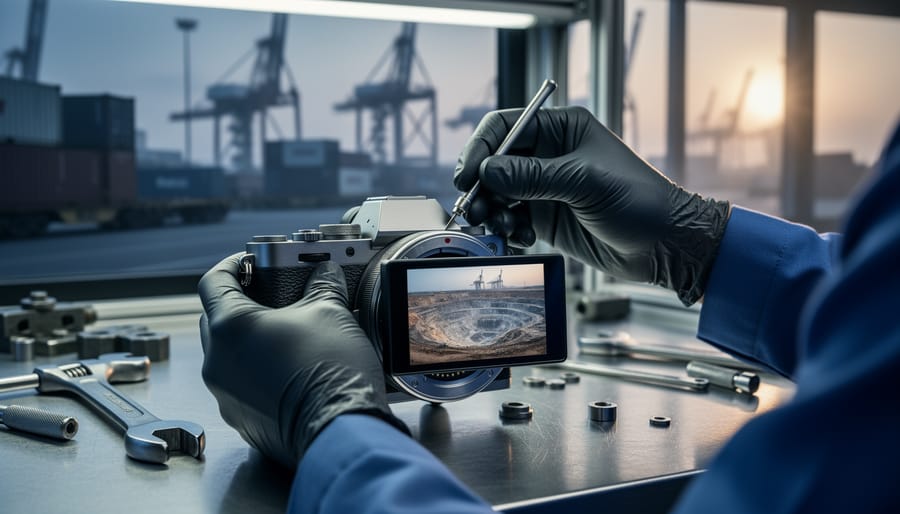
Examine the label on your camera body right now. Chances are, you’ll find “Made in Japan,” “Made in Thailand,” or “Made in China” stamped into the metal. That simple inscription represents a vast, interconnected network of labor, economics, and ethics that most photographers never consider when they press the shutter button.
Image globalization refers to the worldwide distribution of photographic manufacturing, from the mining of rare earth elements in Africa to lens assembly in Southeast Asian factories, sensor production in Japanese cleanrooms, and final distribution through retailers spanning every continent. This system has made professional-grade equipment accessible to millions, dropping the price of a capable camera body from several months’ salary to a few weeks’ worth. Yet this accessibility comes with hidden costs that extend far beyond the price tag.
Understanding this global supply chain matters because every purchase you make as a photographer casts a vote for particular labor practices, environmental standards, and economic structures. The person who assembled your camera’s mirror mechanism likely earned a fraction of what you paid for the body. The rare earth minerals in your sensor may have funded conflicts in distant regions. The carbon footprint of shipping components across three continents before final assembly contributes measurably to climate change, affecting the very landscapes we seek to capture.
This isn’t about inducing guilt or suggesting you abandon photography. Rather, it’s about developing informed awareness of how our creative tools reach our hands and how that human journey of production shapes both the industry and the world beyond it.
The photography community increasingly recognizes that technical excellence and creative vision must coexist with ethical consideration. Understanding image globalization empowers you to make purchasing decisions aligned with your values, support companies with transparent labor practices, and advocate for improvements in an industry you’re passionate about. The following exploration reveals not just where your gear comes from, but what that origin story means for photography’s future.
What Image Globalization Really Means for Photographers
From Darkroom to Data Centers
The shift from analog to digital photography didn’t just change how we take pictures—it fundamentally transformed where those images live and who handles them along the way.
Think back to the film era. When you shot a roll of Kodak or Fuji, your photographs existed as physical objects. You dropped off film at a local lab, and a technician in your community developed your prints. The entire lifecycle happened within a relatively small geographic radius. The labor was local, visible, and direct.
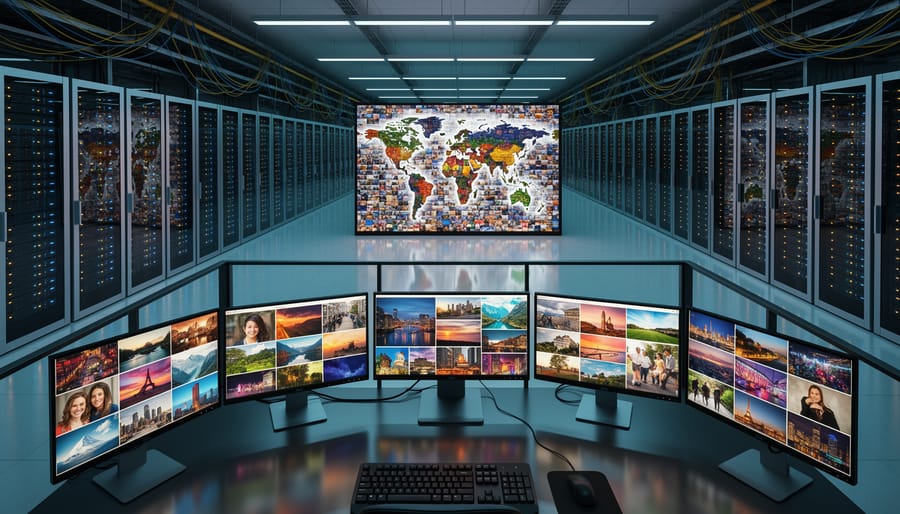
Today, when you press the shutter on your mirrorless camera or smartphone, that image begins an invisible journey across continents. The file might automatically upload to cloud servers in Iowa, get processed by algorithms developed in California, and backed up to data centers in Ireland—all within seconds. If you order prints through an online service, those files travel to fulfillment centers that could be anywhere from Kentucky to Singapore.
This transformation created entirely new categories of photographic labor. Data center technicians now maintain the massive server farms that store billions of images. Software engineers build the compression algorithms that make global image transfer feasible. Content moderators—often working in countries with lower labor costs—review flagged photos for terms of service violations. Cloud storage specialists manage redundancy systems ensuring your vacation photos survive hardware failures.
The darkroom technician who once knew you by name has been replaced by distributed networks of specialized workers you’ll never meet, operating infrastructure you’ll never see, in locations you may never have considered.
The Three Layers of Image Supply Chains
Today’s photographic ecosystem operates through three interconnected layers that most of us rarely think about when we press the shutter button.
The physical layer encompasses everything from sensor fabrication in clean rooms to camera assembly lines. Companies like Sony manufacture sensors used by numerous camera brands, while factories across Asia assemble the bodies, lenses, and accessories we use daily. This layer also includes the raw materials—rare earth elements, glass, and plastics—sourced from around the world.
The digital layer handles what happens after capture. This includes the software that processes RAW files, cloud storage systems hosting millions of images, and the algorithms that tag and organize our photos. Think of Adobe’s servers processing Creative Cloud syncs or Google Photos’ AI scanning billions of images for faces and objects.
Finally, the distribution layer connects photographers with audiences. Stock photography platforms like Shutterstock facilitate commercial licensing, while social media sites like Instagram have become essential portfolios for working photographers. Each platform takes a cut, sets the rules, and ultimately shapes which images reach viewers and generate income. Understanding these layers helps photographers recognize where their work fits into this global machinery and where potential bottlenecks or opportunities exist.
The People Who Build Your Camera
Rare Earth Mining and Sensor Production
Every time you press the shutter button, you’re holding the product of a complex global mining operation that began thousands of miles away. That sensor in your camera—whether it’s a full-frame DSLR or a smartphone—relies on rare earth elements extracted from mines scattered across the globe.
Silicon, the foundation of image sensors, comes primarily from China, which controls roughly 80% of global rare earth processing. The neodymium magnets in your lens autofocus motors and cobalt in your camera’s batteries often originate from the Democratic Republic of Congo, where mining conditions have raised serious humanitarian concerns. Workers frequently labor in hazardous environments with minimal safety equipment, earning wages that barely sustain their families.
The production chain continues to semiconductor facilities in Taiwan, South Korea, and Japan, where these raw materials transform into the sophisticated sensors we depend on. Companies like Sony, Samsung, and Canon operate fabrication plants that employ thousands, though working conditions vary significantly. Some facilities have faced scrutiny over excessive overtime and workplace safety standards.
Consider this: a single camera sensor requires over sixty different elements from the periodic table. Tantalum capacitors, lanthanide glass elements, and indium tin oxide coatings—each component traces back to specific mining operations with their own environmental and social footprints.
Understanding this chain doesn’t mean abandoning photography, but it does invite us to consider the full cost of our creative tools. Some manufacturers have begun publishing sustainability reports and conflict-free mineral certifications, giving conscious consumers a starting point for making informed equipment choices.
Assembly Line Stories from Canon, Sony, and Nikon
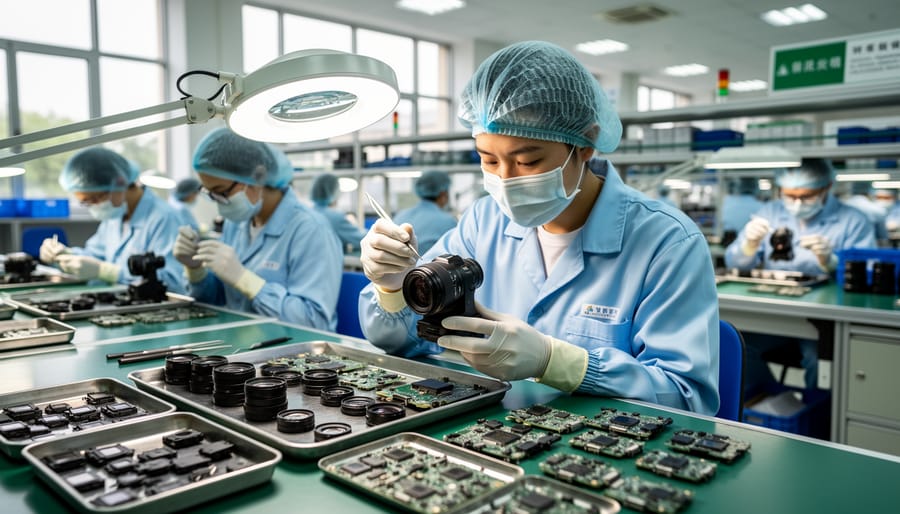
Walk into any Canon facility in Oita, Japan, and you’ll witness a fascinating blend of robotics and human expertise. Technicians in pristine white suits carefully calibrate lens elements that must be accurate to within microns—a process that still requires the human eye and touch despite decades of automation. These skilled workers represent one end of the manufacturing spectrum, earning competitive wages and often staying with the company for decades.
The story shifts considerably at production facilities across Thailand and China. In Ayutthaya, Thailand, Canon operates massive plants where workers assemble entry-level DSLRs and mirrorless cameras. Here, the work becomes more repetitive. Assembly line workers might install the same component—a shutter mechanism or circuit board—thousands of times per shift. While conditions have improved significantly over the past decade, with better ventilation and ergonomic workstations, the work remains physically demanding and mentally monotonous.
Sony’s sensor fabrication in Kumamoto, Japan represents another layer of this story. The clean rooms where imaging sensors are manufactured require extraordinary precision, and workers undergo extensive training. However, even here, much of the work involves monitoring automated processes for hours on end.
Nikon’s production footprint tells a similar tale, with high-end lens grinding happening in Sendai, Japan, while camera body assembly has shifted primarily to Thailand. The company employs thousands of workers who’ve developed specialized skills—detecting minute imperfections in lens coatings or ensuring weather-sealing meets exacting standards.
What emerges from these factories is a complex reality: genuine craftsmanship exists alongside repetitive labor, skilled technicians work steps away from line workers performing the same motion repeatedly, and the camera in your hands represents both human ingenuity and the realities of modern manufacturing economics.
The Invisible Workforce Processing Your Images
Stock Photography’s Global Gig Economy
The rise of stock photography platforms has created a truly global workforce, connecting photographers from Jakarta to Johannesburg with clients worldwide. Sites like Shutterstock, Getty Images, and Adobe Stock have democratized access to the commercial photography market, but this accessibility comes with complex realities worth examining.
These platforms operate on a contributor model where photographers upload their work and earn royalties each time someone downloads an image. Payment structures vary considerably. Shutterstock, for instance, uses a tiered system where contributors earn between $0.25 to $120 per download depending on their lifetime earnings and licensing type. Getty Images offers more favorable rates for exclusive contributors, sometimes reaching 20-40% of the sale price. Adobe Stock typically pays around $0.33 per standard download for non-exclusive content.
The mathematics can be sobering. A photographer might need hundreds or even thousands of downloads monthly to generate meaningful income. This reality has created a hustle economy where some contributors upload massive portfolios—sometimes tens of thousands of images—hoping volume compensates for low per-image earnings.
Geographic disparities add another layer of complexity. Photographers in countries with lower costs of living may find stock photography more financially viable than their counterparts in expensive urban centers. This creates an uneven playing field where production costs, equipment access, and local economic conditions significantly impact whether stock photography can sustain a career or remains supplemental income.
The model undeniably offers opportunities for photographers who might otherwise lack access to commercial markets, but understanding these economic realities helps contributors make informed decisions about their participation in this global marketplace.
Image Taggers and AI Trainers
Behind every smartphone camera that instantly recognizes your face or automatically adjusts settings based on the scene lies an invisible workforce of image taggers and AI trainers. These workers form the foundation of the computer vision technology we’ve come to rely on, yet their contributions remain largely unacknowledged.
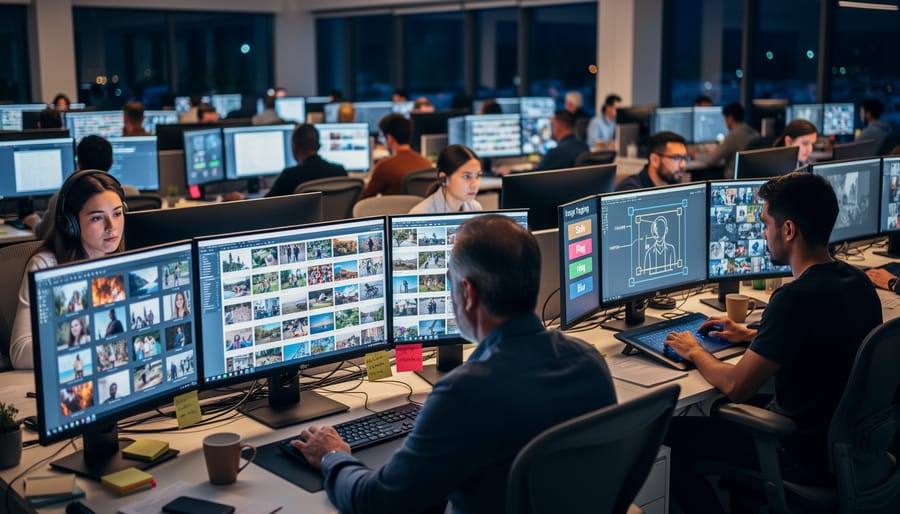
Image tagging is painstaking work. Taggers examine thousands of photos daily, drawing bounding boxes around faces, labeling objects from “bicycle” to “wedding cake,” and identifying subtle contextual elements like “indoor lighting” or “sunset.” A single training dataset for facial recognition might require millions of precisely annotated images. This granular human input teaches algorithms to differentiate between a smile and a smirk, or recognize a person regardless of lighting conditions.
Much of this work happens in countries like Kenya, the Philippines, Venezuela, and India, where digital labor platforms connect workers with tech companies seeking cost-effective annotation services. Workers might earn between $1 to $3 per hour, a fraction of what similar work commands in Silicon Valley, yet this income can be significant in their local economies.
The irony is profound: the very technology designed to automate visual recognition depends entirely on human judgment for its training. These taggers make subjective decisions about how to categorize images, embedding their cultural perspectives and potential biases into the AI systems photographers worldwide now use. When your camera identifies a scene as “beach” or recognizes specific facial features, you’re seeing the cumulative work of countless anonymous annotators whose labor made that computational magic possible.
Content Moderators Behind Photo Platforms
Behind every photo-sharing platform exists an invisible workforce tasked with reviewing flagged content—a job that carries significant psychological weight. Content moderators for platforms like Instagram and Flickr often view thousands of disturbing images daily, from graphic violence to exploitation, working to keep communities safe while photographers share their creative work freely.
These workers, frequently employed through third-party contractors in countries with lower labor costs, face challenging conditions. Many report inadequate mental health support despite constant exposure to traumatic imagery. Industry investigations have revealed moderators working in high-pressure environments with strict quotas—sometimes reviewing one image every few seconds—leaving little time for psychological processing.
For photographers, understanding this hidden labor force adds another dimension to the ethics of image sharing. When you upload photos to global platforms, real people become the gatekeepers between your creative vision and your audience. This system enables the seamless, instantaneous sharing we’ve come to expect, but at a human cost that’s rarely acknowledged in photography discussions about digital distribution and global reach.
How Globalization Changed What We Photograph
The Instagram Aesthetic Goes Global
Open Instagram, scroll through your feed, and you’ll notice something remarkable: photographs from Tokyo, Toronto, and Timbuktu often share an uncanny similarity. This visual homogenization isn’t accidental—it’s the direct result of algorithmic preferences shaping global visual storytelling.
Social media platforms use algorithms that reward specific visual characteristics: high contrast, saturated colors, clean compositions, and certain aspect ratios. When a particular style generates more engagement, the algorithm promotes it, creating a feedback loop that encourages photographers worldwide to adopt these trending aesthetics. That moody teal-and-orange color grade you’ve seen everywhere? It’s partly popular because it performs well algorithmically.
The result is what some critics call “Instagram sameness”—coffee shops in Seoul photographed identically to those in Stockholm, travel photos that prioritize shareability over authenticity. Popular presets and filters spread virally, allowing photographers across continents to apply the same look with a single click.
This creates interesting tensions for working photographers. While these standardized aesthetics can help you gain visibility and followers, they also raise questions about creative authenticity and cultural representation. A street scene in Mumbai filtered through the same preset as one in Melbourne loses some of its unique cultural context.
Understanding these dynamics empowers you to make intentional choices about whether to embrace trending aesthetics for reach or develop distinctive visual signatures that stand apart from algorithmic pressures.
When Everyone Has the Same Gear
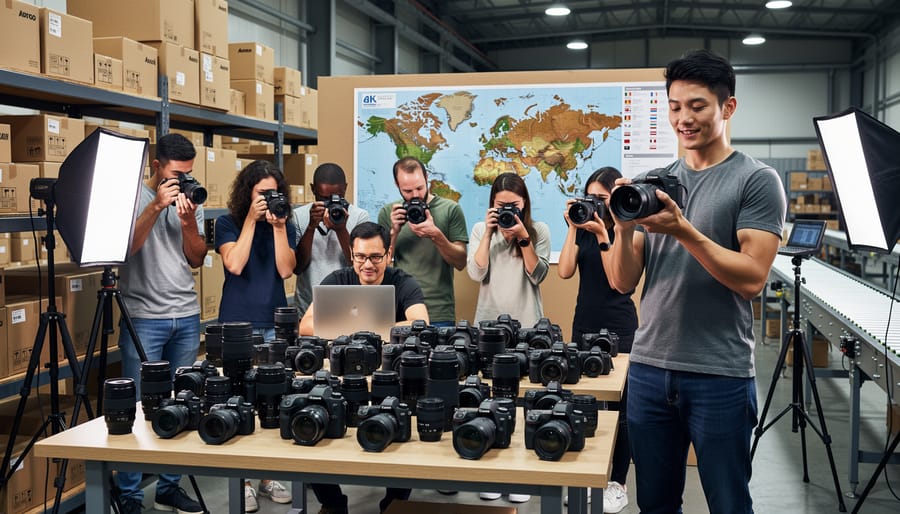
Walk into any photography workshop or professional shoot today, and you’ll notice something interesting: nearly everyone is holding remarkably similar equipment. A photographer in Tokyo, another in Toronto, and a third in São Paulo might all be shooting with the same camera body, the same lenses, even the same lighting modifiers. This is globalized manufacturing at work—a system that has made professional-grade gear accessible to photographers worldwide at prices that would have seemed impossible just two decades ago.
This democratization is genuinely revolutionary. A talented photographer in a developing economy can now access the same tools as established professionals in major markets, leveling the playing field in ways we’ve never seen before. Gone are the days when geographic location determined your access to quality equipment.
But here’s the paradox worth considering: when everyone has access to the same standardized tools, does it inadvertently homogenize our creative output? There’s a subtle pressure that comes with industry-standard gear. When certain camera systems dominate the market, when specific lens focal lengths become “must-haves,” and when popular presets circulate globally through social media, we risk creating a visual monoculture.
This isn’t about nostalgia for expensive, exclusive equipment. Rather, it’s recognizing that while accessible tools empower more voices, they also create invisible guardrails. The challenge becomes using these standardized tools in non-standardized ways—finding your unique vision within a shared technological landscape.
What This Means for Your Photography Practice
Choosing Gear with Labor Standards in Mind
Making informed purchasing decisions doesn’t require a degree in supply chain ethics, but it does take a bit of research and the willingness to ask questions. Start by checking whether manufacturers have obtained third-party certifications like Fair Trade, SA8000 (Social Accountability), or B Corporation status. These aren’t just marketing badges—they represent audited commitments to worker welfare and ethical practices.
When researching brands, visit their websites and look for transparency reports or dedicated pages about manufacturing practices. Companies genuinely committed to labor standards typically share factory locations, worker welfare initiatives, and improvement goals openly. If this information is buried or absent entirely, that’s worth noting.
Don’t hesitate to contact retailers directly with specific questions: Where is this product manufactured? What labor standards does the manufacturer follow? Can you provide information about factory conditions? Reputable retailers increasingly recognize that customers care about these issues and often have answers ready.
Organizations like the Electronics Watch and the Ethical Trading Initiative maintain databases of manufacturer practices in the electronics sector, which includes photographic equipment. These resources can help you cross-reference company claims with independent assessments.
Consider supporting smaller manufacturers who produce locally or regionally, as their supply chains are often more transparent and easier to verify. While premium pricing may reflect genuine labor costs rather than exploitation, remember that expensive doesn’t automatically mean ethical—always verify claims rather than assuming price equals virtue.
Supporting Fair-Pay Image Platforms
As photographers, we hold significant power in choosing where to license our work and which platforms to support with our purchases. Not all stock photography sites are created equal, and some prioritize fair compensation for contributors far better than others.
Traditional microstock platforms like Shutterstock and iStock have faced criticism for their low royalty rates, sometimes paying contributors less than a dollar per download while charging customers substantially more. In contrast, platforms like 500px and EyeEm have experimented with more photographer-friendly models, offering higher commission rates and transparent pricing structures. Alamy stands out in the industry by offering contributors up to 50% commission on sales, significantly higher than most competitors.
Subscription-based models deserve particular scrutiny. While convenient for buyers, they often translate to pennies per download for photographers. If you’re purchasing images, consider pay-per-image platforms where contributors receive a more substantial portion of the sale price.
For those licensing their own work, research each platform’s terms carefully. Look beyond the headline commission rate and examine factors like exclusive versus non-exclusive agreements, minimum payout thresholds, and whether the platform retains rights to your images after you leave.
Supporting cooperative models represents another ethical choice. Stocksy United operates as a photographer-owned cooperative, ensuring contributors receive 50-75% royalties and have voting rights in company decisions. This model demonstrates that stock photography can function profitably while respecting creator rights.
Consider diversifying your portfolio across multiple platforms rather than relying solely on the largest marketplace. This strategy not only maximizes your earning potential but also supports a healthier, more competitive ecosystem that benefits all contributors.
Understanding the global journey of your camera—from rare earth mining to sensor fabrication, from lens assembly to the shipping container that brought it to your doorstep—doesn’t diminish the magic of photography. If anything, it enriches it. When you press the shutter button, you’re not just capturing light; you’re engaging with a worldwide network of miners, engineers, factory workers, logistics coordinators, and countless others whose labor makes your creative vision possible.
This awareness carries responsibility. Every purchase decision you make sends signals through this vast supply chain. When you choose brands committed to ethical manufacturing, you’re voting for better working conditions. When you extend your camera’s lifespan through proper maintenance rather than chasing every upgrade, you’re reducing demand for resource extraction. When you sell or donate used gear instead of discarding it, you’re participating in a more sustainable model of consumption.
The good news is that photographers today have more power than ever before. Social media and industry forums amplify consumer voices. Brands increasingly respond to demands for transparency and sustainability. Your questions about labor practices and environmental impact matter, and companies are listening.
Consider photography’s broader impact on the world—it has the power to document change, preserve memories, and shape perspectives. Similarly, your choices as a photographer can shape the industry itself. You’re not just a consumer; you’re part of a global community of creators whose collective decisions influence how cameras are made, who makes them, and under what conditions.
Image globalization is your story too. Embrace that connection, and let it inform how you participate in this remarkable craft.




 By
By