 By
By 
Every camera you own today exists because of a complex web of patents, licensing agreements, and legal battles happening behind the scenes. When Canon and Nikon engineers develop a new autofocus algorithm, when Sony pushes the boundaries of sensor technology, or when smartphone manufacturers integrate computational photography features, they’re navigating a minefield of intellectual property rights that can make or break innovation.
These legal disputes aren’t abstract corporate squabbles—they directly determine which cameras reach your hands, what features they include, and how much you’ll pay for them. Remember when certain camera brands suddenly couldn’t sell specific models in particular countries? That was intellectual property litigation at work. The ongoing patent wars over image stabilization technology, mirrorless autofocus systems, and video compression methods shape the entire landscape of photographic equipment available to you.
Understanding intellectual property watch means recognizing how patent portfolios influence camera development timelines, why some groundbreaking features appear in one brand but not another, and why certain technological advances seem to stall while others accelerate rapidly. It explains why major manufacturers sometimes release seemingly outdated technology or why promising startups struggle to compete despite having innovative ideas.
The stakes are enormous. A single patent infringement ruling can result in product recalls, import bans, or licensing fees that add hundreds of dollars to a camera’s price tag. Cross-licensing agreements between major manufacturers often determine which companies can implement cutting-edge features, effectively creating technological gatekeepers in the industry. For photographers and enthusiasts who invest thousands in equipment, tracking these intellectual property developments provides crucial insight into which systems offer long-term viability and which innovations will actually reach the market.
Why Patent Wars Matter to Photographers

When Features Disappear Overnight
Patent disputes don’t just affect corporate boardrooms—they can directly impact the camera sitting in your gear bag right now. Sometimes, the features you rely on can vanish overnight when legal challenges emerge, leaving photographers scrambling to adapt.
One notable example involved RED Digital Cinema’s compressed RAW video patent. This aggressive patent enforcement sent ripples throughout the industry, affecting how manufacturers could implement internal RAW recording. Several camera makers either avoided the technology entirely or implemented workarounds that compromised performance, all because of one company’s intellectual property claims.
Canon faced its own patent headaches with dual pixel autofocus technology. While they pioneered and protected this innovation, the legal complexities meant carefully navigating implementation across their product lines. Meanwhile, competitors had to develop alternative autofocus systems, sometimes resulting in products reaching market later than anticipated.
More recently, sensor stabilization technologies have become battlegrounds. When patents covering specific in-body image stabilization methods are enforced, manufacturers must either license the technology, engineer around it, or remove capabilities altogether. We’ve seen features removed through firmware updates when companies discovered potential infringement issues post-launch.
The smartphone industry provides cautionary tales too. Apple and Samsung’s multi-year patent wars over computational photography features demonstrated how quickly imaging capabilities can become legal liabilities. These battles influenced which camera features appeared in products worldwide, affecting professional photographers who increasingly rely on smartphone backup systems.
Understanding these real-world examples helps explain why that anticipated feature might never arrive—or why it suddenly disappeared from your camera’s menu.
The Price Tag of Legal Protection
Patent protection doesn’t come cheap, and those costs inevitably trickle down to consumers. When camera manufacturers license technologies like in-body image stabilization or advanced autofocus algorithms, they’re paying substantial fees to patent holders. These licensing costs can add hundreds of dollars to a camera’s retail price, which explains why some features appear only in higher-end models despite the technology being available.
Consider how Canon and Nikon have historically approached dual card slots. While the technology itself isn’t prohibitively expensive, various implementations involve patented mechanisms. Manufacturers must decide whether licensing particular designs justifies the cost when targeting specific price points. Sometimes they’ll develop alternative approaches, which requires additional R&D investment.
Legal battles create even larger financial drains. A single patent infringement lawsuit can cost millions in legal fees, even before any settlement or judgment. When Samsung faced ongoing patent disputes in the camera market, these battles influenced their eventual decision to exit the camera business in certain regions. Legal uncertainty impacts product availability and market entry strategies.
Smaller manufacturers face particularly difficult choices. Licensing every potentially relevant patent is financially impossible, so they must carefully evaluate which markets offer sufficient sales volume to justify legal risks. This explains why some innovative camera brands remain unavailable in patent-aggressive markets like the United States, instead focusing on regions with different legal landscapes.
Major Patent Battlegrounds in Imaging Technology
Sensor Technology and Image Processing
The cameras in your hands today represent years of fierce patent battles you’ve probably never heard about. Behind every technological leap—sharper images, better low-light performance, faster autofocus—there’s often a complex web of intellectual property disputes that shape which features make it to market and which companies can implement specific innovations.
Back-illuminated sensors stand as a prime example of this patent warfare. These sensors flip traditional design on its head, placing circuitry behind the light-sensitive layer rather than in front, dramatically improving light-gathering ability. Sony pioneered this technology and aggressively defended their patents throughout the 2010s, which partly explains their dominant position in sensor manufacturing. When competitors wanted to develop similar technology, they either needed to license Sony’s patents, engineer workarounds, or wait for patent expirations.
Stacked sensor designs took things further, layering processing circuits directly beneath the sensor array. This architecture enables incredibly fast readout speeds and powers features like electronic shutters without rolling shutter distortion. Patent portfolios around stacked designs have become valuable currency in corporate negotiations, with manufacturers sometimes cross-licensing technologies to avoid courtroom showdowns.
Perhaps nowhere is IP warfare more intense than in computational photography. The sensor technology innovations that enable multi-frame noise reduction, AI-powered subject detection, and advanced HDR processing are protected by thousands of patents. These algorithmic battles directly affect what your camera can do—they’re why certain features appear exclusively on specific brands or why firmware updates sometimes introduce capabilities that seem like they should have existed from day one.
Autofocus and Eye-Detection Systems
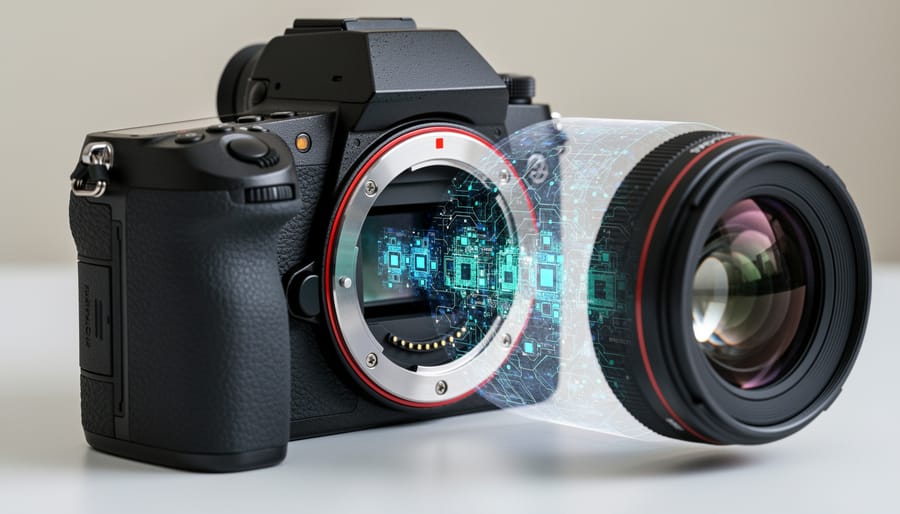
Autofocus technology represents one of the most fiercely contested battlegrounds in camera patent portfolios. The race to achieve faster, more accurate focus has generated thousands of patents, with manufacturers protecting everything from basic phase-detection algorithms to sophisticated AI-driven tracking systems.
Canon’s dual-pixel CMOS autofocus stands as a prime example of how a single patent can define an entire product generation. By placing two photodiodes under each pixel, Canon created a system that simultaneously captures image data and performs phase-detection across nearly the entire sensor. This technology, protected by multiple patents filed since 2013, gave Canon a significant competitive advantage in mirrorless cameras and video-capable DSLRs. Competitors had to develop alternative approaches or wait for licensing agreements, which partly explains why some manufacturers initially lagged in live-view and video autofocus performance.
Eye-detection and subject-tracking systems have spawned their own patent wars. Sony’s Real-time Tracking and Real-time Eye AF technologies are protected by extensive patent filings covering machine learning algorithms, neural network implementations, and specific detection methods. These aren’t just abstract concepts—when you half-press your shutter and see those green boxes lock onto a subject’s eye, you’re witnessing patented innovation at work. The practical impact? Photographers gain tools that were impossible a decade ago, while manufacturers must innovate around existing patents or negotiate cross-licensing deals to offer comparable features.
In-Body Image Stabilization
In-Body Image Stabilization represents one of the most contested technological territories in camera patents. While the concept of stabilizing images by shifting the sensor dates back decades, the practical implementation involves hundreds of individual patents covering sensor mounting systems, actuator designs, and motion detection algorithms.
Olympus pioneered consumer IBIS in the early 2000s, building a substantial patent portfolio that influenced how other manufacturers approached the technology. Sony developed its own distinct approach with its five-axis stabilization system, carefully engineering around existing patents while filing their own protection for unique implementations. This patent dance explains why IBIS systems vary considerably between brands—it’s not just about different engineering philosophies, but about navigating intellectual property boundaries.
The practical impact for photographers is significant. Some manufacturers entered the IBIS market later due to patent considerations, while others licensed technology or developed workarounds. For instance, Canon’s relatively late adoption of IBIS in their mirrorless cameras wasn’t purely a strategic choice—they needed time to develop systems that respected existing patents while delivering competitive performance.
These patents also affect cross-licensing agreements between manufacturers, which can influence what features appear in collaborative products or how quickly innovations spread across the industry. Understanding this context helps explain why certain camera bodies command premium prices and why some features remain brand-exclusive for years.
Video Codecs and Recording Features
Ever wonder why your mirrorless camera stops recording video at 29 minutes and 59 seconds? Patent licensing is likely the culprit. Video compression formats like H.264 and H.265 are protected by patent pools, meaning manufacturers must pay licensing fees to use them. These costs significantly impact camera pricing and feature availability.
Here’s where it gets interesting: the European Union historically classified devices recording beyond 30 minutes as “video cameras” rather than “still cameras,” subjecting them to higher import duties. While this regulation changed in 2019, many manufacturers maintained recording limits due to thermal management concerns and market segmentation strategies. However, patent licensing costs for video codecs remain a genuine factor.
That’s why the industry is gradually embracing open standards like AV1, developed by the Alliance for Open Media. This royalty-free codec promises to eliminate licensing fees while delivering superior compression. Companies like Canon and Sony are exploring these alternatives, though adoption takes time due to processing requirements and ecosystem compatibility.
Understanding these patent dynamics helps explain why professional video features command premium prices and why firmware updates sometimes unlock capabilities that were technically possible all along. The shift toward open codecs could democratize advanced video recording, making professional-grade features more accessible without the burden of licensing fees affecting both manufacturers and ultimately, consumers.
Recent Patent Disputes That Changed the Industry
In 2017, Nikon found itself locked in a heated patent dispute with Sigma Corporation over lens stabilization technology. The disagreement centered on optical image stabilization mechanisms that had become essential for modern photography, particularly in low-light situations and telephoto work. Nikon alleged that several Sigma lenses designed for Nikon mounts infringed on their proprietary stabilization patents.
The practical impact was significant and immediate. Sigma temporarily halted sales of certain Contemporary and Art series lenses in Japan while legal teams sorted through the technical details. Photographers who had eagerly awaited these more affordable alternatives to Nikon’s first-party glass suddenly faced delayed releases and limited availability. The dispute highlighted how a single manufacturer’s patent portfolio could restrict innovation and choice across the entire ecosystem.
What made this case particularly instructive was the resolution. Rather than engaging in years of litigation, both companies reached a cross-licensing agreement within months. This outcome demonstrated how the photography industry often prefers collaborative solutions that keep products flowing to market. The agreement allowed Sigma to continue developing lenses with advanced stabilization while Nikon maintained its patent protections and received licensing revenue. For photographers, it meant continued access to diverse lens options without prolonged market disruptions that could have limited their creative tools.
A cautionary tale emerged in 2012 when MPHJ Technology Investments began targeting office equipment manufacturers and their customers over scanner-to-email functionality. While not exclusively focused on cameras, this case illustrates how patent assertion entities—often called “patent trolls”—can disrupt entire industries, including imaging technology.
MPHJ acquired patents covering the basic concept of scanning documents and sending them via email, then sent demand letters to thousands of small businesses claiming they needed licenses. The company targeted not just manufacturers but end-users, creating widespread concern across industries that relied on scanning technology. This approach affected multifunction printers with imaging capabilities and raised questions about similar tactics being applied to camera connectivity features.
The Federal Trade Commission eventually intervened, calling MPHJ’s practices deceptive. However, the damage was done—countless small businesses paid settlements rather than face costly litigation, and manufacturers faced uncertainty about implementing basic connectivity features.
This situation demonstrates how broadly-worded patents on fundamental imaging functions can create legal landmines. For photographers, it’s a reminder that the devices you rely on exist within a complex legal landscape. Features as simple as wireless image transfer or cloud connectivity could theoretically become litigation targets. Understanding these dynamics helps explain why some manufacturers hesitate to adopt certain technologies or why seemingly obvious features take years to implement—sometimes it’s not about technical capability but navigating an intellectual property minefield.
A perfect example of intellectual property opening doors rather than closing them comes from the JPEG compression format. In the early 2000s, multiple companies held patents covering various aspects of JPEG technology, creating a complex web of licensing requirements. This situation threatened to make the format difficult and expensive for camera manufacturers to implement, potentially fragmenting the industry around proprietary alternatives.
The breakthrough came through patent pools coordinated by organizations like MPEG LA, which brought rights holders together to offer streamlined licensing at reasonable rates. This collaborative approach meant camera makers could implement JPEG compression without negotiating dozens of separate agreements or risking litigation.
The result? JPEG became the universal standard we rely on today, available in everything from professional DSLRs to smartphone cameras. This settlement model demonstrates how intellectual property can actually accelerate innovation when managed cooperatively rather than competitively.
For photographers, this behind-the-scenes agreement meant seamless compatibility across devices and platforms. You can shoot on any camera brand and confidently share files with clients, print labs, and online services. It’s a reminder that sometimes the most impactful IP developments are the ones that simply let technology work smoothly together, removing barriers rather than creating them.
What’s Coming: Emerging IP Trends in Photography
Computational Photography and AI
The world of camera innovation is increasingly shaped by who owns the rights to artificial intelligence and machine learning technologies. Patent filings in this space have exploded over the past five years, with major manufacturers racing to protect their computational photography advances in areas like subject recognition, automatic scene optimization, and AI-driven image processing.
Consider how your smartphone or mirrorless camera now automatically recognizes faces, pets, vehicles, and even specific bird species. Each of these capabilities represents patented technology that took years to develop. Companies like Canon, Sony, and Nikon hold extensive patent portfolios covering machine learning algorithms that predict focus points, optimize exposure for detected scenes, and even predict subject movement before it happens.
The stakes have grown even higher with generative AI features entering consumer cameras. Technologies that remove unwanted objects, extend image borders intelligently, or enhance resolution using AI upscaling are now patent battlegrounds. Google’s computational photography patents, for instance, have influenced how multiple smartphone manufacturers approach multi-frame processing and night mode capabilities.
For photographers, these patent wars determine which features appear in which cameras and at what price point. When one company holds exclusive rights to a breakthrough AI feature, competitors must either license that technology, develop workarounds, or simply omit the capability altogether, directly impacting your creative toolkit options.

Smartphone vs. Dedicated Camera Patents
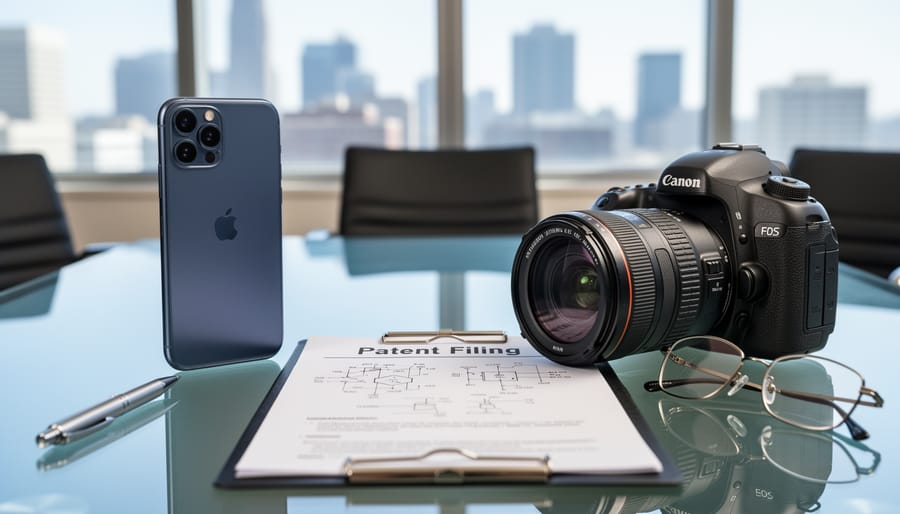
The battle between smartphone and dedicated camera manufacturers has created a fascinating patent crossover that’s reshaping the entire imaging industry. Companies like Apple and Samsung are now filing patents for technologies traditionally associated with professional cameras, while Canon and Nikon are increasingly protecting smartphone-like features in their latest models.
Consider computational photography. What started as a smartphone necessity to compensate for tiny sensors has become one of the hottest patent battlegrounds. Apple’s patent portfolio around multi-frame processing and HDR techniques now influences how mirrorless cameras approach high dynamic range imaging. Meanwhile, Sony holds critical patents on stacked sensor technology that benefits both smartphone makers and traditional camera manufacturers, since Sony supplies sensors to both markets.
The crossover works both ways. Canon’s Dual Pixel autofocus technology, originally developed for DSLRs, has been licensed to smartphone manufacturers. Similarly, phase-detection autofocus patents from camera companies are now fundamental to flagship phone cameras. This creates interesting competitive dynamics where former rivals become licensing partners.
One particularly contentious area involves AI-powered scene recognition and subject tracking. Both smartphone makers and camera companies are racing to patent machine learning implementations for photography, leading to overlapping claims and potential disputes. Google’s computational photography patents, for instance, have influenced how traditional camera makers approach features like background blur and night modes.
For photographers, this patent crossover means innovation in one sector often benefits the other, though licensing disputes can occasionally delay feature releases or increase equipment costs when manufacturers need to design around existing patents.
How to Stay Informed About IP Developments
Keeping tabs on intellectual property developments doesn’t require a law degree, but it does mean knowing where to look and what matters. For photographers who want to stay ahead of the curve, a few reliable sources can make all the difference in understanding how patent battles and licensing agreements might impact your next gear purchase.
Start with specialized photography news sites that cover industry developments. Websites like Imaging Resource, DPReview, and PetaPixel regularly report on major patent filings and legal disputes, translating complex legal language into practical implications. These outlets often connect the dots between a new patent filing and what it might mean for future camera features. For deeper dives, the United States Patent and Trademark Office website allows you to search patent applications directly, though the technical language can be challenging.
Industry trade publications like Photo Business News and Professional Photographer occasionally cover IP issues that affect professional workflows. Following major camera manufacturers on social media and subscribing to their press release notifications helps you catch announcements about licensing agreements or technology partnerships firsthand.
Pay attention to quarterly earnings calls from major manufacturers, where executives sometimes discuss patent portfolios and technology strategies. These transcripts are usually available on company investor relations pages and can reveal which technologies companies consider most valuable.
When interpreting announcements, look beyond the headlines. A patent filing doesn’t guarantee a product will reach market, but multiple related patents suggest serious development. Watch for patterns: if several manufacturers license the same technology, it’s likely becoming an industry standard you’ll encounter across brands.
Consider joining photography forums where technically-minded enthusiasts discuss patent news. Communities like Fred Miranda and DPReview forums often have members who follow IP developments closely and can provide context. Just remember that forum speculation should be balanced with official sources.
The key is developing a regular routine—checking a few trusted sources weekly gives you enough context to make informed decisions without drowning in legal minutiae.
The patents and intellectual property developments happening behind the scenes aren’t just legal abstractions reserved for corporate boardrooms. They’re shaping the cameras you hold in your hands, influencing which features make it to market, and determining how affordable cutting-edge technology becomes. When Canon patents a new autofocus algorithm or when Sony secures protection for a sensor design, these decisions ripple through the entire industry, eventually affecting whether that capability appears in your next camera body.
Understanding intellectual property trends gives you a clearer picture of where photography technology is headed. Patent filings often appear years before products reach store shelves, offering a preview of innovations manufacturers are pursuing. When you see clusters of patents around computational photography or AI-driven features, you’re glimpsing tomorrow’s capabilities today. This foresight helps you anticipate which technologies might become standard and which remain premium features locked behind expensive licensing agreements.
The licensing disputes and cross-licensing agreements between major manufacturers also explain why certain features appear across multiple brands while others remain exclusive. These arrangements shape competitive dynamics and influence pricing strategies throughout the market. A photographer who recognizes these patterns can make smarter gear decisions, understanding not just what a camera does today, but whether its technology base positions it well for future updates and longevity.
Next time you encounter patent news in the photography world, look beyond the technical details. Ask yourself how this development might affect product availability, feature accessibility, and industry innovation patterns. That curiosity transforms abstract legal news into practical intelligence that serves your creative work and investment decisions.




 By
By