 By
By 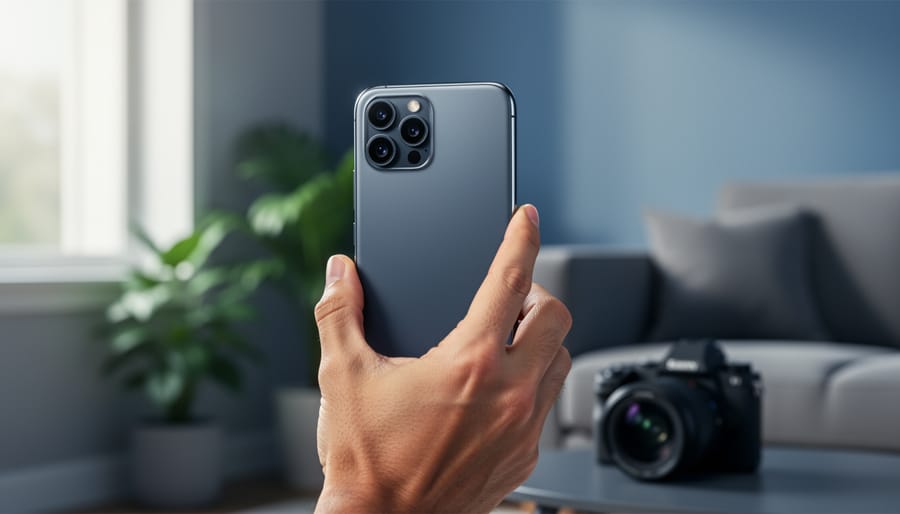
3D sensing cameras have transformed photography from capturing flat images into creating dimensional maps of space, letting you refocus shots after taking them, blur backgrounds with precision that rivals professional lenses, and even measure real-world distances through your viewfinder. This technology isn’t just a fancy add-on anymore—it’s becoming standard in everything from flagship smartphones to mirrorless cameras, fundamentally changing how we approach composition, focus, and creative control.
At its core, a 3D sensing camera uses additional sensors or specialized pixels to measure depth information alongside traditional color and light data. Think of it as giving your camera a sense of spatial awareness, similar to how your two eyes work together to judge distances. When you tap to focus on your phone’s portrait mode and watch the background melt into creamy bokeh, or when a modern autofocus system tracks a running athlete with uncanny precision through cluttered scenes, that’s 3D sensing at work.
The practical benefits extend far beyond Instagram-worthy background blur. These systems enable Face ID security, power augmented reality apps that place virtual furniture in your living room with accurate scaling, and help cameras distinguish between your subject and distracting elements in the frame. For photographers, this translates to faster autofocus in challenging conditions, better subject tracking, and creative possibilities that were previously only achievable with expensive equipment and precise manual techniques.
What Is a 3D Sensing Camera? Breaking Down the Basics
While traditional cameras capture what your eye sees—color, brightness, and detail—3D sensing cameras add a superpower: they understand where objects are in space. Think of it like the difference between looking at a photograph of a room versus actually standing in that room and knowing how far away the couch is, or how many steps it takes to reach the window.
To understand why this matters, let’s first clarify how camera sensors work traditionally. Regular camera sensors capture light in two dimensions—height and width—creating flat images. A 3D sensing camera, however, measures a third dimension: depth. This depth information tells the camera exactly how far away each object is from the lens, creating what’s called spatial awareness.
This depth data gets organized into something called a point cloud—imagine thousands of tiny dots suspended in space, each representing a specific point on your subject with its precise distance from the camera. Together, these points form a three-dimensional map of the scene, much like how individual pixels create a two-dimensional image.
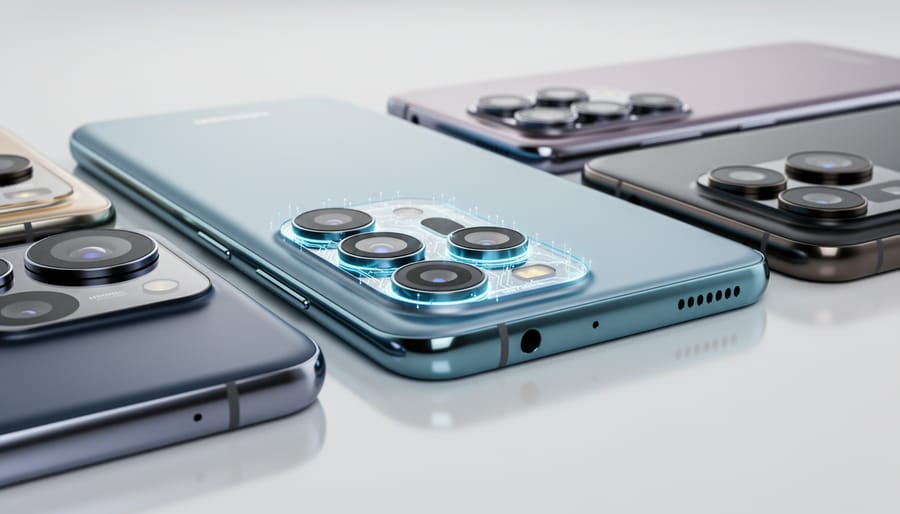
Depth mapping is the process of creating this spatial information. Some 3D sensing cameras use infrared light patterns projected onto the scene, while others use two lenses (like your eyes) to calculate distance through parallax. Still others use laser pulses that measure how long light takes to bounce back from objects.
Why does capturing depth matter beyond taking pictures? Consider autofocus: knowing exact distances lets cameras lock onto subjects with remarkable speed and accuracy, especially in challenging conditions. Portrait photographers benefit from precise subject separation, creating natural background blur. The depth information also enables augmented reality features, accurate measurement tools, and advanced computational photography techniques that simply weren’t possible with traditional sensors.
For practical photography, this means better low-light autofocus, more convincing portrait mode effects, and new creative possibilities like refocusing images after you’ve taken them. The camera essentially sees your scene the way you do—understanding not just what’s there, but where everything sits in three-dimensional space.
The Three Core Technologies Behind 3D Sensing
Structured Light: Projecting Patterns to Map Space
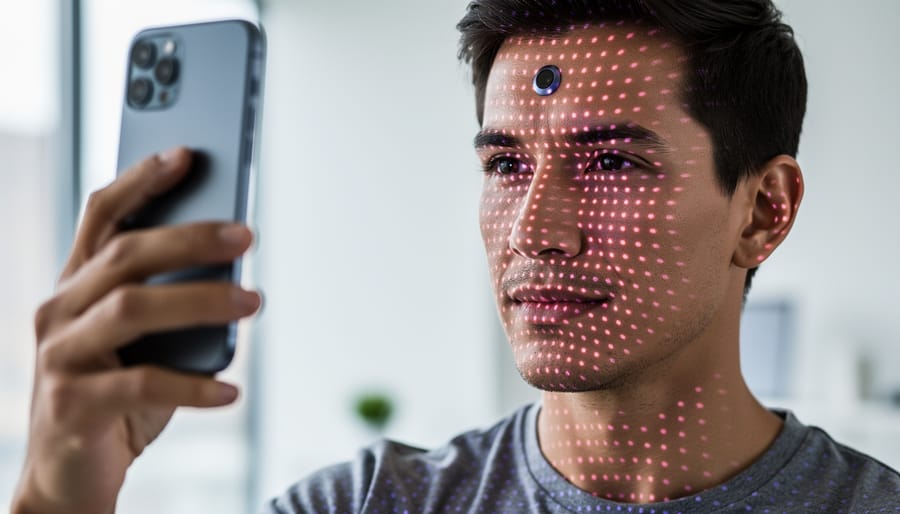
Structured light technology works by projecting a known pattern—usually a grid of dots or lines—onto your subject, then analyzing how that pattern deforms across different surfaces. Think of it like shining a flashlight through a screen door onto a sculpture. The projected grid bends and warps around the contours, and by measuring these distortions with a camera, the system calculates precise depth information for every point it sees.
The technology became mainstream with the original Xbox Kinect sensor back in 2010, which revolutionized motion gaming by projecting thousands of infrared dots to map living rooms and track player movements. More recently, Apple brought structured light to millions of pockets with Face ID on the iPhone X and newer models. That tiny notch at the top of the screen houses a dot projector that maps your face with remarkable precision, creating a detailed 3D model that updates in milliseconds.
The real strength of structured light lies in its accuracy at close range. Unlike infrared sensing technology that relies on emitted pulses bouncing back, structured light captures dense spatial data with impressive resolution, typically within a range of a few centimeters to several meters. This makes it exceptional for facial recognition, object scanning, and portrait photography applications where depth mapping needs to be pixel-perfect.
However, the technology has notable limitations. Outdoor performance suffers significantly because ambient sunlight, especially infrared light, can wash out the projected pattern, making it nearly invisible to the sensor. This is why Face ID occasionally struggles in bright sunshine. Range is another constraint—structured light typically maxes out around 3-5 meters, making it impractical for landscape or distant subject photography. The system also requires a clear line of sight and struggles with highly reflective or transparent surfaces that don’t cleanly display the projected pattern. Despite these boundaries, structured light remains the go-to solution when accuracy matters more than distance.
Time-of-Flight (ToF): Measuring Light Speed for Depth
Time-of-Flight technology works on a beautifully simple principle: measuring how long it takes light to travel to an object and back. Think of it like a highly sophisticated version of echolocation, except instead of sound waves, your camera sends out pulses of infrared light and times their return journey with nanosecond precision.
Here’s how it works in practice. The camera emits a brief flash of infrared light that bounces off everything in the scene. Built-in sensors then calculate the time delay for each point where light returns. Since light travels at a constant speed, the camera can convert these tiny time differences into accurate distance measurements, creating a detailed depth map of your scene. This happens incredibly fast—often many times per second—making ToF sensors particularly valuable for modern camera sensor technology that needs real-time depth information.
You’ll find ToF sensors in several current smartphones, including recent Samsung Galaxy and iPhone Pro models, where they power features like portrait mode and augmented reality applications. Professional cameras like the Sony DepthSense use this technology for advanced autofocus and subject tracking. The technology has also become essential in cinematography cameras that require precise depth mapping for visual effects work.
The advantages are compelling. ToF sensors work reliably in various lighting conditions, including low light where traditional methods struggle. They’re also remarkably fast, making them ideal for tracking moving subjects or enabling responsive autofocus systems. The speed advantage becomes particularly noticeable when you’re photographing active subjects or need instant depth information for video work.
However, trade-offs exist. Current ToF sensors typically offer lower resolution depth maps compared to structured light systems, which can affect edge precision around detailed subjects like hair or foliage. They also consume more power than passive depth-sensing methods, something to consider for battery-dependent devices. Despite these limitations, the technology continues advancing rapidly, with newer implementations addressing resolution concerns while maintaining the speed advantages that make ToF so appealing.
Stereo Vision: Learning from Human Eyes
Think about how you see the world for a moment. You have two eyes, each positioned slightly apart, and your brain uses the subtle differences between what each eye sees to judge distances. When you reach for your coffee cup, you’re not guessing—your visual system calculates depth through this binocular vision. Stereo vision cameras work exactly the same way.
Instead of biological eyes, stereo vision systems use two camera sensors separated by a known distance, called the baseline. Each camera captures a slightly different view of the same scene, and sophisticated algorithms analyze these differences—technically called disparity—to calculate how far away objects are. The principle is called triangulation: if you know the distance between two cameras and the angle at which they view the same point, you can mathematically determine that point’s distance from the cameras.
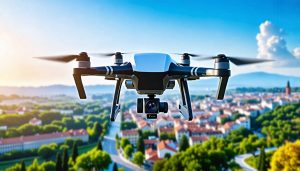
This technology has become incredibly popular in action cameras and drones with stereo vision, where obstacle avoidance is critical. DJI’s drone models, for example, use forward-facing stereo cameras to detect and avoid trees, buildings, and other hazards during flight. GoPro has also experimented with dual-camera systems for creating immersive 3D content.
The biggest advantage of stereo vision is cost. Unlike structured light or time-of-flight systems that require specialized hardware, stereo vision just needs two standard camera modules and processing power. This makes it accessible for consumer devices and scalable for professional applications.
However, there’s a trade-off. The computational requirements are significant. Processing two high-resolution image streams in real-time, finding matching points between them, and calculating depth maps demands serious processing muscle. This can drain batteries quickly and may introduce latency. Additionally, stereo vision struggles in low-light conditions or with textureless surfaces like blank walls, where finding matching points between the two images becomes nearly impossible. Despite these challenges, stereo vision remains one of the most versatile and widely adopted 3D sensing technologies in photography today.
Where 3D Sensing Actually Matters in Photography
Portrait Mode and Background Blur That Actually Works
If you’ve ever been frustrated by portrait mode cutting through someone’s hair, leaving weird halos around their head, or blurring their ears while keeping the background sharp, you’re not alone. Traditional software-based portrait modes rely on algorithms making educated guesses about what’s foreground and what’s background, often with mixed results.
This is where 3D sensing cameras shine. Instead of analyzing a flat image and estimating depth, these cameras actually measure the physical distance to every point in the scene. Think of it like having a tiny laser range finder built into your camera that creates a depth map in real-time. The result? Portrait mode that knows exactly where your subject ends and the background begins.
The difference is particularly noticeable with challenging subjects. Fine hair, glasses, intricate jewelry, or someone standing against a busy background—these scenarios often trip up software-only solutions. A 3D sensing camera handles them with surprising accuracy because it’s working with actual spatial data rather than pattern recognition.
In real-world testing, photos taken with 3D sensing depth maps show cleaner edge transitions and more natural-looking bokeh. The background blur feels like what you’d get from a fast prime lens on a full-frame camera, not the artificial cutout look of poorly executed computational photography. Your subject’s ears stay sharp while the background melts away smoothly, and those wispy strands of hair remain properly defined against the blurred backdrop.
For photographers who’ve been disappointed by smartphone portrait modes, 3D sensing represents a genuine leap forward in subject isolation quality.

Autofocus That Knows What You’re Shooting
Traditional autofocus systems work hard to figure out what you want sharp, often hunting back and forth to find the right focus point. With 3D sensing, your camera already knows where everything is in the frame before it even starts focusing. Think of it as the difference between fumbling for a light switch in the dark versus seeing exactly where it is.
This depth awareness transforms autofocus into something remarkably intelligent. When you’re photographing your kid running toward you at the park, a 3D sensing camera understands the spatial relationship between your subject and the background. It doesn’t just track contrast or edges—it tracks an actual object moving through three-dimensional space. This means fewer missed shots and more keepers when the action gets unpredictable.
Modern mirrorless cameras like Sony’s Alpha series use phase-detection pixels combined with depth mapping to maintain focus lock even when subjects briefly disappear behind obstacles. Your camera essentially predicts where the subject will reappear based on its trajectory through 3D space.
Smartphones have become surprisingly capable here too. The iPhone’s Portrait mode uses depth sensing to continuously adjust focus on faces, even as people move closer or farther from the camera. Google’s Pixel phones employ dual-pixel technology that creates a depth map for each frame, allowing them to separate subjects from backgrounds with remarkable accuracy—all happening invisibly in the background while you concentrate on composition and timing.
Low-Light Performance and Scene Understanding
One of the most impressive advantages of 3D sensing technology is how it helps cameras tackle difficult lighting situations. Traditional cameras struggle in low light because they’re essentially working blind—they can measure overall brightness but don’t truly understand what they’re looking at. This is where depth information becomes a game-changer.
When your camera knows the spatial layout of a scene, it can make remarkably intelligent exposure decisions. For example, if you’re photographing a subject in shadow with a bright background, the camera can prioritize proper exposure for the person rather than being fooled by the backlight. The depth map tells the camera, “This object at 2 meters is your main subject, not that bright window at 10 meters.”
In dimly lit environments, 3D sensing assists autofocus systems by providing a spatial reference point, helping your camera lock focus faster and more accurately than systems relying solely on contrast detection. This is particularly valuable for event photographers working in unpredictable lighting conditions or anyone shooting concerts and indoor gatherings.
Some advanced cameras even use depth data to apply selective noise reduction—keeping your main subject sharp while smoothing grain in less important background areas. This scene understanding means your camera isn’t just capturing light; it’s comprehending the three-dimensional world and making context-aware decisions that result in better-exposed, sharper images even when conditions are less than ideal.
Beyond Photography: Why This Technology Is Everywhere
While photographers might see 3D sensing as just another camera feature, this technology has quietly become the foundation for some of today’s most exciting innovations. Understanding where else it’s being deployed helps explain why major tech companies are investing billions in perfecting these systems—and why your next camera will likely have even better depth-sensing capabilities.
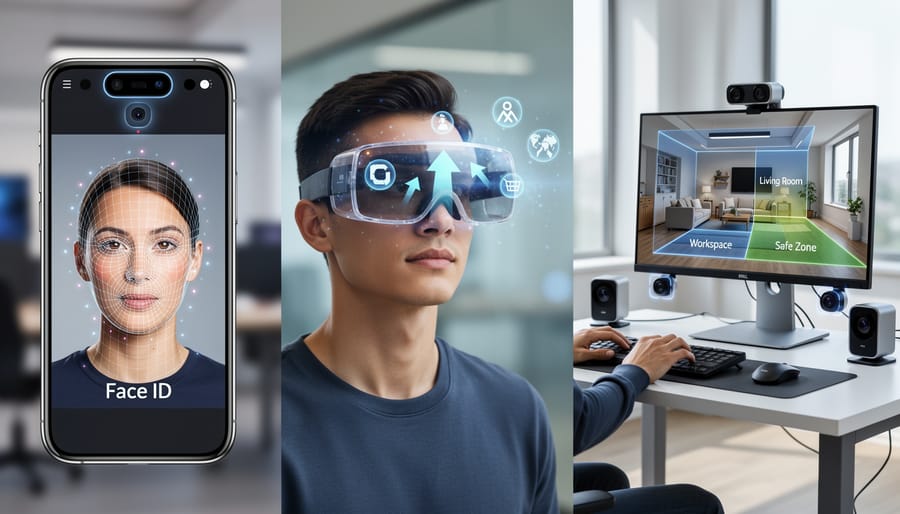
The most visible application outside photography is augmented and virtual reality. Those VR headsets that track your movement with eerie precision? They’re using the same time-of-flight and structured light principles we’ve discussed. AR apps that place virtual furniture in your living room rely on identical depth-mapping technology to understand your space. Apple’s LiDAR scanner, for instance, powers both Portrait mode photography and immersive AR experiences in a single package.
Biometric security has also embraced 3D sensing in a big way. Your phone’s face unlock feature doesn’t just recognize a flat image of your face—it maps the three-dimensional contours to prevent someone from fooling it with a photograph. Banks and secure facilities are implementing similar depth-sensing cameras for access control, creating systems that are exponentially harder to spoof than traditional methods.
Autonomous vehicles represent perhaps the most demanding application. Self-driving cars use sophisticated LiDAR and time-of-flight systems to build real-time 3D maps of their surroundings, detecting pedestrians, other vehicles, and obstacles with split-second precision. The same technology enabling your camera’s autofocus is helping cars navigate safely.
Even industrial 3D scanning and robotics depend on these same principles, from manufacturing quality control to warehouse automation. This cross-industry momentum means the revolutionary camera technologies in your hands benefit from massive research investments driven by applications far beyond photography—a rising tide lifting all boats.
What to Look for When Shopping for 3D Sensing Features
Shopping for 3D sensing features requires cutting through marketing hype to understand what you’ll actually use. Not all 3D sensing technologies are created equal, and the right choice depends entirely on what you shoot.
Start by identifying your primary photography needs. Portrait photographers benefit most from Time-of-Flight systems, which excel at accurate subject separation and background blur. If you’re shooting wildlife or sports, structured light systems often struggle with outdoor lighting conditions, making LiDAR-equipped cameras the better investment. For product photography or architectural work, stereoscopic depth cameras provide the precision you need for dimensional accuracy.
Ask retailers and manufacturers specific questions about performance. How does the 3D sensing perform in low light? What’s the effective range for depth mapping? Does it work with moving subjects or only static scenes? Many marketing materials promise “professional-quality depth maps” but fail to mention that the feature only functions within three meters or requires perfectly still subjects.
Pay attention to real-world limitations that rarely appear in spec sheets. Some smartphone 3D sensors only activate in portrait mode, limiting creative flexibility. Others create noticeable lag between capture and processing, making them impractical for candid photography. Test the camera yourself if possible, particularly in lighting conditions similar to where you’ll shoot most often.
Be skeptical of claims about “revolutionary” autofocus improvements. While 3D sensing genuinely enhances focus accuracy, the difference is most noticeable in challenging scenarios like low contrast or low light. For everyday shooting in good conditions, traditional phase-detection autofocus remains remarkably capable.
Consider the ecosystem too. Some manufacturers lock depth data into proprietary formats, preventing you from using third-party editing software to refine depth effects later. Others provide open access to raw depth maps, offering greater creative control in post-processing.
Finally, evaluate whether you need dedicated 3D hardware or if computational photography alternatives might serve you better. Modern AI-powered depth estimation from standard cameras has improved dramatically, sometimes matching dedicated sensors for common applications while costing considerably less.
We’re witnessing a pivotal moment in photography where cameras aren’t just recording light anymore—they’re genuinely understanding the three-dimensional space before them. This shift from simple image capture to spatial comprehension represents one of the most significant advances in camera technology since the transition to digital sensors. As 3D sensing becomes increasingly sophisticated and affordable, we’ll see it migrate from flagship smartphones and specialized equipment into mainstream cameras across all price points.
The practical implications are already unfolding around us. Portrait modes that once struggled with hair and glasses are becoming remarkably precise. Autofocus systems are achieving accuracy that seemed impossible just a few years ago. Augmented reality features are transforming how we visualize our shots before pressing the shutter. And we’re only scratching the surface—future applications will likely include real-time relighting, automated subject tracking that understands context, and computational photography features we haven’t imagined yet.
If you own a device with depth-sensing capabilities, I encourage you to explore those features you might have dismissed as gimmicks. Experiment with portrait modes on challenging subjects, try the depth-based focus controls, or explore any spatial audio recording options. Understanding how your camera perceives depth will make you a more capable photographer, ready to leverage this technology as it continues evolving.



 By
By