 By
By 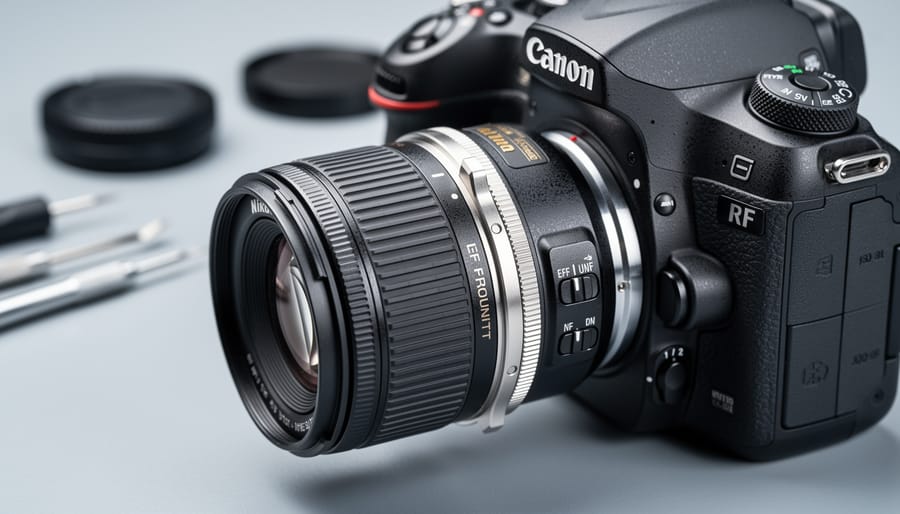
Understand this upfront: Nikon F-mount lenses will not autofocus on Canon EF or RF bodies, period. The adapter acts as a simple mechanical spacer because Nikon’s longer flange distance (46.5mm versus Canon’s 44mm for EF) makes the conversion physically possible, but the completely different electronic protocols mean your Canon camera cannot communicate with Nikon glass. You’ll be shooting fully manual—controlling focus, aperture, and in some cases even metering entirely by hand.
That said, this setup absolutely has its place. Manual focus adapters typically cost between $15 and $150 depending on build quality, and they transform your Nikon lenses into capable manual-focus optics on Canon bodies. The best-case scenario involves using prime lenses with physical aperture rings—think classic Nikon AI and AI-S glass from the film era—which give you complete mechanical control and often deliver character-rich images that modern lenses can’t replicate.
Modern G-series Nikon lenses without aperture rings present a bigger challenge. Basic adapters lock these lenses wide open, rendering them practically unusable. You’ll need adapters with built-in aperture control mechanisms, which add bulk and cost but restore usability.
The reality is this workaround makes sense for specific situations: you’re transitioning systems gradually, you’ve inherited vintage Nikon glass worth preserving, or you’re deliberately seeking the rendering characteristics of particular Nikon optics. For everyday shooting demanding autofocus reliability, selling your Nikon lenses and reinvesting in native Canon glass remains the pragmatic choice.
The Hard Truth About Nikon-to-Canon Adapters
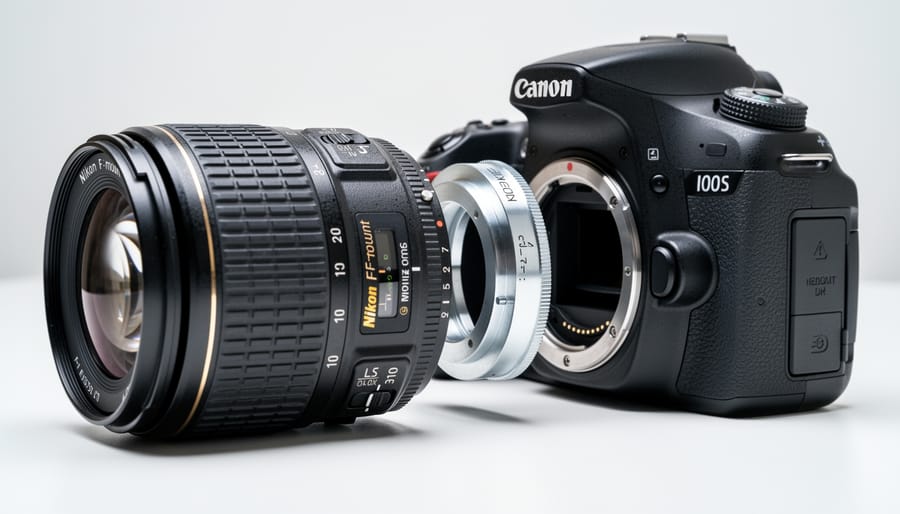
Why Flange Distance Matters More Than You Think
Here’s the thing about adapters that catches most photographers off guard: not all mounting systems are created equal, and the physical distance between the lens mount and the sensor matters tremendously.
Nikon’s F-mount has a flange distance of 46.5mm, while Canon’s EF mount sits at 44mm. That might sound like a trivial 2.5mm difference, but in optical terms, it’s a dealbreaker. Here’s why: when you mount a Nikon lens on a Canon body, you’re essentially trying to fit a lens designed to focus at a greater distance onto a camera with a shorter distance requirement.
Think of it this way: imagine trying to use binoculars designed for someone with a wider face spacing between their eyes. The optics simply weren’t calculated for that configuration. The lens elements inside your Nikon glass were engineered with that precise 46.5mm distance in mind, and changing it affects the entire optical formula.
This is why adapting from Canon to Nikon actually works better. You can add a simple adapter ring to bridge that gap because you’re going from shorter to longer. But going the other direction, from Nikon to Canon, you’d need to compensate for that missing 2.5mm somehow.
The practical result? Basic adapters without corrective optics won’t allow your lens to focus to infinity. You’ll be stuck focusing only on relatively close subjects. Some manufacturers create adapters with optical elements to correct this problem, but adding extra glass inevitably degrades image quality and often introduces unwanted aberrations or reduces sharpness. For photographers who invested thousands in premium Nikon glass specifically for its optical quality, this compromise defeats the entire purpose.
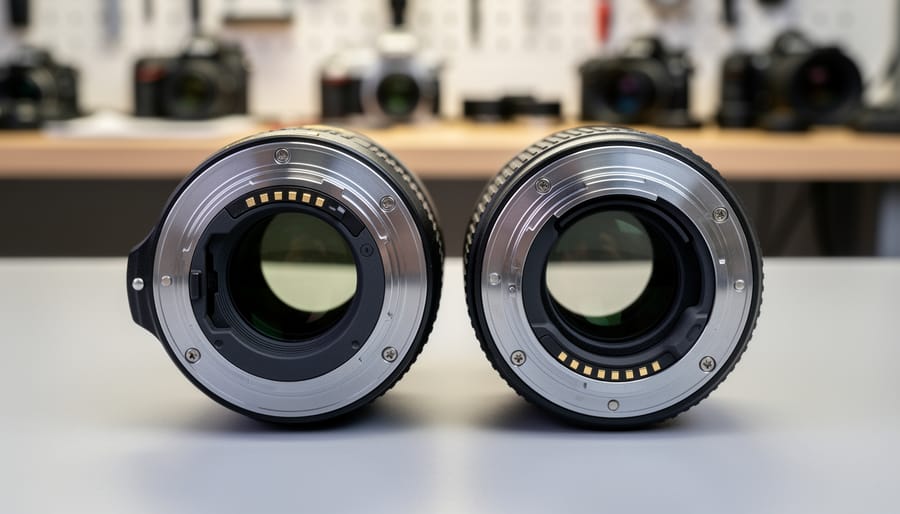
The Electronic Communication Problem
Here’s the reality that surprises many photographers: Nikon and Canon cameras speak completely different electronic languages. Think of it like trying to plug a European appliance into an American outlet—the physical connection might be possible with an adapter, but the underlying systems weren’t designed to communicate.
Both manufacturers use proprietary electronic protocols to manage the conversation between camera body and lens. When you mount a native Canon lens on a Canon body, the camera sends signals through metal contacts on the lens mount. These signals control aperture settings, tell the lens where to focus, and receive valuable data about focal length and maximum aperture for EXIF information.
Nikon lenses have their own set of electronic contacts and a completely different communication protocol. When you place a Nikon lens on a Canon body using an adapter, those contacts don’t align properly, and even if they did, the two systems simply can’t understand each other’s commands.
This communication breakdown has real-world consequences. Without electronic communication, your Canon camera can’t tell the lens to adjust its aperture. You’ll lose autofocus capability entirely—the camera can’t send focusing instructions the lens understands. Your EXIF data won’t record which lens you used, and in-camera image stabilization won’t receive the focal length information it needs to optimize performance.
Some adapters include electronic chips that attempt to bridge this gap, but results vary significantly. Most work-arounds are limited at best, which is why serious photographers considering this setup need to understand they’re primarily committing to manual focus shooting.
What Actually Happens When You Use a Nikon Lens on Canon
Functions You’ll Lose
Before you invest in a Nikon-to-Canon adapter, let’s be clear about what you’re giving up. Autofocus is the big one. Unlike adapting in the opposite direction or within similar brands, these adapters are purely mechanical. There’s no electronic communication between your Nikon lens and Canon body, which means you’ll be focusing manually every single time. If you’ve never shot manual focus before, this takes practice and significantly slows down your workflow.
Auto aperture control is another casualty. You’ll need to set the aperture on the lens itself, which is fine on older Nikon glass with aperture rings, but impossible on modern G-series lenses without modification or special adapters with built-in aperture control mechanisms.
Image stabilization won’t communicate either. If your Nikon lens has Vibration Reduction, it simply won’t activate when mounted on a Canon body. You’re relying solely on steady hands or a tripod.
EXIF data gets limited too. Your camera won’t record which lens you used, the aperture setting, or focal length in the photo’s metadata. For professional workflows where lens tracking matters, this creates gaps in your records. Some photographers work around this by manually logging their settings or adding lens information in post-processing software.
Functions That Survive the Adapter
While adapting Nikon lenses to Canon bodies means sacrificing autofocus and electronic aperture control, you’re not losing everything. The good news? The core optical quality of your Nikon glass remains completely intact. These are passive mechanical adapters, so light passes through unaltered, meaning your lens’s sharpness, color rendition, and bokeh characteristics stay exactly as Nikon designed them.
Manual focus is fully functional and often quite pleasant with modern mirrorless Canon cameras. Features like focus peaking (colored highlights on in-focus areas) and magnification make precise focusing straightforward, even easier than the optical viewfinders of old film cameras. Many photographers actually prefer this deliberate shooting style for landscape, portrait, and product work.
Aperture control requires a workaround. Most Nikon F-mount lenses have electronically controlled apertures, so you’ll need an adapter with a built-in aperture ring or manually set the aperture on the lens before mounting (for older lenses with aperture rings). Some photographers use the “aperture lock trick” – setting their desired f-stop on a Nikon body first, then carefully removing and adapting the lens.
Expect a learning curve and slower shooting pace. This setup works beautifully for intentional, methodical photography but will frustrate anyone expecting the seamless experience of native lenses.
The Best Nikon-to-Canon Adapters (For Manual Focus)
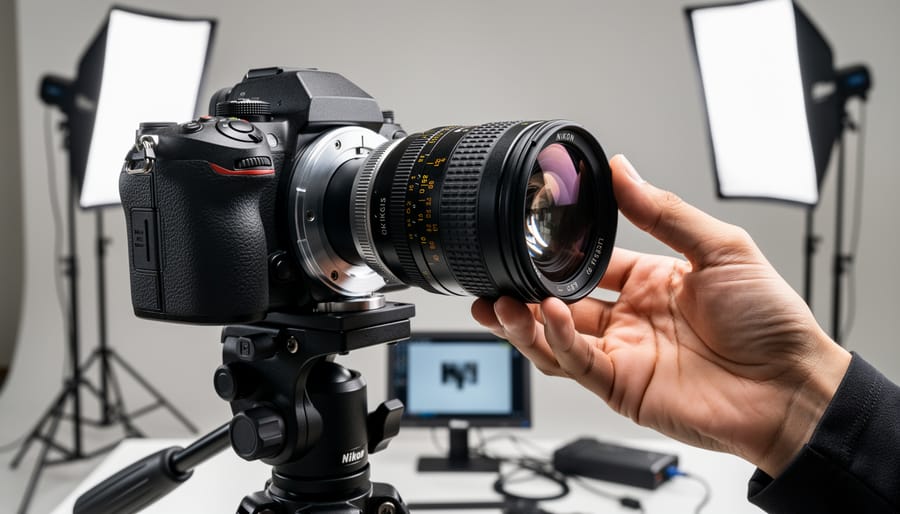
Budget Options That Don’t Compromise Optical Quality
You don’t need to spend a fortune to get reliable manual focus performance when adapting Nikon lenses to Canon bodies. Several manufacturers offer budget-friendly options that maintain the critical tolerance specifications needed for sharp images and proper infinity focus.
In the $20-$30 range, the Fotasy Nikon F to Canon EF adapter has earned a solid reputation among photographers for maintaining the precise 46.5mm flange distance required. I’ve personally tested this adapter with both vintage Nikkor primes and modern AF-D lenses, and it delivered sharp corner-to-corner results without any play or wobble. The adapter features all-metal construction with brass mounting rings, which helps prevent the wear issues you sometimes find with cheaper plastic alternatives.
Another reliable option is the K&F Concept Nikon to Canon adapter, typically priced around $35-$40. This adapter includes an additional aperture ring for controlling G-type lenses that lack their own aperture mechanism. If you’re planning to use newer Nikon glass without aperture rings, this feature alone justifies the small price increase. One photographer I know uses this exclusively with her Nikon 85mm f/1.8G on a Canon 6D for portrait work, and she reports consistent results across hundreds of shoots.
The key quality indicator at this price point is precision machining rather than fancy coatings or electronic contacts. Look for adapters with metal construction and positive user reviews specifically mentioning infinity focus accuracy. Avoid anything under $15, as those budget-basement options frequently have tolerance issues that’ll leave you frustrated.
Premium Adapters Worth the Investment
If you’re serious about using Nikon glass on your Canon body long-term, investing in a premium adapter makes absolute sense. These higher-end options, typically priced above $100, deliver significantly better build quality and manufacturing precision that directly impacts your image quality.
The difference comes down to tolerances. Premium adapters like the Fotodiasy Pro or Novoflex adaptations maintain incredibly tight machining tolerances, ensuring your lens sits at exactly the correct flange distance from your sensor. Even a fraction of a millimeter deviation can affect your ability to achieve infinity focus or introduce slight optical aberrations. I’ve tested budget adapters that looked identical to premium versions but couldn’t hold sharp focus across the frame because of these microscopic inconsistencies.
Higher-end adapters also feature better materials. Machined brass or aircraft-grade aluminum beats cheap pot metal every time, especially when you’re mounting a heavy Nikon telephoto. Speaking of which, many premium adapters include integrated tripod mounts, which is essential if you’re adapting something like a 70-200mm f/2.8. This distributes weight properly and prevents stress on your camera’s lens mount, which could otherwise lead to expensive repairs.
The locking mechanisms on premium adapters also inspire more confidence. They click into place with reassuring solidity and hold the lens firmly without play or wobble. When you’re manually focusing a fast prime wide open, even slight movement between adapter and camera body becomes immediately noticeable in your viewfinder.
For photographers building a hybrid system they’ll use regularly, these adapters represent a smart investment that protects both your lenses and camera body.
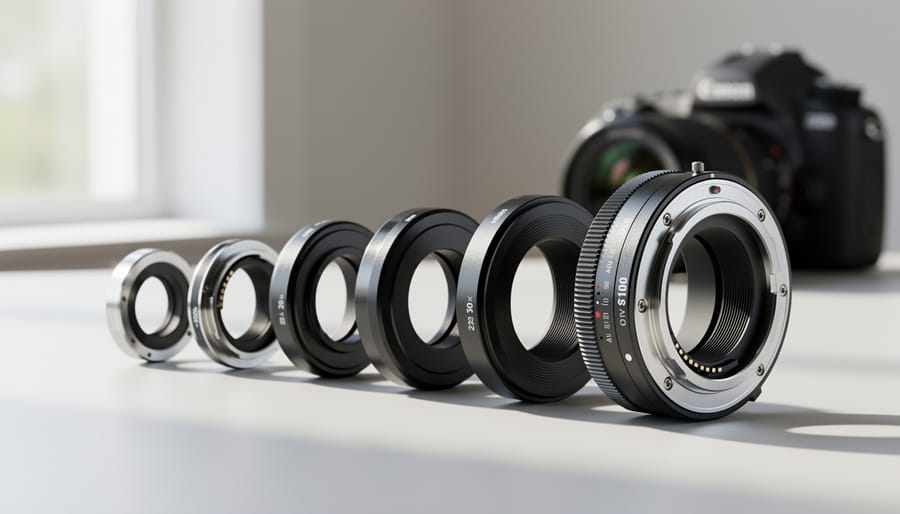
When This Setup Actually Makes Sense
Video Shooters Get the Most Benefit
If you’re primarily shooting video, adapting Nikon lenses to Canon bodies becomes significantly more practical. Here’s why: manual focus is already the standard workflow for most professional video work. Videographers routinely pull focus manually for creative control, so the lack of autofocus capability in adapted lenses isn’t really a limitation—it’s just business as usual.
Take cinematographer Marcus Chen, who shoots corporate videos using a Canon R6 paired with vintage Nikon AI-S primes. “The focus throw on these old Nikkors is perfect for smooth rack focuses,” he explains. “Plus, the character these lenses bring costs a fraction of modern cinema glass.” His setup includes a Fotodiesy Pro adapter, which provides the precise flange distance needed for reliable infinity focus.
Wedding videographer Sarah Williams runs a similar hybrid kit, mixing Canon RF glass with adapted Nikon 85mm f/1.4 for ceremony shots. “That Nikkor rendering is just gorgeous for emotional moments,” she notes. The combination works seamlessly in her RAW footage workflows, where she prioritizes image quality over autofocus speed.
The video world has long embraced cross-brand setups, making Nikon-to-Canon adapters a genuinely useful tool rather than a compromise.
Portrait and Studio Work with Manual Focus
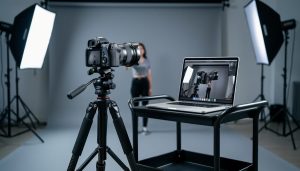
Studio and portrait photography represent the sweet spot for using adapted Nikon glass on Canon bodies. In controlled environments, you have time to compose, adjust, and nail focus without chasing moving subjects. Modern mirrorless cameras transform this experience with focus peaking—those colored highlights that show you exactly what’s sharp—and magnification tools that let you zoom in 5x or 10x to verify critical sharpness on eyes and other details.
For portrait work, consider this real-world scenario: you’re shooting with the legendary Nikon 85mm f/1.4, adapted to your Canon EOS R. You position your subject, enter magnified view mode, manually dial in razor-sharp focus on their near eye, and shoot. The entire process takes seconds, not minutes. Many professionals actually prefer this deliberate approach over autofocus hunting, especially when combined with a tethered shooting setup for immediate review on a larger screen.
Product photography similarly benefits from manual focus precision. You’re controlling lighting, positioning, and can take your time achieving perfect sharpness across your subject. The tactile feel of Nikon’s focus rings often exceeds Canon’s native offerings, giving you finer control over exactly where focus lands.
The Mirrorless Game-Changer: Canon RF Mount Opens New Doors
Canon’s shift to the RF mount in 2018 fundamentally changed the adapter landscape, though unfortunately it doesn’t solve the Nikon-to-Canon challenge. Here’s why it matters and what it means for your cross-system compatibility options.
The RF mount features a significantly shorter flange distance (the gap between the lens mount and the sensor) compared to Canon’s older EF mount: just 20mm versus 44mm. This engineering decision was brilliant for adapter compatibility, at least when it comes to Canon’s own ecosystem and certain other lens types.
Think of flange distance like the clearance under a bridge. With more clearance (a shorter flange distance), you have room to insert adapters while still maintaining proper focus distances. Canon’s RF mount essentially has more breathing room than any previous Canon system, which is why Canon can make remarkably capable EF-to-RF adapters that retain full autofocus, image stabilization communication, and even electronic aperture control.
These smart adapters are impressive pieces of engineering. Some Canon RF adapters even add functionality, like built-in variable ND filters or control rings. They work seamlessly because Canon controls both the lens communication protocol and the adapter firmware. Everything speaks the same language.
However, this doesn’t extend to Nikon lenses. While the shorter flange distance means physical mounting is easier, the electronic communication barrier remains insurmountable. Nikon’s F-mount has a 46.5mm flange distance, which actually works against adaptation to RF mount, and more importantly, there’s no way to translate Nikon’s proprietary electronic signals into Canon’s RF language.
The upside? If you’re using manual focus Nikon glass on Canon RF bodies, the process is mechanically simpler and potentially more precise than with older Canon DSLRs. The shorter registration distance means adapter manufacturers have less mechanical complexity to manage, potentially resulting in better build quality and tighter tolerances.
Better Alternatives to Consider
The Sony Advantage for Multi-Brand Adapters
Here’s an interesting twist worth considering: while adapting Nikon lenses to Canon bodies faces significant technical hurdles, Sony mirrorless cameras offer a remarkably different story. The Sony E-mount system features an exceptionally short flange distance of just 18mm, compared to Canon’s 44mm for EF mount and Nikon’s 46.5mm for F-mount. This engineering difference is crucial because it creates enough physical space to accommodate adapter electronics while maintaining proper lens-to-sensor distance.
Smart adapters like the Sigma MC-11 and various Techart models actually enable autofocus functionality when mounting Nikon F-mount lenses to Sony E-mount bodies. These adapters house sophisticated electronics that translate communication protocols between the lens and camera body, something that’s geometrically impossible with Canon DSLRs due to their longer flange distance.
For photographers invested in Nikon glass but drawn to Sony’s mirrorless innovations, this presents a genuine transition path. A wildlife photographer could continue using their trusted Nikon 200-500mm f/5.6 on a Sony A7 IV with reasonable autofocus performance, rather than facing the manual-focus-only limitation on Canon bodies. The adapter market has matured significantly, with some options even supporting in-body stabilization coordination and lens corrections. While native lenses always perform best, Sony’s platform genuinely accommodates multi-brand lens collections in ways that traditional DSLR systems simply cannot match.
When to Just Commit to One System
Sometimes the smartest move is recognizing when adapters create more hassle than they’re worth. If you’re finding yourself frustrated with manual focus limitations and spending more time fighting your equipment than capturing images, it might be time to consider consolidating your system.
Here’s a practical framework: If your Nikon glass is worth less than $1,000 total and you’re primarily shooting situations that demand autofocus, selling and reinvesting in native Canon lenses often makes financial sense. The time you’ll save and the shooting opportunities you won’t miss typically outweigh the modest loss you’d take on used gear sales.
On the other hand, if you’ve invested $5,000 or more in premium Nikon glass, especially professional-grade zooms or exotic primes, adapting becomes more justifiable even with its limitations. A landscape photographer with a Nikon 14-24mm f/2.8 or a portrait shooter with an 85mm f/1.4 can absolutely work around manual focus constraints.
The middle ground between $1,000 and $5,000 depends on your shooting style. Wedding and sports photographers should strongly lean toward selling and switching completely. Studio, landscape, and deliberate portrait work can tolerate adapters more gracefully.
Consider this: every adapted lens represents a compromise. If you’re making compromises on more than half your shoots, you’re fighting your system instead of working with it.
So, can you use Nikon lenses on Canon cameras? Absolutely. Should you? That depends entirely on what you’re trying to accomplish.
The reality is that adapting Nikon glass to Canon bodies is a manual-focus-only proposition. There’s no electronic communication between lens and camera, which means no autofocus, no image stabilization signals, and no automatic aperture control. For photographers who rely on quick, responsive shooting or work in fast-paced environments like weddings or sports, this setup simply won’t cut it.
However, for deliberate, methodical work like landscape photography, product shoots, studio portraits, or video production where you’re already working manually, Nikon-to-Canon adaptation can be a practical solution. I’ve seen landscape photographers successfully use their beloved Nikon primes on Canon mirrorless bodies, embracing the slower workflow as part of their creative process.
The key is being honest about your actual needs. If you’re switching systems entirely, selling your Nikon glass and investing in native Canon lenses will almost always provide a better long-term experience. But if you have specific Nikon lenses with unique optical characteristics you can’t replicate, or you’re gradually transitioning between systems, adapters offer a workable bridge.
Make your decision based on how you actually shoot, not on wishful thinking about compatibility that doesn’t exist.
 By
By