
 By
By 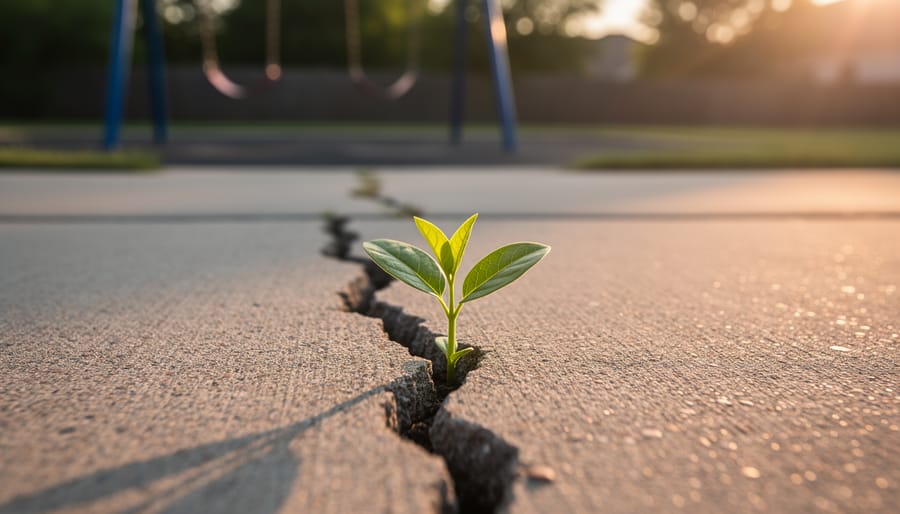
Look beyond literal representation and recognize that a visual metaphor transforms ordinary subjects into symbols that convey deeper meaning—like photographing a single seedling pushing through cracked concrete to represent resilience, or capturing an empty swing set at dusk to evoke childhood nostalgia and the passage of time.
Consider the power of juxtaposition, where placing contrasting elements within your frame creates commentary. A wilted flower beside fresh blooms speaks to mortality and renewal. A weathered hand holding a smartphone bridges generations and technological change. These comparative relationships allow viewers to draw connections that words alone cannot express, making your images resonate on emotional and intellectual levels simultaneously.
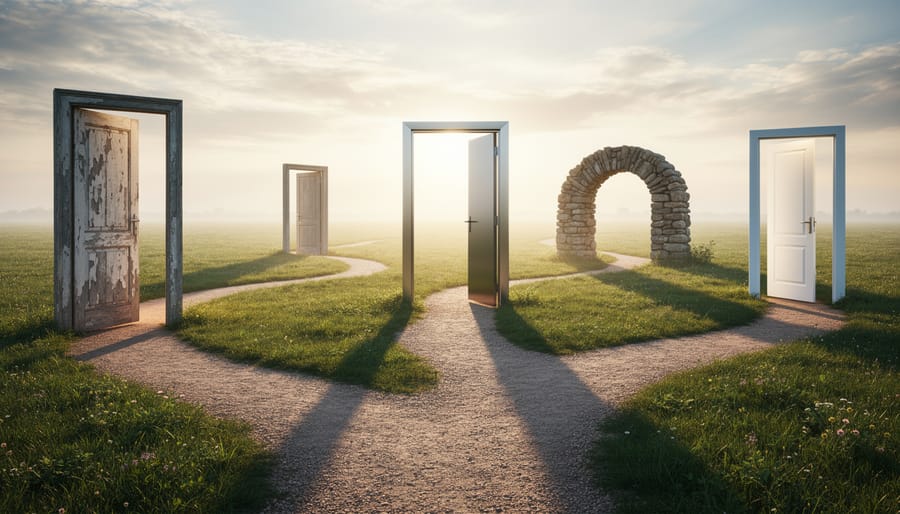
Study how masters of visual storytelling techniques use familiar objects as stand-ins for abstract concepts. Windows and doorways commonly represent opportunity and transition. Paths disappearing into fog suggest journey and uncertainty. Broken chains symbolize freedom. The strength of these metaphors lies in their cultural recognition—viewers instinctively understand the symbolism without requiring explanation.
Train yourself to see beyond the surface by asking what emotions or ideas your subject could represent. That abandoned building isn’t just architecture—it might embody decay, forgotten history, or the impermanence of human achievement. The coffee cup on your desk could symbolize comfort, routine, or the small rituals that structure our lives. This shift in perspective transforms you from someone who captures what things look like into a photographer who reveals what things mean.
What Makes a Visual Metaphor Work in Photography
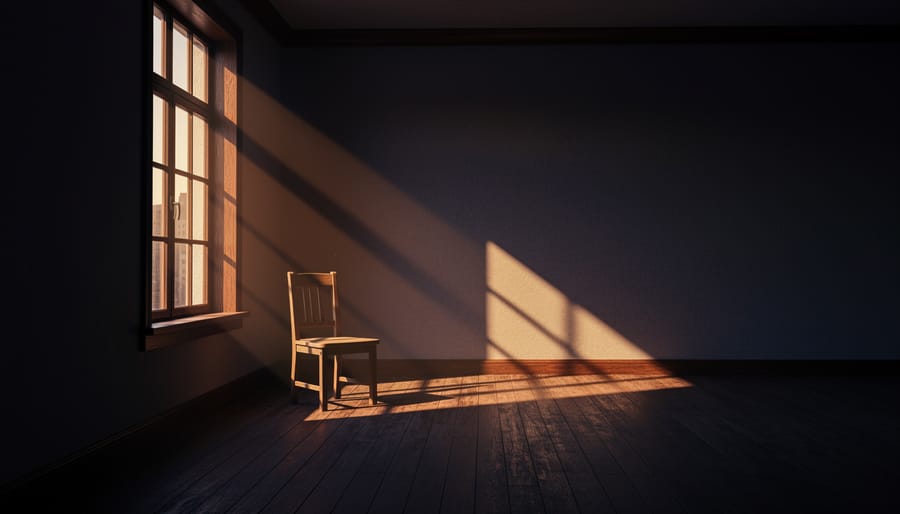
A visual metaphor in photography goes beyond simply capturing what’s in front of your lens. It’s the art of using one visual element to represent something entirely different—an abstract concept, emotion, or idea that can’t be photographed directly. Think of it as visual poetry: you can’t photograph loneliness itself, but you can photograph a single empty chair in a vast room, and viewers instantly understand the feeling you’re conveying.
Here’s where things get interesting: visual metaphors differ fundamentally from literal symbolism. A photograph of a dove is literal symbolism—we’ve collectively agreed that doves represent peace. But a visual metaphor requires viewers to make a cognitive leap. When you photograph cracked, dry earth to represent emotional drought or a relationship falling apart, you’re asking viewers to connect the physical deterioration they see with an emotional state they’ve experienced. This interpretive process is what makes metaphors so powerful.
The psychological impact of visual metaphors taps into how our brains process information. When viewers encounter a metaphor, they don’t just passively observe—they actively participate in creating meaning. This engagement triggers deeper neural processing and emotional responses. Research shows that metaphorical thinking activates multiple brain regions simultaneously, creating stronger memory formation than literal imagery. That’s why a photograph of tangled headphone wires representing life’s complications stays with you longer than a straightforward portrait.
Visual metaphors also give photographers a creative framework for tackling abstract assignments. How do you photograph hope, anxiety, or transformation? By translating these invisible concepts into visible, relatable scenes. A seedling pushing through concrete becomes resilience. Fog obscuring a path becomes uncertainty about the future.
The most effective visual metaphors feel both surprising and inevitable—viewers experience that satisfying “aha” moment when the connection clicks, yet the metaphor feels so natural they wonder why they didn’t see it immediately. This balance between novelty and recognition creates images that resonate long after the initial viewing.
Light and Shadow as Metaphors for Duality
The Window Light Technique
Window light offers one of the most accessible yet powerful opportunities for creating visual metaphors in your photography. The way natural light streams through a window can symbolize everything from isolation and confinement to hope and new beginnings, depending on how you approach it.
To capture isolation or contemplation, position your subject beside a window in an otherwise dark room. Set your camera to spot metering mode to expose for the subject’s face, allowing the surrounding darkness to deepen naturally. This technique works beautifully when mastering light and shadow to create emotional depth. Try shooting at f/2.8 to f/4 for a shallow depth of field that keeps focus on your subject while softening the background.
For hope or transition metaphors, photograph your subject looking toward or stepping into the light. Use a slightly wider aperture like f/1.8 and expose for the midtones to preserve detail in both highlights and shadows. Position yourself so the window frame appears in the composition, creating a literal threshold between darkness and light.
A practical tip: shoot during golden hour when window light takes on warm, ethereal qualities that enhance emotional storytelling. Keep your ISO low, around 400-800, to maintain image quality while working with available light.
Silhouettes as Identity and Mystery
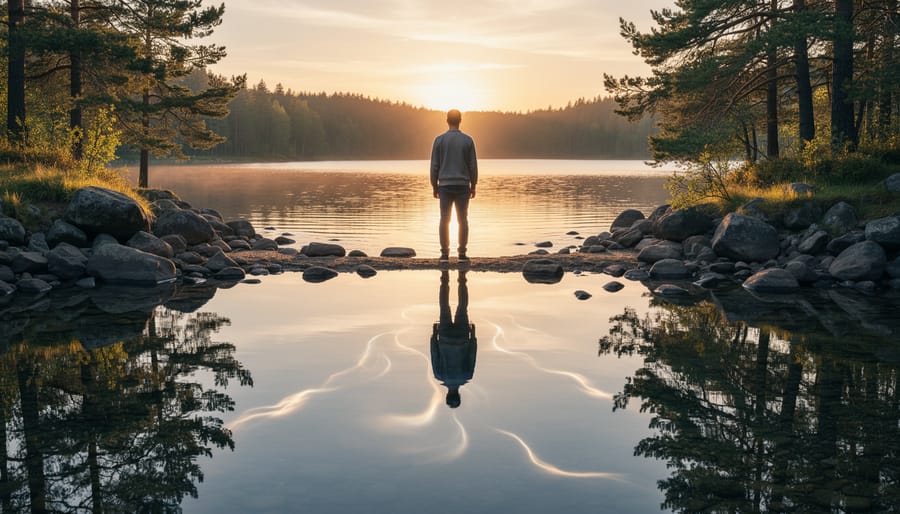
Silhouettes strip away the details that make individuals recognizable—facial features, clothing textures, expressions—leaving only shape and form. This absence transforms subjects into metaphors for broader human experiences. A lone figure silhouetted against a sunset doesn’t represent one specific person; it becomes everyone who’s ever felt small against nature’s vastness, everyone who’s contemplated life’s bigger questions at day’s end.
To capture compelling silhouettes, position your subject between your camera and a strong light source like a window, the setting sun, or bright sky. Expose for the background rather than your subject—most cameras will do this automatically in spot metering mode when you focus on the bright area behind your subject. The key is creating enough contrast that your subject falls into complete shadow.
Silhouettes work beautifully for storytelling when you want viewers to project themselves into the scene. A silhouetted parent holding a child’s hand becomes universal—any parent, any child, any moment of protection and trust. Similarly, obscured faces can represent mystery or anonymity, perfect for conveying themes of isolation, contemplation, or the unknown. Doorways and windows make excellent natural frames for silhouette photography, adding layers of metaphorical meaning about thresholds, transitions, and what lies beyond our current view.
Reflections and Mirrors as Dual Realities
Water Reflections for Emotional Depth
Water serves as one of photography’s most versatile metaphors, offering endless possibilities for conveying emotional complexity and life’s transient nature. A puddle reflecting a cityscape speaks to impermanence—one gust of wind disrupts the mirror-perfect image, much like how fleeting moments shape our memories. Rain-streaked windows distort the world beyond, creating a visual metaphor for confusion, grief, or the barrier between internal and external realities.
When shooting water reflections, timing becomes crucial. The golden hour provides warm, dramatic light that intensifies emotional resonance. For puddles, get low—position your camera just inches above the water’s surface to maximize the reflection while minimizing the surrounding pavement. This perspective transforms an ordinary parking lot into a dreamlike alternate reality.
Lakes and calm water bodies work beautifully for symmetry, suggesting duality or inner contemplation. A slight breeze creating ripples can represent emotional turbulence without being heavy-handed. For rain photography, shoot through glass using a wide aperture to blur the droplets into bokeh, or focus on the droplets themselves to sharp detail while the background dissolves.
Consider capturing the moment just after rain when surfaces glisten and reflections are sharpest. This brief window metaphorically represents clarity emerging from chaos—a powerful narrative element that resonates deeply with viewers seeking meaning in your imagery.
Scale and Perspective as Power Dynamics
The Human vs. Nature Metaphor
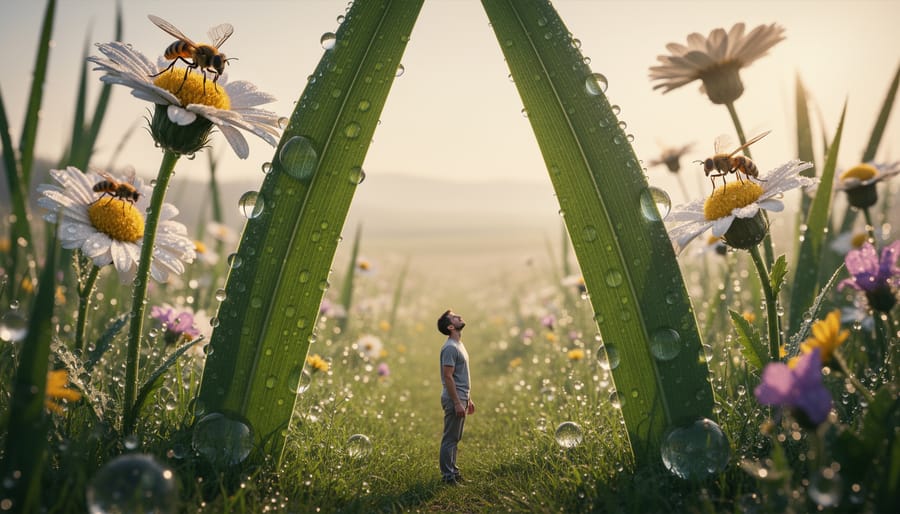
Scale is your most powerful tool when crafting visual metaphors about humanity’s place in the natural world. A lone hiker photographed against a towering mountain range immediately communicates vulnerability and wonder, while an aerial shot of urban sprawl overtaking forest edges tells a sobering story of dominance.
Your lens choice fundamentally shapes this narrative. Wide-angle lenses (14-35mm) excel at emphasizing nature’s vastness by exaggerating the distance between foreground and background. Position a person in the lower third of your frame while capturing expansive skies or landscapes above them, and you’ve created an instant metaphor for humility before nature’s grandeur.
Conversely, telephoto lenses (70-200mm and beyond) compress distance, making that same mountain appear to loom over your subject, creating a different emotional weight—perhaps claustrophobia or confrontation rather than peaceful coexistence.
For harmony metaphors, consider the rule of thirds differently. Place your human element at the intersection points, integrating them into the landscape rather than opposing it. A farmer tending crops at golden hour, positioned to mirror the lines of planted rows, suggests partnership rather than conquest.
Silhouettes work beautifully here too. Backlit human figures against natural elements—sunset, ocean waves, forest canopies—blur the boundary between person and place, suggesting unity. The key is intentional composition: every size relationship you create tells a story about how we relate to our environment.
Empty Spaces and Negative Space as Absence
Sometimes the most powerful statement you can make is to show what isn’t there. Empty spaces and negative space work as visual metaphors precisely because our minds naturally fill in the gaps, creating emotional resonance that can be more profound than any literal representation.
Think of a single empty chair in an otherwise vacant room. Without showing a person, you’ve instantly conveyed absence, memory, or waiting. This is negative space functioning as metaphor—the emptiness itself becomes the subject. A solitary figure standing in a vast, open landscape uses the surrounding emptiness to communicate isolation, insignificance, or conversely, freedom and possibility. The interpretation depends on context, but the emotional impact comes from what surrounds your subject rather than the subject itself.
In minimalist work, photographers like Michael Kenna masterfully use fog, snow, or water to create simplified compositions where negative space dominates. A lone tree in a white winter landscape becomes a metaphor for resilience or solitude. An empty hallway stretching into darkness suggests journey, uncertainty, or transition. These images work because the absence of visual clutter forces viewers to engage with the concept rather than details.
The challenge with using emptiness as metaphor is avoiding images that feel merely empty rather than meaningfully minimal. Here’s the distinction: purposeful negative space includes a clear anchor point—something for the eye to land on that gives the emptiness context and meaning. This might be a small human figure, a single object, or even just a point of contrasting color or texture.
Effective minimalist photography techniques require careful attention to composition. Position your anchor element using rule of thirds or golden ratio principles. The empty space should feel intentional, not accidental. Consider tonal relationships—subtle gradations in seemingly empty areas create visual interest while maintaining the minimalist aesthetic. A gradient sky or textured wall provides just enough information to keep the image engaging without competing with your metaphorical message.
Journey and Path Metaphors
Roads, pathways, and doorways have long served as powerful visual metaphors for life’s journey, and photographers can harness these everyday elements to create deeply resonant images. When you photograph a winding road disappearing into the distance, you’re not just capturing asphalt—you’re depicting uncertainty, possibility, and the unknown future that lies ahead for all of us.
The beauty of journey metaphors lies in how naturally our eyes follow them. Leading lines and vanishing points are essential compositional techniques that draw viewers into the frame, literally taking them on a visual journey. A staircase ascending into fog becomes more than architecture; it represents aspiration, challenge, or spiritual ascent. An open doorway with light streaming through suggests transition, new beginnings, or crossing thresholds in life.
Consider Ansel Adams’ “The Tetons and the Snake River,” where the meandering river guides the eye through the landscape, symbolizing both nature’s path and humanity’s journey through the wilderness. Or think of the countless wedding photos featuring couples walking down tree-lined paths—a universal metaphor for embarking on life’s journey together.
Creating your own journey metaphors is wonderfully accessible. Start by looking for natural leading lines in your environment: train tracks, forest trails, hallways, or even a simple garden path. Position yourself so the path leads from the foreground deep into the frame, using a narrow aperture like f/8 or f/11 to keep everything sharp. Time of day matters too—golden hour casts long shadows that emphasize direction and movement.
For added depth, include a figure walking away from the camera or standing at a crossroads, which introduces decision-making into the narrative. Empty pathways suggest solitude or choices yet to be made, while well-worn trails speak to tradition and commonly traveled routes. The key is intentionality—ask yourself what journey you want your viewer to experience.
Time and Decay as Mortality Metaphors
Time has a way of leaving its fingerprints on everything it touches, and photographers have long turned these marks into powerful visual metaphors for mortality and impermanence. When you photograph weathered objects, decaying structures, or the blur of motion, you’re not just capturing what something looks like—you’re making visible the invisible force of time itself.
Consider abandoned buildings with peeling paint and crumbling walls. These structures become metaphors for forgotten memories, the passage of eras, or the temporary nature of human achievement. A rusted chain, cracked leather, or faded photographs within your frame similarly speak to time’s relentless march. The key is choosing subjects where decay tells a story rather than simply appearing neglected.
Clocks and watches offer more literal but equally effective representations. A stopped clock frozen at a specific moment can evoke loss or the desire to return to the past. Multiple clocks showing different times might suggest the relativity of time or life’s competing demands.
Seasonal changes provide another rich metaphor. Autumn leaves don’t just represent fall—they symbolize aging, transition, and the cycle of life. Spring blossoms counter this with themes of renewal, while winter’s bareness suggests endings or dormancy.
Long exposure photography transforms time into a visible element. Water becomes silky and ethereal, clouds streak across the sky, and moving people blur into ghostly forms while static elements remain sharp. This technique literally shows time passing within a single frame. To achieve this effect, use a tripod for stability and experiment with shutter speeds between one second and several minutes, depending on your subject’s movement and available light.
The beauty of these temporal metaphors lies in their universality—everyone understands that time passes and nothing lasts forever, making these images immediately resonant with viewers.
Color as Emotional and Cultural Metaphor
Color functions as one of photography’s most powerful metaphorical languages, instantly communicating emotions and ideas that transcend literal subject matter. Understanding how colors carry symbolic weight transforms your images from simple documentation into evocative storytelling.
Red immediately signals intensity—whether passion, danger, or urgency. A subject framed against crimson walls suggests emotional heat, while red warning lights in an urban scene create tension without a single word. Blue typically evokes calmness or melancholy, which is why overcast skies naturally enhance contemplative portraits. Green connects to growth and nature, while yellow radiates optimism and energy. Monochrome photography removes temporal markers, creating a timeless quality that emphasizes form, texture, and universal human experiences over contemporary context.
However, color metaphors aren’t universal. While white symbolizes purity in Western cultures, it represents mourning in many Asian traditions. Red signifies luck and prosperity in China but danger in Western contexts. This cultural variation means understanding your audience matters when crafting color-based metaphors. A photograph that resonates powerfully in one culture might communicate unintended messages in another.
Practically applying color theory in photography starts in-camera. Scout locations considering existing color palettes—does the environment’s natural color support your metaphorical intent? Use wardrobe choices strategically, placing subjects in colors that reinforce your message. Time of day dramatically affects color temperature; golden hour warmth creates nostalgia, while blue hour’s coolness suggests isolation or tranquility.
In post-processing, selective color grading amplifies metaphorical impact. Desaturating everything except one color draws attention while creating symbolic hierarchy. Adjusting color temperature shifts emotional tone—warming an image softens it, cooling creates distance. Split-toning adds complexity, perhaps warm highlights with cool shadows to suggest conflicting emotions.
The key is intentionality. Random color choices create visual noise, but deliberate color metaphors communicate layers of meaning your audience absorbs intuitively, making your photographs memorable long after viewing.
Creating Your Own Visual Metaphors: A Practical Framework
Developing your own visual metaphors doesn’t require years of experience or expensive equipment. What it does need is thoughtful planning and a willingness to experiment. Let’s walk through a practical framework that will help you translate abstract ideas into compelling photographic statements.
Start by identifying the core emotion or concept you want to communicate. Be specific here. Rather than simply choosing “freedom,” narrow it down to “the exhilaration of breaking free from limitations” or “the quiet liberation of solitude.” This specificity will guide your visual choices and prevent your work from feeling generic.
Next, brainstorm visual elements that naturally connect to your concept. Grab a notebook and list physical objects, natural phenomena, or scenarios that embody your idea. For isolation, you might consider a single tree in a vast field, an empty chair in a crowded room, or footprints disappearing into fog. Don’t censor yourself during this phase. Even seemingly obvious connections might lead somewhere unexpected.
Now comes the crucial step of considering viewer interpretation. Visual metaphors work best when they’re suggestive rather than prescriptive. Your audience should feel invited to complete the thought. A wilting flower might represent loss to one viewer and transformation to another, and that ambiguity can strengthen your image rather than weaken it.
To avoid clichés, challenge yourself to find the second or third association rather than settling for the first. Everyone associates chains with imprisonment, but what about a bird’s nest woven with human hair? Both suggest confinement, but one feels fresher. Study what’s already been done extensively, then deliberately veer in a different direction.
Iteration is your friend. Shoot your concept multiple ways. Try different lighting, perspectives, and compositional approaches. That lonely park bench might work better photographed from above, making the viewer feel like a distant observer, or from ground level, creating intimacy with the emptiness.
Test your work on trusted peers before sharing it widely. Ask what they see without explaining your intent first. If everyone misses your meaning entirely, you might need to refine your visual language. But if they grasp the essence while adding their own interpretations, you’ve likely succeeded.
Remember, the most powerful visual metaphors often emerge from personal experience. Draw from your own emotional landscape, and you’ll create images that resonate authentically rather than feeling manufactured.
Visual metaphors are what transform a technically proficient photograph into an image that resonates long after someone scrolls past it. They’re the difference between documenting what you see and communicating how you feel about what you see. While a snapshot records a moment, a photograph enriched with metaphorical language tells a story that viewers can interpret through their own experiences.
The examples we’ve explored—from weathered textures representing the passage of time to reflections suggesting duality—are starting points, not formulas. The most compelling visual metaphors emerge when you develop your own symbolic vocabulary, one that aligns with your vision and the emotions you want to convey. Think of these techniques as ingredients rather than recipes. A broken window might symbolize lost opportunities in your work, while another photographer sees it as a portal to new perspectives. Both interpretations are valid when executed with intention.
I encourage you to actively study photographers whose work moves you. Look beyond their technical execution and ask yourself: what metaphors are they employing? How do they layer meaning into their compositions? Then take your camera out with a specific metaphorical concept in mind. Don’t just photograph a stormy sky—photograph it as visual shorthand for internal turmoil or impending change.
Start small. Choose one metaphor from this article and spend a week exploring it through different subjects and lighting conditions. The more deliberately you practice thinking in visual metaphors, the more naturally this language will emerge in your spontaneous photography. Your unique perspective combined with intentional metaphorical thinking is what will make your images unmistakably yours.


 By
By