 By
By 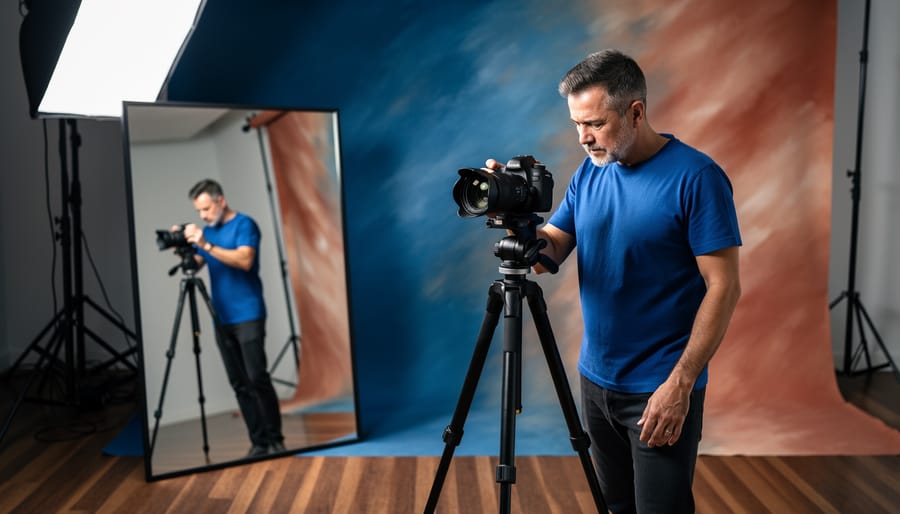
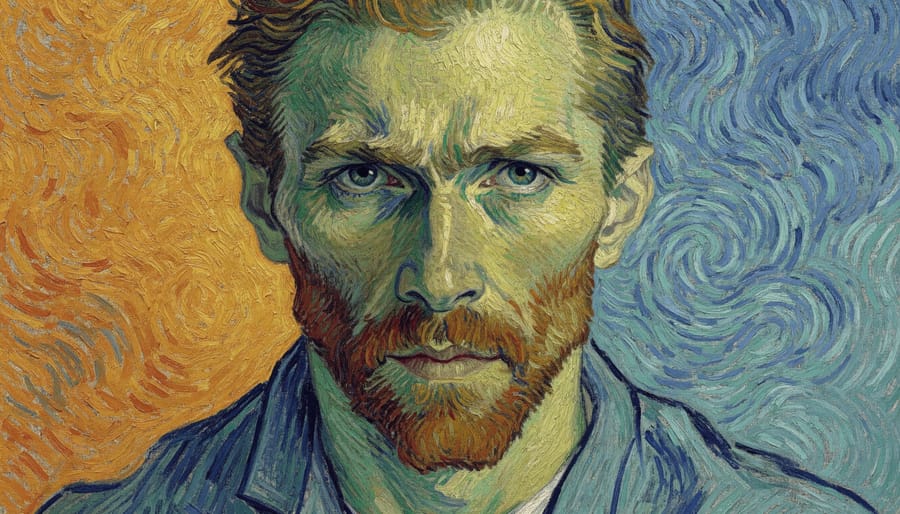
Study Van Gogh’s self-portraits with a photographer’s eye, examining how he used bold, directional brushstrokes to create visual movement that guides the viewer through the frame—the same principle applies when you position leading lines and compositional elements in your self-portraits. Notice how he placed himself off-center in many works, creating dynamic tension rather than static symmetry, a technique you can implement by using the rule of thirds when setting up your camera.
Van Gogh created over 35 self-portraits in just five years, not from vanity but from necessity—he couldn’t afford models, and his own face became his laboratory for experimentation. This prolific practice reveals photography’s most overlooked truth: repetition builds mastery. Each time he returned to his reflection, he explored different emotional states, lighting conditions, and color palettes. For photographers, this translates to treating self-portraiture as an ongoing project rather than occasional experimentation.
The raw emotional honesty in Van Gogh’s work came from his willingness to capture himself during both stability and crisis, never hiding behind artifice or idealization. He painted his gaunt face, his troubled eyes, his asymmetrical features with unflinching directness. Modern photographers can adopt this authenticity by moving beyond the polished, curated self-image that dominates social media. Set up your camera during moments of genuine emotion—fatigue after a long shoot, joy after a creative breakthrough, uncertainty when facing a new challenge.
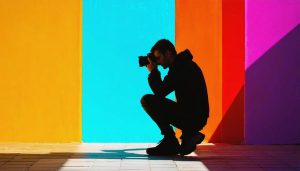
His revolutionary use of complementary colors—vibrant oranges against deep blues, greens against reds—created visual intensity that made his portraits unforgettable. Translate this to photography by deliberately controlling your color palette through wardrobe choices, backdrop selection, and post-processing decisions that create similar chromatic tension and visual impact.
Why Van Gogh Painted Himself So Many Times (And What It Means for Photographers)
The Practical Side: Using Yourself as a Model
Van Gogh didn’t have willing models readily available in Arles or Saint-Rémy, so he turned his attention inward. But this practical limitation became something more valuable: a laboratory for experimentation. His self-portraits served as testing grounds for bold color combinations, expressive brushwork techniques, and compositional ideas he’d later apply to other subjects.
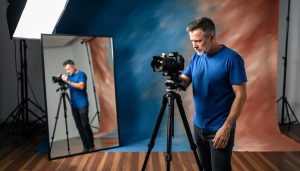
As photographers, we face a similar opportunity. Your own face becomes the perfect subject for mastering new lighting setups without the pressure of a paid session or the guilt of wasting someone else’s time. Want to experiment with dramatic Rembrandt lighting or test that new modifier you just purchased? Set up your camera on a timer and spend an hour learning exactly how different angles and intensities affect facial structure.
This approach extends beyond lighting. Self-portraits let you understand your camera’s capabilities intimately. Try pushing your lens to its widest aperture to see how shallow depth of field renders facial features. Experiment with unconventional white balance settings or test film stocks you’ve been curious about. When you’re both photographer and subject, you can iterate endlessly without apology.
Van Gogh’s technical growth across his self-portraits is remarkable—watch his brushwork evolve from careful rendering to confident, expressive marks. Similarly, your self-portrait practice creates a visual record of your technical development. That awkward lighting from six months ago? It proves you’ve grown. Consider documenting your experiments, even the failures. They’re evidence of the learning process every accomplished photographer travels.
The Emotional Side: Identity Through Repetition
Van Gogh created over thirty self-portraits during his brief artistic career, and each one tells a different story. When you look at them chronologically, you’re witnessing more than technical evolution—you’re seeing a man grappling with identity, illness, and isolation. His Paris self-portraits show experimentation with Impressionist techniques and brighter palettes. By the time he reached Arles, his self-portraits became more intense, more searching. The famous bandaged ear portrait isn’t just documentation of an incident; it’s a raw confrontation with suffering and identity in crisis.
This practice of repetitive self-documentation resonates powerfully with contemporary photographers exploring mental health and personal transformation. Photographer Edward Honaker’s black-and-white series on depression uses visual metaphors—blurred faces, obscured identities—to externalize internal struggle, much like Van Gogh’s turbulent brushwork expressed psychological states. Similarly, JJ Levine’s long-term project documenting queer and trans identities through repeated portraiture creates a visual archive of transformation and self-discovery.
The lesson here isn’t to mimic Van Gogh’s aesthetic, but to embrace repetition as revelation. When you photograph yourself regularly—whether daily, weekly, or during specific life phases—you create a visual diary that captures nuances invisible in single images. Changes in expression, posture, environment, and even lighting choices become meaningful data points in your personal narrative. This systematic approach transforms self-portraiture from narcissism into genuine self-inquiry, allowing both photographer and viewer to witness evolution that gradual change might otherwise obscure.
Three Technical Lessons from Van Gogh’s Self-Portrait Approach
Bold Color Choices and Mood Creation
Van Gogh’s self-portraits weren’t about capturing what he literally looked like. Instead, he used color as an emotional language, painting his face in greens and oranges, surrounding himself with electric blues and swirling yellows that reflected his inner turbulence. This approach to color theory in photography offers photographers a powerful framework for creating psychologically charged self-portraits.
Start experimenting with unconventional color grading in post-processing. In Lightroom or Capture One, try shifting skin tones toward cooler greens or warmer magentas to create unease or passion. The HSL panel becomes your palette: select oranges and shift their hue toward yellow for an anxious quality, or push blues toward cyan for an otherworldly feel. Don’t aim for natural; aim for expressive.
During the shoot, colored gels transform your lighting setup. Place a CTB gel on your key light for a haunting, melancholic blue cast, then add an orange-gelled rim light for contrast and tension. A simple two-light setup with a Canon R6 Mark II at ISO 400, f/2.8, and 1/125s gives you enough flexibility to balance these dramatic color shifts while maintaining detail.
Background choices matter enormously. Van Gogh’s swirling, vibrant backdrops weren’t decorative but integral to the emotional narrative. Photograph yourself against richly colored fabrics, painted canvases, or use practical colored lights in the background. A vibrant yellow backdrop conveys energy or instability, while deep purples suggest introspection. Remember, you’re not documenting appearance but revealing emotional truth through deliberate color decisions.
Direct Gaze and Viewer Connection
One of the most striking elements in Van Gogh’s self-portraits is his unflinching gaze. He didn’t look away or soften his expression for comfort. Instead, he stared directly at his reflection with an intensity that still arrests viewers more than a century later. This direct eye contact creates an immediate psychological connection, transforming what could be a simple image into an intimate confrontation with another human being.
For photographers attempting self-portraits, this principle translates directly to your relationship with the camera lens. The challenge lies in maintaining that authentic connection when you’re simultaneously subject and photographer. When using a self-timer, take a moment before the shutter fires to truly focus on the lens as if it were another person’s eyes. This isn’t about posing but about genuine presence. Set your timer for 10 seconds rather than 2, giving yourself time to settle into the moment and find that authentic gaze Van Gogh mastered.
Remote triggers offer even more control, allowing you to choose the precise instant when your expression feels right. Many photographers find that taking dozens of frames while maintaining continuous eye contact yields one or two images with real emotional resonance. The rest might be technically perfect but lack that spark of genuine connection.
Your focal length choice profoundly affects this intimacy. Van Gogh worked close to his canvas, creating portraits that feel immediate and personal. In photographic terms, an 85mm lens on a full-frame camera approximates natural perspective without distortion, while a 50mm creates slightly more environmental context. Wider lenses can introduce spatial distance even when physically closer, potentially diluting that intense one-on-one feeling. Experiment with different focal lengths while maintaining consistent eye contact to discover which best captures your intended emotional proximity. The goal isn’t technical perfection but honest human connection.
Texture and Surface: The Physical Presence of Art
Van Gogh’s self-portraits carry a physical weight that photographs often lack. His thick impasto technique, where paint is applied so heavily it creates three-dimensional texture, makes the artist’s presence almost tangible. Each visible brushstroke becomes evidence of Van Gogh’s hand moving across the canvas, transforming paint into emotional record.
For photographers, this physical presence presents an intriguing challenge. How do we add tactile quality to our inherently flat medium? One approach involves embracing visible grain. Film photographers might push their ISO or choose grainier film stocks, while digital shooters can thoughtfully add texture in post-processing rather than obsessively eliminating it. This isn’t about degrading image quality; it’s about acknowledging the medium’s fingerprint.
Printing techniques offer another avenue. Photographers like Sally Mann have explored alternative photographic processes like wet plate collodion, where imperfections, streaks, and irregular coating become part of the image’s character. Even with modern digital printing, choosing textured papers or experimenting with matte finishes versus glossy creates different physical experiences.
Contemporary photographer Lyle Owerko intentionally incorporates visible post-processing marks in his work, creating digital equivalents to brushstrokes. The key is intentionality. Van Gogh’s impasto wasn’t carelessness but deliberate technique. Similarly, adding texture to your self-portraits should be purposeful, reinforcing your artistic vision rather than masking technical shortcomings. Your hand, your choices, your presence should be visible in the final work.
Setting Up Your Own Self-Portrait Practice: Camera Techniques Van Gogh Would Have Loved
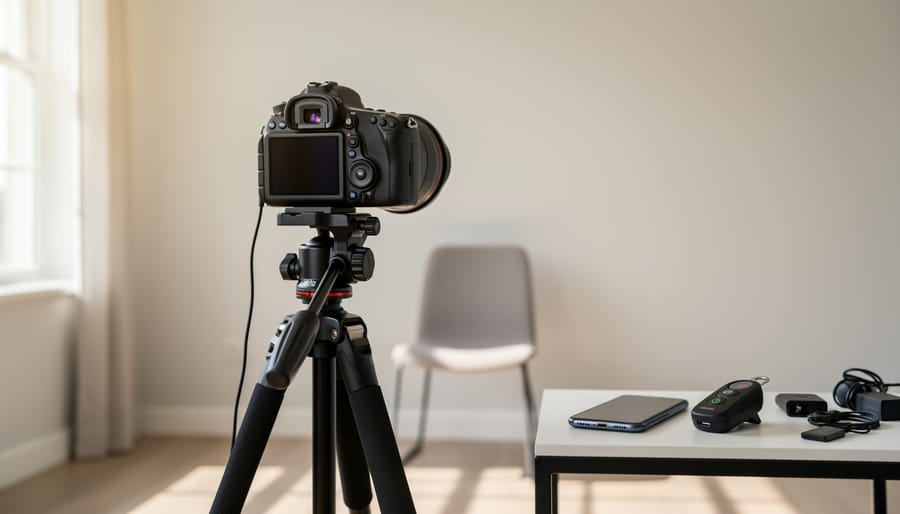
Essential Gear and Setup for Solo Shooting
Creating self-portraits without an assistant requires some essential tools, but you don’t need to break the bank to get started. The foundation of solo shooting is a sturdy tripod. Look for one that extends to at least eye level and offers a ball head for easy adjustments. Budget-conscious photographers can start with an AmazonBasics tripod for under $30, while professionals might invest in a Manfrotto or Really Right Stuff model for superior stability.
Remote triggers are your next priority. Wireless remotes give you freedom to move naturally during your session, unlike wired options that tether you to the camera. For about $15, you can find basic infrared remotes, though radio frequency models work better at longer distances and don’t require line-of-sight. If you’re shooting multiple frames to nail that perfect expression, an intervalometer becomes invaluable. It automatically fires the shutter at set intervals, letting you experiment with different poses without constantly running back to press the button.
Smartphone apps have revolutionized self-portraiture. Many cameras now offer Wi-Fi connectivity, allowing you to control settings and trigger the shutter from your phone. You’ll see a live preview of your composition, making adjustments far easier than guessing and checking.
For precise focusing when you’re both photographer and subject, use a stand-in object at your intended position. A lamp, chair, or even a broom works perfectly. Focus on this substitute, then switch to manual focus to lock it in. Tethering to a laptop provides real-time feedback on composition and lighting, though it limits mobility.
Lighting Yourself Like a Painting
Van Gogh painted most of his self-portraits in modest studios with limited equipment, relying primarily on natural window light. This constraint actually became his signature. The strong directional lighting created dramatic shadows that revealed form and character, exactly what you can achieve in your own space.
Start with a single light source positioned 45 degrees to your side and slightly elevated. Window light during morning or late afternoon works beautifully, offering that soft yet directional quality visible in Van Gogh’s work. Notice how his self-portraits often show one side of the face illuminated while the other falls into shadow, creating depth and dimensionality. You can replicate this by positioning yourself perpendicular to a north-facing window or using a single lamp with a diffusion panel.
For artificial lighting, a single speedlight or continuous LED positioned in the same 45-degree angle mimics this effect. The key is mastering dramatic lighting through simplicity rather than complexity. Van Gogh didn’t have multiple light sources, and you don’t need them either.
Add a white reflector opposite your main light to gently fill shadows without eliminating them entirely. Van Gogh’s portraits maintain rich shadows that define facial structure, so avoid over-filling. A simple white foam board propped at arm’s length does the job perfectly. Experiment with reflector distance: closer softens shadows, further away preserves that painterly contrast. This single-source-plus-reflector setup recreates the exact lighting conditions Van Gogh worked within, proving that limitations often breed creativity rather than hinder it.
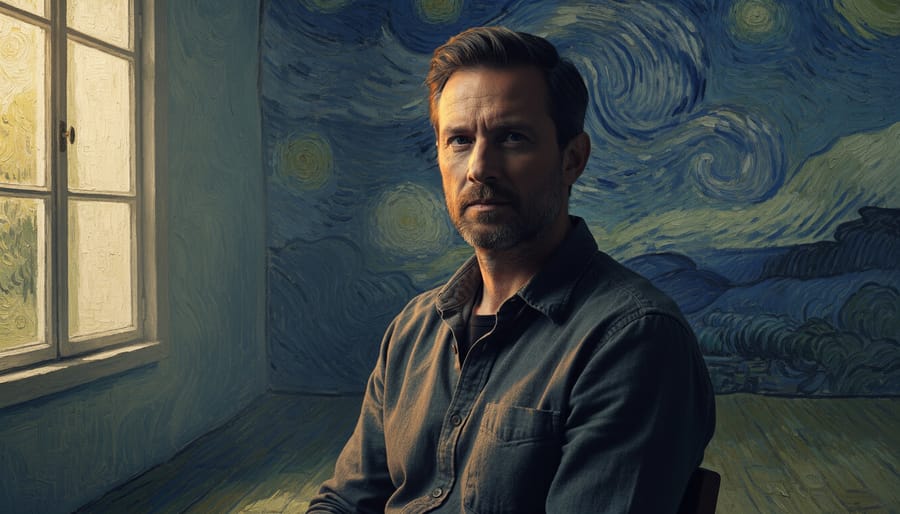
Creating a Series vs. One-Off Images
Van Gogh created over 35 self-portraits in just five years, demonstrating that self-portraiture gains power through repetition and evolution. Rather than shooting isolated images, consider developing your creative practice around sustained exploration. A series allows you to establish consistent elements while documenting genuine change.
Start with a 30-day challenge using identical framing, lighting setup, and background. This consistency reveals subtle shifts in mood, expression, and physical appearance that single images miss. One photographer discovered this approach captured her recovery journey more authentically than sporadic self-portraits ever could.
Seasonal series work beautifully for longer-term projects. Photograph yourself in the same location during each season over multiple years. The unchanging setting becomes a canvas that highlights your transformation, much like Van Gogh’s repeated motifs revealed his artistic evolution.
For ambitious projects, commit to weekly or monthly self-portraits over several years. These extended series create visual diaries that capture life transitions impossible to predict when starting. The discipline mirrors Van Gogh’s relentless practice while building a body of work with genuine narrative depth and emotional resonance.
Contemporary Photographers Channeling Van Gogh’s Self-Portrait Spirit
Van Gogh’s unflinching self-examination continues to inspire contemporary photographers who use their cameras as tools for psychological exploration and visual honesty. These modern artists channel that same introspective intensity, proving that the spirit of Van Gogh’s self-portraits transcends medium and era.
Cristina Nuñez, a Barcelona-based photographer, creates raw, intimate self-portraits that mirror Van Gogh’s emotional transparency. Her ongoing project “The Self-Portrait Experience” spans decades of photographing herself in vulnerable, unguarded moments. Like Van Gogh, who painted himself during periods of mental anguish, Nuñez uses her practice as both therapy and documentation. Her images often feature direct eye contact with the camera, creating that same confrontational intimacy found in Van Gogh’s painted gaze. What makes her work particularly resonant is her refusal to beautify or hide—wrinkles, scars, and emotional exhaustion become part of the narrative, much like Van Gogh’s bandaged ear or gaunt features.
Tomasz Gudzowaty takes a different approach, using conceptual self-portraiture to explore identity and mortality. This award-winning Polish photographer often places himself in surreal, psychologically charged environments. His self-portraits employ dramatic lighting and symbolic props that recall Van Gogh’s bold color choices and meaningful background elements. Where Van Gogh used swirling brushstrokes to convey inner turbulence, Gudzowaty uses visual metaphor and staged scenarios to externalize internal states.
For those just beginning their self-portrait journey, look to Vivian Maier, whose posthumously discovered street photography included numerous self-portraits captured in mirrors and reflective surfaces. Though not exclusively a self-portraitist, Maier’s work demonstrates how self-documentation can become a lifelong practice of observation and honesty. Her shadow portraits and reflected images show that meaningful self-portraiture doesn’t require elaborate setups—just consistent, authentic engagement with your own image.
Each photographer proves that Van Gogh’s legacy isn’t about mimicking Post-Impressionist aesthetics, but about embracing self-portraiture as serious psychological inquiry. They demonstrate that whether you’re shooting with a smartphone or professional equipment, conceptual staging or documentary candor, what matters is bringing Van Gogh’s commitment to truth-telling into your own photographic practice.
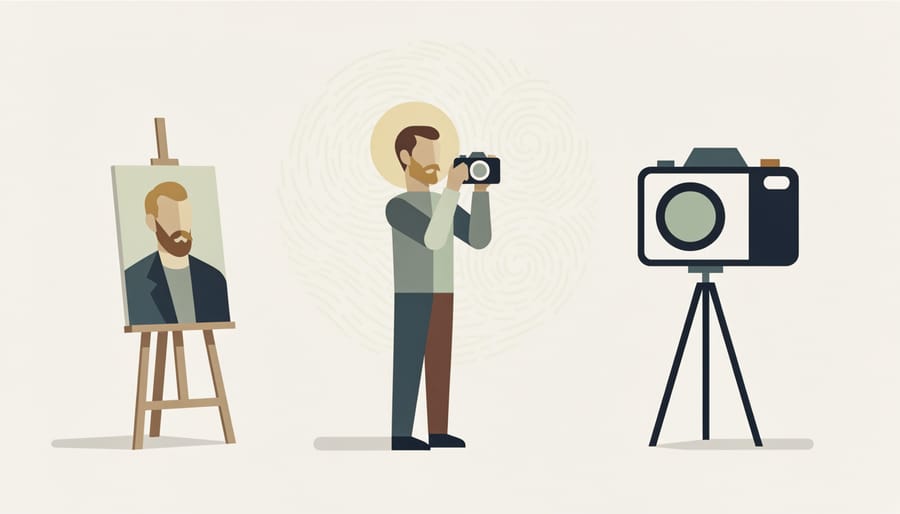
The Vulnerability Question: Why Self-Portraiture Still Matters
We live in an era saturated with self-images. The average smartphone contains hundreds of selfies, each one carefully angled, filtered, and curated for public consumption. Yet somehow, Van Gogh’s paint-smudged face staring back at us from 1889 feels more real, more vulnerable, more human than most of what fills our camera rolls today.
The difference lies not in the medium but in the intention. Social media self-presentation asks, “How do I want to be seen?” Artistic self-examination asks something far more challenging: “Who am I, really?” Van Gogh’s self-portraits weren’t about projecting an idealized version of himself. During his most turbulent periods, including after severing his own ear, he picked up his brush and looked unflinchingly at what was there. These weren’t glamour shots. They were investigations.
This distinction matters profoundly for photography as artistic expression. When we turn the camera on ourselves with genuine curiosity rather than performance, something shifts. Self-portraiture becomes therapeutic, a visual journal that captures not just how we looked but how we felt, what we struggled with, and who we were becoming.
Consider this: Van Gogh created over thirty self-portraits, many during periods when he couldn’t afford models. Financial constraint became creative opportunity. He documented his aging face, his changing mental states, his evolving artistic vision. Each portrait was practice, yes, but also confession.
For photographers today, this offers a liberating model. Your self-portraits don’t need to be flattering or Instagram-worthy. They can be raw explorations of identity, experiments with light and shadow that reveal rather than conceal. They can document your journey through difficult seasons, capturing authentic emotion that photographing others simply cannot access. The vulnerability required to truly see yourself, and then share that vision, is precisely what transforms a selfie into art.
Van Gogh created over thirty self-portraits not because he was vain, but because he couldn’t afford models and desperately needed to understand himself. That raw honesty, that willingness to stand unflinchingly before his own reflection, transformed what could have been simple practice exercises into some of art history’s most powerful images. The same principle applies when you turn your camera on yourself today.
Self-portraiture isn’t about achieving Instagram perfection or mastering complicated lighting setups on the first try. It’s about showing up repeatedly with your camera, just as Van Gogh showed up with his canvas, and allowing yourself to be genuinely seen. Some sessions will feel awkward. Some images will miss the mark entirely. That’s not failure; that’s the process.
What makes this practice invaluable isn’t the portfolio pieces you’ll eventually create, though those will come. It’s what happens along the way. When you work through the discomfort of seeing yourself honestly, when you experiment with light and shadow on your own face, when you discover which angles and expressions feel authentically you, something shifts. You develop empathy for every subject who’s ever stood before your lens feeling vulnerable or self-conscious.
So pick up your camera this week. Set it on a tripod, use a timer, and create one self-portrait. Don’t overthink it. Van Gogh didn’t wait for ideal conditions; he painted himself by lamplight in cramped rooms. Your artistic voice grows stronger not through perfection, but through honest, repeated practice. Start examining yourself, and watch how it transforms everything else you photograph.
 By
By