 By
By 
University photography isn’t just about capturing campus events and student portraits anymore. Today’s university photographers face unique challenges that set them apart from commercial or editorial shooters: navigating complex institutional hierarchies, balancing diverse stakeholder expectations, maintaining consistent visual branding across hundreds of annual projects, and justifying photography budgets to administrators who may not understand the medium’s value.
The University Photographers Association of America addresses these specific pain points through a collaborative network that transforms isolated campus photographers into a connected professional community. Founded when university photographers recognized their shared challenges required collective solutions, UPAA provides members with proven workflows for everything from athletic event coverage to research documentation, alongside direct access to peers who’ve already solved the problems you’re currently facing.
Consider the practical value: when you’re tasked with photographing a Nobel laureate’s visit with two hours’ notice, UPAA’s member forums connect you instantly with photographers who’ve handled identical situations. When your administration questions your equipment requests, you’ll access salary surveys and benchmark data showing how peer institutions allocate photography resources. When emerging technologies like 360-degree campus tours become institutional priorities, you’ll find step-by-step implementation guides from members who’ve already navigated those waters.
This collaborative approach extends beyond problem-solving into career development, offering annual conferences where portfolio reviews happen alongside technical workshops, and mentorship programs connecting emerging photographers with seasoned professionals who understand the unique institutional landscape you navigate daily.
What Makes UPAA Different from Other Photography Organizations
While many photography organizations cast a wide net, the University Photographers Association of America occupies a distinctly specialized space in the professional photography landscape. Founded in 1961, UPAA emerged from a simple recognition: photographers working in higher education face unique challenges that general photography associations simply don’t address.
Think about it this way. A wedding photographer’s daily concerns revolve around client management, booking systems, and perfecting portraiture techniques. A commercial photographer focuses on product shots, advertising campaigns, and corporate clients. But a university photographer? They’re documenting everything from groundbreaking scientific research to athletic events, commencement ceremonies to campus architecture—often all in the same week.
UPAA was created specifically to support these multi-talented professionals who serve as visual historians for their institutions. The organization’s mission centers on advancing the profession of higher education photography through collaboration, education, and advocacy. This isn’t about general photography trends or commercial opportunities; it’s about understanding the nuances of telling a university’s story through imagery.
What truly sets UPAA apart is its laser focus on the higher education environment. Members share experiences navigating university bureaucracies, managing relationships with diverse campus stakeholders, and balancing administrative demands with creative work. They exchange practical advice on challenges unique to this sector—like photographing sensitive research facilities, maintaining consistent visual branding across sprawling campuses, or adapting to shrinking departmental budgets while expectations continue growing.
Compare this to organizations like the Professional Photographers of America or the American Society of Media Photographers, which serve broader markets and diverse photography specialties. These groups offer valuable resources, but they can’t provide the targeted, institution-specific guidance that UPAA delivers. When a university photographer needs to understand best practices for documenting a medical school procedure or creating compelling recruitment materials that resonate with prospective students, UPAA’s specialized community offers peer-to-peer insights that general photography forums simply cannot match.
This focused approach makes UPAA an invaluable resource for anyone serious about excelling in higher education photography.
The Power of Platform-Based Collaboration in University Photography
Real-World Challenges University Photographers Face Daily
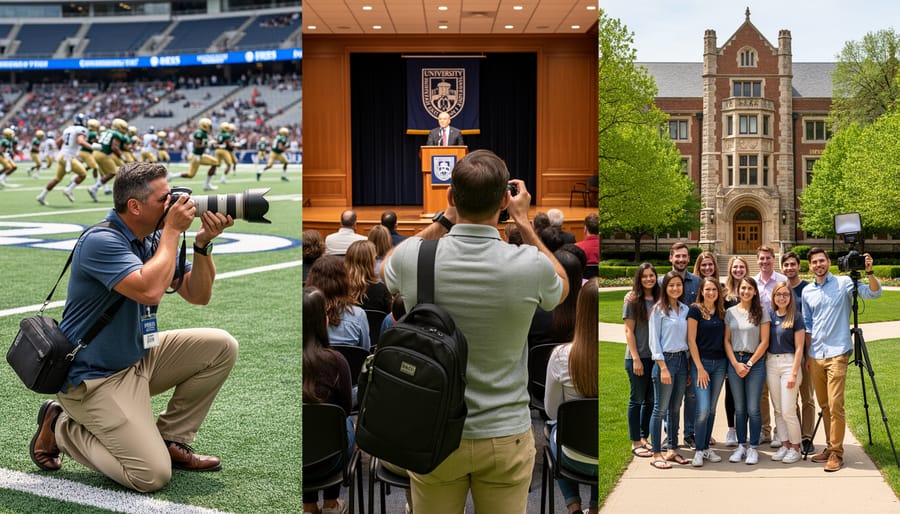
University photographers juggle an impressive array of responsibilities that would challenge even the most organized professional. Unlike commercial photographers who might specialize in one niche, these visual storytellers must master everything from fast-paced sports action to formal portrait sessions, often within the same week.
One of the most persistent challenges is working in isolation. Many institutions employ just one or two photographers to cover entire campuses, meaning there’s rarely a colleague down the hall to troubleshoot equipment issues or discuss creative approaches. This isolation extends to workflow development—photographers frequently spend valuable time building systems from scratch that colleagues at other universities have already perfected.
Navigating institutional bureaucracy adds another layer of complexity. Simple decisions about equipment purchases can require multiple approvals through procurement departments unfamiliar with photography needs. Budget cycles don’t always align with urgent equipment failures, and explaining why a particular lens costs several thousand dollars to administrators accustomed to office supply pricing becomes an exhausting exercise.
The workload diversity presents its own pressures. Monday might involve documenting delicate laboratory research requiring macro techniques and controlled lighting, Tuesday could demand courtside positions for basketball championship coverage, Wednesday brings headshots for 50 faculty members, and Friday requires event photography at the president’s gala. Each situation requires different gear, different mindsets, and different post-processing workflows.
These photographers also face constant deadline pressure, often delivering images within hours for social media and publications while maintaining archival standards. Without a support network, these daily challenges can feel overwhelming and lead to burnout.
Why Going Solo No Longer Works
University photography has evolved dramatically over the past decade, transforming from a straightforward documentation role into a multifaceted content creation powerhouse. Today’s campus photographers juggle an overwhelming array of demands that would have seemed impossible just a few years ago. A single athletic event now requires game-day action shots, behind-the-scenes video clips for Instagram Stories, vertical format content for TikTok, and immediate uploads for real-time social media engagement.
This complexity extends across all campus activities. Admissions offices need authentic student life imagery within hours, not days. Marketing departments require coordinated visual campaigns across multiple platforms. Alumni relations wants professional event coverage that doubles as fundraising material. Meanwhile, the technical standards keep rising—4K video is now baseline, drone footage is increasingly expected, and photo quality must work equally well on billboards and smartphone screens.
Working alone in this environment isn’t just difficult; it’s increasingly unsustainable. When a photographer faces equipment failure during a critical presidential visit or needs specialized lighting expertise for a high-stakes donor event, having a network matters. The photography group challenges that seemed manageable in simpler times now require coordinated teams who can share knowledge, backup equipment, and workload distribution to meet modern expectations.
How UPAA’s Collaborative Tools Actually Work

Member Forums and Knowledge Sharing
UPAA’s member forums serve as a vital lifeline for photographers tackling complex campus assignments. When a member faces an unexpected challenge—whether it’s photographing a darkened auditorium during commencement or capturing fast-moving athletes in difficult lighting—they can post their question and typically receive practical responses within hours from colleagues who’ve solved similar problems.
These discussion platforms function as real-time problem-solving hubs. Members regularly share equipment recommendations based on actual university scenarios, such as which lenses work best for cramped press box environments or how to balance ambient and flash lighting during indoor ceremonies. Rather than relying on generic photography advice, UPAA members benefit from context-specific guidance tailored to higher education settings.
The forums also facilitate online critique and feedback for challenging assignments. A photographer unsure about their approach to documenting a sensitive campus event can share sample images and receive constructive input from experienced peers. This collaborative environment accelerates skill development and helps members avoid common pitfalls. Many photographers report that the forums’ searchable archives have become an invaluable reference library, allowing them to find solutions to technical challenges that might otherwise require expensive trial-and-error experimentation.
Resource Libraries That Save Time and Money
UPAA members gain immediate access to practical resources that address everyday challenges faced by university photographers. The association maintains an extensive library of contract templates specifically tailored for higher education environments, including model releases adapted for student athletes, event photography agreements for campus functions, and licensing terms appropriate for institutional use. These documents save members countless hours of legal consultation and provide tested frameworks that protect both photographer and institution.
The pricing guides prove particularly valuable for photographers navigating budget conversations with university departments. Rather than guessing at appropriate rates for commencement coverage or athletic events, members reference comprehensive benchmarks drawn from real university photography programs nationwide. One community college photographer shared how the pricing guide helped her justify a 30% rate increase by demonstrating her fees were actually below regional averages.
Workflow documentation covers everything from equipment management systems to digital asset organization strategies used by major university photography departments. Members frequently cite these resources when implementing new processes, adapting proven systems rather than reinventing solutions. The template collection also includes shot lists for common university events, social media content calendars, and client communication templates that maintain professional consistency while reducing administrative time.
Mentorship Connections That Accelerate Growth
The University Photographers Association of America recognizes that transitioning into university photography comes with unique challenges, from navigating administrative protocols to mastering fast-paced event coverage. That’s why the association has developed expert mentorship programs that connect seasoned professionals with newcomers to the field.
Through structured initiatives like the UPAA Mentor Match program, members can request pairing with experienced photographers who understand the specific demands of higher education environments. These mentorships typically run for six months and include monthly check-ins, portfolio reviews, and practical guidance on everything from working with athletic departments to photographing commencement ceremonies effectively.
Beyond formal programs, the association facilitates organic connections through regional meetups, annual symposiums, and an active online community where questions receive responses from veterans who’ve solved similar problems. One new member shared how connecting with a mentor helped them develop efficient workflows for same-day turnaround during orientation week, a common university photography challenge that requires both technical skill and strategic planning.
Success Stories: Collaborative Projects That Wouldn’t Exist Otherwise
When the University of Michigan needed aerial coverage of their new engineering complex but their drone pilot was on medical leave, they didn’t scramble to hire an expensive contractor. Instead, they reached out through UPAA’s network. Within hours, a photographer from nearby Eastern Michigan University offered to help, having just completed a similar project on their campus. This simple exchange saved both universities time and money while strengthening their professional relationship.
This kind of practical collaboration happens regularly within UPAA, transforming how universities approach photography challenges. Take the 2023 Solar Eclipse documentation project, where sixteen university photographers across the path of totality coordinated their coverage through UPAA channels. Each photographer captured unique perspectives from their institution, then shared high-resolution images with the entire group. The result was a comprehensive visual archive that individual universities could never have produced alone, complete with diverse geographic perspectives and scientific documentation value.
Shared equipment arrangements have also flourished through these connections. When Hurricane Ian damaged Florida Gulf Coast University’s photography equipment, UPAA members from unaffected institutions immediately offered loaner gear. Several universities shipped backup cameras and lighting equipment, keeping their colleague operational during the critical recovery documentation period. This wasn’t charity but reciprocal support, understanding that any institution might face similar emergencies.
The association has also sparked innovative collaborative photography projects that benefit entire regions. A consortium of ten historically Black colleges and universities used UPAA connections to coordinate a traveling exhibition showcasing campus life across their institutions. Photographers shared shooting schedules, technical specifications, and even visited each other’s campuses to maintain visual consistency. The exhibition toured nationally, providing exposure no single institution could have achieved independently.
Problem-solving extends beyond specific projects. When several West Coast universities struggled with new NCAA media credential requirements, UPAA facilitators organized a working group that developed standardized templates and procedures. This collective approach saved countless hours of duplicated effort and helped smaller institutions navigate complex regulations they might have struggled with alone.
These success stories demonstrate UPAA’s fundamental value: creating opportunities and solutions that simply wouldn’t exist in isolation, turning individual photographers into a powerful collaborative network.

Getting Started with UPAA’s Collaborative Ecosystem
Who Benefits Most from UPAA Membership
UPAA membership delivers distinct advantages depending on where you are in your university photography career. New hires find immediate value in the association’s mentorship resources and technical training sessions. If you’ve just landed your first campus photography position, connecting with seasoned professionals who’ve navigated similar challenges—from managing athletic event coverage to establishing relationships with university communications departments—can shorten your learning curve considerably. The annual conference workshops provide hands-on training with equipment and techniques specific to higher education photography.
Solo practitioners working at smaller institutions benefit enormously from the collaborative network. When you’re the only photographer on campus, UPAA becomes your virtual department. Members regularly share solutions for common obstacles like inconsistent lighting in historic buildings or creating compelling images during repetitive ceremonial events. The online forums and regional meetups offer that essential professional community you might otherwise lack.
Veteran photographers seeking fresh inspiration find UPAA particularly valuable for staying current with emerging technologies and creative approaches. Long-time members often cite the association’s case study presentations and peer critiques as catalysts for reimagining their work. When you’ve photographed countless commencement ceremonies, learning how colleagues at other universities are experimenting with drone photography or immersive 360-degree campus tours can reignite your creative energy and demonstrate new possibilities to your administration.
Your First 30 Days: Making Connections That Matter
Your first month sets the foundation for meaningful professional relationships. Start by completing your UPAA member profile with your specialties, whether that’s sports photography, campus events, or portraits. This helps colleagues with similar interests find you quickly.
Within week one, introduce yourself on the member forum by sharing a recent project challenge you’ve faced. For example, one new member posted about struggling with low-light indoor graduation ceremonies and received ten actionable responses within 48 hours, including specific equipment recommendations and exposure techniques that immediately improved her next shoot.
By week two, join at least one special interest group aligned with your focus area. These smaller communities organize virtual photography meetups where you can share work and troubleshoot technical challenges in real time. Many groups also maintain shared resource libraries with location releases and workflow templates that save hours of administrative work.
During weeks three and four, reach out directly to three members whose work inspires you. A simple message acknowledging their portfolio and asking one specific question typically leads to genuine conversations. One photographer credits his now-regular equipment-sharing arrangement with a colleague across the state to this exact approach during his first month.
The Future of University Photography Collaboration
The landscape of university photography is transforming rapidly, and UPAA is positioning itself at the forefront of these changes. As institutions increasingly demand visual content for digital platforms, social media, and virtual experiences, the association recognizes that tomorrow’s university photographers need more than traditional skills—they need collaborative frameworks that keep pace with evolving technology and storytelling methods.
UPAA is actively developing enhanced digital collaboration tools that go beyond simple networking. The association is piloting cloud-based critique platforms where members can receive real-time feedback on their work from peers across the country. Imagine uploading your latest campus event coverage and getting insights from photographers at institutions similar to yours, learning what techniques resonate with different audiences. This kind of peer-to-peer learning creates a rising tide that lifts all boats.
Emerging technologies like artificial intelligence for image editing and virtual reality campus tours present both opportunities and challenges. UPAA is creating specialized working groups to help members navigate these innovations together, ensuring no one gets left behind as the field evolves. Members who engage actively in these initiatives gain early access to training resources and beta-testing opportunities.
The future also holds expanded partnerships with universities seeking to professionalize their visual communications departments. Active UPAA members position themselves as industry leaders, often becoming the go-to consultants when institutions invest in upgrading their photography programs. By participating now, you’re not just joining an association—you’re helping shape the future of university photography itself.
Working in isolation might feel comfortable, but it’s rarely the path to growth. University photographers who operate alone miss crucial opportunities to refine their craft, stay current with industry shifts, and build the professional networks that sustain long-term careers. When you’re the only photographer on campus, every challenge becomes yours alone to solve, every technique something you must discover independently, and every career decision made without the benefit of collective wisdom.
The University Photographers Association of America exists specifically to break down these barriers. Through its collaborative platform, you gain immediate access to photographers facing similar challenges at institutions across the country. Whether you’re troubleshooting lighting in historic buildings, navigating administrative expectations, or exploring sustainable workflow improvements, you’re tapping into a community that’s already addressed these issues.
Real-world evidence backs this up. Members consistently report tangible improvements in their work quality, more efficient production methods, and greater job satisfaction after joining. The combination of technical workshops, peer critiques, and informal networking creates an environment where professional development happens naturally rather than feeling forced.
If you’re ready to move beyond isolation and invest in your career sustainability, exploring UPAA membership is the logical next step. Visit their website to review current membership benefits, upcoming conference details, and sample resources. The decision isn’t whether you need professional community—it’s whether you’re willing to take advantage of one specifically designed for your unique role.





 By
By