 By
By 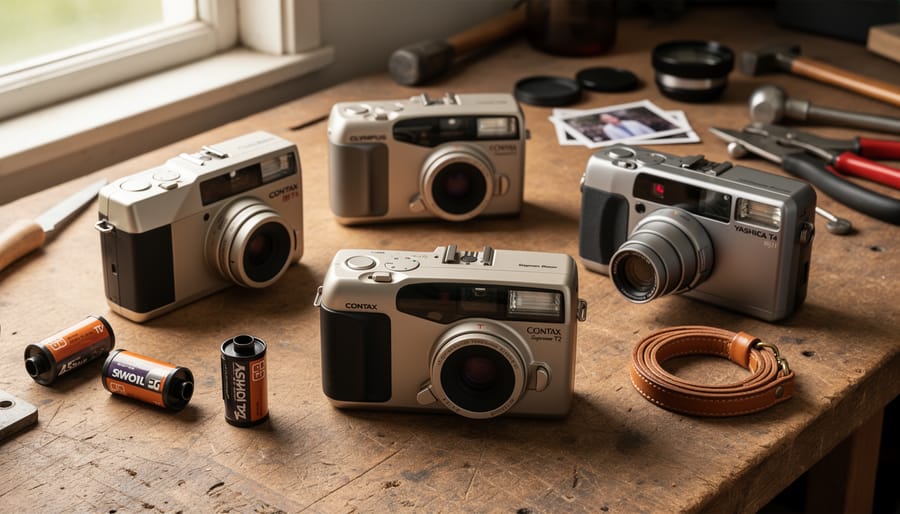
The plastic fantastic cameras of the 1990s represent a curious paradox in photography history. These point-and-shoots, once dismissed as disposable consumer goods, now command serious attention from collectors and working photographers alike. A Yashica T4 that sold for $50 at a garage sale in 2005 might fetch $600 today, while the Canon Sure Shot Supreme remains a practical choice for street photographers who want film’s aesthetic without manual focus hassles.
What makes these cameras special isn’t nostalgia alone. The 1990s marked the peak of film camera engineering before digital technology took over. Manufacturers like Olympus, Contax, and Ricoh poured decades of optical expertise into compact bodies, creating sharp lenses rivaled only by equipment costing ten times more. The Contax T2’s Carl Zeiss lens delivers image quality that still impresses in 2024, while the Olympus Mju II combines weather resistance with genuine pocketability.
Understanding which 90s cameras deserve your money requires looking beyond hype. Some models gained cult status through celebrity endorsements or limited availability, inflating prices beyond their actual capabilities. Others remain undervalued workhorses offering excellent image quality at reasonable costs. Whether you’re building a collection, seeking an everyday film camera, or investing in photographic equipment, knowing the difference between genuine quality and manufactured scarcity will save you money and disappointment.
This guide cuts through the marketing myths to reveal what actually matters in 90s vintage cameras.
What Makes 90s Cameras Different From Other Vintage Gear

The Last Golden Age of Film Camera Engineering
The 1990s represented the culmination of over a century of mechanical and optical refinement in camera design. By this decade, manufacturers had essentially perfected the art of building film cameras, creating machines that balanced sophisticated electronics with robust mechanical engineering. The result? Cameras that were pushing technological boundaries when new and remain remarkably reliable workhorses three decades later.
Consider the build quality: manufacturers like Canon, Nikon, and Minolta were using metal chassis, precision-engineered shutters rated for 100,000+ actuations, and weather-sealing that genuinely worked. These weren’t marketing gimmicks. Many professional photographers today still use their 90s bodies for paid work because they simply refuse to quit. The Nikon F5, released in 1996, exemplified this philosophy with its titanium-hybrid body and legendary durability.
What makes these Japanese vintage cameras particularly special is that manufacturers had decades of experience solving mechanical problems. Sticky aperture blades, light leaks, and mirror damping issues that plagued earlier generations had been engineered away. Meanwhile, electronics were mature enough to be reliable but simple enough to be serviceable.
The 90s also brought us genuinely useful features: spot metering, multiple autofocus points, film DX coding, and advanced flash TTL systems that actually worked consistently. These weren’t experimental technologies—they were refined, tested, and production-ready. That’s why a well-maintained 90s camera body often functions as flawlessly today as it did when it left the factory.
Affordable Access to Professional Features
One of the most compelling reasons to explore 90s cameras today is the incredible value proposition they offer. During this decade, technology that was once exclusive to flagship professional bodies trickled down to mid-range consumer models. Features like sophisticated matrix metering systems, which evaluate light across multiple zones rather than just a center spot, became standard equipment. The autofocus systems of this era, particularly from the mid-90s onward, delivered accuracy that remains perfectly adequate for most photography today.
Program modes also matured during this period, offering intelligent automation that could handle challenging lighting situations while still giving photographers creative control. A camera like the Nikon N80 or Canon EOS Elan IIe, which originally cost a few hundred dollars new, now sells for under $100 in good condition. You’re essentially getting professional-grade metering, reliable autofocus that works in low light, and multiple shooting modes that can handle everything from portraits to sports photography.
These cameras prove that vintage doesn’t mean compromised. The core imaging technology—the lens and film—remains identical to what professionals used. You’re simply accessing it through a more affordable body that still delivers impressive capability. For photographers on a budget or those experimenting with film for the first time, these cameras remove financial barriers while maintaining technical excellence.
The Most Sought-After 90s Camera Models and Why
The Contax T Series: Compact Perfection
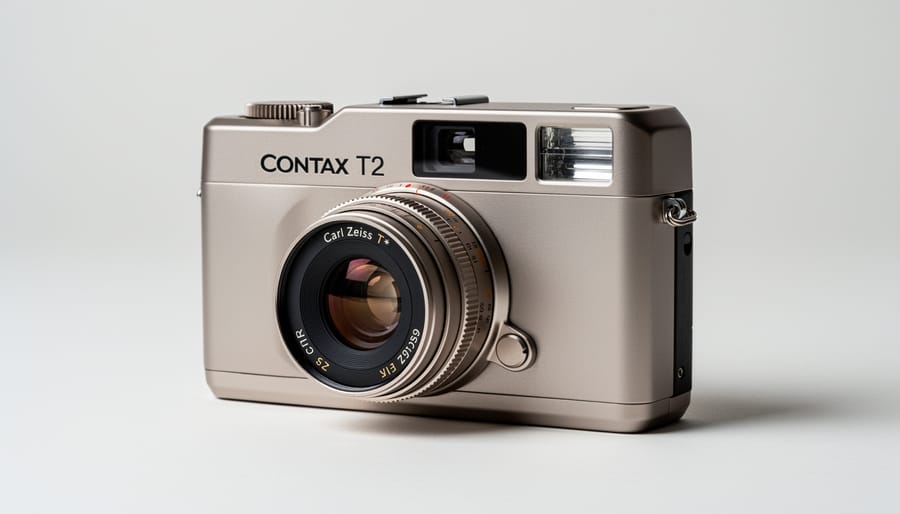
The Contax T2 and T3 represent something of a paradox in the camera world—point-and-shoot cameras that regularly sell for over $1,000. What justifies these eye-watering prices? In a word: optics. Both models feature legendary Carl Zeiss Sonnar lenses (38mm f/2.8 on the T2, 35mm f/2.8 on the T3) that deliver sharpness and color rendition that rival many professional setups.
Unlike typical pocket cameras from this era, the Contax T series offered genuine manual control alongside automatic modes. You could adjust aperture priority, focus manually using the distance scale, and apply exposure compensation—features that gave photographers creative control without the bulk of an SLR.
The T2, released in 1990, became the darling of street photographers and professionals wanting an unobtrusive backup. Its titanium body felt substantial, and that lens produced images with a unique three-dimensional quality. The T3, launched in 2001, refined the design with a slimmer profile and data back.
Today’s premium prices reflect both optical excellence and scarcity. These cameras are increasingly difficult to find in working condition, as the electronics can fail with age. If you’re considering one, budget not just for purchase but for potential servicing—but that Zeiss glass delivers results that genuinely stand apart.
Canon EOS Film Bodies: The Smart Investment
Canon’s EOS film bodies from the 1990s represent perhaps the smartest entry point into vintage film photography. Unlike their manual-focus predecessors, these cameras use the same EF lens mount that modern Canon DSLRs and mirrorless cameras (with an adapter) employ today. This means you can share lenses between your film and digital systems, or take advantage of the used EF lens market’s incredible selection and affordability.
The EOS-1N, released in 1994, served as Canon’s professional workhorse throughout the decade. It offers weather sealing, a built-in vertical grip, and a rugged magnesium alloy body that can handle demanding shooting conditions. I’ve seen these cameras survive desert shoots and rainy weddings without missing a beat. For photographers wanting professional-grade reliability, it’s an excellent choice that typically sells for $150-300.
The EOS 3, introduced in 1998, brought eye-controlled autofocus to the masses—a genuinely innovative feature that lets you select focus points simply by looking at them. While it takes practice, once mastered, it’s remarkably fast. This camera also includes 45-point autofocus and advanced metering systems that rival some early digital bodies.
Budget-conscious shooters should consider the EOS Rebel series from this era, particularly the Rebel G or 2000. These deliver excellent image quality and modern conveniences at incredibly low prices, often under $50.
Nikon F5 and F100: Built Like Tanks, Shoot Like Dreams
If you’re serious about shooting film in the 21st century, the Nikon F5 and F100 deserve your attention. These cameras represent the pinnacle of 1990s film technology, built to professional standards that make most modern cameras feel fragile by comparison.
The F5, introduced in 1996, was Nikon’s flagship professional body. Weighing in at nearly four pounds with batteries, it’s an absolute tank that can withstand conditions that would destroy lesser cameras. Wedding photographers and photojournalists relied on these bodies through countless assignments, and many are still working today. The F100, released in 1999, offered similar performance in a lighter, more affordable package that appealed to serious enthusiasts and pros alike.
What makes these cameras particularly attractive today is their compatibility with virtually every Nikon F-mount lens ever made, spanning seven decades. Mount a modern G-series lens, and you’ll have full autofocus and metering. Attach a vintage AI lens from the 1970s, and it works beautifully. This versatility is unmatched.
Both cameras feature excellent metering systems, fast autofocus that holds up remarkably well, and matrix metering that rivals some digital bodies. Expect to pay between $200-400 for a clean F100, while F5 bodies typically run $300-500, making them incredible values for what you’re getting in terms of build quality and performance.
Hidden Gems Worth Finding
Beyond the usual suspects, several 90s cameras deserve serious attention. The Minolta Maxxum 9 delivers professional-grade build quality and weather sealing at bargain prices compared to contemporaries. Pentax’s MZ-S combines compact dimensions with impressive durability and compatibility with decades of K-mount glass. The Olympus OM-3Ti, while technically launched in 1994, represents the final evolution of the legendary OM system with its all-mechanical reliability and titanium construction. These cameras shoot just as capably as their more famous counterparts but cost significantly less, making them perfect whether you’re shooting regularly or ready to display your collection with pride.
What to Look For When Buying a 90s Camera
The Battery Question
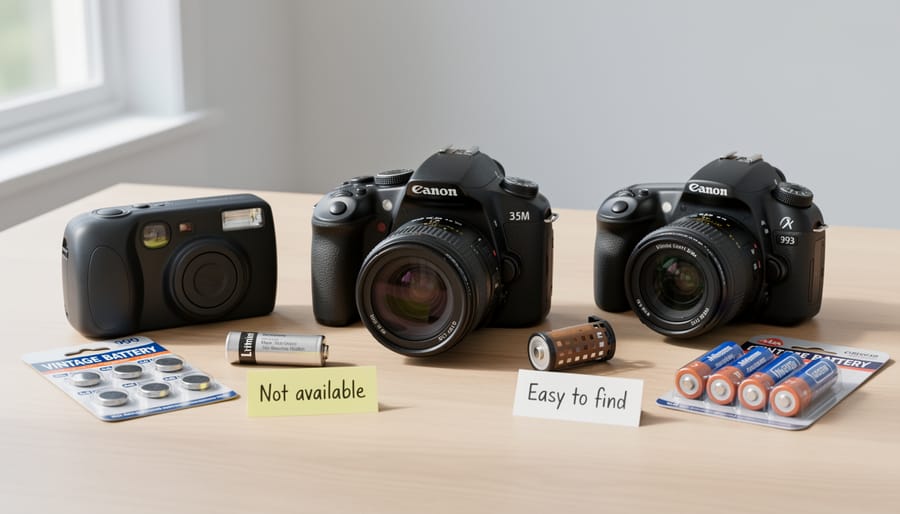
One of the biggest practical challenges with 90s cameras is power. Many models from this era used batteries that are either expensive or discontinued entirely. The lithium 2CR5 battery, common in cameras like the Canon EOS-1N and Nikon F100, is still available but can run $15-20 per battery at major retailers. The CR123A, found in many autofocus compacts, is easier to find and more affordable, especially when purchased in bulk online.
If you’re shopping for a 90s camera you’ll actually use regularly, battery availability should factor into your decision. The Canon EOS Elan series and Nikon F5, for example, use readily available AA batteries, making them far more economical for everyday shooting. Some photographers even consider battery cost when choosing between otherwise comparable models.
For cameras requiring discontinued batteries like the 6-volt 2CR5, there are workarounds. Battery adapters exist that let you use more common CR123A cells instead, though they can be bulky. Another option is rechargeable solutions, where some third-party manufacturers offer compatible rechargeable versions of these lithium batteries.
Before committing to any 90s camera, research its power requirements. Calculate the real cost of ownership beyond the camera body itself. A $50 camera that needs $20 batteries every few months adds up quickly, while a slightly pricier model running on AAs might save you money and frustration over time.
Electronics: The Double-Edged Sword
The leap from mechanical film cameras to electronic systems in the 1990s brought incredible features like autofocus, multi-mode metering, and motorized film advance. But here’s the catch: electronics age differently than brass and glass. While a 1960s manual camera might work perfectly after sitting in a closet for decades, a 90s camera with circuit board corrosion could be dead on arrival.
Before buying, test every electronic function. Fire the shutter at all speeds and listen for consistent timing. Cycle through all autofocus modes and verify the lens actually focuses when you half-press the shutter. Check the LCD display for missing segments, a common failure point. Test the built-in flash if present, and verify the light meter responds to changing light levels by covering and uncovering the lens.
Watch for specific red flags: sticky or sluggish shutter buttons often indicate internal electronic issues, not just dirt. Battery compartment corrosion is a deal-breaker since it damages circuit traces. If the camera powers on but behaves erratically, intermittently freezing or displaying error codes, walk away. These issues rarely get better and repair costs often exceed the camera’s value.
The good news? A well-stored 90s camera that’s been used regularly typically outlasts one that’s sat unused. Electronics actually benefit from occasional use, which is why buying from an active photographer often beats estate sale finds.
Rubber Grip Deterioration and Other Age Issues
Unfortunately, 90s cameras come with predictable aging issues that can affect both usability and value. The most notorious problem is rubber grip deterioration—that once-grippy coating on bodies and zoom rings often becomes sticky, gummy, or completely degraded after decades. This happens because manufacturers used rubber compounds that break down over time, and there’s no way to prevent it entirely. You can clean affected areas with isopropyl alcohol or remove the coating completely, though this affects the camera’s originality.
LCD screens from this era also tend to fade or develop dead segments, particularly in cameras stored in hot environments. While these displays often show basic shooting information, their failure can make certain functions difficult to access. Additionally, electrolytic capacitors inside these cameras have finite lifespans, typically 20-30 years. When they fail, you’ll notice sluggish performance, erratic behavior, or complete power failure. Replacing capacitors requires professional service but can restore full functionality. Regular film camera maintenance and proper storage in cool, dry conditions helps minimize these age-related issues, though some deterioration is simply inevitable with vintage electronics.
Actually Using Your 90s Camera in 2024
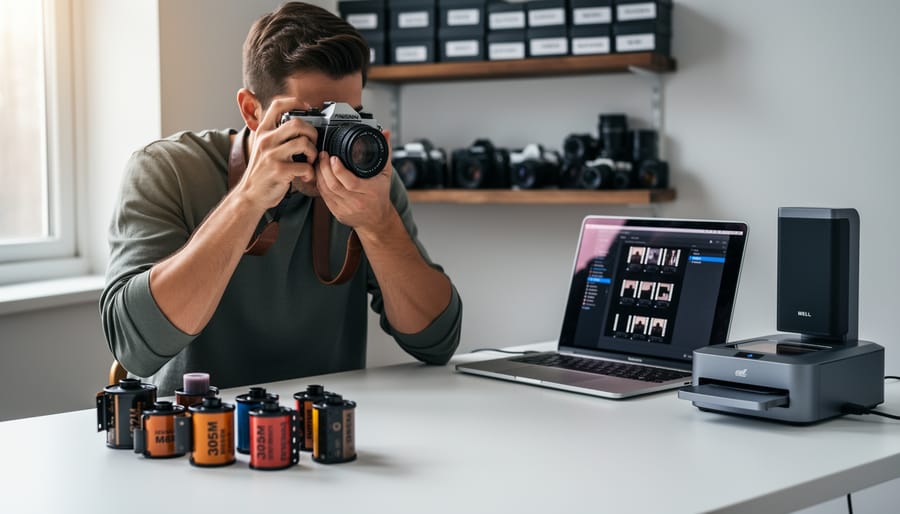
Film Options and Where to Get Them Developed
Getting your 90s camera up and running means navigating today’s film market, which is smaller but still accessible. You’ll find 35mm color negative film (like Kodak Gold or Fujifilm C200) widely available at camera shops and online retailers for $8-15 per roll. Slide film and black-and-white options cost slightly more, ranging from $12-20 per roll.
For development, you have several routes. Local options include remaining camera shops and some drugstores, typically charging $12-18 for develop-and-scan services. Mail-order labs like The Darkroom, IndieFilmLab, and TheFindLab offer convenient prepaid mailers with high-quality scans, usually running $15-25 per roll including shipping. Many photographers prefer these labs for their consistent results and various scan resolution options.
Budget roughly $25-35 total per roll when factoring in film purchase, development, and standard scans. High-resolution scans add $5-10 more. Some labs offer discounts for bulk orders, which helps if you’re shooting regularly.
Pro tip: Start with a three-pack of consumer color film and use a mail-order lab to establish your workflow. Their turnaround typically runs 1-2 weeks, so plan accordingly. Once you’re comfortable, experiment with different film stocks to discover what aesthetic matches your vision.
Getting the Most From Autofocus and Program Modes
Cameras from the 90s were the first to offer sophisticated autofocus systems that you could actually customize, rather than just accepting what the camera decided. Take the time to explore your camera’s autofocus settings. Many models from this era, like the Nikon F5 or Canon EOS-1N, let you choose between single-point AF, dynamic area modes, or predictive tracking for moving subjects. If you’re shooting portraits, lock onto a single focus point for precise control over what’s sharp. For sports or street photography, switch to continuous autofocus to track subjects as they move through the frame.
Program modes deserve more credit than they get. The intelligent Program mode on cameras like the Minolta Dynax 9 doesn’t just pick random settings—it analyzes the scene and makes educated decisions about aperture and shutter speed combinations. Use it as a starting point, then shift the program by rotating a dial to maintain the same exposure while adjusting the aperture-shutter relationship. This gives you creative control without losing the benefit of the camera’s metering intelligence. Think of these features as collaborative tools rather than automatic crutches—they handle the technical baseline while you focus on composition and timing.
Digitizing Your Results
Once you’ve shot your film, getting those images into the digital realm opens up a world of sharing and editing possibilities. The most accessible option is a flatbed scanner, which many people already own. These work reasonably well for prints and can handle film with the right attachments, though results vary significantly by model. For serious film work, dedicated film scanners deliver superior sharpness and color accuracy. Models from Plustek and older Nikon Coolscan units remain popular choices, though prices have climbed as demand increased.
The DSLR scanning method has become remarkably popular in recent years, and for good reason. By photographing your negatives with a modern digital camera, macro lens, and a light source, you can achieve excellent results quickly. This approach is faster than traditional scanning and gives you immediate high-resolution files. You’ll need a film holder to keep negatives flat and software like Negative Lab Pro to invert your images, but the initial investment pays off if you’re processing multiple rolls. Many photographers find this method strikes the perfect balance between quality and convenience, especially when working with 35mm film from those beloved 90s cameras.
The Investment Angle: Are 90s Cameras Worth Collecting?
Which Models Are Appreciating
The collector market has shown clear winners among 90s cameras, with certain models experiencing steady appreciation while others have leveled off. Contax G-series rangefinders, particularly the G2, have seen dramatic price increases—from around $400 in 2015 to $1,200-1,500 today for clean examples. These cameras combine exceptional Zeiss optics with compact design, making them highly sought after by both shooters and collectors.
Nikon’s F100 and Canon’s EOS-3 represent strong investments in the professional SLR category. Their shared technology with flagship film cameras (F5 and EOS-1V respectively) at more accessible price points has driven steady appreciation. Expect to pay $300-500 for excellent condition bodies, up from $150-250 five years ago.
Point-and-shoot models showing the strongest growth include the Contax T2, Yashica T4, and Olympus Mju-II, though their prices may be plateauing after explosive growth. Recent market data suggests vintage camera values for premium compacts have stabilized as buyers become more selective.
Conversely, standard consumer SLRs like the Canon EOS Rebel series remain affordable and show minimal appreciation potential. These cameras offer excellent value for actual shooting but limited collectibility.
The ‘User Grade’ Sweet Spot
Here’s the truth most newcomers to 90s film cameras miss: you don’t need a mint-condition, box-fresh specimen to enjoy these machines. In fact, for shooters rather than collectors, a well-used but functional camera often represents the best value.
User-grade cameras show honest wear. Think brassing on the corners, minor scuffs on the body, perhaps a small ding or two. The viewfinder might have a speck of dust, and the light seals probably need replacing (a simple fifteen-minute fix with a kit). But here’s what matters: the shutter fires accurately, the meter works, and the lens is clean without fungus or separation.
These cameras typically cost 40-60% less than collector-grade examples, yet they’ll produce identical photographs. That Canon EOS 3 with some body wear? It’ll shoot just as reliably as a pristine one, and you won’t wince every time you bump it against your camera bag.
The practical advantage extends beyond price. When you’re actually using these cameras in the field, they’re going to accumulate wear anyway. Starting with a user-grade body means you can focus on making photographs rather than preserving an artifact. You’re buying a tool, not a museum piece, and tools are meant to show their history.
The cameras of the 1990s represent a unique sweet spot in photographic history—a bridge between the mechanical mastery of earlier decades and the digital revolution that followed. These machines captured the final evolution of film camera technology, incorporating sophisticated electronics and autofocus systems while maintaining the tactile, intentional shooting experience that many photographers crave today. Whether you’re drawn to the workhorse reliability of a Canon EOS-1N, the innovative engineering of a Nikon F5, or the accessible excellence of a compact point-and-shoot, there’s a 90s camera waiting to match your creative vision.
What makes these cameras particularly special is their dual appeal. Collectors appreciate them as the culmination of over a century of film camera development, while working photographers value them as practical, capable tools that can still deliver professional results. Unlike earlier vintage cameras that require patience and mechanical knowledge, most 90s models are ready to shoot straight out of the box, making them ideal entry points for anyone curious about film photography.
If you’re ready to explore this world, start by identifying what draws you in. Visit local camera shops to hold different models and get a feel for their ergonomics. Join online communities where experienced shooters share their knowledge and equipment recommendations. Purchase a roll or two of film alongside your camera—after all, these beautiful machines are meant to be used, not just admired. The 90s vintage camera scene welcomes everyone, from curious beginners to seasoned professionals rediscovering the joy of film.


 By
By