 By
By 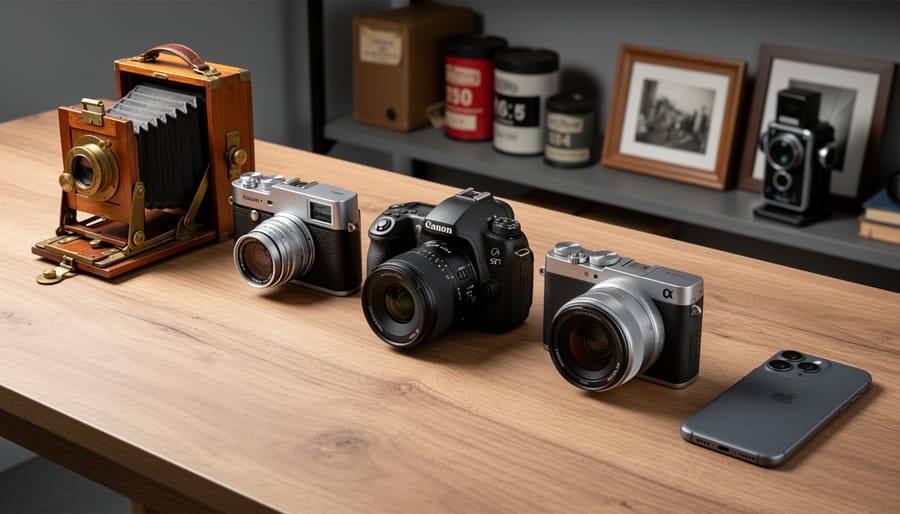
The camera you’re holding today—whether it’s a smartphone or a professional DSLR—represents nearly two centuries of remarkable innovation, trial and error, and creative breakthroughs. From chemical-coated metal plates that required 8-hour exposures in 1826 to digital sensors capturing split-second action at 120 frames per second, photography’s evolution mirrors humanity’s relentless drive to freeze and preserve moments in time.
Understanding this timeline isn’t just about appreciating dusty museum pieces. Every major development in camera history solved a real problem photographers faced: How do we reduce exposure times from hours to seconds? How do we make cameras portable enough to capture candid moments? How do we eliminate the need for darkrooms? These weren’t abstract technical exercises—they were responses to photographers’ frustrations and creative ambitions.
The journey from Joseph Nicéphore Niépce’s first permanent photograph to today’s computational photography reveals patterns that still influence modern cameras. The transition from daguerreotypes to film parallels today’s shift from DSLRs to mirrorless systems. The democratization of photography through Kodak’s Brownie camera echoes smartphone photography’s current revolution. Each era faced resistance from purists who claimed new technology would ruin “real” photography—a debate that continues today.
This timeline illuminates not just what changed, but why those changes mattered to working photographers. Whether you’re trying to understand why certain vintage cameras command premium prices or simply curious how we arrived at today’s technology, this chronological journey provides context for every click of your shutter.
The Camera Obscura and Early Optical Discoveries (Pre-1800s)
Long before anyone captured a photograph, artists and scientists were already exploring the optical magic that would eventually make cameras possible. The story begins with the camera obscura—literally “dark room” in Latin—a phenomenon that humans observed for thousands of years before understanding how to harness it.
The basic principle is wonderfully simple: when light passes through a small hole into a darkened space, it projects an inverted image of the outside world onto the opposite wall. Chinese philosopher Mozi documented this effect as early as the 5th century BCE, and Aristotle made similar observations in ancient Greece. But it wasn’t just theoretical curiosity—this discovery laid the groundwork for understanding how light and lenses work together, which is fundamental to every camera you’ve ever used.
By the Renaissance, the camera obscura had evolved from a curious natural phenomenon into a practical tool. Artists like Leonardo da Vinci and Johannes Vermeer used room-sized camera obscuras to achieve the stunning perspective and lighting accuracy that still captivates us in their paintings today. Imagine standing in a darkened room, watching the bustling street scene outside projected perfectly onto your canvas, allowing you to trace accurate proportions and capture fleeting expressions. This wasn’t cheating—it was embracing technology to push creative boundaries, much like photographers debate digital editing today.
The 17th and 18th centuries brought crucial optical refinements. Scientists like Johann Kepler added convex lenses to camera obscuras, making images brighter and sharper. These portable devices became essential for landscape artists and surveyors. The addition of mirrors allowed users to flip images right-side-up, making the tool even more practical for everyday use.
What makes this era so significant for photographers today is recognizing that the camera obscura proved something essential: you could capture reality through optics alone. The only missing piece was a way to permanently record what appeared on that wall. Artists had been manually tracing these projected images for centuries, but the race was on to find a chemical or mechanical method to preserve them automatically—setting the stage for photography’s birth in the 1800s.
The Birth of Photography (1826-1880s)
Niépce’s First Photograph (1826)
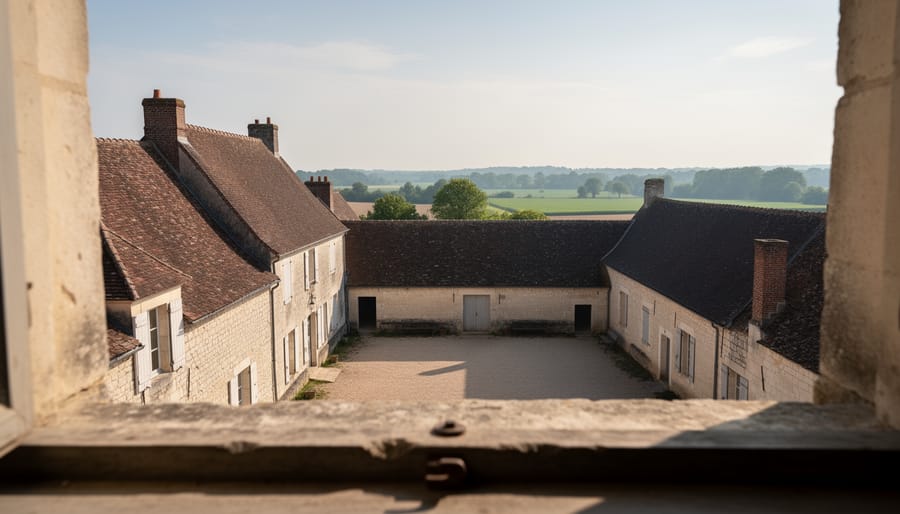
In 1826, French inventor Nicéphore Niépce created something that had never existed before: a permanent photograph captured from real life. From the window of his estate in Saint-Loup-de-Varennes, France, he pointed his camera obscura at the courtyard below and began an exposure that would last approximately eight hours. The resulting image, known as “View from the Window at Le Gras,” shows a hazy but unmistakable scene of buildings and rooftops—proof that light could be permanently captured.
Niépce called his technique heliography, which literally means “sun drawing.” The process involved coating a pewter plate with bitumen of Judea, a naturally occurring petroleum derivative. When exposed to light, the bitumen hardened in proportion to the light’s intensity. After the lengthy exposure, Niépce washed the plate with lavender oil and white petroleum, dissolving the unhardened bitumen and leaving behind a permanent image. The bright areas of the scene created hardened bitumen, while shadows remained as bare metal—a direct positive image.
Why did this take eight hours? The bitumen simply wasn’t very light-sensitive. This meant that shadows moved across the courtyard during the exposure, creating the strange effect of sunlight appearing on multiple sides of the buildings simultaneously. By today’s standards, the image quality is barely recognizable, but this technical limitation doesn’t diminish the achievement.
This breakthrough fundamentally changed humanity’s relationship with visual memory. Before Niépce, the only way to preserve what you saw was through drawing or painting—subjective interpretations requiring artistic skill. Now, light itself could create an objective record of reality. While eight-hour exposures made portraits impossible and limited practical applications, Niépce had proven the concept worked, opening the door for future innovators to refine the process into something truly usable.
Daguerreotype Takes the World by Storm (1839)
On August 19, 1839, the French government made history by purchasing Louis Daguerre’s photographic process and releasing it as a gift to the world. This moment transformed photography from laboratory curiosity into practical reality. The daguerreotype process created stunningly detailed images on silver-plated copper sheets, offering unprecedented clarity that amazed viewers across Europe and America.
Within months, daguerreotype studios opened in major cities worldwide. Entrepreneurs recognized the commercial potential immediately, and photography became accessible to the middle class for the first time. A portrait that once required hours of sitting for a painter could now be captured in mere minutes, though those minutes presented their own challenges.
Early daguerreotype portraits demanded subjects remain absolutely still for anywhere from 20 seconds to several minutes, depending on lighting conditions. Portrait photographers developed ingenious solutions to help clients maintain stillness. Metal head clamps, disguised as decorative chair backs, held sitters firmly in place. Studios installed large skylights to maximize natural light and reduce exposure times. Photographers instructed subjects to fix their gaze on a specific point and breathe shallowly.
The results often showed the strain of these sessions. Many early daguerreotypes capture subjects with rigid postures and uncomfortable expressions, unable to maintain natural smiles for extended periods. Children proved especially challenging subjects, leading photographers to specialize in quick exposures or resort to photographing sleeping infants.
Despite these practical difficulties, the daguerreotype sparked photography mania. By 1850, millions of daguerreotypes had been produced worldwide, establishing photography as both art form and commercial enterprise.
Wet Plates and the Civil War Era (1850s-1880s)
The wet collodion process, introduced by Frederick Scott Archer in 1851, revolutionized photography but came with serious logistical challenges. Photographers had to coat glass plates with a sticky collodion solution, sensitize them in silver nitrate, expose them while still wet, and develop them immediately—all within about fifteen minutes before the chemicals dried.
This tight timeline meant photographers needed portable darkrooms wherever they went. During the American Civil War, Mathew Brady and his team of photographers, including Alexander Gardner and Timothy O’Sullivan, hauled wagon-based darkrooms directly onto battlefields. These “Whatsit Wagons,” as soldiers called them, were essentially mobile chemical labs that allowed documentation of war’s harsh realities for the first time in history.
The wet plate process produced incredibly sharp negatives that could create multiple prints, unlike daguerreotypes. Exposure times dropped to just a few seconds in good light, making portraiture more practical and affordable for middle-class families. However, the chemistry was unforgiving—plates were extremely sensitive to blue light but nearly blind to red, meaning blue skies appeared white and red objects looked unnaturally dark in photographs.
Despite these limitations, wet collodion dominated photography for three decades. It gave us hauntingly detailed Civil War images, expansive Western landscape surveys, and countless studio portraits. These photographs weren’t just pictures—they became historical evidence, shaping how future generations understood their past.
Film Makes Photography Accessible (1888-1940s)
Kodak’s “You Press the Button” Revolution (1888)
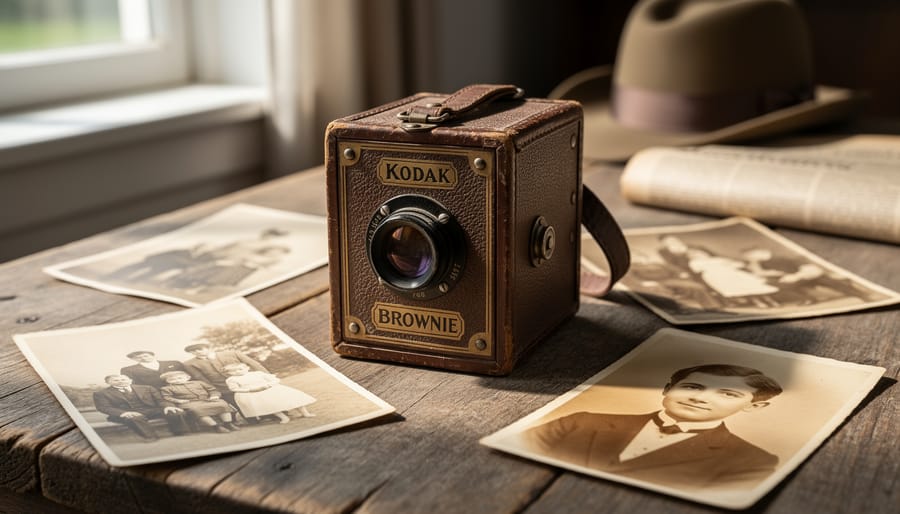
In 1888, George Eastman transformed photography from a specialized craft into something anyone could enjoy with a single brilliant tagline: “You press the button, we do the rest.” This wasn’t just clever marketing—it was a complete reimagining of how photography could work.
Before Eastman’s Kodak camera, photography meant hauling around bulky equipment, mixing chemicals, and possessing considerable technical knowledge. Photographers needed to understand wet plate processes, carry portable darkrooms, and develop plates almost immediately after exposure. It was expensive, messy, and frankly intimidating for the average person.
Eastman’s revolution came in a compact box that cost $25 (about $750 today). The camera came pre-loaded with enough roll film for 100 exposures—a dramatic departure from the glass plates photographers had used for decades. Once you’d taken all your pictures, you didn’t develop them yourself. Instead, you sent the entire camera back to Kodak. For $10, the company would develop your photos, print them, reload the camera with fresh film, and send everything back to you.
This business model was genius. Eastman understood that the real profit wasn’t in selling cameras—it was in the ongoing film and development services. He created what we’d now call a subscription-based approach, establishing a relationship with customers that lasted years rather than ending with a single purchase.
The impact was immediate and profound. Photography shifted from professional studios and dedicated hobbyists to families, travelers, and everyday people documenting their lives. Eastman didn’t just make cameras accessible—he fundamentally changed what photography meant in society, transforming it into a tool for preserving personal memories rather than just formal portraits.
35mm Film Changes Everything (1913-1925)
The story of 35mm film begins, surprisingly enough, not in the photography world but in cinema. Thomas Edison’s team developed this perforated film format in 1892 for their Kinetoscope motion picture system. The sprocket holes on each side of the 35mm-wide strip allowed for precise frame advancement—a clever engineering solution that would prove far more influential than anyone imagined.
For two decades, 35mm remained exclusively a motion picture format. Still photographers worked with larger, bulkier cameras using various film sizes. But in 1913, a German optical engineer named Oskar Barnack had a revolutionary idea while working at Ernst Leitz Optische Werke (later known as Leica). Barnack suffered from asthma, and lugging heavy photography equipment during his hiking trips in the Alps was exhausting. He envisioned a small, portable camera that could use readily available movie film.
Barnack’s prototype, built around 1913, exposed frames horizontally rather than vertically like movie cameras, creating a 24x36mm image area—the format we still call “full frame” today. However, World War I delayed commercial production until 1925, when the Leica I finally launched to the public.
Why did 35mm dominate for nearly a century? The format struck a perfect balance. It was small enough to make cameras truly portable yet large enough to produce excellent image quality when properly exposed and developed. The standardization meant photographers worldwide could buy film anywhere, and the chemical industry could mass-produce it efficiently, driving costs down.
The 35mm format democratized serious photography. Photojournalists like Henri Cartier-Bresson and Robert Capa could capture decisive moments with lightweight, unobtrusive cameras—something impossible with previous bulky equipment. This portability fundamentally changed what photography could document and how photographers could work.
Color Photography Arrives (1930s-1940s)
The 1930s brought photography into full color, transforming how we captured and remembered the world. While earlier color processes existed, they were impractical and expensive for everyday use. That changed in 1935 when Kodak introduced Kodachrome, a revolutionary slide film that delivered vibrant, stable color images.
What made Kodachrome special wasn’t just its stunning color accuracy—it was the longevity of those colors. Images captured on Kodachrome could last for decades without fading, making it perfect for preserving family memories and documenting history. The film used a complex three-layer emulsion process, with each layer sensitive to different wavelengths of light. While photographers simply loaded the film and shot, the developing process required specialized equipment that only Kodak labs could handle initially.
The impact was immediate and far-reaching. National Geographic embraced color film enthusiastically, bringing distant lands and cultures into American living rooms with unprecedented realism. Photojournalists could now show not just what happened, but convey the emotional impact through color—the red of blood, the green of jungle canopies, the blue of open skies.
For families, color snapshots became treasured heirlooms. Birthday parties, vacations, and everyday moments gained new depth and emotional resonance. These early film photography techniques required understanding exposure and lighting more carefully than before, as color film had less latitude for error than black-and-white.
By the 1940s, despite wartime restrictions, color photography had secured its place in both professional and amateur photography worlds.
The Era of Automation and Innovation (1950s-1980s)
Single-Lens Reflex (SLR) Cameras Go Mainstream
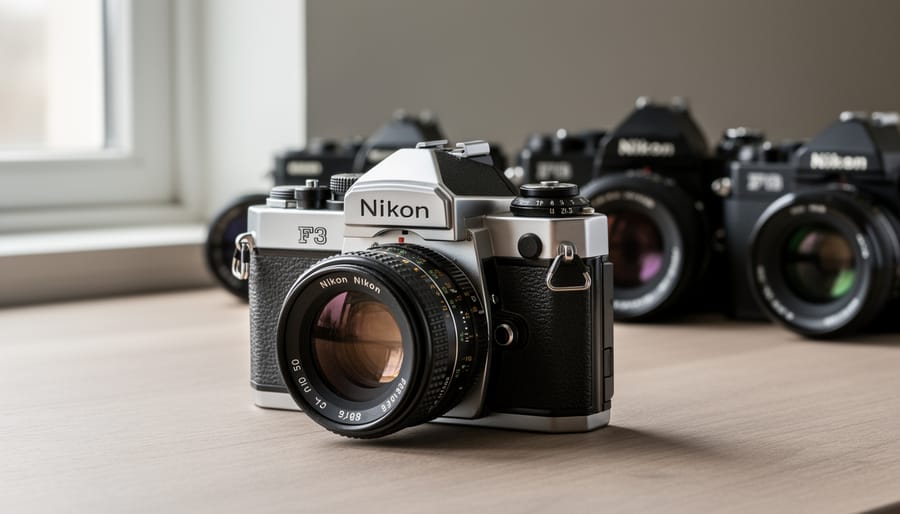
By the 1950s and 1960s, single-lens reflex cameras revolutionized photography by solving a problem that had frustrated photographers for decades: what you saw through the viewfinder wasn’t always what the lens captured. Unlike rangefinder cameras, which used a separate viewing window, SLRs employed an ingenious mirror and prism system that let photographers see exactly what the lens saw.
Here’s how it worked: a mirror inside the camera body sat at a 45-degree angle, reflecting light from the lens up through a pentaprism and into the viewfinder. When you pressed the shutter button, the mirror flipped up, allowing light to hit the film. This through-the-lens (TTL) viewing was a game-changer, especially for close-up photography, telephoto work, and any situation where precise framing mattered.
The practical advantages over rangefinders were substantial. With interchangeable lenses, you could switch from a wide-angle to a telephoto and immediately see the exact perspective and depth of field. No more parallax error—that annoying offset between what the viewfinder showed and what the lens captured. Macro photography became infinitely easier since you could see your exact focus point without guessing.
Japanese manufacturers like Nikon, Canon, and Pentax dominated the SLR market, producing increasingly sophisticated models throughout the 1960s and 1970s. The Nikon F, introduced in 1959, became legendary among photojournalists covering Vietnam and other major events. Its rugged build quality and extensive lens system set the standard for professional photography.
By the 1970s, SLRs had essentially replaced rangefinders as the professional standard. The combination of precise viewing, interchangeable lenses, and TTL metering systems made them the obvious choice for serious photographers. This format would reign supreme until digital technology began reshaping the landscape decades later.
Instant Photography and the Polaroid Phenomenon
In 1947, Edwin Land introduced something that seemed almost magical: a camera that produced finished photographs in about 60 seconds. The Polaroid Model 95, commercially available by 1948, eliminated the wait time that had always been an inherent part of photography. Before instant cameras, you’d shoot your film, send it off to a lab or develop it yourself in a darkroom, and only then discover whether you’d captured the moment successfully.
The appeal was immediate and universal. Professional photographers used Polaroids to test lighting setups before committing expensive film to the shot—a practice that became industry standard for decades. Wedding photographers could give couples a preview print on the spot. Police departments documented crime scenes with cameras that produced evidence immediately, without the risk of tampering during processing. Scientists and medical professionals embraced instant photography for documentation that couldn’t wait.
But the cultural impact went far beyond professional applications. Polaroid cameras democratized photography in a unique way. The instant feedback taught people about composition and exposure much faster than waiting days for prints. Families could see vacation photos before the trip even ended. The iconic white-bordered square prints became synonymous with capturing authentic, unguarded moments—there was no second chance to pose or perfect the shot.
By the 1970s and 80s, Polaroid had become a verb. The SX-70 folding camera, introduced in 1972, added design elegance to the mix, making instant photography fashionable. Artists like Andy Warhol elevated Polaroids to fine art status. This wasn’t just technological innovation; it fundamentally changed how people experienced photography—making it truly instant and tangible.
Autofocus and Program Modes Arrive
The mid-1970s through the 1980s brought what many consider photography’s most democratizing revolution: autofocus and program modes. Before this era, achieving sharp focus meant manually turning a lens ring while looking through the viewfinder, and proper exposure required understanding the relationship between aperture, shutter speed, and light. These were skills that took time to master, and even experienced photographers occasionally missed critical shots while adjusting settings.
Canon’s AF35M, introduced in 1979, became the first mass-market autofocus camera, though it was Minolta’s Maxxum 7000 in 1985 that truly changed the game for SLR users. This wasn’t just incremental improvement; it was transformative. Wedding photographers could now track moving subjects during ceremonies. Sports shooters captured decisive moments they’d have missed while manually focusing. Parents at school plays suddenly had sharp photos instead of blurry disappointments.
Program modes went hand-in-hand with autofocus, analyzing scenes and selecting appropriate settings automatically. Critics worried this would reduce photography to merely pointing and shooting, eliminating the craft. In reality, these technologies lowered the technical barrier to entry while freeing photographers to focus on composition, timing, and storytelling. Professional photographers still needed creative vision and understanding of light, but now the camera handled the mechanical precision, ensuring they captured the moment rather than fumbling with dials while it passed.
The Digital Revolution Begins (1990s-2000s)
First Consumer Digital Cameras and Their Limitations
When Kodak released the DC40 in 1995 and Sony introduced the Cyber-shot DSC-F1 in 1996, photographers finally had access to digital cameras that didn’t require a corporate budget. But let’s be honest—these early models were hardly impressive by today’s standards. The DC40 offered a mere 0.38 megapixels for around $1,000, while most professional photographers were producing stunning images on 35mm film that cost pennies per frame.
The limitations were glaring. Early digital cameras struggled with image quality, producing grainy photos that looked acceptable on computer screens but fell apart in print. Battery life was abysmal—you’d be lucky to capture 50 shots before needing fresh batteries. Storage was equally frustrating, with proprietary memory cards holding only a handful of images. Then there was the lag time between pressing the shutter and actually capturing the image, making spontaneous photography nearly impossible.
Professional photographers remained deeply skeptical. Why invest thousands in inferior technology when film delivered superior results every time? Wedding photographers couldn’t risk missing crucial moments due to shutter lag. Portrait photographers needed resolution that early digital simply couldn’t provide.
The turning point came around 2002-2003 when cameras crossed the 6-megapixel threshold at reasonable prices. The evolution of digital cameras accelerated rapidly as manufacturers addressed core concerns. Suddenly, digital could match film quality for most applications, instant preview eliminated costly mistakes, and the ability to shoot hundreds of images without changing rolls became too valuable to ignore. The convenience finally outweighed the compromises.
DSLRs Cross the Quality Threshold (2000s)
The early 2000s marked the moment professional photographers had been waiting for: digital cameras that could genuinely rival film. While earlier digital cameras had shown promise, they carried significant compromises in image quality, file size, and usability. That all changed when manufacturers refined digital sensor technology to deliver results that satisfied even the most critical eyes.
Canon’s EOS D30, released in 2000, represented a watershed moment. Priced at under $3,000 and featuring a 3.1-megapixel CMOS sensor, it brought professional-grade digital photography within reach of serious enthusiasts. More importantly, it used the same EF lens mount as Canon’s film cameras, meaning photographers could transition without replacing their entire kit. This practical consideration removed a massive barrier to adoption.
Nikon’s D1, launched in 1999, had already proven that digital could work for press and sports photographers who needed immediate file delivery. With its 2.7-megapixel sensor and robust build quality, it became a newsroom staple despite its $5,000 price tag.
The real tipping point came with cameras like the Canon EOS-1Ds in 2002, which featured a full-frame 11.1-megapixel sensor. Suddenly, digital files could be enlarged to the same sizes as 35mm film without visible quality loss. Wedding photographers, commercial shooters, and photojournalists began making the switch en masse. The convenience of instant review, the elimination of film and processing costs, and rapidly improving ISO performance made the transition not just possible, but inevitable. By the mid-2000s, major camera manufacturers had stopped developing new professional film cameras entirely, signaling that digital had definitively won.
The Death of Film and Rise of Memory Cards
The shift from film to memory cards fundamentally changed photography overnight. When digital cameras gained serious traction in the early 2000s, photographers suddenly found themselves freed from the constraints of 36-exposure rolls and darkroom chemistry. Instead of carefully rationing each shot, they could review images instantly on LCD screens, delete the duds, and keep shooting. This immediate feedback loop accelerated learning curves dramatically—particularly for newcomers who could see exposure and composition mistakes in real-time rather than days later when prints returned from the lab.
For the industry, the transformation was seismic. Film manufacturers like Kodak struggled to adapt, while memory card producers and image sensor companies thrived. Professional photographers had to retool their entire workflows, investing in computers, backup systems, and image editing software. The cost per photograph plummeted to essentially zero after the initial equipment investment, making photography more accessible but also more competitive. Wedding photographers could deliver hundreds of edited images instead of a few dozen prints. Photojournalists transmitted images from conflict zones within minutes rather than shipping film canisters across continents. The chemical darkroom became a digital one, trading enlargers and stop baths for Lightroom and Photoshop.
The Smartphone Camera Disruption (2007-Present)
Computational Photography Changes the Rules
Around 2016, something remarkable happened in the photography world. Smartphones with sensors smaller than your pinky fingernail started producing images that, in certain situations, rivaled cameras costing thousands of dollars. The secret wasn’t better hardware—it was computational photography, a paradigm shift that fundamentally changed how we think about image capture.
Traditional cameras rely on optical and mechanical components: larger sensors capture more light, wider apertures create better bokeh, and longer exposures gather detail in darkness. Physics sets the rules. But computational photography rewrites those rules by using software algorithms and artificial intelligence to overcome hardware limitations. Instead of capturing a single image, your phone might capture dozens of frames in milliseconds, then intelligently combine them into something no single exposure could achieve.
Portrait mode perfectly illustrates this revolution. Professional photographers once needed fast prime lenses and full-frame sensors to achieve that creamy background blur separating subjects from their surroundings. Now, smartphones use dual cameras or depth sensors to map the scene in three dimensions, then apply algorithmic blur that mimics shallow depth-of-field. While purists can spot the difference in edge detection around hair or glasses, the results fool most viewers and democratized a technique previously reserved for those with expensive gear.
Night mode demonstrates even more impressive computational wizardry. Point your phone at a dimly lit scene, and it captures multiple frames at varying exposures—some protecting highlights, others rescuing shadows. AI algorithms then align these frames (compensating for hand shake), merge the data, and apply noise reduction selectively across the image. The Google Pixel 3’s Night Sight, introduced in 2018, shocked photographers by producing handheld low-light images that previously required tripods and long exposures.
This approach doesn’t just replicate what dedicated cameras do—it sometimes surpasses them. Computational HDR processes exposure brackets faster than any DSLR burst mode. Smart HDR recognizes faces and optimizes skin tones differently than backgrounds. AI scene recognition adjusts processing based on whether you’re photographing food, landscapes, or pets.
The implications extend beyond smartphones. Modern mirrorless cameras now incorporate computational features like focus stacking, in-camera compositing, and AI-powered subject tracking. The boundary between hardware and software continues blurring, suggesting that future photography advances may come more from algorithms than optics.
The “Best Camera Is the One You Have” Philosophy
The smartphone revolution fundamentally changed how we think about photography. Chase Jarvis, a renowned commercial photographer, popularized the phrase “the best camera is the one you have with you” in 2009, and this philosophy became the unofficial motto of the smartphone camera age. It perfectly captured a reality that the traditional camera industry struggled to accept: most people care more about capturing a moment than achieving technical perfection.
This shift devastated the point-and-shoot camera market. Sales of compact digital cameras peaked around 2010 at approximately 121 million units worldwide, then plummeted by over 80 percent within just five years. The reason was simple—smartphone cameras became “good enough” for most people’s needs while offering unbeatable convenience. You could snap a photo, edit it, and share it with friends across the world in under a minute, all from a device already in your pocket.
The decline wasn’t about image quality alone. Point-and-shoots often produced technically superior images compared to early smartphone cameras, but they couldn’t compete with the instant gratification and connectivity smartphones offered. Professional photographers might debate sensor sizes and lens quality, but the average person valued the ability to instantly share a child’s first steps or a sunset during their commute.
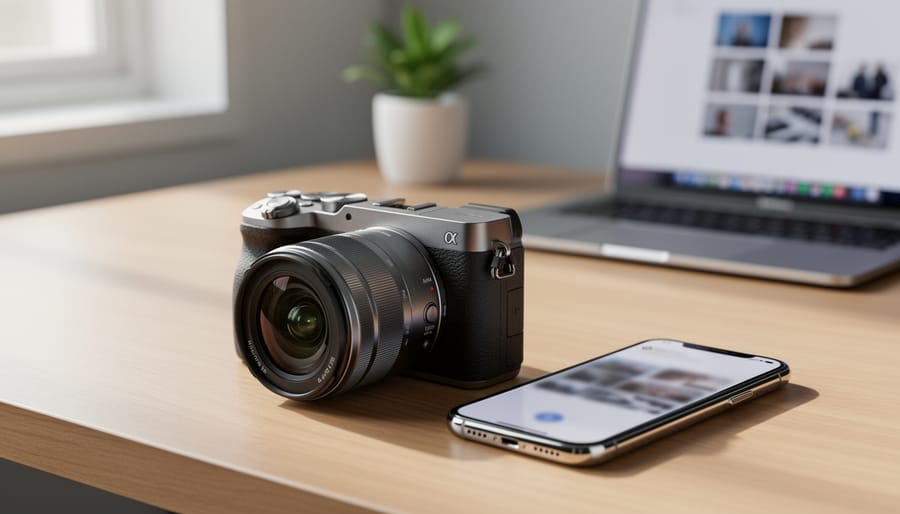
This convenience-first mindset forced camera manufacturers to pivot dramatically, focusing on either high-end enthusiast models that offered something smartphones couldn’t match, or embracing the smartphone ecosystem through app integrations and wireless connectivity features.
Modern Camera Technology (2010s-Today)
Mirrorless Cameras Take Over
Around 2013, something remarkable started happening in the camera world. While DSLRs had dominated professional photography for over a decade, a new challenger emerged that would fundamentally reshape the industry: mirrorless cameras. These innovative systems ditched the traditional mirror box and optical viewfinder in favor of electronic viewfinders (EVFs) and digital displays, sparking a revolution that’s still unfolding today.
The practical advantages quickly became undeniable. Without the bulky mirror mechanism, camera bodies could shrink dramatically—sometimes by 30-40% in both size and weight. Professional photographers who once carried 8-pound camera kits suddenly found themselves working with systems weighing half as much. For wedding photographers shooting 10-hour days or travel photographers hiking mountain trails, this wasn’t just convenient; it was career-changing.
Electronic viewfinders offered capabilities impossible with optical systems. Photographers could now preview exposure, white balance, and depth of field before taking the shot. What you saw was literally what you’d get. Combined with advances in video camera technology, mirrorless systems became hybrid powerhouses, equally capable with stills and motion.
The turning point came between 2018 and 2020 when Canon and Nikon—the DSLR giants—announced their full commitment to mirrorless with the RF and Z mount systems. Sony had already proven the concept with their acclaimed Alpha series, but these announcements signaled the end of an era. Today, major manufacturers have stopped developing new DSLRs entirely, focusing resources exclusively on mirrorless innovation. The transition isn’t just about smaller bodies; it’s about embracing a fundamentally different approach to image-making that prioritizes speed, versatility, and computational photography.
High-Resolution Sensors and Low-Light Performance
The last decade has witnessed camera technology leap forward in ways that would have seemed like science fiction to earlier generations of photographers. Today’s sensors pack resolutions exceeding 60 megapixels in consumer-grade cameras, while ISO capabilities routinely reach 100,000 or higher with usable results. This isn’t just about bigger numbers—it’s fundamentally changed what’s possible in real shooting situations.
Understanding how camera sensors work helps appreciate these advances. Modern sensors capture extraordinary detail while managing noise levels that plagued earlier digital cameras. A professional photographer shooting a dimly lit wedding reception can now confidently use ISO 6400 and still deliver clean, printable images—something unthinkable just fifteen years ago when ISO 1600 pushed the boundaries of acceptable quality.
The megapixel race has practical benefits beyond bragging rights. Wildlife photographers can crop heavily into their images while retaining enough resolution for large prints. Landscape photographers capture textures and details that rival medium format film. Concert photographers working in challenging lighting conditions combine high resolution with impressive ISO performance, freezing action without sacrificing image quality. These technological advances haven’t just made photography easier—they’ve expanded creative possibilities, allowing photographers to tackle scenarios that once required specialized equipment or simply weren’t feasible.
AI, Eye Tracking, and Intelligent Autofocus
Machine learning transformed cameras into intelligent devices that can think ahead. Modern cameras equipped with AI-powered autofocus systems analyze scenes in real-time, recognizing faces, eyes, animals, and even vehicles with remarkable accuracy. The technology uses neural networks trained on millions of images to distinguish between a bird in flight and background foliage, or to lock onto a soccer player’s eye while they sprint across the field.
The practical impact is nothing short of revolutionary. Wildlife photographers benefit enormously from subject recognition that maintains focus on an eagle’s eye as it dives, even when branches momentarily obscure the view. Sports photographers capture crisp shots of athletes in unpredictable motion because predictive algorithms anticipate where the subject will move next, adjusting focus before the action happens. Portrait photographers enjoy systems that prioritize human eyes automatically, ensuring sharp results even when shooting wide open at f/1.4.
Sony’s Real-time Tracking and Canon’s EOS iTR AF X represent this technology at work. These systems don’t just follow contrast changes—they understand what they’re photographing. A camera recognizing a motorcycle racer’s helmet differs fundamentally from traditional focus systems that might latch onto a nearby fence. This intelligence means fewer missed moments and higher keeper rates, fundamentally changing what’s possible to capture reliably.
We’ve traveled an extraordinary 200-year journey together, from Nicéphore Niépce squinting at a fuzzy rooftop scene that took eight hours to capture, to today’s smartphones that can photograph the Milky Way in seconds using computational wizardry. It’s a testament to human ingenuity that we’ve compressed what once required dangerous chemicals, heavy equipment, and the patience of a saint into something you can do while waiting for your coffee.
But here’s what strikes me most about this entire timeline: while the tools have transformed beyond recognition, the fundamental act of photography hasn’t changed one bit. Whether you’re coating a copper plate with bitumen in 1826 or tapping a screen in 2024, you’re still making the same creative decisions. Where do I stand? What do I include in the frame? How do I capture this moment in a way that means something?
The greatest photographers throughout history didn’t succeed because they had the best equipment. Dorothea Lange captured the haunting desperation of the Great Depression with relatively simple cameras. Henri Cartier-Bresson defined “the decisive moment” without autofocus or motor drives. Ansel Adams created masterpieces while hauling 50 pounds of large-format gear up mountainsides. Their vision, their eye, their understanding of light and composition—these were the real tools that mattered.
Today’s mirrorless cameras with their eye-tracking autofocus and in-body stabilization are remarkable achievements. Tomorrow’s cameras might use AI to suggest compositions or predict when your subject will smile. Some are already experimenting with light-field technology that lets you refocus after shooting, or computational photography that merges dozens of exposures in ways our eyes can’t naturally see.
Yet none of these technological marvels can replace the photographer’s creative vision. The camera, whether it’s a wooden box from 1839 or a cutting-edge digital marvel, remains what it’s always been: a tool that serves the artist. Technology opens doors and removes barriers, but walking through those doors and deciding what to create—that’s still entirely on you.

 By
By