 By
By 
Freeze a tennis player mid-serve in bright afternoon sun with your flash wide open at f/2.8. That’s the promise of high-speed sync (HSS), a technology that breaks through your camera’s normal sync speed barrier of 1/200th or 1/250th second. Without HSS, shooting with flash in bright light forces you into a frustrating compromise: either stop down to f/11 or darker to avoid the dreaded black bar across your frame, or abandon flash altogether and lose that beautiful fill light that makes your subject pop.
High-speed sync works by transforming your flash from a single burst into a rapid pulse of light that fires continuously while your shutter curtains travel across the sensor. This means you can shoot at 1/2000th, 1/4000th, or even 1/8000th second with flash, maintaining those gorgeous shallow depth-of-field portraits even in harsh midday sun. The trade-off? Your flash loses significant power, sometimes up to two stops, because it’s spreading that energy across time rather than delivering one concentrated punch.
Understanding when you actually need HSS versus when you’re better off with standard sync can save your shoots and your sanity. Wedding photographers shooting outdoor ceremonies need it for balanced exposures that don’t blow out skies. Sports photographers use it to add catchlights and dimension to athletes in stadium lighting. Portrait photographers rely on it to overpower sunlight while keeping backgrounds beautifully blurred.
Testing your HSS setup and calculating proper exposures requires moving beyond automatic modes and understanding the relationship between ambient light, flash power, and shutter speed. This guide walks you through the technical foundations, practical testing procedures, and calculator tools that transform HSS from a confusing spec sheet feature into a reliable creative weapon.
What Is Flash Sync Speed (And Why It Limits You)
The Black Bar Problem
Picture this: you’re shooting an outdoor wedding on a bright afternoon, trying to balance the sunny background with proper exposure on the couple’s faces. You dial in 1/500th second, fire off a shot with your speedlight, and notice something strange—there’s a thick black bar running across the bottom third of your image. Congratulations, you’ve just met the dreaded shutter curtain.
This black bar appears when your shutter speed exceeds your camera’s maximum sync speed without High Speed Sync enabled. Here’s what’s actually happening: your camera’s mechanical shutter has two curtains—a front curtain that opens to start the exposure, and a rear curtain that closes to end it. At normal sync speeds (typically 1/200th to 1/250th second), the front curtain fully opens, the flash fires while the entire sensor is exposed, then the rear curtain closes. Simple and clean.
But push past that sync speed, and the rear curtain starts closing before the front curtain has fully opened. The sensor is never fully exposed at one time—instead, a traveling slit moves across it. When your flash fires its quick burst of light, it only illuminates the portion of the sensor currently exposed by that slit. The rest? That’s your black bar, which is actually the physical shutter curtain blocking light.
This isn’t the same issue as banding in photos caused by LED lights—it’s a mechanical limitation. Most photographers first encounter this problem when shooting action sports, trying to freeze fast-moving subjects while adding fill flash, or when working in bright conditions where they need faster shutter speeds to avoid overexposure.

Finding Your Camera’s Native Sync Speed
Your camera’s native sync speed, also called the X-sync speed, is typically found in your camera’s user manual under the flash or specifications section. If you’ve misplaced the manual, a quick online search for your camera model plus “sync speed” usually does the trick.
Most modern DSLRs and mirrorless cameras have sync speeds between 1/160th and 1/250th of a second. Entry-level cameras often sync at 1/160th or 1/200th, while professional bodies may reach 1/250th or even 1/320th in rare cases. Some older or specialized cameras might sync as slowly as 1/125th.
Here’s a real-world tip: you can discover your sync speed experimentally by shooting a series of test images with flash at progressively faster shutter speeds. Start at 1/125th and work your way up in half-stop increments. When you see a dark band or black bar appearing at the bottom of your frame, you’ve exceeded your sync speed. That telltale black bar is actually your shutter curtain blocking part of the sensor.
For studio photographers, this limitation becomes obvious when trying to overpower bright ambient light or freeze fast action with flash. That’s precisely where high-speed sync becomes invaluable, though it does come with trade-offs in flash power.
How High-Speed Sync Actually Works
The Power Trade-Off You Need to Know
Here’s the reality check about high-speed sync: it comes at a significant cost to your flash power. When you engage HSS, you’ll typically lose around 2 to 3 stops of light, sometimes even more depending on how far beyond your normal sync speed you venture. That might not sound dramatic until you realize that a 2-stop loss means your flash is now operating at just one-quarter of its normal power.
So why does this happen? Remember, HSS works by firing multiple rapid pulses throughout your entire shutter exposure rather than one powerful burst. Think of it like comparing a fire hose to a garden sprinkler. The fire hose delivers massive volume all at once, while the sprinkler distributes a smaller amount over time. The total water might seem similar, but the intensity at any given moment is drastically reduced.
This power reduction has real-world consequences for your shooting. Let’s say you’re photographing an outdoor portrait at midday. With normal flash sync, you might work comfortably at ISO 100, standing 10 feet from your subject. Switch to HSS at the same distance, and you’ll either need to bump your ISO to 400 or move your flash significantly closer, perhaps within 5 feet.
The faster your shutter speed climbs beyond the sync threshold, the more power you sacrifice. At 1/500th second, you might lose 2 stops. Push to 1/2000th, and you could be down 3 or even 4 stops.
This is precisely why many photographers invest in more powerful strobes or portable battery packs when planning to use HSS regularly. Your trusty speedlight that works beautifully at normal sync speeds might struggle outdoors in bright sunlight when HSS is engaged, requiring you to compensate with higher ISOs or additional light sources.
When You Actually Need High-Speed Sync
Shooting Wide Open in Bright Light
Picture this: you’re shooting an outdoor portrait on a sunny afternoon, and you want that gorgeous, creamy background blur you get at f/1.8. You also need a touch of fill flash to soften the harsh shadows under your subject’s eyes. Sounds simple enough, right? Here’s where many photographers hit a frustrating wall.
When you shoot wide open in bright conditions, your camera needs a fast shutter speed to prevent overexposure. On a sunny day at ISO 100 and f/1.8, your shutter speed might need to be 1/4000s or even 1/8000s. But here’s the problem: most cameras have a native flash sync speed of just 1/200s or 1/250s. Try to use flash with a faster shutter speed, and you’ll get that dreaded black bar across part of your image where the shutter curtain blocked the light.
This is exactly the scenario where high-speed sync becomes essential. Without it, you’re forced to choose between three compromises: stop down your aperture (losing that beautiful shallow depth of field you wanted), use slower shutter speeds with neutral density filters (adding complexity and cost), or skip the flash entirely (leaving those unflattering shadows).
High-speed sync removes these limitations, letting you maintain creative control over both your depth of field and your lighting. It’s particularly valuable for wedding photographers, portrait artists, and anyone who regularly combines wide apertures with flash outdoors during daylight hours.

Freezing Motion While Using Flash
Imagine you’re photographing a soccer match on a sunny afternoon. You want to freeze the goalkeeper’s diving save while also filling in the harsh shadows on their face. You’d naturally reach for a fast shutter speed—say, 1/1000s—but here’s the problem: your flash won’t fire properly above your camera’s sync speed of 1/250s. This is exactly where high-speed sync becomes essential.
High-speed sync allows you to combine the freezing fast-moving subjects capabilities of fast shutter speeds with the fill-light benefits of flash. Sports photographers use it constantly—whether capturing a tennis serve, a sprinting athlete, or water droplets from a swimmer’s stroke. The technique also proves invaluable for wildlife photography when birds take flight or for automotive work when panning with moving vehicles.
The tradeoff? You’ll lose some flash power since HSS pulses the light rather than delivering one full-power burst. This means you’ll need to position your flash closer to your subject or use more powerful units. In bright conditions, you might need shutter speeds of 1/2000s or faster, making HSS not just helpful but absolutely necessary for balancing ambient light with flash fill.
Overpowering Sunlight for Dramatic Effect
One of the most striking creative applications of high-speed sync is overpowering harsh midday sunlight to create mood and drama. Picture this: you’re shooting an outdoor portrait at noon, and instead of settling for washed-out, flat lighting, you intentionally underexpose the ambient light by two or three stops. This darkens the sky to a rich, saturated blue and adds depth to the background. Then, you use HSS flash as your primary light source on your subject, effectively creating studio-quality lighting outdoors.
Without HSS, you’d hit your camera’s sync speed ceiling quickly when trying to use wide apertures like f/2.8 in bright conditions. But with HSS enabled, you can shoot at 1/2000s or faster, controlling ambient exposure independently from your flash exposure. The result? Your subject appears dramatically lit against a darker, more cinematic background. This technique works brilliantly for fashion photography, editorial portraits, or any situation where you want that “magazine cover” look. Just remember that HSS reduces your flash’s effective power, so you’ll need your flash closer to the subject or may need to increase ISO slightly to compensate.
Using a Flash Sync Calculator to Plan Your Shots
Reading the Results: What the Numbers Tell You
When you run the numbers through a high-speed sync calculator, you’re getting several key pieces of information that help you make smart shooting decisions. Let’s break down what those outputs actually mean for your photography.
The first thing to check is whether you’re within your camera’s native sync range. If your desired shutter speed is at or below your sync speed (typically 1/200s or 1/250s), the calculator will tell you that HSS isn’t necessary. This is great news because you’ll have full flash power available. For example, if you want to shoot at 1/160s, you’re golden—stick with regular flash sync and enjoy maximum output.
When the calculator indicates you need HSS, pay close attention to the power loss estimate. At twice your sync speed (say, 1/500s when your sync is 1/250s), you’re looking at roughly one stop of power reduction. Jump to 1/2000s, and you might lose two to three stops. This matters because if you’re already shooting at full power, HSS could leave you underexposed.
Here’s where it gets practical: many calculators suggest alternative settings to consider. Maybe instead of shooting at 1/2000s at f/2.8, you could achieve a similar look at 1/500s at f/4 with a neutral density filter. You’ll lose less flash power and maintain better battery efficiency. Or perhaps opening your aperture slightly and accepting a shallower depth of field lets you avoid HSS entirely. These trade-offs are worth exploring before you commit to a setup that drains your flash battery in twenty shots.
Testing Your Flash Sync Setup
The Simple Wall Test
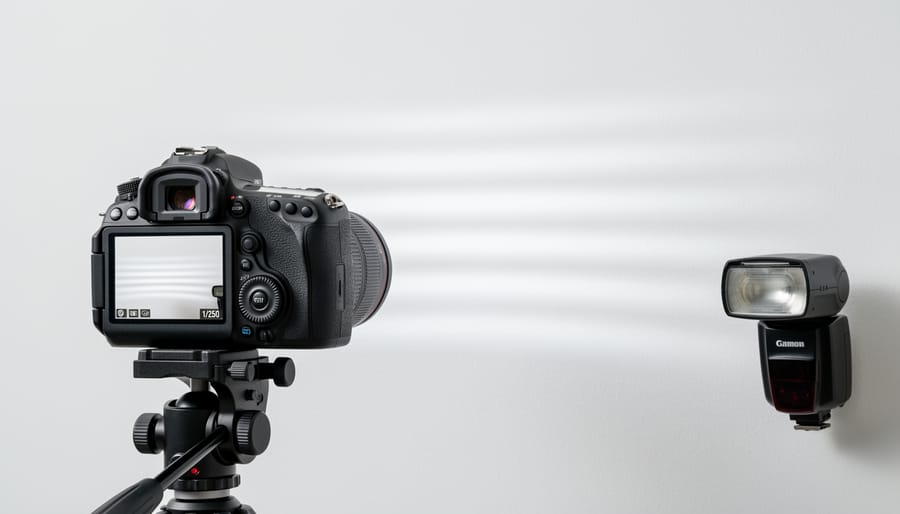
Here’s a straightforward way to discover your camera’s native sync speed and confirm whether high-speed sync is actually working. Grab your camera, flash, and find any plain white or light-colored wall. This simple test shooting methodology takes just five minutes but reveals exactly where your equipment stands.
Set your camera to manual mode and position yourself about three feet from the wall. Turn on your flash and set it to TTL or a moderate manual power like 1/8. Start at your camera’s native sync speed, typically 1/200 or 1/250 second, and take a shot. Review the image on your LCD screen, looking for any dark bands or uneven exposure across the frame. Now increase your shutter speed by one stop to 1/320 or 1/400 and shoot again.
Continue incrementing your shutter speed, checking each image carefully. The moment you see a dark band creeping into your frame, you’ve exceeded your sync speed without high-speed sync enabled. Now activate HSS on your flash and repeat the test at those faster speeds. The bands should disappear, confirming the feature is working properly.
Troubleshooting Common HSS Problems
Even when you think you’ve got everything set up correctly, HSS can sometimes refuse to cooperate. Let’s walk through the most common culprits and their solutions.
If HSS simply won’t activate, start with the basics. First, confirm your camera actually supports HSS—not all models do, particularly older or entry-level bodies. Check that your flash is HSS-compatible and that you’ve enabled the feature in both your camera’s flash menu and on the flash unit itself. Many photographers overlook this dual requirement. Also verify you’re shooting above your camera’s native sync speed; some systems won’t engage HSS until you actually need it.
Compatibility issues between brands can be tricky. While using a Canon flash on a Canon body seems straightforward, third-party flashes often require firmware updates to maintain compatibility with newer camera models. I’ve seen photographers troubleshoot for hours only to discover their flash needed a simple firmware update available on the manufacturer’s website.
Menu settings can be silent saboteurs. Some cameras have “silent shooting” or “electronic shutter” modes that disable flash entirely. Others have custom function settings that limit maximum shutter speeds when using flash. Dig through your camera’s flash-related menus and temporarily reset everything to defaults if you’re stuck.
Wireless triggers present their own challenges. Not all radio triggers support HSS—budget models often sacrifice this feature. Even compatible triggers may require specific settings or channel configurations. When possible, use the manufacturer’s dedicated wireless system, as these typically offer the most reliable HSS performance. If you’re using third-party triggers, verify they explicitly support HSS for your camera brand.
Alternatives to High-Speed Sync
High-speed sync is a powerful tool, but it’s not your only option when you need to control ambient light with flash. Understanding the alternatives can save you money, conserve battery power, and sometimes even produce better results.
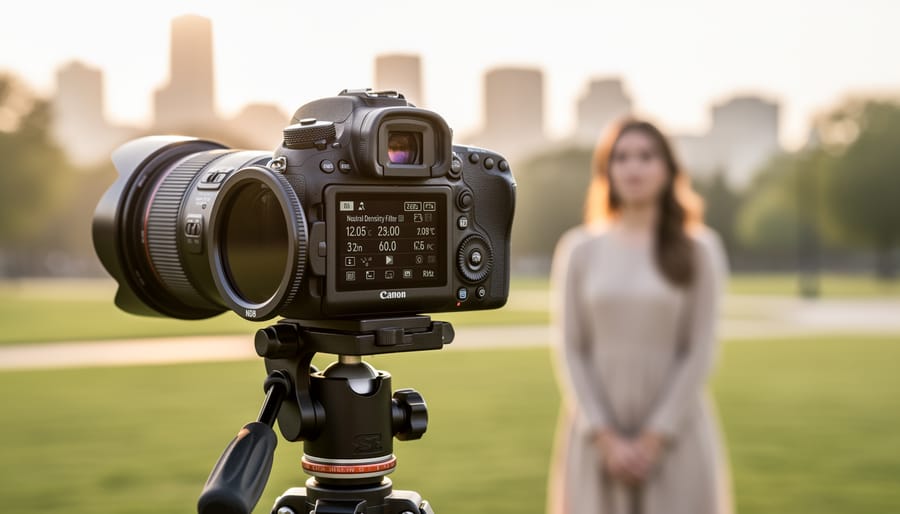
The most effective alternative is using neutral density (ND) filters. These filters reduce the amount of light entering your lens, allowing you to use wider apertures even at your camera’s native sync speed. For example, if you want to shoot at f/2.8 in bright sunlight but your sync speed is 1/250th of a second, a 3-stop ND filter lets you achieve that without needing HSS. The added benefit? Your flash operates at full power efficiency, giving you greater range and faster recycling times. Think of ND filters as sunglasses for your camera, enabling creative freedom without the technical compromises of HSS.
Another practical approach is timing your shoots strategically. Golden hour and blue hour naturally provide softer, more manageable light that works beautifully within native sync speed limitations. Portrait photographers often schedule outdoor sessions during these times specifically to avoid harsh midday sun. You’ll still get gorgeous background blur at f/2.8 or wider, and your flash won’t struggle to overpower intense sunlight.
You can also embrace the native sync speed creatively. At 1/200th or 1/250th of a second, motion blur becomes a creative element rather than a problem. Imagine capturing a dancer mid-movement with flash freezing their face while the background shows subtle motion blur. This technique, sometimes called dragging the shutter, adds dynamic energy to images that HSS alone cannot provide.
Finally, consider using your flash off-camera with a longer lens. By increasing your distance from the subject and using a telephoto lens, you can achieve beautiful background separation even at smaller apertures like f/5.6, which works perfectly within native sync speed constraints in many lighting conditions. This approach is particularly effective for environmental portraits where you want context along with subject isolation.
High-speed sync is an incredibly useful tool, but it’s not always the answer to every outdoor lighting challenge. The key is understanding when you truly need it versus when your camera’s native sync speed will work just fine. Remember, HSS cuts your flash power significantly—often by two or more stops—which means you’ll drain batteries faster and potentially need more powerful (and expensive) equipment.
Before you invest in HSS-capable gear or rely on it for an important shoot, take time to understand your camera’s sync speed limitation. That number, typically somewhere between 1/160th and 1/250th of a second, is your baseline. If you can work within that speed by adjusting your aperture or using neutral density filters, you’ll get more power and efficiency from your flash.
That said, when you need to shoot wide open in bright sunlight, or when you’re trying to freeze action while balancing ambient light, HSS becomes invaluable. It opens creative possibilities that simply aren’t available otherwise. The portrait photographer shooting at f/1.4 in midday sun and the sports photographer mixing flash with fast shutter speeds both depend on this technology.
My strongest recommendation? Test everything before your critical shoots. Experiment with your equipment in similar conditions to what you’ll face. Try different power settings, distances, and shutter speeds. See where your gear’s limits actually are. Understanding these boundaries through hands-on experience will give you confidence when it matters most and help you make faster decisions in the field. Photography is as much about problem-solving as creativity, and HSS is just one more tool in your kit.


 By
By