 By
By 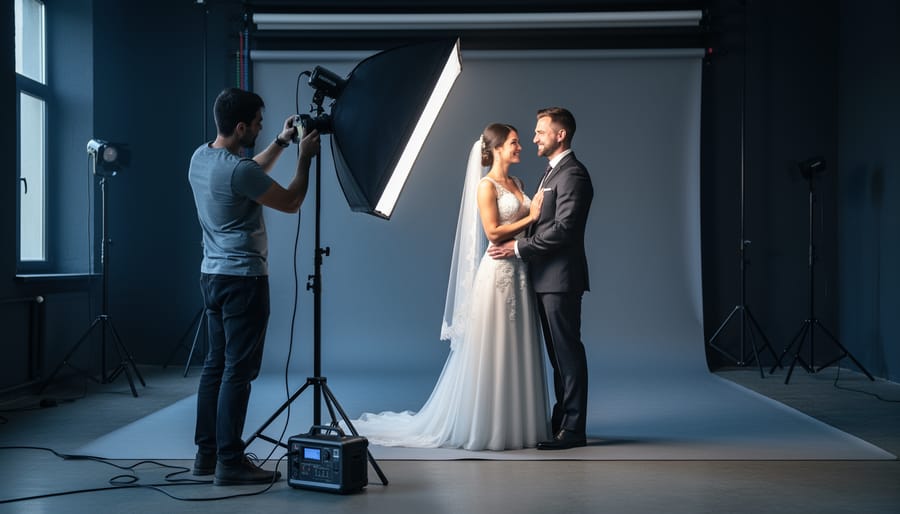
Picture this: You’re halfway through a high-paying wedding shoot when the power cuts out. Your strobes go dark, your continuous lights fade, and you’re left scrambling with nothing but window light and a panicked couple. For professional photographers, a single power failure can mean lost revenue, damaged reputation, and disappointed clients who’ve invested thousands in capturing their most important moments.
Emergency power and lighting equipment isn’t just insurance against worst-case scenarios—it’s professional infrastructure that separates reliable studios from vulnerable ones. Whether you’re running a brick-and-mortar studio, shooting on location, or working from a home setup, understanding your power requirements and having backup systems in place protects both your business continuity and creative workflow.
The challenge lies in matching equipment to your actual needs. A portrait photographer with a simple two-light setup requires vastly different solutions than a commercial shooter running multiple high-wattage strobes, computers, and climate control systems. Getting this wrong means either overspending on unnecessary capacity or, worse, investing in backup systems that fail when you need them most.
This guide walks you through calculating your studio’s power requirements, evaluating different emergency power solutions from portable battery packs to whole-studio generators, and implementing safety protocols that protect your equipment investment. You’ll learn which specific products match different studio types and budgets, along with practical tips drawn from real photographers who’ve navigated power failures successfully. By the end, you’ll have a clear roadmap for building reliable emergency power infrastructure tailored to your exact shooting conditions.
Why Studio Photographers Need Emergency Power (It’s Not Just About Backup)
Emergency power isn’t just about keeping your lights on when the grid fails. It’s about protecting your business, your reputation, and thousands of dollars in equipment from scenarios that happen more often than you might think.
Consider this: you’re midway through a corporate headshot session when the building’s circuit breaker trips because someone plugged in a space heater three offices down. Your strobes die, your client checks their watch, and you’re scrambling to reset breakers you don’t have access to. Or imagine booking a lucrative wedding shoot at a historic venue, only to discover their electrical system can’t handle your lighting setup. Without backup power, you’re either shooting in compromised conditions or potentially losing that client forever.
Power outages affect the average American home for 8 hours annually, according to recent utility data, but commercial and older buildings face even higher rates. For photographers who rent studio spaces or work on location, these disruptions can mean immediate income loss. A single missed shoot can cost anywhere from a few hundred to several thousand dollars, making emergency power systems pay for themselves after just one or two saves.
The equipment damage factor is equally concerning. Power surges cause an estimated 80 billion dollars in equipment damage across all industries each year. Photography gear, with its sensitive electronics and calibration requirements, is particularly vulnerable. A sudden voltage spike can fry your strobe’s capacitors, corrupt your camera’s firmware, or damage your computer’s hard drive along with unbackup images. Quality emergency power systems include surge protection that shields your gear from these invisible threats.
Remote location shoots present another challenge entirely. That abandoned warehouse with perfect lighting? Probably no power. The beach at sunset? Definitely no outlets. Emergency power solutions transform these locations from impossible to ideal, expanding your creative possibilities while ensuring you can deliver consistent, professional results regardless of infrastructure limitations. It’s not paranoia; it’s professional preparedness that separates photographers who consistently deliver from those who make excuses.
Understanding Your Studio’s Power Requirements
Calculating Wattage for Your Lighting Setup
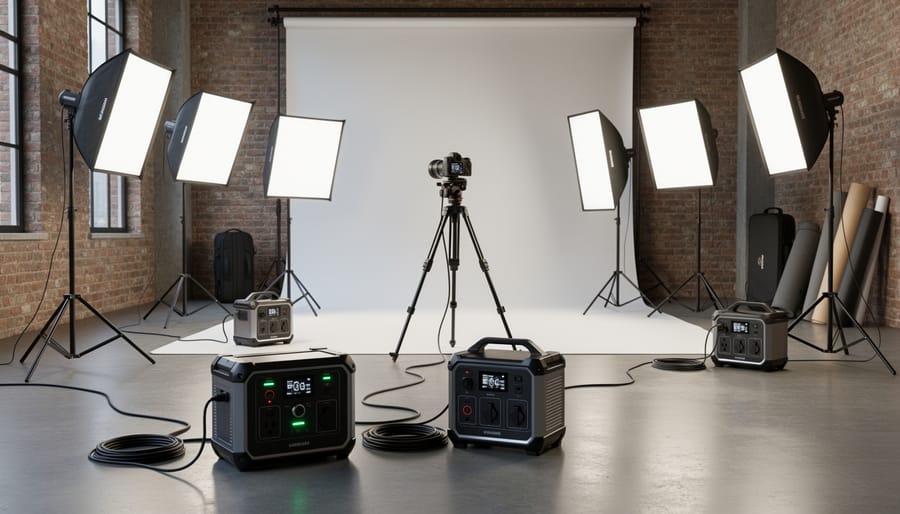
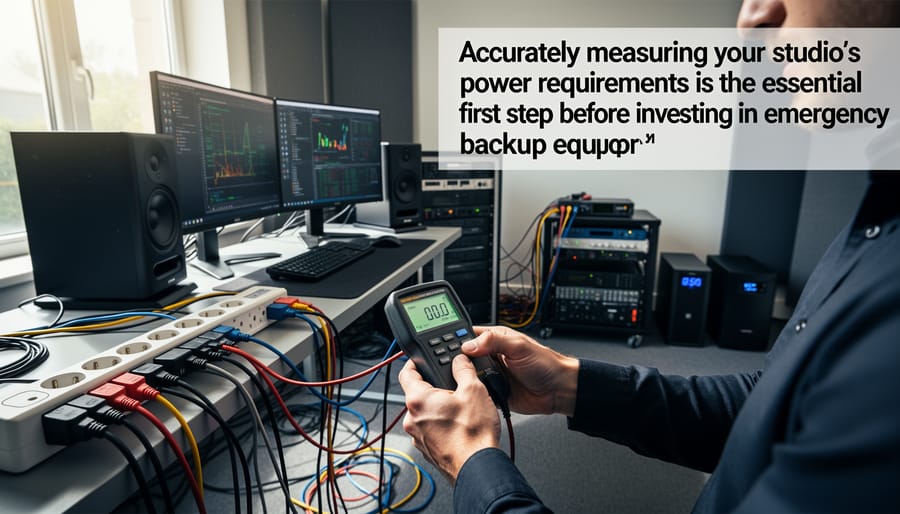
Understanding your total power requirements is essential before investing in emergency backup solutions. Let’s walk through calculating the wattage needs for a typical studio lighting setup, so you’ll know exactly what capacity your backup power system needs to handle.
Start by listing every piece of equipment you’ll use during a typical shoot. For strobes, you need to look beyond the flash output rating. A Godox AD600Pro might advertise 600 watt-seconds of flash power, but during recycling, it draws approximately 650 watts from your power source. Similarly, a Profoto B10 Plus rated at 500 watt-seconds actually draws about 300 watts during operation. These numbers matter when sizing your backup system.
For continuous lights, the calculation is more straightforward. An Aputure 600d Pro draws exactly 600 watts when running at full power. Two of these units would require 1,200 watts combined. Remember that LED panels like the Godox FL150R consume only 150 watts but can still provide substantial output for video work or product photography.
Now add your modifiers and accessories. A laptop typically draws 60-100 watts, while your camera battery chargers need another 50-100 watts. Even items like a ring light for behind-the-scenes content or a small fan for comfort can add 20-50 watts each.
Here’s a practical example: Two Godox AD600Pro strobes (1,300 watts), one Aputure 300d continuous light (360 watts), a laptop (80 watts), and miscellaneous chargers (75 watts) total 1,815 watts. Add a 20 percent safety buffer, and you’re looking at approximately 2,200 watts of required capacity for your emergency power solution.
Don’t Forget Your Support Equipment
When calculating your emergency power needs, it’s easy to focus on the obvious equipment like strobes and continuous lights while completely overlooking the support gear that keeps your studio functioning. These “invisible” power draws can quickly add up and catch you off-guard during an outage.
Let’s start with your workstation. A typical desktop computer draws between 200-500 watts under normal use, while monitors add another 30-60 watts each. If you’re running a dual-monitor setup for tethered shooting or client review, that’s already 300-600 watts before you’ve powered a single light. Laptops are more efficient at 50-100 watts, making them a smarter choice for emergency situations.
Charging stations represent another hidden drain. Modern studios often need to keep multiple camera batteries, phone chargers, and tablet chargers running simultaneously. Each phone charger pulls 5-20 watts, but when you’re charging three cameras, two phones, and a tablet, you’re looking at 100+ watts combined.
Climate control is perhaps the most overlooked power hog. A small space heater can draw 1,500 watts, while a portable air conditioner might pull 1,000-1,500 watts. During extreme weather when you need backup power most, running climate control can quickly drain your battery reserves. Consider whether you can work without it temporarily, or if you need to significantly upsize your power system.
Here’s a real-world example: A photographer recently told me his 1,500-watt backup system kept failing during sessions. After investigating, he discovered his computer, two monitors, phone chargers, and a small fan were consuming 650 watts before any photography equipment was even powered on.
Types of Emergency Power Solutions for Photography Studios
Uninterruptible Power Supply (UPS) Systems
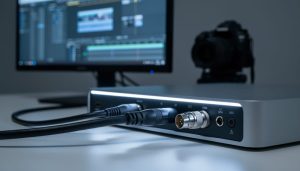
Think of a UPS system as a sophisticated bridge that stands between your photography equipment and the unpredictable power grid. When the lights go out, a UPS provides instantaneous backup power, so seamless that your computer won’t even know anything happened. Unlike generators that take seconds to start, a UPS kicks in within milliseconds, making it essential for protecting sensitive electronic equipment in your studio.
Here’s how they work: A UPS contains a battery that’s constantly charged while plugged into wall power. When it detects an outage or voltage irregularity, it instantly switches to battery power through an inverter that converts DC battery power to the AC power your equipment needs. Better models use what’s called double-conversion technology, where your equipment always runs on battery power that’s being continuously recharged, eliminating any switching delay whatsoever.
For photographers, runtime expectations are typically measured in minutes rather than hours. A 1500VA UPS running a desktop computer, two monitors, and an external hard drive might provide 15-20 minutes of power. That’s not meant for continuing a full shoot, but rather for safely saving your work and shutting down equipment properly. If you’re in the middle of a critical file transfer or tethered shooting session, those minutes are invaluable.
Popular options include the APC Back-UPS Pro 1500VA, which offers about 10 outlets and sufficient capacity for a workstation setup, typically running between 200-250 dollars. For larger studios with multiple computers or NAS systems, the CyberPower CP1500PFCLCD provides pure sine wave output that’s gentler on power supplies. I recommend calculating your total wattage needs and choosing a UPS rated at least 25 percent higher to account for startup surges and maintain battery longevity.
Portable Power Stations (Battery Generators)
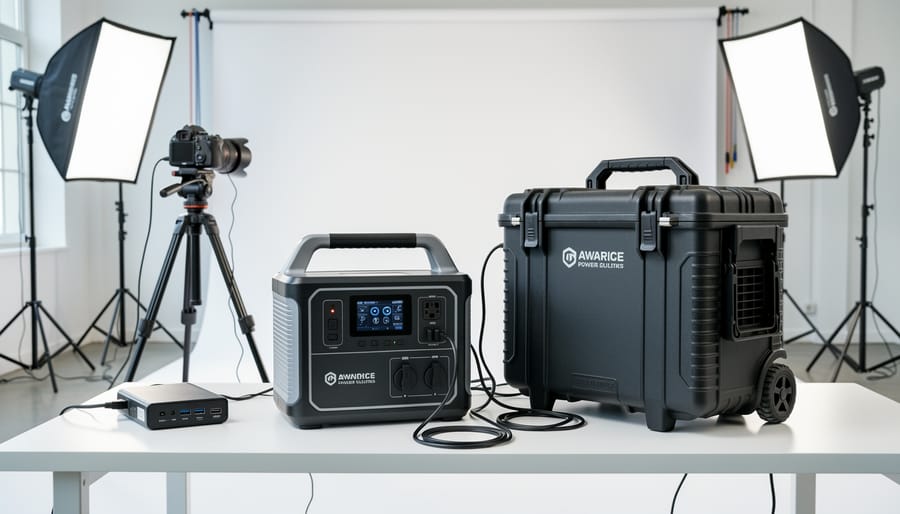
Modern portable power stations have revolutionized how photographers approach location work and emergency backup power. Unlike traditional gas generators, these lithium battery-powered units are silent, emission-free, and safe to use indoors, making them ideal for studio environments during power outages.
These battery generators essentially function as massive rechargeable power banks with standard AC outlets, USB ports, and sometimes DC outputs. Capacity ranges from compact 300Wh units suitable for charging camera batteries and powering laptops, up to hefty 3000Wh+ models capable of running studio strobes and continuous lights for hours.
For photography applications, the sweet spot typically falls between 500Wh and 1500Wh. A 1000Wh unit, for example, can power a 400-watt strobe for approximately two hours of continuous use, accounting for efficiency losses. This is usually sufficient for portrait sessions or product photography during brief outages. Popular models among photographers include the Jackery Explorer series, EcoFlow Delta line, and Goal Zero Yeti range. The EcoFlow Delta Pro particularly stands out for its expandable capacity and fast recharging capability, reaching 80 percent in under an hour.
The main advantages are obvious: zero noise pollution during shoots, no fumes, instant power availability, and minimal maintenance. However, limitations exist. These units are expensive relative to their power capacity, with quality models costing several hundred to several thousand dollars. They also take hours to recharge, unlike gas generators that simply need refueling. Cold temperatures significantly reduce lithium battery performance, and total capacity degrades over years of use.
When selecting a portable power station, calculate your actual power needs including surge requirements for equipment startup, then choose a model with at least 20 percent extra capacity as a safety margin.
Gas and Propane Generators
Gas and propane generators have been the workhorses of emergency power for decades, and they’re incredibly effective in the right circumstances. These traditional generators excel at outdoor events, location shoots, and venues where noise and exhaust aren’t deal-breakers. A 3,500-watt gas generator can power multiple strobes and keep your laptop charged during an all-day wedding shoot in a park or remote outdoor location.
However, studio photographers should approach gas and propane generators with caution. The primary concern is ventilation. These generators produce carbon monoxide, a colorless, odorless gas that’s potentially fatal in enclosed spaces. You absolutely cannot run a gas generator inside your studio, attached garage, or any area without adequate outdoor ventilation. Even opening windows isn’t sufficient – these units need to be positioned outside, at least 20 feet from any building openings.
Noise is the second major consideration. Gas generators typically operate at 65-75 decibels, roughly equivalent to a vacuum cleaner running constantly. This makes conversation difficult and renders them completely impractical for video work or any situation requiring clean audio. Your clients won’t appreciate shouting over engine noise during portrait sessions.
For outdoor photographers shooting events, commercial work, or environmental portraits, gas generators remain viable options. They’re cost-effective per watt generated and fuel is readily available. Just plan for the logistics: storing fuel safely, regular maintenance schedules, and positioning the generator far enough away to minimize noise intrusion. For indoor studio work, battery-based solutions or properly installed backup power systems are almost always the better choice.
Emergency Lighting Options That Actually Work on Battery
Battery-Powered Strobes and Speedlights
When the power goes out mid-shoot, battery-powered strobes and speedlights become absolute lifesavers. Unlike studio strobes that depend on wall power, these self-contained units keep firing regardless of what’s happening with the electrical grid. I’ve seen photographers complete entire wedding receptions by speedlight alone when venues lost power, and the clients never knew there was an issue.
The beauty of modern speedlights lies in their versatility. A quality unit like the Godox V1 or Canon Speedlite 600EX II-RT can deliver hundreds of full-power flashes on a single set of batteries. They’re part of your essential lighting equipment precisely because they offer this independence. Battery-powered strobes like the Profoto B10 take this concept further, providing studio-quality output with rechargeable lithium-ion packs that last for hundreds of full-power pops.
The key to reliability is maintaining a charging routine. Keep spare battery sets on rotation, charging them after every shoot regardless of how much capacity remains. Invest in a quality battery charger that shows individual cell status. For lithium-ion powered strobes, follow the manufacturer’s storage guidelines, typically keeping them at 40-60% charge when not in use for extended periods.
Consider this practical backup system: two speedlights with four sets of rechargeable batteries each, plus one battery-powered strobe with two spare battery packs. This setup ensures you’re never caught without light, whether facing a power outage or shooting on location where outlets don’t exist.
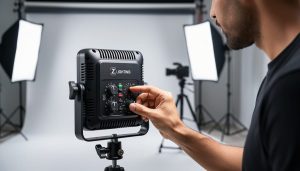
LED Continuous Lights: Your Low-Power Allies
When the power goes out during a crucial shoot, LED continuous lights become your best friends. Unlike traditional tungsten or halogen lights that guzzle electricity like a thirsty camel, LEDs sip power delicately while delivering impressive output.
Here’s the real-world difference: a 100-watt LED panel can produce the same brightness as a 500-watt tungsten light. That’s an 80% reduction in power consumption. During an emergency when you’re running on battery backup or a generator, this efficiency means your lights can run five times longer on the same power source.
I learned this lesson the hard way during a corporate headshot session when our building lost power. My old 300-watt tungsten softbox drained my portable battery in under 30 minutes. Now I use 60-watt LED panels that run for three hours on the same battery, giving me plenty of cushion to finish the job.
Beyond runtime, LEDs generate minimal heat, which matters when you’re working in enclosed spaces without climate control during outages. They’re also more durable than fragile tungsten bulbs, making them reliable allies when conditions aren’t perfect. Investing in energy-efficient studio lighting isn’t just environmentally conscious; it’s practical emergency preparedness.
Electrical Safety Essentials Every Photographer Should Know
Avoiding Circuit Overload and Equipment Damage
Understanding how to safely distribute electrical loads isn’t just about protecting your equipment—it’s about preventing fires, data loss, and potentially dangerous situations during shoots. I learned this lesson the hard way during a commercial shoot when I unknowingly overloaded a circuit, tripping breakers right before the client arrived.
Circuit breakers exist for a reason: they’re your first line of defense against overload. Most standard household circuits provide 15 or 20 amps at 120 volts. To calculate your safe load capacity, multiply amps by volts (a 15-amp circuit provides 1,800 watts), then use only 80 percent of that capacity for continuous loads—giving you about 1,440 watts of usable power. When you consider that a single 1,000-watt strobe, a laptop, and a few modeling lights can quickly approach this limit, you can see how easy it is to run into trouble.
When setting up your emergency power system, distribute loads across multiple circuits whenever possible. I keep different colored tape on my extension cords to track which circuit they’re connected to, preventing accidental overloading. Your power distribution setup should account for startup surges—some equipment draws significantly more power when first switched on than during normal operation.
Warning signs of electrical problems demand immediate attention. If you notice flickering lights, warm outlets or plugs, buzzing sounds from equipment, or frequently tripping breakers, stop using that circuit immediately. These symptoms often indicate loose connections, damaged wiring, or sustained overload conditions. During one studio session, I noticed a slightly warm plug on my backup generator connection—investigating revealed a loose connection that could have caused serious damage.
Power distribution units with built-in circuit breakers and surge protection provide an extra safety layer, allowing you to monitor individual device consumption and respond quickly if problems develop.
Surge Protection and Power Conditioning
Here’s a scenario many photographers learn the hard way: you plug your $3,000 strobe into what looks like a surge protector, only to discover after a lightning strike that it was just a basic power strip offering zero protection. The difference between these two devices can mean the difference between a minor inconvenience and a major insurance claim.
Power strips simply multiply available outlets, while true surge protectors actively monitor incoming voltage and divert excess electricity away from your equipment. When voltage spikes occur from lightning strikes, power grid fluctuations, or even heavy machinery cycling on the same circuit, surge protectors sacrifice themselves to save your gear.
For photography equipment, look for surge protectors with these specifications: a minimum rating of 2,000 joules (higher for strobes and continuous lights), response time under one nanosecond, and connected equipment warranty coverage. Quality units include EMI/RFI filtering, which conditions power by removing electromagnetic interference that can cause flickering in budget-friendly LED panels.
I recommend avoiding cheap big-box store models. Instead, invest in brands like Tripp Lite, APC, or Furman, which are trusted in professional environments. Check that your unit includes individual circuit breakers and properly spaced outlets to accommodate bulky power adapters. Remember, surge protectors degrade with each voltage spike, so replace them every few years or immediately after protecting against a major surge event.
Safe Generator and Battery Station Operation
Safe generator operation starts with proper grounding and location. Always position generators outdoors, at least 20 feet from any building openings, doors, or windows. Carbon monoxide is odorless and deadly—it can seep into your studio faster than you think, and I’ve heard too many close-call stories from photographers who thought “just this once” wouldn’t matter.
For proper ventilation with battery stations, ensure your charging area has adequate airflow, especially when using lithium batteries. These units generate heat during heavy discharge or recharge cycles, and overheating shortens their lifespan considerably.
When connecting equipment, always turn off the generator before plugging in devices. Use heavy-duty outdoor-rated extension cords appropriate for your wattage needs—undersized cords create heat and fire hazards. Never backfeed power into your building’s electrical panel without a proper transfer switch; this endangers utility workers and violates electrical codes.
Common mistakes include overloading circuits by plugging in everything at once. Instead, stagger your startup sequence, beginning with your most critical lighting first. Also, avoid running generators in wet conditions without proper covers, and never refuel while the engine is hot or running. These simple precautions protect both your expensive photography gear and, more importantly, your safety during shoots.
Building Your Emergency Power Plan: A Practical Approach
Budget-Friendly Solutions for Home Studio Photographers
Starting a home photography studio doesn’t mean you need to drain your savings on emergency power solutions. Let’s be honest—when you’re building your business or pursuing photography as a serious hobby, every dollar counts.
For basic backup power, consider a mid-range portable power station in the 500-1000Wh capacity range. Brands like Jackery Explorer 500 or EcoFlow River Pro offer reliable performance between $400-700. These units will keep two or three speedlights running for several hours during an outage, which is sufficient for most portrait sessions. Yes, you’re sacrificing continuous strobes for speedlights, but that’s an acceptable compromise when you’re starting out.
The reality is that budget-conscious photographers need to prioritize differently. Instead of investing in a full uninterruptible power supply system, focus on battery-powered lighting. Modern LED panels like the Neewer 660 or Godox SL60W with optional battery adapters provide flexibility without requiring heavy-duty backup power infrastructure. This approach costs roughly $300-500 total while maintaining professional results.
One practical strategy is building your emergency kit incrementally. Start with battery-powered speedlights that you likely already own, add a basic power station for charging between sessions, then upgrade to powered strobes once your business justifies the investment. Remember, clients judge your final images, not your power backup system. Many successful photographers have built thriving businesses starting with exactly this tier of equipment.
Professional-Grade Systems for Commercial Studios
When your livelihood depends on delivering consistent results, consumer-grade backup solutions simply won’t cut it. Commercial studios require robust systems designed for continuous operation and zero compromise on reliability.
The foundation of professional emergency power starts with modular UPS systems, typically in the 3000VA to 5000VA range. Brands like APC Smart-UPS and Eaton 9PX series offer hot-swappable batteries, meaning you can replace battery modules without powering down your entire professional lighting setup. These units provide sine wave output essential for sensitive equipment and can support multiple strobes, continuous lights, and computer workstations simultaneously.
For extended outages, commercial studios should integrate standby generators rated for 7500 watts or higher. Generac and Kohler manufacture automatic transfer switch systems that detect power loss and engage backup power within 10 seconds. I’ve witnessed these systems save six-figure wedding shoots when storms knocked out grid power for hours.
Redundancy planning separates professionals from amateurs. This means having backup batteries for your UPS, spare lighting units already connected to separate power circuits, and documented load distribution plans. Consider splitting your critical equipment across multiple power sources so a single point of failure never stops production.
Many successful studios also maintain relationships with equipment rental houses for emergency gear. When everything else fails, knowing you can source replacement strobes within two hours provides invaluable peace of mind when clients are waiting.
Maintenance and Preparedness: Making Sure Your Backup Actually Works
Here’s the uncomfortable truth: most backup systems fail not because of equipment malfunction, but because nobody bothered to check if they actually worked. I learned this the hard way during a commercial shoot when my supposedly “ready” UPS had dead batteries after sitting unused for eighteen months. The client wasn’t amused, and neither was my reputation.
Testing your emergency power equipment isn’t just good practice—it’s essential insurance. Schedule monthly load tests for all backup systems. For UPS units, this means unplugging them from the wall while running actual studio loads for at least 15 minutes. Note the runtime carefully. If your 1500VA UPS used to power your lights for 20 minutes but now only manages 8, those batteries are telling you something important.
Battery maintenance deserves special attention because batteries are usually the weakest link. Lead-acid batteries in UPS systems typically need replacement every 3-5 years, though this varies with temperature and usage. Keep your backup equipment in climate-controlled spaces—heat is battery enemy number one. If your UPS lives in a sweltering storage closet, expect half the normal lifespan.
For portable generators, run them under load for at least 30 minutes every month. Change the oil according to manufacturer specifications, typically after 50-100 hours of use or annually, whichever comes first. Fuel stabilizer is non-negotiable if gasoline will sit for more than 30 days—stale fuel causes more generator problems than any other issue.
Create a simple emergency protocol document that lives near your equipment. Include startup procedures, load priorities (which lights or equipment matter most), and troubleshooting basics. During an actual power failure isn’t the time to figure out which breaker feeds what outlet.
Consider keeping a log sheet with each backup system. Record test dates, runtime results, and any maintenance performed. This simple habit transforms emergency preparedness from wishful thinking into documented reliability. When that power failure eventually happens, you’ll shoot through it confidently rather than scrambling in the dark.
Here’s the truth: investing in emergency power and lighting equipment isn’t about being paranoid or expecting disaster around every corner. It’s about professional preparedness, plain and simple. Just like you wouldn’t show up to a wedding shoot without backup memory cards or an extra camera body, you shouldn’t operate a studio or take on critical assignments without some form of power protection.
Think about what you stand to lose during a power outage. For some photographers, it’s an afternoon of inconvenience. For others, it’s thousands of dollars in lost bookings, damaged client relationships, or corrupted files from an improperly shut-down workstation. The good news? You don’t need to invest tens of thousands of dollars overnight to protect yourself.
Start by honestly assessing your vulnerability. How often does your power flicker? What work would be catastrophic to lose? Are you shooting time-sensitive events or working with clients who’ve traveled to your location? Based on these answers, you can prioritize your investments, beginning with basic surge protection and UPS units for critical equipment, then scaling up to generators or battery systems as your business grows and your needs expand.
The smartest step you can take right now is to audit your current setup. Walk through your studio or workspace and identify every piece of equipment that would cause problems if the power failed this instant. Calculate your power needs, research your options, and create a realistic timeline for implementing protection measures. Your future self, facing an unexpected outage with confidence rather than panic, will thank you.
 By
By