 By
By 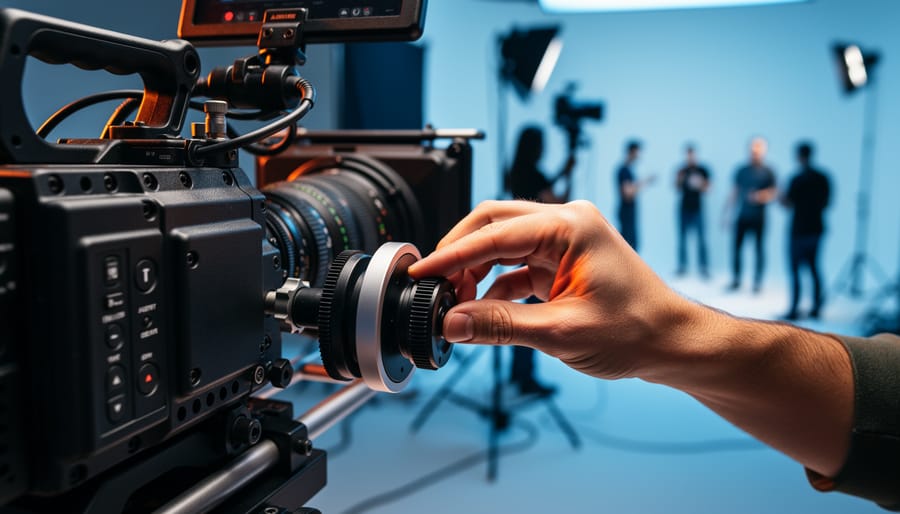
Focus pulling separates amateur footage from cinematic storytelling, and q-focus represents one of the most sophisticated approaches to achieving rack focus transitions. This wireless follow focus system transforms how camera operators execute focus shifts during live recording, replacing guesswork with precision-mapped focus points that can be triggered on demand. Unlike traditional manual focus pulling that requires estimating distances and memorizing lens markings, q-focus allows you to pre-program exact focus positions—say, from an actor’s face at three feet to a doorway at fifteen feet—then execute that transition smoothly with a single trigger command.
The technology emerged from the professional cinema world where focus pullers needed repeatable, frame-accurate transitions across multiple takes. Consider a dialogue scene where focus must shift between two actors at different depths: q-focus lets you rehearse and save those exact positions, then recall them instantly during the actual take. This eliminates the common problem of slightly missing your mark on the second or third attempt, which wastes time and frustrates directors.
What makes q-focus particularly valuable is its integration with modern wireless focus systems. You’re not just turning a focus ring—you’re working with a system that remembers coordinates and can execute transitions at varying speeds. A slow, contemplative shift might take eight seconds as the camera lingers on background details before revealing the foreground subject. A rapid transition might snap focus in under a second during an action sequence.
Understanding when q-focus provides genuine advantage versus when traditional pulling suffices helps you choose the right tool for each shooting scenario. This guide explores the technical foundations, equipment requirements, and practical applications that make q-focus essential for demanding cinematography work.
What Exactly Is Q-Focus?
Q-focus is a specialized technology that creates digital reference points on your lens’s focus ring, allowing you to mark and return to specific focus distances with remarkable accuracy. Think of it as creating invisible bookmarks on your focus barrel—points you can feel as subtle resistance or see as indicators on a display, making it possible to pull focus between predetermined positions repeatedly and consistently.
The technology has its roots in professional cinema cameras and high-end focus systems, where precision is paramount. In film production, focus pullers need to shift focus seamlessly between subjects during a single take, often while the camera is moving. Missing focus by even a fraction can ruin an expensive shot with multiple actors, complicated lighting setups, and costly production time on the line. Q-focus emerged as a solution to make these transitions reliable and repeatable.
At its core, q-focus works by electronically marking positions on compatible lenses or wireless follow focus systems. When you find your desired focus point—say, an actor’s face at ten feet—you can save that exact position. Move to your second subject at twenty feet, save that position too, and the system now knows both points. During the actual take, you can smoothly pull between these marked positions, with the system providing tactile feedback or visual cues to confirm you’ve hit your marks.
What makes this particularly valuable is the repeatability factor. In multi-take scenarios, you can return to the exact same focus points take after take, maintaining consistency across your footage. This becomes crucial when shooting coverage from different angles or when reshoots are necessary.
The technology varies slightly depending on the manufacturer—some systems use motors to create physical resistance at marked points, while others display reference indicators on a controller or monitor. But the fundamental principle remains the same: transforming the traditionally analog art of focus pulling into a more precise, repeatable process without sacrificing the organic feel that manual focus control provides.
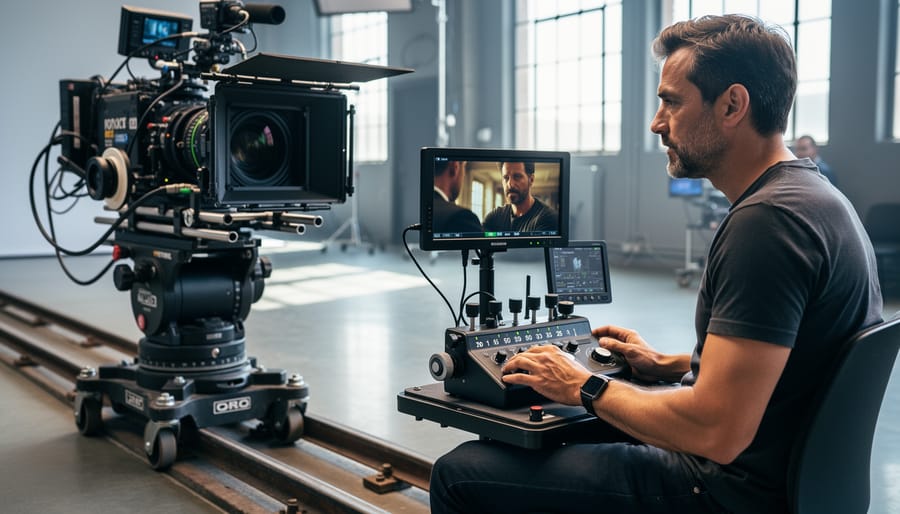
How Q-Focus Works in Practice
Setting Your Focus Marks
Setting your focus marks properly can mean the difference between a crisp, professional-looking shot and a frustrating series of missed focus points. The good news is that with q-focus, the process becomes surprisingly straightforward once you understand the fundamentals.
Start by determining how many marks you’ll actually need. For a simple two-person dialogue scene, two marks are often sufficient—one for each actor’s face. More complex movements might require three to five reference points. Here’s a practical rule: set a mark wherever your subject will pause or where critical action occurs. Avoid overcomplicating things with too many marks, especially when you’re first learning the system.
The physical process is simple. Position your subject at the first focus point, then use your follow focus wheel to rack focus until they’re sharp in your monitor or viewfinder. Press the appropriate button on your wireless follow focus unit to store that mark. Repeat this process for each subsequent position. Most systems let you store marks sequentially, making it easy to remember which button corresponds to which position.
Before you commit to rolling, always test your marks. Have your talent rehearse the movement while you trigger each stored position in sequence. Watch carefully for any drift or imprecision—environmental factors like temperature changes can slightly affect lens calibration. This verification step takes just thirty seconds but saves you from discovering focus issues during post-production when it’s too late to reshoot. If something feels off, simply reset that particular mark and test again.
Executing Repeatable Focus Pulls
Once you’ve marked your focus positions, the real magic of q-focus begins. The system allows you to execute smooth, repeatable focus transitions by simply rotating the focus ring between your pre-set marks. Here’s how to make the most of this feature across multiple takes.
Start by practicing your pull without recording. Rotate the focus ring from position A to position B at different speeds to get a feel for the timing. Most q-focus systems allow you to control the duration of the transition—anywhere from a quick snap focus taking half a second to a slow, dramatic pull lasting several seconds. The beauty is that once you find the right speed for your scene, the camera remembers it and replicates that exact timing every time you execute the move.
For scenes involving dynamic camera movements, consistency becomes essential. Imagine you’re shooting a dolly shot where an actor walks toward camera while you pull focus from the background to their face. With traditional manual focus, getting identical results on take five as you did on take two is challenging. Q-focus eliminates this variable. As long as your camera position and the actor’s blocking remain consistent, your focus transition will be identical every single time.
Timing your pull with action is straightforward. Most focus pullers coordinate the start of their rotation with a visual cue—perhaps when an actor begins speaking or reaches for an object. Practice this coordination during rehearsals, and you’ll find that muscle memory develops quickly. The marked positions provide tactile feedback, so you don’t need to watch the focus ring while executing the pull, allowing you to keep your eyes on the monitor or the action itself for perfect timing.
Q-Focus vs. Traditional Focus Pulling Methods
Let’s get real for a moment: q-focus is impressive, but it’s not always the right tool for every situation. Understanding how it stacks up against traditional focus pulling methods helps you make smarter choices on set.
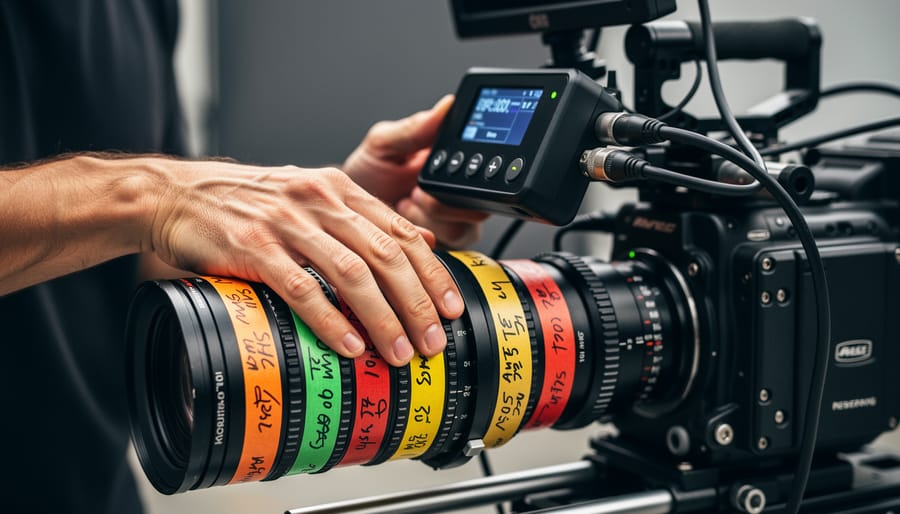
Traditional focus pulling relies on three primary techniques that have served cinematographers for decades. Witness marks—those pieces of white tape placed on your focus ring—remain the gold standard for repeatable, precise focus pulls. They’re analog, reliable, and work on any lens regardless of electronic capabilities. When you need to nail the same rack focus fifty times for a commercial shoot, witness marks combined with measured distances rarely let you down.
Then there’s the tape measure method, where your assistant measures distances from the sensor plane to your subject’s eye. It sounds tedious, but for static shots with predictable subject positions, this approach delivers mathematical precision. No batteries required, no calibration needed, and it works with any camera and lens combination from a vintage Cooke to modern glass.
Pure instinct—what veteran focus pullers develop over thousands of hours—shouldn’t be underestimated either. Experienced operators develop an almost supernatural ability to feel focus through subtle changes in the image. This method excels in documentary situations where subjects move unpredictably and you’re working fast without time for marks or measurements.
So where does q-focus fit? It shines brightest in scenarios where traditional methods struggle. Multi-camera shoots benefit enormously because one focus puller can control multiple cameras simultaneously through wireless systems. Live broadcasts and reality television, where crew size is limited and action is spontaneous, see immediate advantages. The technology also excels during complex dolly moves where distance relationships constantly change—your follow focus calculates adjustments faster than mental math allows.
However, q-focus has clear limitations. It requires compatible lenses with built-in encoders or external encoder systems, which adds cost and setup time. Battery dependence introduces another potential failure point. Traditional methods carry no such constraints. Additionally, q-focus systems need calibration and occasional troubleshooting, whereas witness marks work until someone physically removes them.
The honest answer? Most professional focus pullers use a hybrid approach. They’ll leverage q-focus’s advantages for complex shots while keeping witness marks as backup references. On documentary projects where gear must stay minimal, traditional methods often prove more practical. For high-budget narrative work with controlled environments, q-focus integration streamlines workflow considerably.
Consider your specific needs: budget constraints, crew size, shooting style, and equipment ecosystem. Neither approach universally beats the other—they’re simply different tools solving different problems. The best focus pullers master all techniques and choose strategically based on each project’s demands.
Camera Systems and Equipment That Support Q-Focus
Professional Cinema Cameras
When you’re working with high-end cinema cameras, q-focus integration becomes remarkably streamlined. ARRI’s ALEXA series, for instance, has long supported lens data systems that communicate directly with wireless follow focus units, making q-focus workflows feel almost effortless on set. The camera receives precise distance information from compatible professional cinema lenses, displaying real-time focus data on monitors and recording metadata that’s invaluable in post-production.
RED cameras like the KOMODO and V-RAPTOR feature similar integration capabilities when paired with compatible lens control systems. Sony’s VENICE line stands out for its sophisticated lens metadata recording, which works beautifully with Preston and ARRI wireless systems to provide frame-accurate focus information.
What makes these professional systems special isn’t just the technology—it’s the reliability. When you’re on a commercial shoot with hundreds of people waiting, you need gear that communicates flawlessly. These cameras are designed from the ground up to work within established cinema workflows, ensuring that your focus puller can mark positions confidently and hit them repeatedly throughout a demanding shooting day. The investment pays dividends in consistency and peace of mind.
Third-Party Focus Control Systems
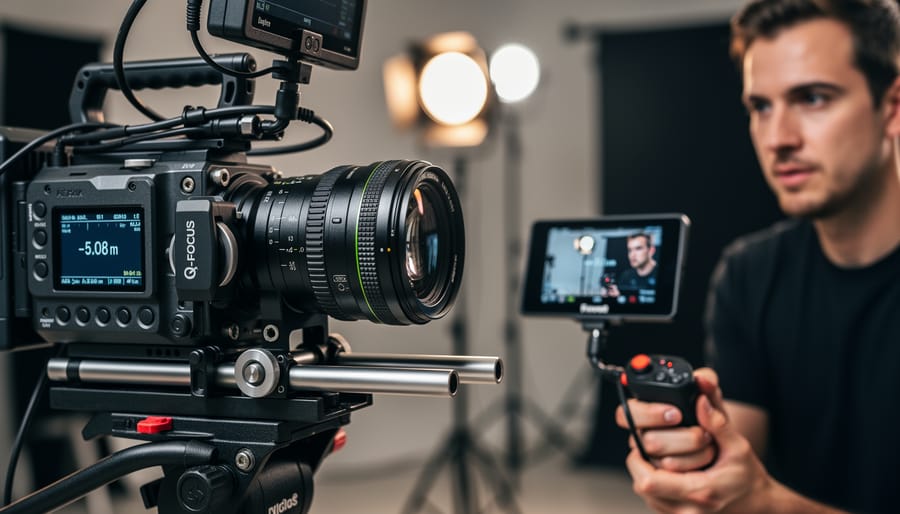
If your camera doesn’t have built-in q-focus capability, don’t worry—several third-party wireless follow focus systems can add this functionality to your setup. These lens control systems have become game-changers for cinematographers working with cameras that lack native quick-focus features.
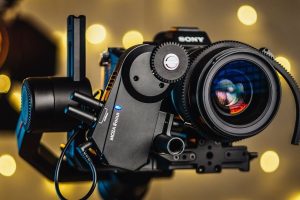
Wireless follow focus units like the Tilta Nucleus-M and DJI Ronin 4D Hand Grips offer q-focus functionality through their handset controllers. These systems work by allowing you to mark focus points during setup, then instantly recall them with a button press during shooting. Think of it as creating a focus bookmark system that lives in your wireless controller rather than the camera body.
The way it works is straightforward: during rehearsal, you’ll rotate your focus wheel to a specific point—say, an actor’s face—and press a button to save that position. When you need to return to that exact focus point during the take, a single button press will command the motor to rack focus to that saved position. You can typically store multiple points, making complex focus pulls between three or more subjects much more manageable.
Preston Cinema Systems and Arri’s WCU-4 represent the professional end of this spectrum, offering extremely precise lens control with customizable speed curves and multiple saved positions. These systems are standard on major film productions where repeatable, frame-accurate focus pulls are essential.
The beauty of these third-party solutions is their versatility—they work across different camera brands and can often control zoom and iris simultaneously, making them invaluable tools for serious video work.
When Q-Focus Becomes Your Best Friend
Complex Choreographed Movements
When you’re orchestrating scenes with multiple actors moving through space while the camera itself performs intricate maneuvers, repeatability becomes absolutely essential. This is where q-focus truly demonstrates its value in professional production environments.
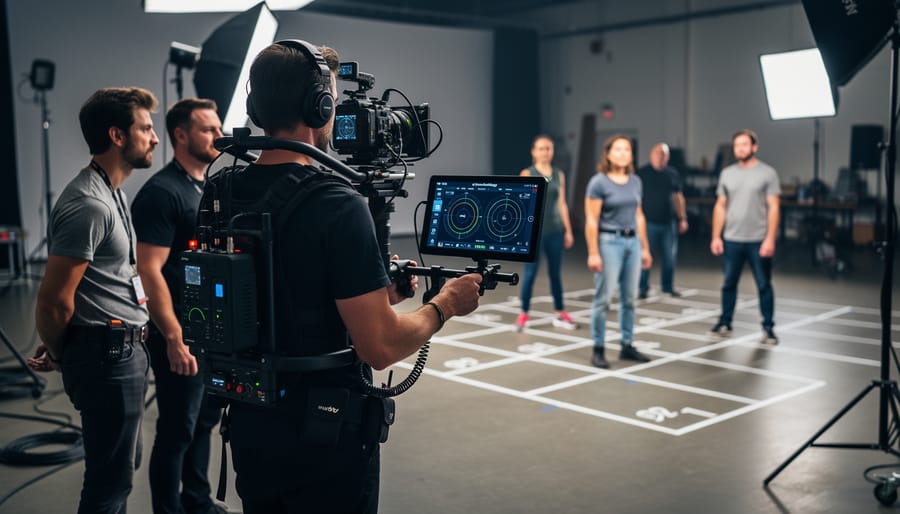
Consider a dramatic scene where your Steadicam operator glides through a crowded restaurant while following two actors engaged in heated conversation. The camera needs to rack focus between them as they move, perhaps pulling to a third character watching from across the room, then returning to the main subjects. Without q-focus, nailing this sequence would require extraordinary skill and likely numerous takes, burning through time and budget. With q-focus, your focus puller records the move during a rehearsal, capturing every focus transition with precise timing. Now each take maintains consistent focus points regardless of slight variations in camera movement.
The same principle applies to crane shots, jib work, or any scenario involving complex camera movements. When you’re coordinating a 360-degree rotating shot around a dinner table with eight actors, manually pulling focus while tracking every position becomes nearly impossible to replicate consistently. Q-focus lets you program the entire focus journey, ensuring that take seventeen looks identical to take twelve, giving your director freedom to choose performances rather than being limited by technical execution.
This repeatability also proves invaluable for VFX work, where multiple passes of the same shot with identical focus characteristics are required for compositing elements together seamlessly.
VFX and Match-Move Situations
When you’re shooting plates for compositing—whether it’s a greenscreen subject, foreground elements, or environmental passes that will be layered together—maintaining identical focus pulls across each take becomes absolutely critical. This is where q-focus truly shines in production workflows requiring visual effects integration.
Imagine you’re shooting an actor against greenscreen who will later be composited into a separately filmed background plate. Your focus needs to rack from a foreground prop at 3 feet to the actor’s face at 8 feet. With traditional focus pulling, replicating that exact timing and speed across the foreground pass, the talent pass, and potentially a clean pass becomes challenging. Even experienced focus pullers can introduce slight variations that create headaches in post-production when the compositor notices focus doesn’t quite match between layers.
Q-focus eliminates this guesswork entirely. Record your focus pull once during the hero take, and the system will replay it with frame-accurate precision on every subsequent pass. This becomes invaluable when shooting match-move scenarios where camera movement is repeated using motion control rigs or precise manual repositioning. The focus remains a constant variable you don’t need to worry about.
This technique also proves useful for time-slice effects, where multiple cameras capture the same moment from different angles, or when shooting clean plates without actors that must match the focus characteristics of your main footage. The repeatability ensures your VFX team receives consistent material that integrates seamlessly.
The Learning Curve: What to Expect
Let’s be honest: q-focus isn’t something you’ll master overnight. While the concept sounds straightforward—programming focus points to recall later—the practical execution requires developing a specific skill set that can take weeks or even months to refine.
The good news? You probably already have some of the foundational skills. If you’re comfortable with manual focus pulling and understand depth of field, you’re halfway there. The real learning curve comes from developing muscle memory for marking positions accurately and trusting your prep work enough to execute pulls confidently during actual takes.
One of the most common mistakes beginners make is rushing the calibration process. I’ve watched countless camera assistants try to set their marks while the director is already calling for picture, leading to sloppy focus points that fall apart during the actual shot. Take the time during blocking to properly mark your positions. Walk through the movement multiple times, and don’t be afraid to ask for an extra rehearsal if you need it.
Another pitfall? Over-relying on the technology. Q-focus is a powerful tool, but it won’t compensate for poor technique or insufficient preparation. Some operators make the mistake of thinking they can wing it because the marks are saved electronically, forgetting that those saved positions are only as accurate as their initial setup.
Here’s a practical tip that will accelerate your learning: start simple. Don’t attempt a complex multi-point rack focus on your first day with the system. Begin with two-point pulls between static positions. Once you can nail those consistently, gradually add complexity—moving subjects, additional focus points, or combining q-focus with manual adjustments.
Practice on your own time makes a massive difference. If you have access to the gear outside of production days, spend an hour just programming and executing pulls. You’ll build confidence far more quickly than trying to learn exclusively under the pressure of a live set.
Limitations and When to Skip Q-Focus
Q-focus is undeniably powerful, but it’s not a universal solution for every shooting scenario. Understanding when to leave it in the bag is just as important as knowing when to deploy it.
Documentary and observational filmmaking present the clearest case against q-focus. When you’re following unpredictable subjects through changing environments, the time required to mark focus points becomes a liability rather than an asset. A documentary filmmaker tracking a subject through a busy market or capturing spontaneous interviews simply can’t pause the action to calibrate their system. In these situations, traditional follow focus techniques or even relying on autofocus tracking may serve you better.
Run-and-gun productions face similar constraints. When you’re moving quickly between setups with minimal crew, the preparation time q-focus demands can slow your workflow to a crawl. If you’re shooting a corporate video with three hours to capture everything across multiple locations, measuring distances and programming focus points might consume time better spent on additional coverage.
Improvisational shoots also benefit from more flexible approaches. When actors are encouraged to move organically through space or when blocking changes during takes, your pre-marked focus points become obsolete instantly. The system works brilliantly for choreographed movement but struggles with spontaneity.
It’s crucial to remember that q-focus is one tool in your arsenal, not a replacement for fundamental focus pulling skills. The best focus pullers can read a scene, anticipate movement, and make smooth transitions by feel and experience. Q-focus enhances these skills in appropriate scenarios but shouldn’t become a crutch that prevents you from developing manual proficiency. Think of it as training wheels you can add when precision and repeatability matter most, but be prepared to ride without them when the situation demands flexibility and speed.
Q-focus represents a powerful addition to the modern cinematographer’s workflow, but it’s important to view it as one tool among many rather than a replacement for fundamental skills. Think of it as a precision instrument that enhances your capabilities when the situation calls for it—particularly in high-stakes productions where the margin for error is razor-thin or when working with extremely shallow depth of field where millimeters matter.
The key is recognizing when q-focus serves your creative vision best. For documentaries requiring spontaneity, traditional pulling might offer more flexibility. For scripted productions with repeatable action, q-focus can deliver unprecedented consistency. There’s no universal answer, which is why experimenting with the technology during low-pressure shoots helps you understand its strengths and limitations firsthand.
Remember that no amount of technology substitutes for understanding depth of field, knowing your lenses intimately, and developing the instinct to anticipate action. Q-focus simply allows you to execute those skills with greater precision. Master the fundamentals first, then explore how tools like q-focus can elevate your work.
Looking ahead, depth control technology continues advancing rapidly. We’re seeing improvements in wireless protocols, more intuitive interfaces, and broader lens compatibility. Staying curious and adaptable ensures you’ll leverage these innovations effectively while maintaining the artistic foundation that makes great cinematography timeless.




 By
By