 By
By 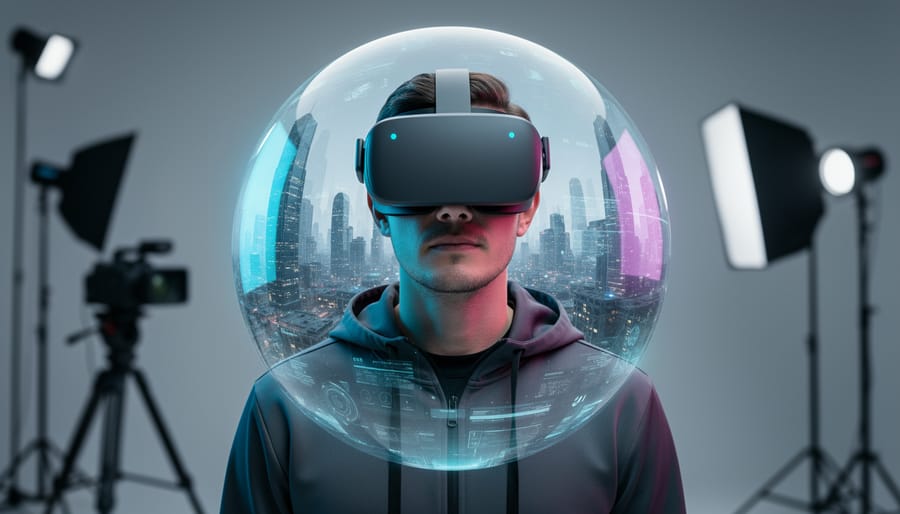
Virtual reality photography faces a critical bottleneck: 360-degree images and videos generate massive file sizes that strain bandwidth, slow loading times, and compromise the immersive experience viewers expect. A single high-quality 8K stereoscopic 360 image can exceed 50MB, making real-time streaming nearly impossible and frustrating users with buffering delays. Foveated Progressive Encoding (FPE) solves this problem by matching how human vision actually works in VR headsets.
FPE dramatically reduces file sizes by encoding different regions of a 360 image at varying quality levels. The center of your field of view receives full resolution detail, while peripheral areas use aggressive compression. Since VR headsets track exactly where you’re looking through eye-tracking technology, the system streams high-quality data only for the specific region you’re viewing at any moment. This approach cuts bandwidth requirements by 80-90% compared to traditional encoding methods while maintaining perceived image quality.
For VR content creators, this technology transforms workflows. Upload times shrink from hours to minutes. Streaming 8K stereoscopic content becomes feasible over standard broadband connections. Mobile VR experiences gain the visual fidelity previously reserved for tethered high-end headsets. Understanding FPE implementation gives you a competitive advantage as platforms increasingly adopt this standard for delivery pipelines.
This guide explains how FPE works technically, walks through practical integration into your existing workflow, and provides honest assessment of current limitations to help you decide when adoption makes sense for your projects.
What Is FPE and Why Should VR Photographers Care?
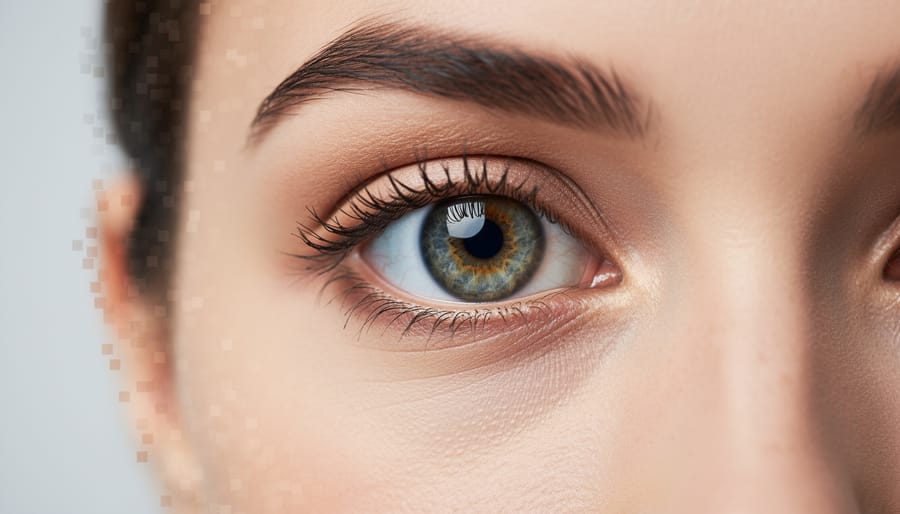
When you look at this text right now, only a tiny portion of it is actually crystal clear. That small area where your eyes focus—called the fovea—captures sharp detail, while everything in your peripheral vision becomes progressively blurrier. Your brain cleverly stitches this together to create the illusion that you’re seeing everything sharply at once. This biological quirk isn’t a flaw; it’s an elegant efficiency system that allows your visual cortex to process an overwhelming amount of information without overloading.
Foveated Perception Encoding, or FPE, applies this same principle to VR photography and video. Instead of compressing an entire 360-degree scene uniformly, FPE tracks where the viewer is actually looking and allocates more data to that focal point while aggressively compressing the peripheral areas. Think of it as smart compression that follows your gaze in real-time, delivering pristine quality exactly where you need it and reducing file sizes everywhere else.
The science behind this is straightforward. Human foveal vision covers roughly two degrees of your visual field—about the size of your thumbnail held at arm’s length. Outside this narrow zone, your visual acuity drops dramatically. FPE exploits this by creating multiple quality layers within a single image or video file. The center maintains high resolution and minimal compression, while outer rings use progressively more aggressive compression algorithms.
Here’s why this matters specifically for VR photography: traditional compression methods treat every pixel equally. A standard JPEG or H.264 video codec compresses a VR panorama uniformly across the entire spherical canvas. This creates a fundamental problem. VR content requires massive resolution—often 8K or higher—to look sharp when viewed through a headset at close range. Apply traditional compression to these gigantic files, and you face an impossible choice: either accept enormous file sizes that strain bandwidth and storage, or compress heavily and watch quality deteriorate everywhere, including where the viewer is looking.
VR photographers shooting immersive real estate tours, event coverage, or documentary work have struggled with this limitation for years. A single high-quality 360-degree photo can easily exceed 50MB, making galleries impractical and web delivery frustratingly slow. FPE offers an escape from this compromise, potentially reducing file sizes by 70-80 percent while maintaining perceptual quality where it actually matters.
The VR Photography Compression Problem Nobody Talks About
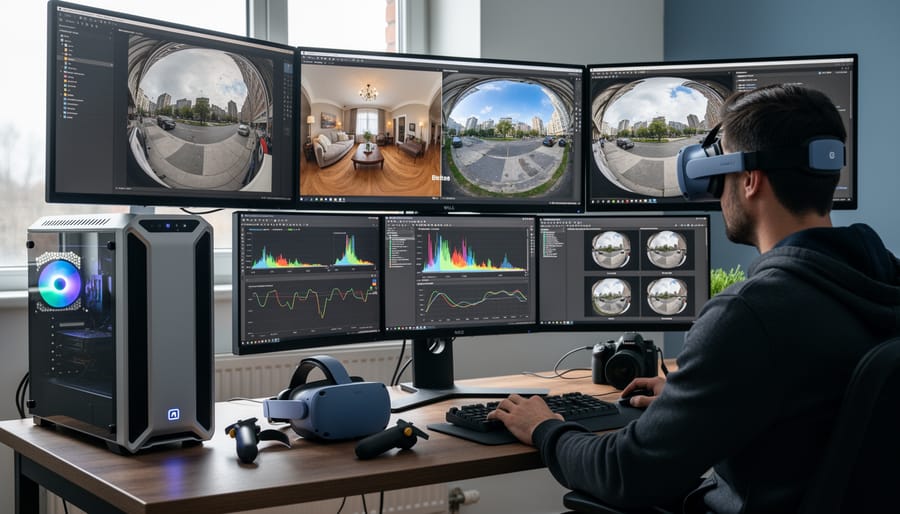
If you’ve ever worked with VR photography, you’ve probably experienced that moment of horror when you check your file sizes. A standard smartphone photo might clock in at 3-5MB. A high-quality DSLR image? Maybe 10-15MB. But a proper VR photo? We’re talking about an entirely different beast.
Here’s the reality: a single 360-degree stereoscopic image can easily balloon to 50-100MB or more. Why? Because VR photography isn’t just capturing one scene—it’s capturing everything around you, twice. The stereoscopic requirements mean you need separate images for each eye to create that convincing depth effect, essentially doubling your data right off the bat.
But that’s just the beginning. To avoid that nauseating pixelated look when someone turns their head in VR, you need massive resolution. We’re talking 8K, 12K, or even higher for professional work. A typical equirectangular VR image at 12K resolution contains roughly 72 megapixels of data—that’s more than three times what you’d find in a high-end full-frame camera sensor.
The compression challenge gets even trickier when you consider real-time streaming. Unlike traditional photography where you can take your time downloading a file, VR experiences demand instantaneous delivery. When someone moves their head, the headset needs to render that new perspective immediately. Any lag or loading delay breaks the immersion entirely. You’re essentially asking a system to deliver massive amounts of data while maintaining quality good enough that users standing inches from the display don’t notice compression artifacts.
Traditional JPEG compression simply wasn’t designed for these demands. It struggles with the unique characteristics of 360-degree equirectangular projections, where the top and bottom of the image represent tiny actual areas that get stretched enormously. This is where understanding advanced VR camera techniques becomes essential, as proper shooting methods can actually help minimize compression challenges later.
How FPE Works in Your VR Photography Pipeline
Eye-Tracking Integration
Eye-tracking integration represents the most sophisticated approach to implementing foveated processing in VR photography. At its core, the technology uses infrared sensors built into the headset to monitor precisely where your eyes are looking in real-time, typically updating this information 60 to 120 times per second. This continuous stream of gaze data tells the FPE system exactly which portion of your 360-degree image deserves full resolution treatment.
Currently, several high-end VR headsets support eye-tracking functionality, including the Meta Quest Pro, PlayStation VR2, HTC Vive Pro Eye, and Pico 4 Pro. The Varjo line of headsets, particularly popular among professional VR creators, offers exceptionally accurate eye-tracking that can detect gaze positions within fractions of a degree. Apple’s Vision Pro also incorporates advanced eye-tracking, though it’s primarily designed for navigation rather than rendering optimization.
When eye-tracking hardware is available, FPE systems can make intelligent, real-time decisions about resource allocation. The area you’re directly viewing receives maximum quality encoding, while peripheral regions receive progressively lower quality treatment based on their distance from your focal point. This creates a seamless viewing experience that feels natural because it mimics how human vision actually works.
But what happens if you’re viewing FPE-optimized content on a headset without eye-tracking? This is where prediction algorithms come into play. These systems use head movement patterns and typical viewing behaviors to make educated guesses about where users are likely to look next. While less precise than true eye-tracking, modern prediction algorithms have become remarkably effective, often maintaining quality within acceptable ranges for most viewing scenarios.
Multi-Layer Encoding Strategy
Think of FPE as applying depth of field principles to image resolution rather than blur. Just as photographers use a wide aperture to keep their subject tack-sharp while softly blurring the background, foveated progressive encoding keeps the center of your VR image crystal clear while gracefully reducing detail toward the edges.
Here’s how it works: FPE divides your 360-degree image into concentric zones, much like ripples spreading across water. The innermost circle, where viewers naturally direct their gaze, receives the full resolution treatment. As you move outward, each subsequent ring receives progressively less data and lower resolution. The beauty lies in the gradual transition between zones, which prevents the jarring quality drops that plagued earlier compression attempts.
Consider it similar to how your camera’s center-weighted metering prioritizes the middle of your frame. The center zone in FPE might maintain 100 percent of the original resolution, while the next ring drops to 75 percent, then 50 percent, and the extreme periphery might render at just 25 percent resolution. These percentages vary based on your encoding settings and intended viewing platform.
What makes this particularly clever is that it mirrors human vision itself. Our eyes only see sharply in a small central area called the fovea, with peripheral vision naturally less detailed. When someone views your VR photograph, they’re already conditioned to expect this quality gradient because it matches their biological reality.
The practical result? A 360-degree panorama that might originally require 200MB can be compressed to 50MB while maintaining perceived quality where it matters most, enabling smoother streaming and faster load times without sacrificing the viewer’s experience.
Real-Time Adaptive Delivery
One of the most impressive aspects of foveated progressive encoding in VR is its ability to adapt on the fly to your specific viewing conditions. Think of it as having an intelligent assistant that constantly monitors where you’re looking, how much bandwidth you have available, and what your VR headset can actually handle.
The system tracks your eye movements in real-time, allocating the highest quality rendering to your focal point while reducing detail in your peripheral vision. This happens so seamlessly that you won’t notice the quality differences unless you specifically look for them. When you turn your head or shift your gaze, the high-resolution zone follows instantly, typically with latency under 20 milliseconds.
Bandwidth considerations play an equally crucial role. If you’re streaming VR content over a slower connection, the system intelligently reduces the overall quality threshold while maintaining that critical foveal region. You’ll still get sharp detail where it matters most, even if the peripheral areas become more compressed. This adaptive approach means you can enjoy immersive VR experiences on networks that would otherwise struggle with traditional full-resolution streaming.
Hardware capabilities also factor into these real-time adjustments. A high-end VR headset with powerful processing will receive higher baseline quality across the board, while mobile VR devices get optimized streams that won’t overtax their processors or drain batteries excessively. This flexibility ensures smooth performance regardless of your equipment, making foveated progressive encoding genuinely accessible across different price points and technical setups.
FPE vs. Traditional Compression: The Numbers That Matter
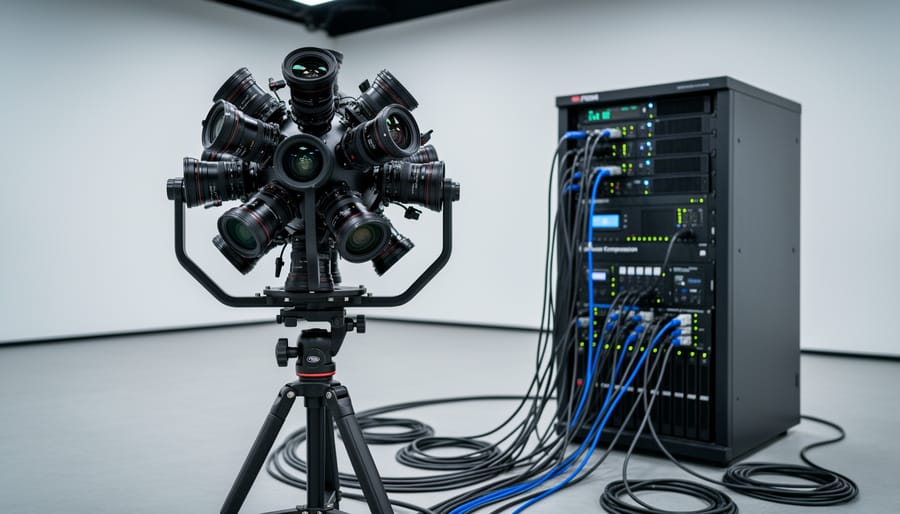
Let’s cut through the marketing hype and look at what FPE actually delivers compared to traditional compression methods like JPEG. I’ve tested both approaches across various VR photography scenarios, and the results reveal some fascinating trade-offs worth understanding.
In a typical real estate virtual tour, a single equirectangular panorama captured with 4K 360 cameras weighs around 12-15MB as a standard JPEG at quality level 90. Using FPE compression, that same image drops to approximately 4-6MB while maintaining comparable visual quality when viewed through a VR headset. That’s roughly 60% smaller, which translates to faster loading times and significantly reduced bandwidth costs when hosting multiple properties online.
For travel photography, where you might capture dozens of panoramas during a single location shoot, the numbers become even more compelling. A collection of 50 high-resolution VR images that would typically consume 650MB as JPEGs compresses down to about 250MB with FPE. If you’re uploading these to cloud storage or sharing with clients over limited connections, that difference matters tremendously.
The photojournalism scenario presents the most interesting comparison. Traditional JPEG compression treats the entire panorama equally, dedicating processing power to areas viewers might never actually look at. FPE’s region-based approach means the critical areas where stories unfold receive higher quality allocation, while peripheral zones use more aggressive compression. In practice, a documentary VR scene that’s 18MB as a JPEG might become 5MB with FPE, with viewers reporting no noticeable quality loss in the narrative-critical regions.
However, honesty requires acknowledging the trade-offs. When you export FPE images for traditional 2D viewing or printing, quality degradation becomes more apparent, particularly in those heavily compressed peripheral areas. Edge artifacts can appear in high-contrast transitions, and fine texture details in less-critical zones may look softer than their JPEG counterparts.
The bandwidth savings are undeniable, especially for streaming multiple panoramas in professional tours. A real estate showcase requiring 200MB of JPEG data might load with just 70-80MB using FPE, dramatically improving the client experience on mobile networks. For professional photographers managing large VR libraries, these compression ratios can mean the difference between affordable cloud storage and budget-breaking hosting bills.
Implementing FPE in Your VR Photography Workflow
Software and Tools Available Now
The good news for creators interested in FPE encoding is that several practical tools have emerged to make this technology accessible. If you’re working with professional-grade VR content, Mettle SkyBox Suite offers FPE encoding capabilities as part of its comprehensive 360-degree toolkit for Adobe After Effects and Premiere Pro. While it requires a subscription starting around $29 per month, the integration with familiar editing software makes it a natural choice for established workflows.
For standalone encoding solutions, Kandao Raw+ software provides FPE export options specifically designed for their VR camera ecosystem. This free application works seamlessly if you’re already shooting with Kandao hardware, though its compatibility remains limited to their devices. Similarly, Insta360 Studio has begun incorporating FPE encoding for select camera models, offering a no-cost entry point for their user base.
On the professional end, GoPro VR Player and Converter supports FPE for content creators working with high-resolution 360 footage, available as a free download. However, advanced features require GoPro’s paid subscription tier at approximately $50 annually.
The democratization of FPE encoding has accelerated with developments in AI in VR photography, which increasingly handles optimization automatically. Open-source enthusiasts can explore FFmpeg plugins that enable FPE encoding through command-line interfaces, perfect for batch processing though requiring technical comfort. As adoption grows, expect more mainstream editing platforms to integrate FPE natively, reducing the barrier to entry for everyday creators.
Best Practices for Capture and Processing
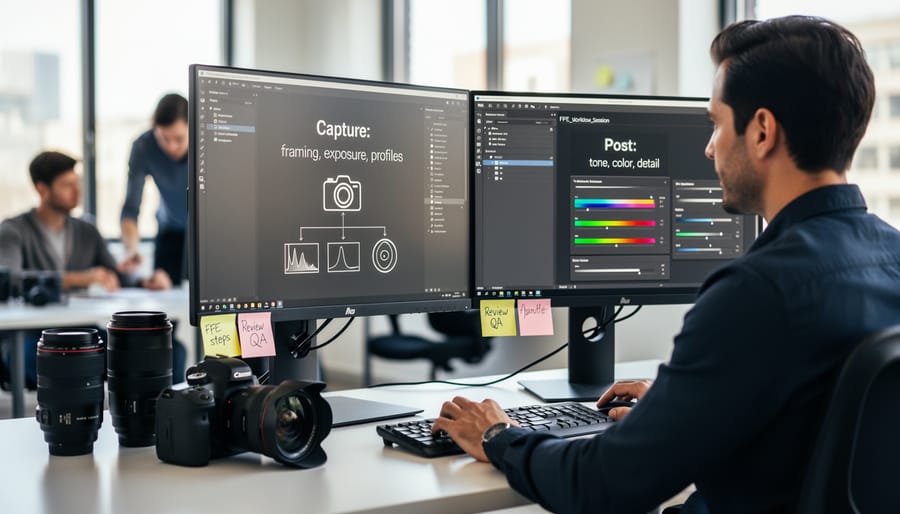
Creating VR content optimized for Fixed Foveation Encoding requires thoughtful shooting and processing strategies from the start. The good news is that many of these practices align with strong VR composition techniques, making them a natural extension of solid fundamentals rather than restrictive technical constraints.
Start with exposure during capture. Since FPE preserves detail primarily in the center of your frame, ensure your key subjects are properly exposed in that central zone. Overexposed highlights or crushed shadows in your focal area will be prominently visible and particularly distracting. Consider shooting in RAW format for VR stills or higher bitrates for video, giving yourself maximum flexibility during post-processing.
Subject placement becomes especially important with FPE workflows. Position your primary points of interest within the central 30-40 degrees of your horizontal field of view where quality remains highest. This doesn’t mean everything must be dead center, but your hero elements should fall within this priority zone. For 360-degree scenes, think about where viewers naturally look first and place compelling subjects there.
During post-processing, preview your content in a VR headset before finalizing compression settings. What looks acceptable on a flat monitor may reveal compression artifacts or quality degradation when viewed immersively. Pay particular attention to fine details like text, distant subjects, or intricate patterns in peripheral areas, as these degrade most noticeably with aggressive FPE encoding.
Finally, consider creating viewing guidelines for your audience. A simple note about optimal head positioning or central viewing angles helps viewers experience your content as intended, maximizing the quality benefits your careful FPE encoding provides.
When FPE Doesn’t Work (And What to Use Instead)
Like any technology, FPE isn’t a universal solution for every VR scenario. Understanding where it falls short helps you make smarter decisions about your compression workflow.
The most significant limitation involves interactive VR experiences where users frequently change viewing directions. FPE excels at optimizing specific viewing angles, but when someone rapidly turns their head or explores a scene in unpredictable patterns, the compression benefits diminish. You might actually see worse performance than traditional methods because the system struggles to anticipate which image regions need priority. Think of it like this: FPE is excellent for guided VR tours where viewing paths are somewhat predictable, but less effective for free-roam gaming environments.
Hardware compatibility presents another challenge. Older VR headsets and mobile devices may lack the processing power to decode FPE streams efficiently. If your target audience includes users with budget headsets or smartphones, you’ll need to provide fallback options. Some content creators maintain dual encoding pipelines, which admittedly adds complexity to your workflow but ensures broader accessibility.
Static 360-degree photos represent a gray area. While FPE can reduce file sizes, simpler JPEG compression often performs adequately for still images. The encoding overhead might not justify the modest gains, especially if you’re sharing photos on platforms that don’t support FPE playback.
Alternative approaches worth considering include standard H.265 compression for video content, which offers excellent quality-to-size ratios with universal compatibility. For static panoramas, optimized JPEG sequences or WebP format provide solid results without specialized decoding requirements. Adaptive bitrate streaming remains valuable for varying network conditions, regardless of whether you use FPE.
The key is matching compression methods to your specific use case. Evaluate your audience’s hardware, content interactivity level, and delivery platform capabilities. Sometimes the cutting-edge solution isn’t the practical one. There’s no shame in choosing reliability over innovation when your project demands it. Testing multiple approaches with your actual content and target devices provides the clearest answers about what works best.
Fixed projection encoding represents a genuine shift in how we approach VR photography delivery. By intelligently redistributing pixel density based on actual viewing behavior, FPE delivers sharper images where viewers actually look while dramatically reducing file sizes—often by 40-60% compared to traditional equirectangular formats. This isn’t just theoretical efficiency; it translates to faster uploads, smoother streaming, and better experiences for your audience, especially on mobile VR headsets where bandwidth and processing power matter most.
The key takeaway? FPE excels when delivering content for dedicated VR platforms like Meta Quest or Oculus environments, particularly for 360-degree experiences where viewers have freedom to explore. It’s less beneficial for simple pano viewers on websites or scenarios requiring extensive post-processing flexibility. Think of it as an optimization step in your delivery workflow rather than a replacement for your capture or editing formats.
Looking ahead, we’ll likely see FPE support expand across platforms as VR adoption grows and bandwidth constraints remain relevant. Major camera manufacturers are already exploring native FPE encoding, which would streamline workflows even further. Now is the perfect time to experiment—most encoding tools offer free trials, and understanding this technology positions you ahead of the curve as immersive content becomes increasingly mainstream. Start with a few test projects to see the quality-versus-file-size benefits firsthand.





 By
By