 By
By 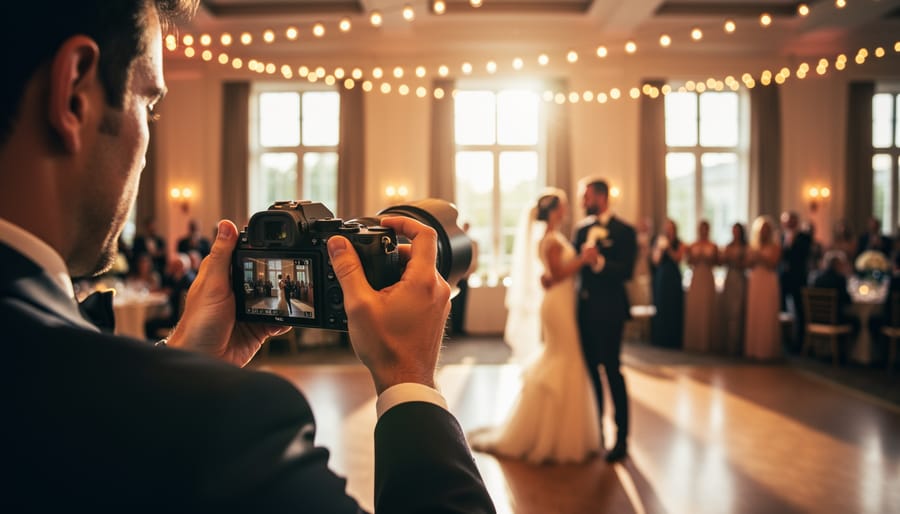
Second shooting offers photographers a low-risk entry point into professional wedding and event photography while building experience alongside established professionals. A second shooter supports the primary photographer by capturing alternative angles, detail shots, and moments the main photographer might miss, typically earning $200-$500 per event depending on experience and location.
Start by strengthening your foundational skills through portfolio development in multiple lighting conditions, since you’ll need to deliver consistently sharp, well-exposed images without constant direction during fast-paced events. Second shooters must work independently once they understand the shot list, meaning your technical proficiency needs to be automatic rather than deliberate.
Network directly with lead photographers in your area through local photography groups, wedding vendor meetups, and social media communities where professionals openly advertise for backup shooters. Many established photographers maintain lists of reliable second shooters they call regularly, so one successful shoot often leads to repeat opportunities.
Prepare a focused portfolio showcasing 15-20 images from weddings or events, even if you’ve only photographed friends’ celebrations or volunteered at community gatherings. Lead photographers prioritize reliability and technical competence over artistic vision when hiring support, so demonstrate you can nail the essential moments—ceremony coverage, family portraits, and candid reception shots—before showcasing creative experiments.
Expect to invest 10-12 hours per wedding day including travel and editing time if you’re providing processed images, though some photographers only require delivery of unedited RAW files. Understanding these terms upfront prevents misunderstandings about compensation and deliverables that could damage your professional reputation before your second shooting career gains momentum.
What Does a Second Shooter Actually Do?
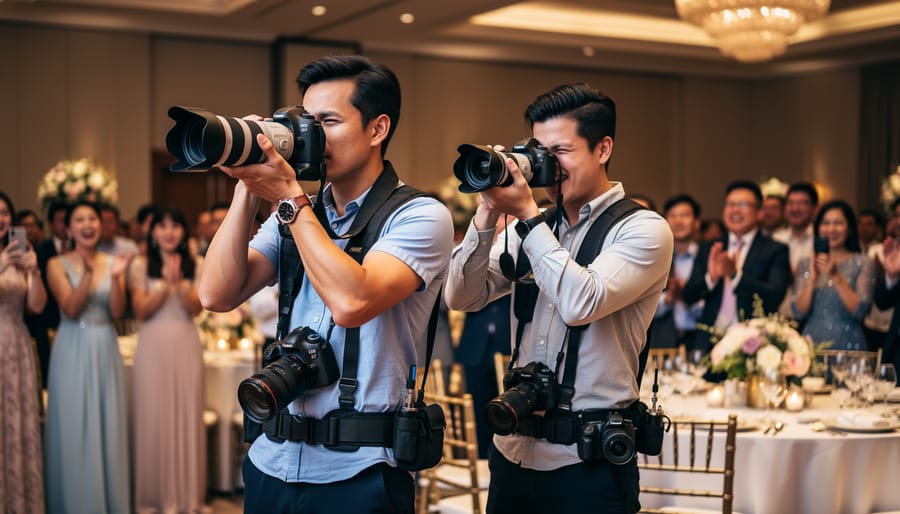
Second Shooter vs. Photography Assistant: Know the Difference
While these terms are sometimes used interchangeably, second shooters and photography assistants actually fill different roles at events, and understanding the distinction can save you from awkward misunderstandings when accepting gigs.
A second shooter operates with significant creative autonomy. You’re typically another experienced photographer hired to capture different angles and moments the primary photographer might miss. Think of it this way: at a wedding, while the lead photographer focuses on the bride walking down the aisle, you might be positioned to capture the groom’s emotional reaction. Second shooters use their own professional equipment, make independent compositional decisions, and their work often appears in the final client gallery. Because you’re contributing creative input and using your gear, compensation tends to be higher, usually ranging from $200 to $800+ per event depending on your market and experience level.
Photography assistants, on the other hand, provide technical and logistical support. Your responsibilities might include carrying equipment, adjusting lighting setups, managing reflectors, organizing gear between locations, or handling basic administrative tasks. Assistants generally don’t shoot independently or contribute images to the final deliverables. You’re there to make the primary photographer’s job easier, not to create your own portfolio pieces. The role requires less experience and creativity, so compensation is typically lower, often $15 to $30 per hour.
Many photographers start as assistants to learn professional workflows before transitioning into second shooter roles as their skills develop.
Why Second Shooting Is Your Secret Weapon for Growth
The Skills You’ll Develop Behind the Scenes
Working as a second shooter is like attending an intensive masterclass while getting paid. The photography skill development you’ll experience is both practical and profound, shaping you into a more versatile photographer.
First, you’ll master the art of working under pressure. Weddings and events don’t allow for do-overs, so you’ll quickly develop the ability to anticipate moments, adjust settings on the fly, and stay calm when Uncle Bob accidentally walks into your shot during the ceremony. This pressure-cooker environment transforms good reflexes into exceptional ones.
Adapting to different shooting styles becomes second nature. Every lead photographer has their own approach, whether they prefer candid documentary-style coverage or carefully posed portraits. You’ll learn to read their style within the first hour and complement it seamlessly. This flexibility is invaluable, as it expands your own creative toolkit with techniques you might never have discovered on your own.
The technical aspects are equally important. You’ll become proficient with backup photography techniques, understanding which angles provide safety coverage and which moments absolutely require redundancy. Equipment management becomes instinctive as you learn to swap lenses efficiently, monitor battery levels without missing shots, and troubleshoot gear issues without disrupting the flow of an event. These behind-the-scenes skills separate hobbyists from professionals and make you an indispensable asset to any photography team.
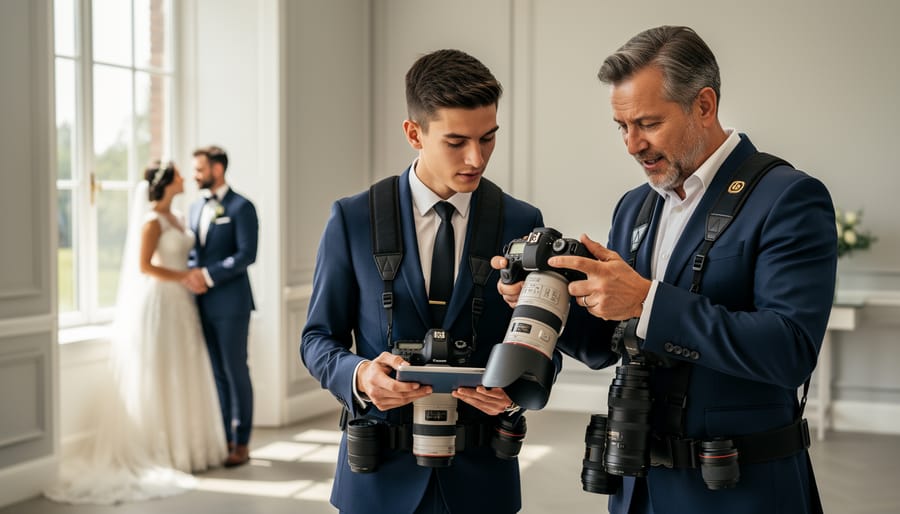
Building Your Network One Shoot at a Time
Every wedding you shoot as a second opens doors that extend far beyond that single event. While you’re capturing the ceremony processional, you’re working alongside florists, planners, videographers, and venue coordinators who notice your professionalism and might recommend you for future work. I’ve seen second shooters land corporate headshot contracts simply because a wedding planner was impressed by their efficiency under pressure.
The relationships you build with lead photographers are particularly valuable. Many leads actively refer overflow work to reliable seconds when they’re double-booked or when a client’s budget fits a newer photographer better. Some leads become genuine mentors, sharing everything from editing techniques to pricing strategies. These mentorship opportunities can accelerate your learning curve dramatically, providing insights that would take years to discover independently.
Client relationships matter too, though always respect boundaries set by your lead photographer. When couples see quality work from their second shooter in their gallery, they remember you for family sessions, newborn photos, or referrals to friends. One second shooter I know built her entire portrait business from wedding guests who approached her between shots.
The networking happens organically. Show up consistently, deliver quality work on time, and treat every vendor interaction as a potential future collaboration. In photography, your reputation travels through relationships, and second shooting puts you directly in those valuable professional circles where opportunities naturally emerge.
Finding Second Shooter Opportunities That Actually Pay
Online Platforms and Communities to Join
Finding second shooter opportunities requires knowing where to look. Several platforms specialize in connecting photographers with lead shooters seeking assistance.
Start with Facebook groups dedicated to wedding and event photography in your region. Search for “[Your City] Wedding Photographers” or “Photography Jobs [Your State]” to find active communities where lead photographers regularly post openings. These groups often provide real-time opportunities and allow you to build relationships with local professionals. Just remember to introduce yourself thoughtfully before jumping into job requests.
LinkedIn serves as an excellent professional platform for connecting with established photographers and studios. Optimize your profile by showcasing your portfolio, highlighting relevant experience, and using keywords like “second shooter,” “assistant photographer,” and specific photography niches you work in. Join photography-focused groups and engage meaningfully with posts rather than simply promoting yourself.
Photography-specific job boards like PhotoJobz, Snappr, and ShootProof regularly list second shooter positions. Meanwhile, general freelance platforms such as Upwork and Thumbtack feature photography gigs, though you’ll need to filter through various opportunities to find second shooting roles.
Instagram shouldn’t be overlooked as a networking tool. Follow local photographers whose style you admire, engage genuinely with their content, and showcase your own work consistently. Many photographers discover their regular second shooters through Instagram connections.
When creating profiles across these platforms, include a concise bio explaining your experience level, equipment you own, and availability. Always feature your strongest portfolio pieces that demonstrate you can handle various lighting conditions and capture candid moments. Response time matters significantly, so enable notifications for job postings in your preferred communities.
Making Local Connections in Your Photography Community
While online platforms offer excellent opportunities, nothing beats the power of face-to-face connections in your local photography community. Building genuine relationships offline often leads to the most reliable second shooter opportunities.
Start by attending photography meetups and local industry events. Camera stores, photography workshops, and professional association gatherings are goldmines for networking. When you attend these events, focus on building authentic relationships rather than immediately asking for work. Share your passion, ask questions about others’ experiences, and exchange business cards. Many second shooter positions are filled through word-of-mouth before they’re ever advertised.
Consider reaching out directly to wedding and event planners in your area. These professionals work with multiple photographers and often know who regularly needs backup shooters. A simple introduction email with your portfolio and availability can open doors. Similarly, contact wedding venues and ask if they maintain a preferred vendor list—getting on these lists increases your visibility to photographers booking those spaces.
The most effective strategy is building relationships with established photographers whose work you admire. Follow them on social media, engage thoughtfully with their content, and when appropriate, send a respectful message expressing your interest in assisting them. Offer to shadow them for free initially to learn their workflow. Many lead photographers prefer working with second shooters they know and trust, so investing time in these relationships pays dividends throughout your career.
What You Need to Get Started (Gear and Skills)
The Essential Camera Gear for Second Shooters
Let’s talk about what you actually need in your camera bag as a second shooter. The good news? You likely already own most of it if you’re seriously considering this work.
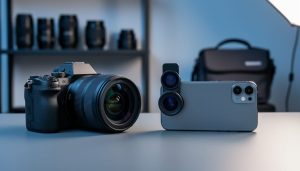
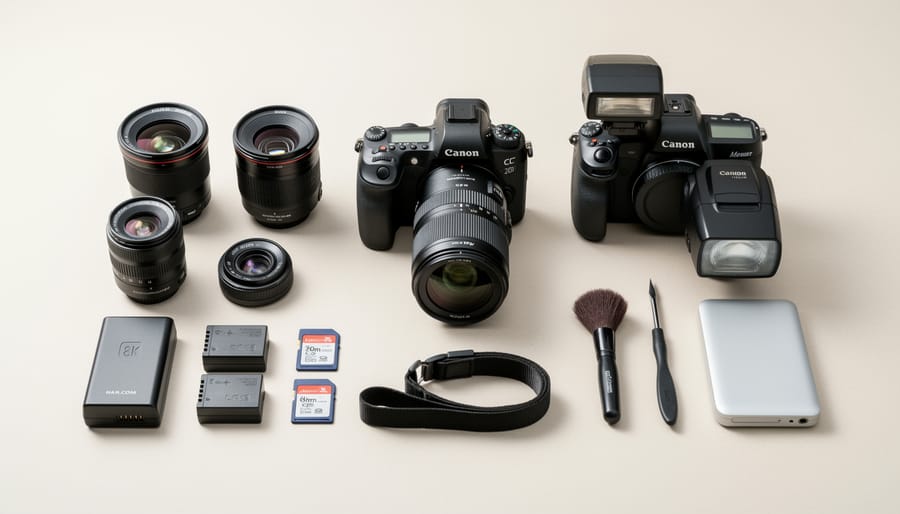
At minimum, you’ll need two professional or prosumer camera bodies. Notice I said two, not one. Backup equipment isn’t optional in professional photography—it’s your safety net when a shutter fails mid-ceremony. Many second shooters start with what they have, whether that’s a Canon 5D series, Nikon Z6, or Sony A7 III. The key is reliability and good low-light performance, since you’ll often be shooting in challenging lighting conditions.
For lenses, a versatile zoom lens in the 24-70mm range is your workhorse. Pair this with either a 70-200mm for ceremony coverage or a fast prime like a 50mm f/1.8 for reception shots. While the lead photographer handles essential camera gear decisions, you need equipment that complements their setup and can handle whatever angle you’re assigned.
Memory cards deserve serious attention. Carry at least four high-speed cards with 64GB or more capacity. I recommend keeping two in your camera and two as backups. The few extra dollars spent on reliable cards could save your reputation.
Don’t forget the basics: extra batteries (at least three per body), a comfortable camera strap, and lens cleaning supplies. Some lead photographers provide backup equipment, but never count on it. Your professionalism shines through preparation, and showing up fully equipped demonstrates you’re serious about this work.
Technical Skills That Lead Photographers Expect
Lead photographers consistently seek second shooters who can operate independently with minimal supervision. At the foundation, you’ll need to shoot confidently in manual mode, adjusting aperture, shutter speed, and ISO on the fly as lighting conditions change. This isn’t about showing off technical prowess—it’s about delivering consistent, well-exposed images whether you’re in a dimly lit church or harsh midday sun at an outdoor ceremony.
Understanding different lighting scenarios is equally crucial. You should recognize when to use natural light, how to work with existing venue lighting, and when flash is appropriate. Many lead photographers will expect you to handle your own lighting decisions without constant direction.
File management might sound mundane, but it’s remarkably important. You’ll need an organized workflow for naming files, backing up images on-site, and delivering them to the lead photographer in their preferred format. Lost or disorganized files can cost you future opportunities quickly.
Basic post-processing knowledge rounds out the technical foundation. While you typically won’t edit the final images, understanding editing principles helps you capture photos that will look great after processing. Know what the lead photographer can and cannot fix in post-production, and shoot accordingly.
How Much Second Shooters Really Make (And How to Negotiate)
Let’s talk numbers. Second shooter pay varies widely depending on where you live, the type of photography, and your experience level. Understanding these ranges helps you enter negotiations with confidence and ensures you’re fairly compensated for your work.
In most U.S. markets, wedding second shooters typically earn between $200 and $800 per event. That’s a broad range, right? Here’s why: A beginner in a smaller Midwestern city might start at $200-300 for an eight-hour wedding, while an experienced second shooter in New York or Los Angeles can command $600-800 or more. The national average hovers around $400-500 for weddings, which usually includes the ceremony, portraits, and reception coverage.
Corporate events and commercial shoots generally pay $25-75 per hour, with session minimums of three to four hours. Portrait sessions and family shoots often fall in the $100-250 range for shorter commitments. Geographic location matters tremendously here. Urban markets with higher costs of living naturally support higher rates, while rural areas typically see lower but still reasonable compensation.
Several factors influence what you can charge. Your equipment quality matters because bringing professional backup gear adds value. Experience level plays a role, though don’t undersell yourself as a beginner. The shoot’s complexity, duration, and whether you’re delivering edited images versus raw files all affect pricing. Rush jobs or peak season dates like summer Saturdays justify premium rates.
When negotiating, research is your foundation. Check local photography Facebook groups or ask fellow photographers about typical rates in your area. This gives you a realistic starting point. Approach the conversation professionally: “Based on my experience and equipment, my rate for wedding second shooting is $500” sounds much stronger than “I was hoping for maybe $300?”
Don’t be afraid to discuss what’s included in your rate. Clarify whether travel time counts, if meals are provided for long events, and when payment is due. Many second shooters request 50 percent upfront for bookings more than three months out.
Remember this golden rule: never work for “exposure” or free if you’re being asked to perform professional duties. Your time and skills have value. If you’re truly starting from zero experience, consider shadowing one or two shoots unpaid specifically to learn, but transition quickly to paid work once you’re contributing meaningfully to the final product.
Common Mistakes Second Shooters Make (And How to Avoid Them)
Even experienced photographers can stumble when transitioning into second shooting. Let’s look at the most common missteps and how to sidestep them.
The biggest mistake? Overstepping your creative boundaries. I’ve heard stories of second shooters who started directing the couple or rearranging the lead photographer’s setups because they had “a better idea.” Remember, you’re there to support the primary shooter’s vision, not showcase your own. If you spot an opportunity, quietly mention it to the lead rather than acting independently. Save your creative direction for your own bookings.
Equipment failures are another preventable disaster. Showing up with dead batteries or faulty memory cards isn’t just embarrassing—it can cost you future opportunities. The solution is simple but non-negotiable: check everything the night before. Format your cards, charge all batteries (bring extras), and pack backup gear. Experienced second shooters often keep a checklist on their phone to review before leaving for each event.
Communication breakdowns happen more often than you’d think. Some second shooters assume they know what’s expected and never clarify their responsibilities beforehand. This leads to missed shots and frustrated lead photographers. Always have a pre-event conversation covering your specific role, shot list priorities, and any family dynamics to be aware of. During the event, stay visible and check in periodically without being disruptive.
Professionalism issues can be subtle but damaging. Arriving just on time (rather than early), dressing inappropriately for the venue, or chatting excessively with guests all reflect poorly on both you and the lead photographer. Treat every second shooting gig as a job interview for your next one. Arrive fifteen minutes early, dress one step above the expected formality, and maintain a friendly but focused presence.
The best second shooters are those who make the lead photographer’s job easier, not harder. By avoiding these common pitfalls, you’ll build a reputation that keeps the bookings coming.
When to Transition from Second Shooter to Lead Photographer
You’ll know you’re ready to transition from second shooter to lead photographer when certain signs start appearing consistently. First, you’re confidently handling entire portions of events independently, anticipating moments before they happen, and receiving direct compliments from clients at weddings you’ve second shot. When lead photographers start seeking your creative input rather than just your extra hands, that’s a strong indicator your skills have matured beyond assistance work.
Another telling sign is when you’re turning down second shooting opportunities because your calendar fills with inquiries from friends, family, and referrals asking you to shoot their events. If you’ve also built a portfolio that genuinely represents the style you want to be known for, rather than just a collection of other photographers’ aesthetics, you’re likely ready to make the leap.
Making this transition gracefully requires honest communication. Inform the photographers you work with about your plans well in advance, ideally several months before you stop accepting their bookings. Frame it positively and express gratitude for the learning opportunities they provided. Many lead photographers genuinely want to see their second shooters succeed and will appreciate your transparency.
Here’s the key insight many emerging photographers miss: you don’t have to completely abandon second shooting when you start your own business. In fact, maintaining these relationships benefits everyone. You can still accept second shooting gigs during your slower seasons or for dates when you’re not booked as a lead. This provides income stability during your business’s early stages and keeps you connected to the photography community.
Set clear boundaries about your availability and be selective about which second shooting jobs you accept. Prioritize working with photographers whose style aligns with yours and who treat you professionally. This approach lets you build your own client base while maintaining the safety net of consistent second shooting income until your business gains momentum.
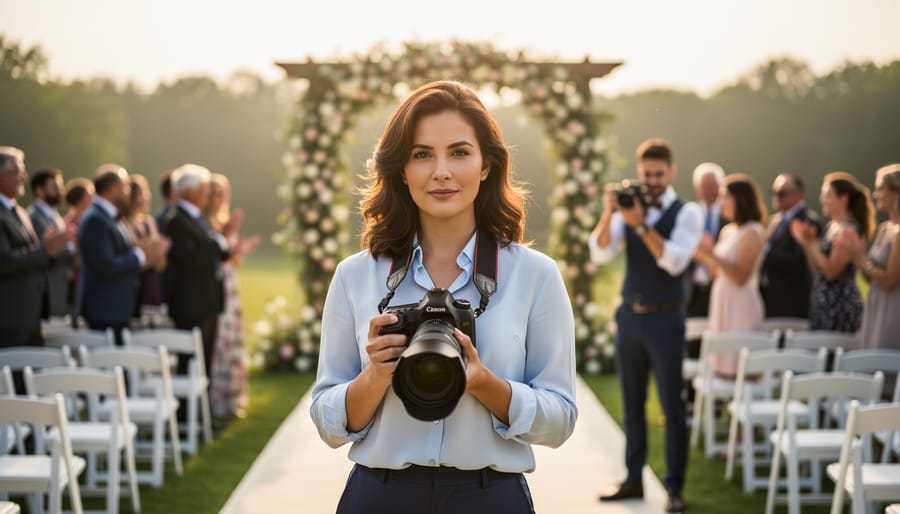
Second shooting isn’t just a convenient side gig to fill your weekends. It’s a strategic career move that builds the foundation for long-term success in professional photography. The skills you develop, the relationships you forge, and the real-world experience you gain while working alongside established photographers create value that extends far beyond the day rate you’re earning.
Think of second shooting as your paid apprenticeship. While you’re capturing ceremony details or scouting angles for the lead photographer, you’re simultaneously learning workflow systems, client management techniques, and problem-solving approaches that would otherwise take years to figure out independently. Many successful studio owners and lead photographers credit their second shooting years as the most formative period of their careers, where they learned not just how to take better photos, but how to run a sustainable photography business.
If you’re ready to pursue second shooter opportunities, start with three concrete actions this week. First, reach out to five photographers in your area whose work you admire and offer your assistance. Second, create a targeted portfolio that showcases your ability to support another photographer’s vision. Third, join local photography groups where second shooter positions are regularly posted.
The wedding you shoot as a second this month might feel like just another gig, but the connections you make, the techniques you observe, and the confidence you build are investments in your future as a photographer. Every frame you capture in this role moves you closer to defining your own photographic voice and establishing your place in the industry.





 By
By