 By
By 
When Canon releases a new mirrorless camera system, trademark law protects not just the name but the logical business territories the brand might naturally enter. This legal concept—the zone of natural expansion—determines whether a company can stop others from using similar trademarks in related markets, and it profoundly affects the photography industry you navigate daily.
Picture this: You’re browsing for camera gear online and encounter two brands with nearly identical names—one selling professional DSLRs, the other marketing smartphone photography accessories. Should the DSLR manufacturer have legal grounds to challenge the accessory brand? The answer hinges on whether smartphone accessories fall within the camera maker’s zone of natural expansion.
This doctrine recognizes that brands don’t remain static. Nikon didn’t always manufacture mirrorless cameras, and Sony once focused solely on electronics before dominating the full-frame camera market. Trademark law acknowledges these evolutionary paths, granting companies exclusive rights not only in their current markets but in adjacent spaces they’re likely to enter. For photographers, this explains why major brands aggressively protect their names across lenses, lighting equipment, editing software, and even camera bags—products that represent their natural growth trajectory.
Understanding this concept matters beyond legal curiosity. It shapes which products reach the market, influences brand pricing strategies, and explains why certain innovative accessories never materialize due to trademark conflicts. When a promising new photography brand faces legal challenges from an established manufacturer, the zone of natural expansion often sits at the heart of the dispute.
The photography industry’s rapid technological evolution—from film to digital, DSLR to mirrorless, standalone cameras to smartphone integration—makes these trademark boundaries particularly fluid and contentious.

What Is a Trademark Zone of Natural Expansion?
The Basic Principle Behind Natural Expansion
Trademark law isn’t just about protecting a logo or brand name from copycats selling identical products. It also recognizes something quite intuitive: successful brands naturally expand into related categories. This principle, known as the zone of natural expansion, acknowledges that when consumers see a trusted brand name on a related product, they assume it comes from the same company they already know and trust.
Think about Canon, a name synonymous with cameras among photographers. When Canon introduced lenses, nobody questioned whether they were really from the same company. The connection was obvious—cameras need lenses, and a camera manufacturer naturally understands lens design. This expansion made perfect sense to consumers and fell squarely within Canon’s zone of natural expansion. Later, when Canon moved into photo printers, the logic held: photographers need to print their images, so a photography company offering printing solutions feels like a natural progression.
Beyond trademark protection basics, this principle considers the brand’s reputation, the relationship between products, and consumer expectations. If Nikon suddenly started making kitchen appliances, that would fall outside their zone of natural expansion because consumers don’t associate camera expertise with cooking equipment.
For photographers, this concept matters because it explains why certain brand expansions succeed legally while others face challenges. It also helps you understand why established photography brands can prevent newcomers from using similar names in related markets—even if they’re not direct competitors yet.
Why This Matters for Photography Brands
For photography brands, the zone of natural expansion isn’t just an abstract legal concept—it’s fundamental to their business strategy and product development. When Canon introduces a new mirrorless camera body, they’re protected from competitors launching a suspiciously similar “Cannon” branded lens lineup. This protection matters because camera manufacturers invest millions in research, development, and brand building before bringing innovations to market.
Consider how major brands operate today. Nikon doesn’t just make cameras—they produce lenses, flashes, camera bags, and even software for image editing. Sony expanded from electronics into becoming a dominant force in full-frame mirrorless systems. These expansions feel logical because they fall within each brand’s natural trajectory. The zone of natural expansion doctrine recognizes this reality, preventing opportunistic competitors from creating confusion in related product categories.
This protection works alongside broader photography legal protections to maintain marketplace clarity. When you purchase a Fujifilm lens, you reasonably expect it’s designed to work with Fujifilm cameras and meets their quality standards. If another company launched “Fuji-Film” branded memory cards or tripods without authorization, it would undermine that trust and potentially damage the original brand’s reputation.
For accessory makers like Peak Design or Think Tank Photo, these protections allow them to expand into complementary products—camera straps to camera bags to tech pouches—without fear of trademark squatters waiting to exploit their growing reputation in adjacent markets.
How Courts Decide What’s ‘Natural’ for Camera and Photography Brands
The Relatedness Test: What Products Feel Connected?
When courts evaluate trademark disputes, they don’t just look at whether two products are identical. Instead, they apply what’s called the “relatedness test” to determine if consumers might reasonably expect one company to make both products. Think of it as asking: “Does this make sense for this brand?”
For a camera manufacturer, the zone of natural expansion is pretty intuitive. If Canon or Nikon started selling tripods, memory cards, camera bags, lens filters, or photo editing software, most photographers wouldn’t bat an eye. These products live in the same ecosystem. You use them together, often in the same shooting session. Courts recognize this natural connection because consumers already associate these products with photography brands.
The relationship becomes clearer when you consider the shopping experience. When you’re browsing for a new camera body, you’re likely looking at compatible lenses, considering which memory cards offer the fastest write speeds, and maybe eyeing a sturdy tripod. These products solve related problems for the same customer base.
However, if that same camera company suddenly launched a line of athletic wear or kitchen appliances, the connection breaks down. Sure, photographers wear clothes and eat meals, but there’s no logical product relationship. A consumer seeing “Nikon” on a coffee maker would be confused rather than confident about the purchase.
Courts examine factors like whether products are sold in the same stores, marketed to the same customers, and serve complementary functions. For photography gear, this typically means anything that helps capture, store, process, or display images falls within the natural zone, while unrelated consumer goods do not.
Consumer Expectations and Brand Perception
What consumers reasonably expect from a brand plays a central role in determining trademark protection for product expansions. When you see the Canon logo, you naturally expect cameras, lenses, and related imaging equipment. This expectation isn’t random—it’s built through decades of brand positioning and market presence. Courts recognize this psychological connection when evaluating whether a brand’s expansion into new territory deserves protection.
Consider established photography brands like Nikon or Sony. If Nikon introduced a new line of camera bags or tripods, most photographers would assume these products maintain Nikon’s quality standards and are designed specifically for their camera systems. This consumer expectation creates a natural zone where the brand can reasonably expand. Similarly, when Fujifilm moved from film production into digital cameras, consumers accepted this transition because both products served the same fundamental purpose: capturing images.
The key question becomes: would a typical consumer believe this new product naturally comes from this brand? If a respected lens manufacturer like Sigma suddenly launched photography-themed apparel, consumer expectations might not support trademark protection in that space, as clothing falls outside what photographers reasonably associate with the brand’s core expertise.
The Brand’s History and Announced Plans
A company’s history of product launches and public announcements plays a surprisingly significant role in trademark disputes. When a brand consistently operates in specific categories and signals future expansion plans, courts often recognize a “zone of natural expansion” that deserves protection—even before new products hit the market.
Consider Canon’s evolution in the imaging space. Starting with cameras, they naturally expanded into scanners, printers, and professional video equipment. When Canon announced plans to enter new photography-adjacent markets, their trademark protection extended to cover those intentions because they had established credibility and momentum in related fields.
Similarly, Nikon’s announced development of mirrorless technology years before releasing the Z-series created a protected zone. Their decades-long reputation in professional imaging, combined with public statements about future product lines, meant competitors couldn’t simply register similar trademarks in that space during the development period.
The key factor is consistency and credibility. If Fujifilm announces plans to develop underwater camera housings—building on their existing waterproof camera expertise—that creates stronger protection than a completely unrelated venture would. Courts examine press releases, investor presentations, and trade show demonstrations as evidence of genuine expansion intent versus empty claims designed solely to block competitors.
Real Cases That Shaped Photography Brand Protection
When Camera Brands Expanded Successfully
Camera manufacturers have built some of the most successful trademark expansions in consumer electronics, carefully protecting their brands as they moved into adjacent product categories. These cases demonstrate how companies strategically leveraged their photographic expertise into natural territories.
Canon’s expansion from cameras into printers represents a textbook example of zone of natural expansion. When the company introduced photo printers in the 1990s, their trademark protection extended seamlessly because printing photographs was directly connected to capturing them. Consumers already associated Canon with image quality, so seeing the Canon name on a device that produces photographic prints felt logical and protected. This wasn’t just about slapping a logo on any electronic device—it was about maintaining the brand’s promise of photographic excellence through the entire workflow.
Sony successfully defended its trademark expansion from professional video cameras into consumer digital cameras and eventually into full-frame mirrorless systems. Each step represented a natural progression within the imaging sphere. Courts and trademark offices recognized that Sony’s movement from broadcast equipment to consumer photography equipment stayed within a coherent zone where consumers expected to find the brand.
Similarly, Nikon’s expansion into binoculars, telescopes, and microscopes received trademark protection because these products all involve precision optics and lens technology—the company’s core expertise. This differs from trade dress protection, which covers product appearance rather than category expansion.
The key factor in these successes was maintaining a clear connection to photography and optical engineering, ensuring consumers understood the brand’s natural presence in these spaces.
When Protection Didn’t Apply
Not every brand expansion gets legal protection, and courts have drawn clear boundaries when companies stretch their trademarks too far beyond their original market. Understanding where protection ends is just as important as knowing where it begins.
One notable example involves attempts by luxury fashion brands to prevent camera accessory companies from using similar design elements. Courts have generally ruled that a camera strap manufacturer operating in the photography space doesn’t infringe on a fashion brand’s trademark, even with similar styling, because the markets are fundamentally different. A photographer buying a functional camera strap isn’t likely to confuse it with haute couture, no matter how similar the patterns might appear.
The photography industry saw this principle tested when a well-known lens manufacturer tried to block a photography education company from using a similar name. The court determined that selling lenses and teaching photography workshops represent distinct markets with different customer expectations. Someone purchasing a physical lens isn’t entering the same transaction space as someone booking an online photography course, even though both serve photographers.
Geographic expansion has also tested these limits. A regional photography studio chain that attempted to prevent an international stock photography website from using a comparable name discovered their trademark protection didn’t extend that far. The court recognized that brick-and-mortar portrait studios and digital stock imagery platforms serve entirely different customer needs, despite both operating in photography.
Similarly, when a drone photography service provider challenged a traditional wedding photographer over naming similarities, courts sided with the wedding photographer. The reasoning was straightforward: aerial cinematography for commercial clients and ground-based wedding photography represent sufficiently different specializations that customers wouldn’t confuse the two services.
These cases demonstrate that trademark protection requires more than operating somewhere within the broad photography industry. Courts look for genuine market overlap where consumer confusion could realistically occur, not just thematic connections.
Where Photography Brands Can and Cannot Expand
The Inner Circle: Clear Natural Extensions
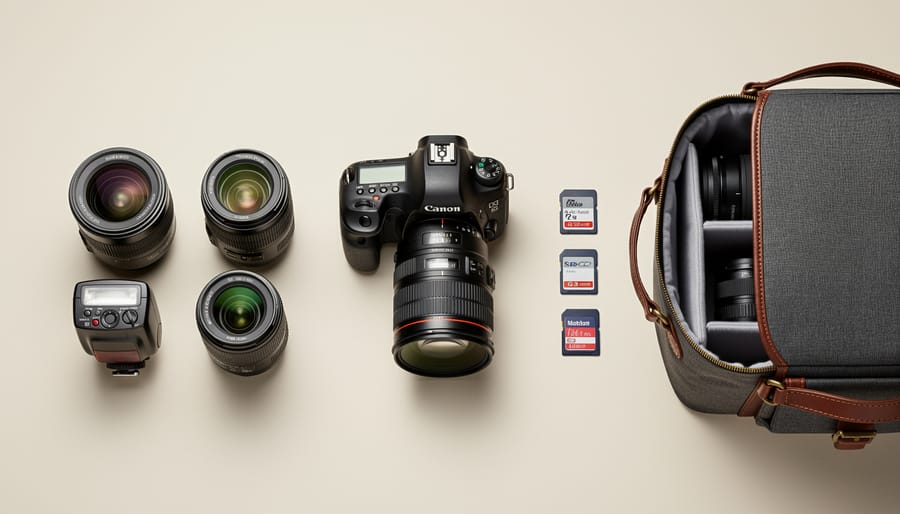
When a camera manufacturer puts their logo on a product, there’s an unspoken understanding between the brand and its customers about what makes sense. This “inner circle” represents accessories and gear that any reasonable person would expect a photography brand to produce—products so closely related to cameras that their connection feels obvious and natural.
The clearest examples include lenses, which are essentially extensions of the camera body itself. When Canon or Nikon releases a new lens lineup, nobody questions whether they have the right to use their trademark on these products. The same logic applies to flashes and lighting equipment, which photographers have been pairing with cameras since the early days of photography.
Moving slightly outward but still firmly within the circle, we find camera bags, tripods, and stabilization equipment. These items exist specifically to support photography activities, making them natural additions to any camera brand’s product catalog. Memory cards and other storage solutions fall here too—after all, what good is capturing images if you can’t store them?
Editing software represents another clear extension. In our digital age, the photography workflow doesn’t end when you press the shutter button. Programs that help photographers process, organize, and enhance their images are logical offerings from camera manufacturers who understand the complete creative process.
The Gray Zone: Arguable Expansions
This is where things get interesting—and legally murky. Some product categories fall into contested territory where courts haven’t consistently agreed on whether they represent natural brand expansion for photography companies.
Take drones, for example. When Canon or Nikon consider entering this market, the argument becomes less clear-cut. Is a drone a natural extension for a camera company because aerial photography is now mainstream? Or is it primarily aviation technology that happens to include a camera? The answer affects whether existing drone manufacturers could claim trademark protection against photography brands entering the space. Understanding camera drone regulations matters, but so does knowing which brands can legally operate in this market.
Smartphones present similar challenges. While they’re now primary cameras for many people, they’re fundamentally communication devices. Could a hypothetical “Leica Phone” be blocked by existing phone manufacturers, or does Leica’s photographic heritage give them reasonable expansion rights?
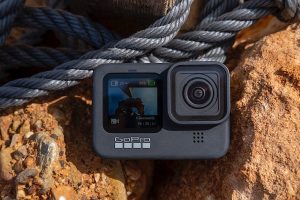
Action cameras, projectors, and binoculars occupy this same gray zone. They’re imaging-adjacent but involve distinct technologies and markets. Courts evaluate these case-by-case, considering factors like consumer confusion likelihood, brand reputation strength, and how directly the new product relates to the company’s core expertise. For consumers, this means some brand expansions might appear and disappear based on legal challenges rather than product quality.

The Outer Limits: Probably Not Protected
Not every product category falls within a brand’s natural zone of expansion. A camera manufacturer like Nikon or Canon would face significant challenges claiming trademark protection in truly unrelated markets. For instance, if someone started selling Nikon-branded breakfast cereal or Canon coffee beans, these would likely fall outside the zone of natural expansion. There’s simply no reasonable connection between photography equipment and food products in consumers’ minds.
Similarly, apparel generally sits beyond this protective zone unless the brand has actively marketed clothing lines. A hypothetical Leica clothing boutique would seem disconnected from the company’s core business of precision optics. The same applies to unrelated electronics—a Pentax microwave oven or Olympus hair dryer would struggle to claim protection based on natural expansion alone, despite these companies manufacturing electronic products. The key distinction is whether consumers would reasonably expect the brand to enter that market based on its established reputation and product categories. When that connection becomes too tenuous, trademark protection weakens considerably, allowing other businesses more freedom to operate without infringement concerns.

What This Means for Photographers Buying Gear
Spotting Legitimate Brand Extensions vs. Trademark Infringement
When you’re considering purchasing photography gear or accessories, knowing whether you’re buying from the brand you trust—or from an unrelated company trading on a familiar name—can save you from disappointment and wasted money.
Start by examining the product category itself. If Canon releases a new lens cleaning solution, that’s clearly within their zone of natural expansion. But if you see “Canon Coffee Mugs” being sold by a kitchenware company with no connection to the camera manufacturer, that’s likely operating in unrelated territory. The key question is: would a reasonable person expect this brand to make this product?
Check the packaging and branding carefully. Legitimate brand extensions will display the same quality of design, legal information, and trademark symbols you’d see on the company’s core products. Look for official distributor information, warranty cards, and customer service contacts that match the parent company. Counterfeit or infringing products often have subtle differences in logo design, color schemes, or font choices.
Research before you buy. Visit the brand’s official website to see if the product appears in their catalog. Major photography brands like Nikon, Sony, or Fujifilm clearly list all their official accessories and related products. If you can’t find it there, you’re likely looking at either a third-party product or potential trademark infringement.
Understanding these distinctions connects to broader property rights considerations that affect photographers in multiple ways. When in doubt, contact the manufacturer directly or purchase only from authorized dealers who can verify a product’s authenticity and legitimate connection to the brand.
Why Gray-Market and Third-Party Accessories Exist
The zone of natural expansion concept creates a fascinating dynamic in the photography accessories market. When camera manufacturers focus their trademark protection on core products—cameras, lenses, official flashes—they leave breathing room for third-party manufacturers to serve adjacent needs. This isn’t an oversight; it’s often an acknowledgment that brands can’t or won’t expand into every possible accessory category.
Consider battery grips, camera straps, and memory card cases. Canon or Nikon could theoretically produce premium versions of these items, but they often choose not to saturate these markets. This creates legitimate space for third-party manufacturers to step in without risking trademark infringement. The legal reasoning is straightforward: if a brand hasn’t historically made a product and shows no interest in doing so, courts are less likely to view that category as part of their natural expansion zone.
However, gray-market goods operate differently. These are genuine manufacturer products sold outside authorized distribution channels—often imported from regions with lower prices. While legally murky, they exist because manufacturers segment markets geographically, and the zone of natural expansion doesn’t typically extend to controlling every sales territory. This creates opportunities for resellers, though buyers should understand they’re sacrificing warranty coverage and manufacturer support for lower prices.
Understanding trademark zones of natural expansion empowers you as a photographer and consumer to navigate the marketplace more confidently. These legal protections exist for good reasons: they prevent confusion when established brands like Canon, Nikon, or Sony announce new product categories, and they safeguard the investments companies make in building trust with their customers over decades. When you see Fujifilm expanding from cameras into lenses, or Adobe moving from software into cloud storage, trademark law recognizes these moves as logical extensions that consumers would naturally associate with those brands.
For photographers, this knowledge translates into practical benefits. You’ll better understand why certain brand announcements receive trademark protection while knockoff products face legal challenges. It helps you identify legitimate products versus confusing imitations that might compromise your work or waste your money. The key takeaway is simple: stay informed when major photography brands announce new ventures into adjacent categories like lighting equipment, editing software, or camera accessories. These expansions typically fall within their natural zone, meaning they’re authentic extensions backed by the brand’s reputation. By understanding these protections, you support genuine innovation in the photography industry while protecting yourself from marketplace confusion that could affect your creative toolkit and professional reputation.





 By
By