 By
By 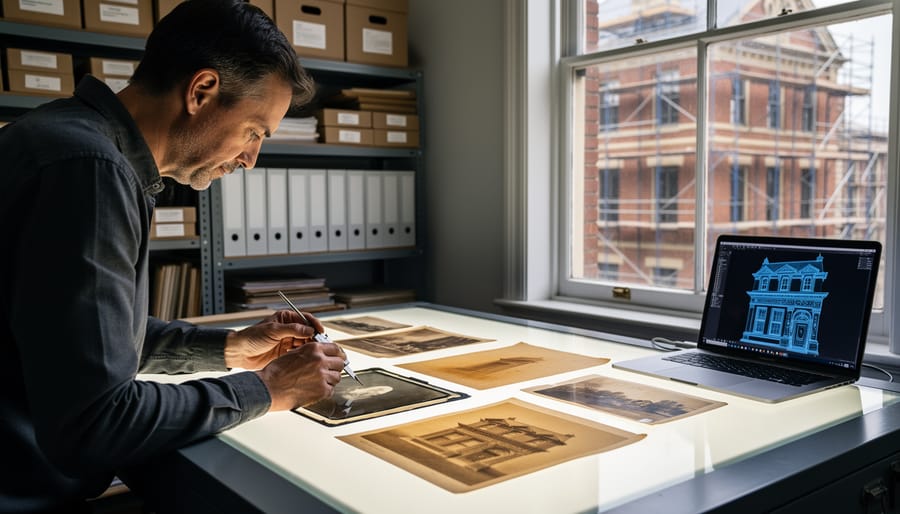
Examine historical photographs with attention to architectural details, measuring shadows and light angles to determine exact building dimensions and spatial relationships—this forensic approach transforms century-old images into blueprints for heritage reconstruction. Study multiple photographs of the same structure from different perspectives, as the Western Photographic Historical Society’s archives demonstrate that triangulating viewpoints reveals precise measurements that single images cannot provide. Document your own community’s changing landscape now, using consistent vantage points and standardized focal lengths, because today’s casual snapshots become tomorrow’s archaeological evidence when buildings disappear or natural disasters strike.
The Western Photographic Historical Society stands at the intersection of preserving cultural memory and practical heritage reconstruction, transforming glass plate negatives and daguerreotypes into precise architectural records. Founded by photographers who recognized that their medium captured more than moments—it preserved vanished worlds with mathematical accuracy—the society has spent decades teaching both historians and photographers how to extract dimensional data from vintage prints. When fire destroyed Colorado’s historic mining town facades in 1994, society members used stereoscopic photographs from the 1880s to recreate building elevations accurate to within three inches.
This work demands understanding both vintage photographic processes and modern digital reconstruction techniques. A single albumen print from 1875 contains information about lens distortion, film sensitivity, and exposure times that directly translate to building heights, window placements, and material textures. The society’s methodology combines photogrammetry software with traditional darkroom knowledge, proving that photographers possess unique skills for heritage conservation. Whether you shoot film or digital, understanding how your camera documents space makes you a potential contributor to preserving architectural history before it crumbles beyond recovery.
What Is the Western Photographic Historical Society?
The Western Photographic Historical Society stands as a remarkable organization dedicated to bridging the past and present through the power of photography. Founded in the early 1990s by a group of archivists, historians, and passionate photographers, the society emerged from a simple yet profound realization: countless historical photographs sitting in dusty archives and private collections held the key to accurately reconstructing buildings, monuments, and entire districts lost to time, war, and natural disasters.
At its core, the society’s mission revolves around three interconnected objectives. First, they actively collect and catalog historical photographs from across Western regions, creating comprehensive digital databases that document everything from architectural details to street layouts as they existed decades or even centuries ago. Second, they preserve these invaluable images using both traditional archival methods and cutting-edge digitization techniques, ensuring future generations can access this visual heritage. Third, and perhaps most importantly, they make these photographic resources available to reconstruction specialists, urban planners, and heritage organizations working to restore or rebuild lost landmarks.
What sets this organization apart is their practical approach to heritage preservation. Rather than simply maintaining archives for academic purposes, they actively collaborate with reconstruction projects worldwide. When historic buildings need restoration after damage, or when communities seek to revive demolished landmarks, the society provides detailed photographic evidence that guides every decision, from facade ornaments to window placements.
The organization has grown into a respected voice within the broader heritage preservation movement, partnering with UNESCO, national archives, and local historical societies. They’ve proven that photographs aren’t merely nostalgic keepsakes but essential technical documents. A single well-composed image from the 1920s might reveal construction materials, architectural proportions, and design details that written records never captured.
For photographers today, the society offers an inspiring reminder that every photograph we take potentially becomes tomorrow’s historical document, making thoughtful composition and thorough documentation more meaningful than ever.
The Science Behind Photographic Reconstruction
Photogrammetry: Turning Flat Images Into 3D Models
Photogrammetry might sound like cutting-edge technology, but the principles behind it have been around since the 19th century. Today, this technique breathes new life into historical photographs by transforming flat, two-dimensional images into detailed three-dimensional models. For heritage reconstruction projects, photogrammetry has become an invaluable tool that allows us to virtually rebuild structures that no longer exist.
The process works by analyzing multiple photographs of the same subject taken from different angles. Software identifies common points across these images and calculates spatial relationships, essentially reverse-engineering depth information that was captured in those original photographs. When historical societies work with archival images, they often have access to numerous photographs of important buildings or landscapes taken by different photographers over the years. These varied perspectives become the raw material for reconstruction.
One remarkable example comes from the reconstruction of San Francisco’s Palace Hotel before the 1906 earthquake. Researchers collected dozens of historical photographs from various archives, including amateur snapshots and professional documentation. By processing these images through photogrammetric software, they created a detailed 3D model showing architectural features that written descriptions alone could never capture, from ornate cornices to the exact proportions of windows and columns.
Similarly, teams have successfully reconstructed entire ghost towns in the American West using photogrammetry. The mining town of Bodie, California, benefited from this approach when historians combined stereoscopic photographs from the 1880s with early 20th-century documentation. The resulting models revealed construction techniques and spatial arrangements that helped inform preservation efforts at the actual site.
For photographers interested in contributing to these projects, the key is methodical documentation. When photographing historic sites today, consider taking multiple shots from various angles and distances. These images could become tomorrow’s archival treasures, providing future researchers with the material needed for accurate reconstruction.
The Camera Technology That Made It Possible
Understanding the cameras that captured historical Western images is like being handed a key to the past. The Western Photographic Historical Society emphasizes that successful heritage reconstruction depends heavily on knowing what equipment photographers used a century ago and recognizing the unique fingerprints these tools left on every image.
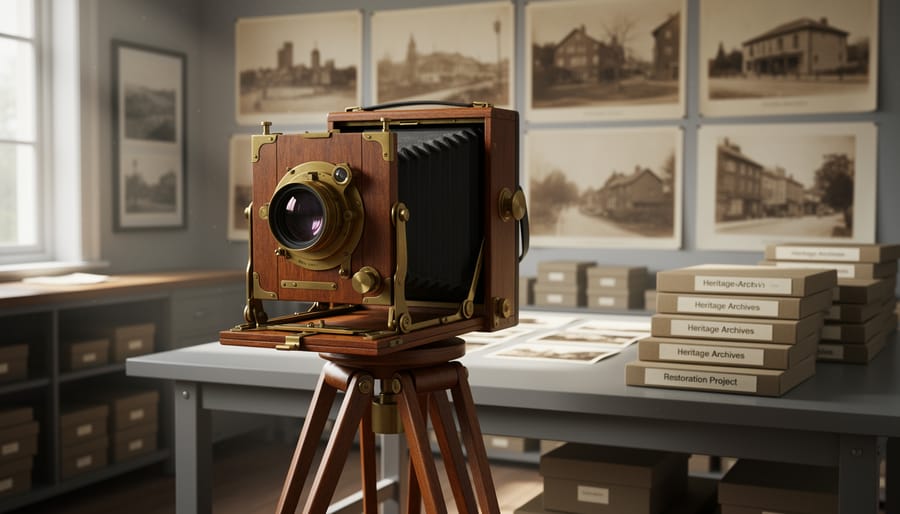
Most photographs from the late 1800s and early 1900s were captured using large format cameras, typically 8×10 or even larger glass plate negatives. These weren’t your quick-draw street cameras. They required sturdy tripods, lengthy exposure times, and tremendous skill to operate. The large format meant exceptional detail, which is precisely why these images remain valuable for reconstruction work today. When you’re trying to determine the exact placement of a window frame or the pattern of decorative trim on a demolished building, that level of detail becomes critical.
The lenses of this era also had distinct characteristics that matter for modern reconstruction. They typically offered limited depth of field and specific distortion patterns, particularly wide-angle lenses which could create barrel distortion at the edges. Understanding these optical signatures helps researchers correct for distortions when creating architectural plans or 3D models from historical photographs.
Film sensitivity was another major limiting factor. Early emulsions were primarily sensitive to blue light, meaning blue skies often appeared washed out while red objects photographed much darker than they appeared to the human eye. This orthochromatic film limitation affects how we interpret materials and colors in historical scenes.
Why does this technical knowledge matter? Because when you’re comparing a 1890s photograph to a modern reconstruction attempt, you need to account for how the camera saw the world versus how it actually looked. That weathered wooden facade might appear nearly black in the original photo not because it was that dark, but because of the film’s color sensitivity. Recognizing these technical limitations transforms old photographs from simple historical curiosities into precise documentary evidence.
Notable Reconstruction Projects From Historical Archives
Pre-Earthquake San Francisco: Rebuilding Through Glass Plates
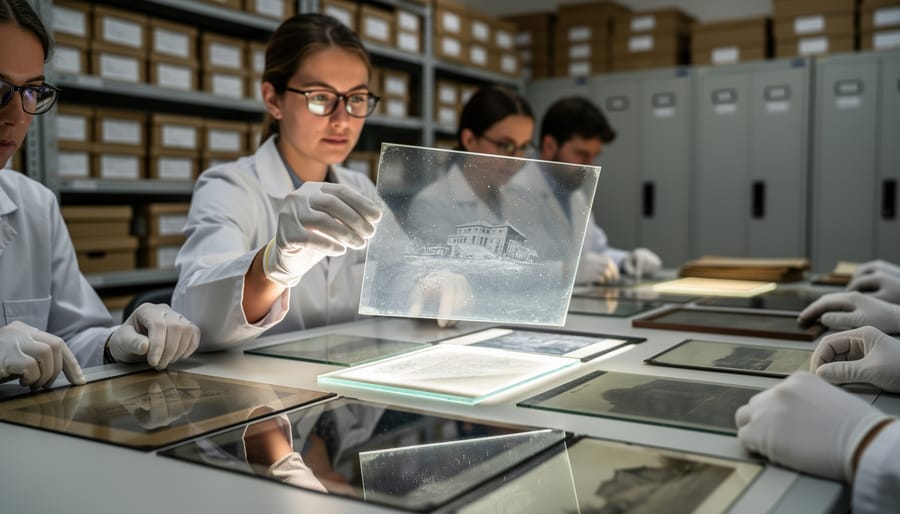
When the 1906 earthquake and subsequent fires devastated San Francisco, they erased countless architectural treasures from the city’s landscape. But thanks to photographers who had documented the city in the preceding decades, these lost buildings weren’t completely forgotten. The glass plate negatives captured by both professional and amateur photographers became invaluable historical documents, providing architects and historians with precise visual records of what once stood.
These photographs, many housed in collections like those preserved by western photographic historical societies, contain remarkable detail. The large-format glass plates used in late 19th and early 20th century photography captured intricate architectural elements that would prove essential for understanding Victorian-era building techniques, ornamental details, and urban planning. Unlike modern digital images, these plates offered exceptional clarity and tonal range, making them perfect reference materials for reconstruction efforts.
Historians studying these images discovered far more than building facades. The photographs revealed streetscapes, showing how structures related to one another and how residents actually used public spaces. This urban transformation photography documented everything from storefront signage to street furniture, creating a comprehensive visual archive.
Today, architects working on historic preservation projects in San Francisco regularly consult these photographic collections. The glass plates have guided restoration work on surviving buildings and informed reconstructions of notable structures. This practical application demonstrates how systematic photographic documentation, even when created without preservation in mind, becomes invaluable historical evidence. For modern photographers, this legacy underscores the importance of thoroughly documenting our contemporary built environment.
Lost Indigenous Sites and Sacred Spaces
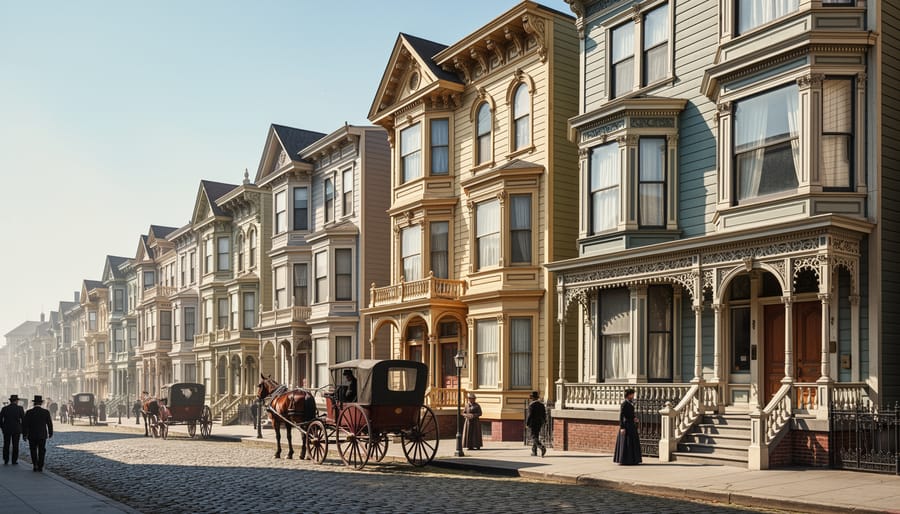
Historical photographs serve as crucial time capsules for reconstructing indigenous heritage sites that have been lost to time, development, or deliberate destruction. The Western Photographic Historical Society maintains extensive archives of images documenting ceremonial grounds, village layouts, and sacred landscapes across the American West from the 1860s onward. These photographs, originally captured by government surveyors, railway documentarians, and early ethnographers, now provide invaluable data for heritage reconstruction efforts.
Working alongside tribal historians and archaeologists, researchers use techniques like photogrammetry to extract three-dimensional information from historic images. By analyzing multiple photographs of the same location from different angles, specialists can reconstruct spatial relationships and architectural details of structures that no longer exist. This process has proven particularly valuable for sites like ceremonial kivas, rock art panels destroyed by reservoir construction, and traditional gathering places buried under urban development.
The society’s collections include rare stereoscopic images, which contain inherent depth information, making them especially useful for reconstruction work. Glass plate negatives, with their exceptional clarity and detail, often reveal features invisible in later paper prints. One notable success involved using 1880s photographs to help a Pueblo community recreate traditional ceremonial structures using historically accurate dimensions and orientations.
For photographers interested in contributing to preservation efforts, documenting contemporary indigenous sites requires respectful collaboration with tribal authorities. Always seek permission before photographing, understand which areas are restricted, and consider how your images might serve future generations. High-resolution digital photography, combined with GPS metadata and detailed written descriptions, creates comprehensive records that honor both technical excellence and cultural sensitivity.
How Modern Photographers Can Contribute to Heritage Preservation
Essential Camera Settings and Techniques for Archival Documentation
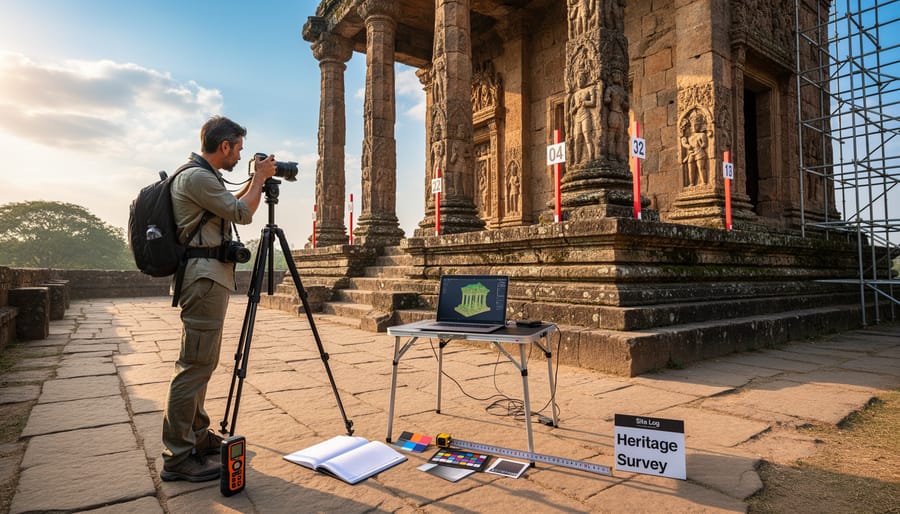
When documenting cultural heritage sites for future reconstruction, your camera settings make the difference between a helpful reference and an invaluable archival resource. Start by shooting in RAW format exclusively. While RAW files are larger, they preserve every detail your sensor captures, giving future researchers maximum flexibility to extract information your JPEG might discard.
Set your camera to its base ISO, typically 100 or 200, to minimize noise and maximize dynamic range. Use a tripod whenever possible and shoot with apertures between f/8 and f/11, the sweet spot where most lenses deliver peak sharpness across the frame. This ensures architectural details remain crisp from foreground to background.
White balance matters more than you might think. Set it to daylight or a specific Kelvin value rather than auto, and record that setting in your shot list. Future colorists reconstructing painted surfaces need to know your lighting conditions. Speaking of documentation, metadata is your secret weapon. Enable GPS tagging if available, and use your camera’s voice memo feature or a notebook app to record detailed notes: exact location, compass direction you’re facing, time of day, and weather conditions.
Bracket your exposures religiously. Shoot at least three frames at different exposures for every composition. This high dynamic range approach captures detail in both deep shadows and bright highlights that a single exposure might miss. For scale reference, include a measuring tape or common object like a coin in at least one frame of each area.
Finally, establish a systematic shooting pattern. Work methodically around structures in a clockwise direction, photographing every surface from multiple angles and distances. This comprehensive approach transforms casual snapshots into genuine archival documentation that historians will thank you for decades later.
Getting Involved With Historical Societies and Archives
Getting involved with historical photographic societies opens doors to meaningful preservation work while expanding your understanding of photography’s heritage. The Western Photographic Historical Society and similar organizations actively welcome new members, regardless of experience level.
Start by visiting the society’s website or contacting them directly through email or social media. Most organizations offer multiple membership tiers, from basic supporter levels to active volunteer positions. Attending monthly meetings or public lectures is an excellent way to meet fellow photography enthusiasts and learn about ongoing projects before making a formal commitment.
If you own historical photographs, cameras, or equipment, consider contributing to archival collections. Reach out to your local historical society to discuss donation processes. They’ll typically assess items for historical significance, condition, and relevance to their collection focus. Don’t assume older photographs lack value—even family snapshots from the early to mid-20th century can provide valuable documentation of daily life, architecture, and cultural practices.
For those interested in active documentation work, propose a personal heritage reconstruction project. Identify a historically significant location in your community and research its photographic history through local archives and libraries. Use your modern photography skills to create comparative studies, matching historical viewpoints as precisely as possible. Document your methodology and share findings with relevant historical societies—this approach transforms hobby photography into genuine historical contribution.
Many societies also need volunteers for digitization projects, helping scan and catalog photographic collections. This hands-on work provides invaluable learning opportunities about photographic processes, conservation techniques, and historical research methods while directly supporting preservation efforts.
The Challenges of Working With Historical Photographs
Working with historical photographs for heritage reconstruction presents a unique set of challenges that even the most experienced photographers and archivists must navigate carefully. Unlike contemporary digital images with their high resolution and embedded metadata, vintage photographs often come with significant limitations that require creative problem-solving.
The first hurdle is image quality. Many historical photographs have deteriorated over time, with fading, scratches, water damage, or chemical degradation affecting their clarity. When you’re trying to determine exact architectural details from a photograph taken in the 1880s, every crack and stain becomes an obstacle. These images might have been stored improperly for decades, exposed to humidity, light, or extreme temperatures that compromise their integrity. Restoring vintage photographs becomes an essential first step before any reconstruction work can begin.
Beyond physical degradation, historical photographs often lack crucial contextual information. Early photographers rarely documented camera settings, exact locations, or dates. A beautiful image of a Western frontier building might exist without any notation of which town it depicts or what year it was captured. Researchers must become detectives, cross-referencing clothing styles, architectural features, and landscape elements to pinpoint specifics.
Perspective and scale present additional complications. Without knowing the lens focal length or the photographer’s exact position, determining accurate measurements becomes challenging. A building might appear larger or smaller than it actually was, depending on these unknown variables.
Interpretation difficulties arise when trying to understand what’s happening outside the frame. Early cameras had limited dynamic range, meaning shadow areas might appear completely black while bright areas wash out, hiding valuable details that would aid reconstruction efforts.
Societies and researchers overcome these challenges through collaboration, combining multiple photographs of the same subject when available, consulting historical records and maps, and employing modern digital enhancement techniques that can reveal hidden details without altering the original image’s authenticity.
Digital Tools That Make Reconstruction Possible Today
The good news for anyone interested in contributing to heritage reconstruction projects is that the technology has never been more accessible. Whether you’re a hobbyist wanting to help preserve local history or a professional working on major restoration initiatives, there’s a suite of digital tools that can transform those dusty old photographs into valuable reconstruction resources.
For beginners, free software like GIMP (GNU Image Manipulation Program) offers powerful image enhancement capabilities without the price tag. It’s particularly useful for cleaning up damaged photographs, adjusting contrast to reveal hidden details, and creating layered composites when working with multiple historical images of the same structure. Many photographers start here before investing in premium tools.
Adobe Photoshop remains the industry standard for serious reconstruction work, especially when paired with its suite of AI-powered features. The Camera Raw filter can breathe new life into faded photographs, while Content-Aware Fill helps reconstruct missing portions of images based on surrounding context. For architectural projects, Photoshop’s perspective correction tools prove invaluable when working with photographs taken at awkward angles or with vintage cameras that introduced distortion.
Photogrammetry software has revolutionized how we convert flat photographs into three-dimensional models. Programs like Agisoft Metashape and RealityCapture can take multiple historical photographs of a building from different angles and generate surprisingly accurate 3D reconstructions. While professional versions carry hefty price tags, hobbyist-friendly alternatives like Meshroom offer similar capabilities at no cost, though with a steeper learning curve.
For those specifically interested in architectural reconstruction, SketchUp provides an intuitive platform for translating photographic evidence into detailed 3D models. Many historians appreciate its relatively gentle learning curve and extensive library of historical architectural elements. When combined with historical photographs as reference materials, it becomes a powerful tool for visualizing lost structures.
Cloud-based platforms like Google Earth and historical mapping services allow photographers to georeference their images, placing them precisely where they were originally captured. This spatial context proves crucial when multiple photographers contribute images to a single reconstruction project, ensuring everything aligns correctly.
The Western Photographic Historical Society maintains an updated list of recommended tools and frequently hosts workshops teaching these techniques, recognizing that accessible technology democratizes heritage preservation and allows more voices to participate in safeguarding our shared visual history.
The work of the Western Photographic Historical Society reminds us that every photograph we take today becomes tomorrow’s historical record. When you press that shutter button, you’re not just capturing a moment for Instagram or your personal portfolio—you’re creating a document that future generations might rely on to understand our world. The society’s heritage reconstruction projects demonstrate this beautifully, showing how images taken decades ago now serve as blueprints for rebuilding lost architectural treasures and preserving cultural memory.
What can we learn from their work? First, that documentation matters. Those casual snapshots of your neighborhood, the buildings you pass daily, or community events you attend could become invaluable resources fifty or a hundred years from now. Second, technical details count. The photographers whose work proves most useful for reconstruction didn’t necessarily intend their images for that purpose, but they captured sharp, well-exposed images with contextual information intact.
As photographers, we have a responsibility to think beyond the immediate. Consider maintaining proper archival practices for your work—organize your files, add metadata, and preserve your negatives or RAW files. Partner with local historical societies or archives to ensure your documentary photography survives you.
Photography possesses a remarkable power to collapse time, allowing future eyes to witness what we see today. Every frame you capture carries the potential to preserve something irreplaceable. Make your photographs count, because somewhere down the line, someone might need them to rebuild not just a building, but a piece of shared human history.




 By
By