 By
By 
Recognize when your booking calendar consistently fills months in advance and inquiries exceed your capacity—this signals you’ve outgrown solo operations. Calculate your effective hourly rate by dividing total annual revenue by actual working hours, including editing, admin, and client communication. If you’re earning less than $50 per hour after expenses, you’re leaving money on the table that proper scaling could capture.
Audit your current workflow to identify repetitive tasks consuming 20% or more of your week. Editing, client correspondence, and social media management are prime candidates for delegation. Start by hiring a virtual assistant for five hours weekly rather than immediately bringing on a full-time team member. This low-risk approach lets you test systems and processes before committing to larger overhead.
Document every aspect of your business operations as if training someone tomorrow. Create standard operating procedures for your shooting style, editing presets, client onboarding sequences, and contract processes. Without this foundation, scaling becomes chaotic rather than strategic. Many photographers assume their intuitive approach can’t be systematized, but breaking down your process reveals teachable patterns.
Understand that scaling fundamentally changes your role. You’ll transition from photographer to creative director and business manager, spending less time behind the camera and more time building systems, managing people, and developing client relationships. This shift challenges many photographers who fell in love with the craft, not spreadsheets and team coordination.
Different photography business models require distinct scaling approaches. A high-volume wedding studio operates differently from a boutique portrait business or commercial photography agency. Your scaling strategy must align with your specific niche, market positioning, and personal goals—not generic advice that ignores these critical variables.
The Tipping Point: Recognizing When You’re Ready to Scale

Financial Indicators That You’re Leaving Money on the Table
Your bank account tells a story about whether you’re ready to scale. When you’re consistently generating monthly revenue of at least $5,000 to $7,000 as a solo photographer, that’s your first green light. This threshold indicates you’ve built a sustainable client base and proven your pricing strategy works in your market.
Profit margins matter more than gross revenue. If you’re keeping 40% to 50% of what you earn after expenses, you’re in healthy territory. Lower margins might mean you’re undercharging or spending inefficiently, both issues to address before hiring help or leasing studio space. Track this for at least six months to understand your true financial picture.
Look for revenue consistency rather than occasional windfalls. Booking three $3,000 wedding packages in one month, then struggling for two months afterward, doesn’t signal readiness. You need predictable income streams. Perhaps you’ve established retainer relationships with five local businesses, or you’ve booked weddings for the next nine months. This stability indicates clients trust you enough to plan ahead.
Building your financial stability means having three to six months of operating expenses saved before scaling. When Sarah, a portrait photographer in Calgary, reached $8,000 monthly revenue with a six-month emergency fund, she confidently hired her first assistant. That cushion meant temporary setbacks wouldn’t derail her expansion.
If you’re regularly turning down projects because you lack time or equipment, you’re literally watching money walk away. That’s the market telling you it’s time to grow.
The Workflow Bottlenecks Only You Can Solve
You’ve likely experienced at least one of these telltale bottlenecks: your hard drive is bursting with unedited sessions from three weeks ago, you’re turning down weekend bookings because you’re already booked solid, or your inbox has become a source of anxiety rather than excitement. These aren’t just annoyances—they’re actually valuable signals pointing toward your business’s next evolution.
The editing backlog is often the first domino to fall. When you’re spending Tuesday through Thursday glued to Lightroom instead of marketing or meeting clients, you’ve hit a processing ceiling. Similarly, if you’re declining profitable work simply because there aren’t enough hours in your week to physically show up with a camera, you’ve maxed out your shooting capacity. Then there’s the communication bottleneck—when responding to inquiries, coordinating sessions, and managing post-shoot follow-ups starts eating into creative time.
Here’s what most photographers miss: these constraints aren’t personal failures. They’re growth indicators. That editing backlog? It proves you’ve built consistent demand. Those scheduling conflicts? They demonstrate your reputation has outpaced your availability. The overflowing inbox? It signals you’ve moved beyond hunting for clients to managing an established pipeline.
The photographers who successfully scale recognize these pressure points as opportunities rather than obstacles. They start asking different questions: “What if I brought on an editor?” or “Could I train an associate shooter?” These bottlenecks are your business telling you it’s ready for the next chapter—you just need to listen.
Your First Hire Changes Everything (And That’s Okay)

Second Shooter vs. Associate Photographer vs. Editor: Who First?
Your first hire can make or break your scaling journey, so let’s examine the three most common options and their real-world implications.
Second shooters are typically the easiest entry point. You hire them per-event, usually paying $200-500 per day depending on your market. The beauty here is flexibility—you’re not committed to ongoing expenses, and there’s minimal administrative burden. Wedding photographers often start here because client demand naturally fluctuates by season. The downside? Second shooters won’t help with the editing backlog that’s probably keeping you up at night, and finding reliable, skilled shooters when you need them can be challenging.
Associate photographers represent a bigger commitment. These are photographers who shoot under your brand independently, allowing you to book multiple events on the same day. This is the holy grail for wedding and event photographers looking to double or triple revenue without cloning themselves. However, associates require extensive training, detailed systems, and often a percentage of the booking fee (typically 30-50%). You’re also responsible for their performance with your clients, which can be nerve-wracking until you’ve built deep trust.
Editors offer a completely different value proposition. Hiring an editor for $25-75 per hour (or per-image rates) immediately returns your most precious resource: time. Portrait and commercial photographers who control their own shooting schedules often benefit most from this option. You’re buying back evenings and weekends to either shoot more or actually have a life. The financial math is straightforward—if an editor costs $500 weekly but frees you to book one additional $2,000 session monthly, you’re ahead.
The decision framework is simpler than you think. If your bottleneck is fulfilling demand on peak dates, hire second shooters or associates. If you’re drowning in post-production and turning away bookings because you lack editing time, hire an editor first. Most commercial and portrait photographers start with editors, while wedding and event photographers typically begin with second shooters before graduating to associates.
Protecting Your Creative Vision While Delegating
Your creative signature is your most valuable asset, and protecting it while delegating feels like teaching someone to paint with your brush. The key is creating systems that preserve your vision without requiring you to hover over every decision.
Start with a comprehensive style guide that goes beyond basic technical specs. Include your approach to composition, lighting preferences, color grading decisions, and even the emotional tone you aim for. When photographer Jasmine Rodriguez scaled her wedding business, she created a 30-page visual guide featuring side-by-side comparisons: “This is how I’d frame it” versus “What to avoid.” She included actual client images with annotations explaining why certain editing choices were made. This transformed her style from something instinctive into something teachable.
Training should be hands-on and iterative. Have new team members shadow you on shoots, then assign them to photograph practice sessions or smaller projects. Review their work together, focusing on the why behind adjustments rather than just making corrections yourself. Think of it as teaching someone to see through your lens.
Quality control doesn’t mean micromanaging every detail. Establish clear approval checkpoints at strategic stages rather than reviewing every single frame. For editors, this might mean checking the first five fully edited images from a shoot before they proceed. For second shooters, conduct post-shoot reviews where you discuss their decision-making process.
Remember, you’re not cloning yourself. The goal is maintaining consistency in quality and approach while allowing collaborators to bring their own strengths to your vision. Some variation is healthy and can even enhance your offerings when guided properly.
The Gear Equation: When to Invest in Duplicate Systems
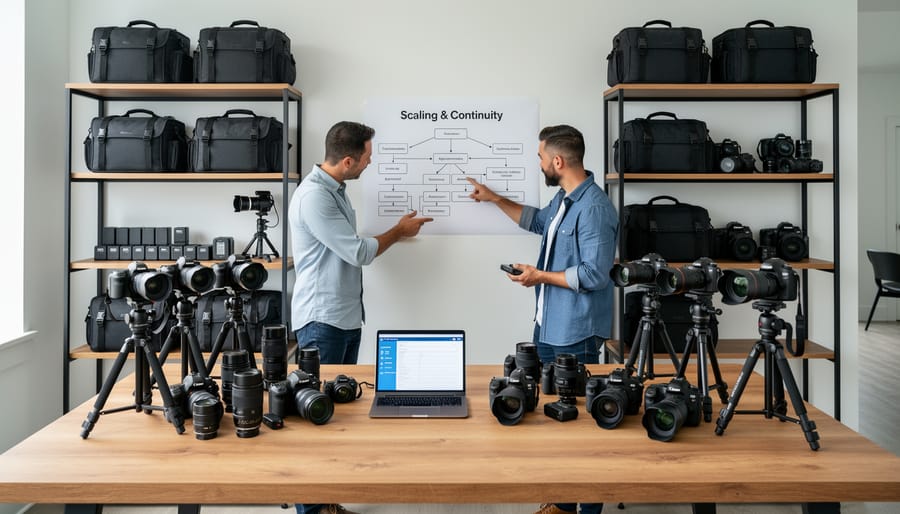
Building a Studio Kit vs. Personal Kit Philosophy
When you’re scaling your freelance photography business, one of the most significant mental shifts involves how you think about gear. What worked for your personal kit won’t necessarily serve your growing operation.
As a solo freelancer, you probably built your kit around your shooting style and preferences. Maybe you’re a Canon shooter who invested in L-series glass, or perhaps you’ve committed to the Fujifilm ecosystem. That’s perfectly fine for personal work, but scaling often means thinking bigger picture.
Studio kits need to prioritize versatility and redundancy over personal preference. This means maintaining backup bodies, even if you rarely use them yourself. It means investing in lighting equipment that multiple photographers can operate, not just the specific modifiers you prefer. When a second shooter picks up your gear for an event, they need familiar, reliable equipment that doesn’t require specialized knowledge.
The financial treatment changes too. Your personal kit was likely purchased piecemeal as you could afford it. Studio assets require proper business accounting, complete with depreciation schedules and equipment replacement planning. You’ll need adequate insurance that covers not just theft or damage, but also business interruption. A broken camera when it’s just you means lost income, but when you’re managing multiple bookings simultaneously, it can cascade into much larger problems.
Maintenance becomes scheduled rather than reactive. Set calendar reminders for sensor cleanings, lens calibrations, and equipment inspections. Create standardized checklists for gear prep before shoots. This systematic approach prevents the nightmare scenario where an assistant discovers malfunctioning equipment mid-assignment.
Consider designating specific equipment for studio use versus personal projects. This separation helps track actual business costs and prevents wear on critical assets from personal experimentation.
The Studio Space Decision: Home Base vs. Commercial Location
The decision to move from your home studio to a commercial space isn’t just about prestige—it’s a calculated financial move that needs careful consideration. I’ve seen photographers make this leap too early and struggle with overhead, while others waited too long and lost potential clients who expected a more professional setup.
Start by running the numbers. A commercial studio typically costs between $1,500 and $5,000 monthly depending on your market, plus utilities, insurance, and often a security deposit equal to two or three months’ rent. Compare this against your current home expenses. If you’re claiming home office deductions, you’ll lose those tax benefits, but you’ll gain the ability to deduct 100% of your studio costs as business expenses.
The breakeven analysis is straightforward: divide your total monthly studio costs by your average profit per session. If a commercial space costs $2,500 monthly and you profit $400 per shoot, you need at least seven additional bookings monthly to justify the move. But here’s the reality—a professional studio often commands higher rates and attracts corporate clients who won’t come to residential locations.
Zoning laws matter more than many photographers realize. Some municipalities prohibit running photography businesses from residential areas, especially if you’re seeing clients regularly. One violation complaint from a neighbor can shut down your entire operation. Check your local regulations before making assumptions about your home studio’s legality.
Client perception varies by photography niche. Wedding and portrait photographers often succeed with home studios if they’re well-appointed, while commercial and corporate photographers almost universally need dedicated commercial space to land contracts. Product photographers fall somewhere in between, where the quality of your shooting area matters more than the building’s exterior.
Consider a hybrid approach initially: rent studio space by the day or join a co-working photography studio. This tests whether commercial space actually increases your bookings before you commit to a long-term lease.
Pricing Restructure: From Hourly Artist to Business Packages
Building Pricing That Supports Multiple Team Members
When you’re operating solo, your pricing calculation is relatively straightforward: your time plus overhead plus desired profit equals your rate. But once you bring team members into the picture, the math becomes more nuanced.
Let’s break down a real-world scenario. Imagine you currently charge $2,500 for a wedding as a solo photographer. Your personal overhead (insurance, equipment, marketing) runs about $800 monthly, and you shoot roughly four weddings per month. That gives you a decent living as a one-person operation.
Now you’re hiring an associate photographer at $350 per wedding. Here’s where many photographers stumble—they simply subtract that $350 from their existing rate, leaving $2,150. But this doesn’t account for additional overhead costs that come with employees: workers’ compensation insurance, additional equipment, increased liability coverage, administrative time for scheduling and quality control, and taxes.
Industry benchmarks suggest adding 25-35% to direct labor costs to cover these hidden expenses. So that $350 photographer actually costs you closer to $470 per wedding. You’ll also need financial planning support to structure this properly.
A sustainable pricing model for team-based work typically looks like this: 40% labor costs, 20% overhead, 20% owner profit, and 20% reinvestment into the business. Using this formula, if you’re paying an associate $350, your minimum package price should be around $1,750 just for their work, not including your involvement as primary photographer or second shooter.
The key insight: scaling isn’t about doing more work at the same rates. It’s about restructuring your entire pricing model to support a profitable, sustainable team operation.
Communicating Your New Value Proposition to Existing Clients
Honesty builds trust when explaining changes to existing clients. Start the conversation by acknowledging the relationship: “You’ve been with me since the beginning, and I wanted to personally share some exciting developments.” Frame your growth positively—you’re not abandoning them, you’re evolving to serve them better.
A practical script might sound like: “As I’ve expanded my studio capabilities, I can now offer you enhanced services like faster turnaround times and specialized equipment. This does mean my pricing structure has changed to reflect these improvements. Your session rate will increase from $X to $Y starting next season.”
Provide context without over-explaining. Share one or two tangible benefits they’ll experience: access to a larger studio space, backup photographers for guaranteed coverage, or professional retouching included. Real-world example: when photographer Maria Rodriguez transitioned to studio ownership, she offered existing clients a grandfather rate for one additional booking, giving them time to adjust while maintaining goodwill.
Give advance notice—ideally 60-90 days before new rates take effect. Send personalized emails rather than mass announcements for your most loyal clients. Some attrition is normal and healthy; clients who valued you solely for rock-bottom pricing weren’t sustainable long-term partners anyway. Those who appreciate your quality will understand that professional growth requires investment.
Systems and Processes: The Unsexy Foundation of Scaling
Client Management: CRM Tools That Actually Work for Photographers
When you’re juggling multiple shoots weekly, client communication can quickly spiral into chaos. I learned this the hard way when I missed a rescheduling request buried in my Instagram DMs while another client’s email sat in my spam folder. That’s when I realized spreadsheets and good intentions weren’t going to cut it anymore.
For photographers specifically, studio management systems like HoneyBook and Dubsado have proven themselves in real-world use. These platforms handle the entire client journey from initial inquiry to final gallery delivery. HoneyBook excels at workflow automation, sending personalized emails based on triggers like contract signing or invoice payments. I’ve seen photographers reclaim 10+ hours weekly just by automating follow-ups and questionnaire reminders.
Dubsado offers deeper customization if you have specific workflow needs. For instance, you can create conditional forms that adjust questions based on client responses, which is invaluable when you shoot both weddings and commercial work requiring different information.
The sweet spot for most growing photography businesses is Tave, which balances robust features with photography-specific tools like session tracking and product ordering integration. Its calendar syncing prevents double-bookings across team members, critical when you’re managing multiple shooters.
Start with one system’s free trial and commit to using it exclusively for one month with new clients. The key isn’t finding the perfect CRM but actually using whichever you choose consistently. Your future self will thank you when tax season arrives and everything’s organized in one searchable location.
Creating Your Operations Manual (Before You Think You Need One)
Here’s the uncomfortable truth: if your business processes only exist in your head, you can’t scale. I learned this the hard way when a family emergency pulled me away for two weeks, and client projects nearly collapsed because no one else knew my workflow.
Start documenting now, even if hiring feels distant. Begin with your client journey from first contact to final delivery. Open a simple Google Doc and walk through your actual process. When someone inquires about a portrait session, what happens next? Do you send a specific email template? What information do you collect? Document every step, no matter how obvious it seems.
For example, my initial inquiry response includes pricing, availability check, location discussion, and a link to my portfolio. That’s four distinct steps I once did intuitively but needed written down for consistency.
Next, map your shoot-day workflow. What equipment gets packed? How do you handle lighting setups? This becomes invaluable when training assistants or second shooters.
Then tackle post-production. Which software do you use? What’s your editing sequence? How do you organize files? Specific details matter here. My manual specifies folder naming conventions, backup procedures, and delivery timelines down to the hour.
This documentation serves two purposes: it enables workflow automation and creates your training bible. When you eventually hire, you’ll hand someone a playbook instead of scrambling to explain everything while juggling client work. The photographer who documents early scales faster, because systems beat memory every time.
The Marketing Shift: From Personal Brand to Studio Brand

Social Media Strategy When You’re Not Behind Every Camera
As your photography business grows and you’re no longer shooting every project yourself, maintaining a consistent social media presence requires intentional strategy. The key is establishing clear brand voice guidelines that any team member can follow—think of it as a style guide for your captions, not just your images.
Start by creating a simple document outlining your typical tone, emoji usage, and posting approach. For example, if you always ask questions in captions or share behind-the-scenes moments, document these patterns. When team members shoot projects, have them send you iPhone behind-the-scenes shots and quick notes about the session that you can transform into posts.
Attribution matters too. Develop a consistent system for crediting your associate photographers—perhaps a closing line like “captured by Sarah on our team” or tagging them when appropriate. This builds their profiles while maintaining transparency with your audience.
Consider batching your content strategy: dedicate time weekly to review upcoming work from all photographers and plan posts in advance. Tools like Later or Planoly let you maintain oversight without micromanaging every upload. Remember, your followers care about the quality and consistency of your brand’s work, not necessarily who pressed the shutter.
Showcasing Team Work Without Losing Your Signature Style
Your portfolio needs to tell a cohesive visual story even as multiple hands contribute to the work. Think of it as conducting an orchestra—each musician plays differently, but they’re all following the same score.
Start by creating a detailed style guide for your team. Document everything from your preferred color grading formulas to your typical shooting angles and composition preferences. When wedding photographer Sarah Chen scaled her business, she created a 40-page lookbook showing exactly how she approaches different lighting scenarios and post-processing decisions. This became her team’s bible.
Curate your portfolio strategically. Rather than separating work by photographer, organize it by project type or aesthetic category. This reinforces your studio’s unified vision. Include only work that meets your quality bar, regardless of who shot it. If you need to showcase range, create separate portfolio sections for different service tiers while maintaining visual harmony within each category.
Consider implementing a two-tier review system where you personally approve all portfolio-worthy images. Many successful studios have the lead photographer do final color grading on showcase pieces, ensuring consistency even when associates handle initial editing.
Remember, clients hire your studio for a specific look and feel. Your portfolio should make it impossible to tell where your work ends and your team’s begins—that’s the mark of successful scaling.
Common Scaling Mistakes (And How to Avoid Them)
Scaling your photography freelance business sounds exciting until you’re sitting at 2 AM, drowning in administrative work you never anticipated. Let’s talk about the mistakes that trip up most photographers on this journey—and more importantly, how you can sidestep them.
The premature hiring trap catches photographers off guard more than any other misstep. Take Sarah, a wedding photographer who hired two assistants within a month of each other because she felt overwhelmed. Within six months, she was struggling to keep them both busy during the off-season while still covering their salaries. The lesson? Scale your team incrementally. Start with contractors or part-time help for specific tasks—a photo editor for two days a week or a virtual assistant for five hours monthly. This approach lets you test actual workload needs before committing to full-time salaries and benefits.
Expanding your service offerings too quickly creates another common pitfall. You might think adding videography, drone work, and product photography simultaneously will attract more clients, but it often dilutes your brand and stretches your expertise thin. One commercial photographer I know invested $15,000 in video equipment before landing a single video client. Instead, validate demand first. When three clients ask about a particular service within a short timeframe, that’s your signal to explore expansion in that direction.
The creative fulfillment crisis sneaks up quietly. As administrative duties multiply—client communications, invoicing, scheduling, equipment maintenance—your actual shooting time shrinks. Before you know it, you’re running a business instead of creating art. Combat this by blocking non-negotiable creative time in your calendar. Whether it’s personal projects every Friday afternoon or one experimental shoot monthly, protect this space fiercely. Remember why you started this journey.
Cashflow problems destroy scaling efforts faster than anything else. You’re landing bigger contracts with higher payouts, but those payments come 30, 60, or even 90 days after delivery. Meanwhile, you’ve got equipment purchases, new hires, and marketing expenses hitting your account immediately. Build a cashflow buffer equal to three months of operating expenses before major scaling moves. Negotiate deposit structures that cover at least 50 percent upfront, and consider a business line of credit as a safety net.
If you’ve already fallen into these traps, recovery is possible. Reduce expenses immediately, have honest conversations with your team about workload realities, and refocus on your most profitable services. Scaling isn’t a race—it’s a strategic evolution of your business.
Here’s the truth: scaling isn’t the right choice for every photographer, and that’s perfectly okay. Some of the most successful creatives I know have deliberately kept their operations lean, choosing artistic freedom and work-life balance over expansion. Growth should never be a default setting—it needs to align with your personal values, lifestyle preferences, and long-term vision for both your business and your craft.
Take an honest inventory of what you want from your photography career. If you thrive on direct client relationships, hands-on shooting, and maintaining complete creative control, traditional scaling might dilute exactly what makes your work special. There’s no shame in choosing sustainability over expansion. However, if you’re genuinely excited about building systems, mentoring other photographers, and creating opportunities beyond what you can accomplish alone, scaling opens doors you never imagined possible.
The transition will challenge you. You’ll trade some camera time for spreadsheets, exchange complete autonomy for delegation, and invest financially before seeing returns. But you’ll also discover new creative outlets through directing teams, develop leadership skills that enhance every aspect of your life, and potentially build something that outlasts your individual capacity to shoot.
If you’re ready to explore this path, start small. Document one repeatable process this week—maybe your client onboarding workflow or post-production routine. Research a single automation tool. Have one conversation with a photographer who’s scaled successfully. These modest steps create momentum without overwhelming you, allowing you to test whether scaling energizes or drains you. Your answer to that question will illuminate your next move.





 By
By