 By
By 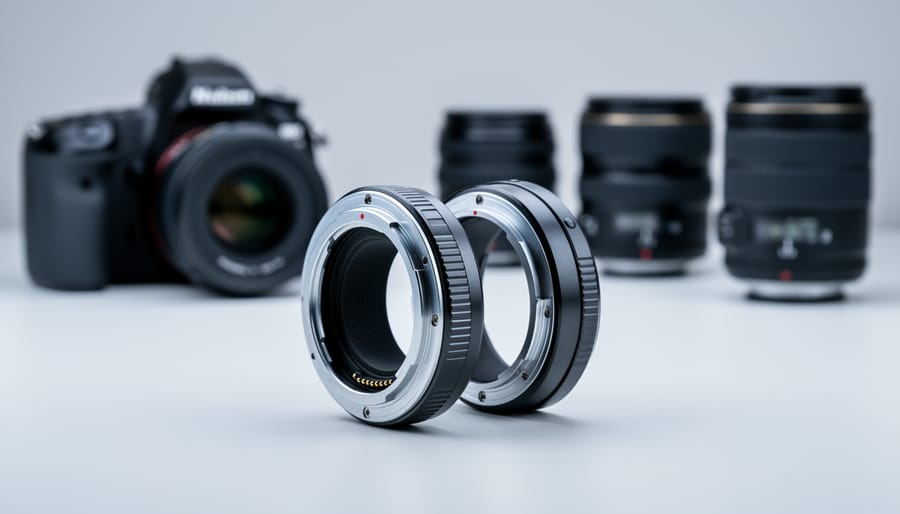
A lens mount adapter is a precision mechanical coupling that lets you attach lenses designed for one camera system to a body with a different mount, and the right adapter can either unlock hundreds of affordable glass options or waste your money on frustrating incompatibility. The key is understanding that adapters fall into two categories: passive rings that maintain manual focus only, and smart adapters with electronic contacts that attempt to preserve autofocus and aperture control. For most photographers exploring adapters in 2026, autofocus performance matters more than any other factor, which is why adapters with unreliable or sluggish AF often sit unused in a drawer despite their promise of expanded lens compatibility.
The challenge is straightforward but consequential. Mount adapters work by compensating for the difference in flange distance between systems, the space between the lens mount and the sensor. When adapting a lens from a system with a longer flange distance to a shorter one, such as Canon EF lenses to Sony E-mount, the adapter simply fills the gap without optical elements. This setup preserves image quality and infinity focus. But when the math runs the other way, shorter to longer flange distance, you need optical glass in the adapter to correct focus, which typically degrades sharpness and adds vignetting.
What complicates buying decisions is the enormous quality gap between adapters at similar price points. A $400 smart adapter from a reputable manufacturer might deliver near-native autofocus speeds, while a $350 generic alternative can hunt endlessly in anything but perfect light. The difference comes down to firmware development, motor quality, and how well the adapter communicates lens data to the camera body. Understanding these distinctions before you buy prevents expensive mistakes and ensures your adapted lenses actually get used in real shooting scenarios.
What Are Lens Mount Adapters and Why Use Them?
A lens mount adapter is a mechanical interface that sits between your camera body and a lens with a different mount system, allowing you to use lenses that weren’t designed for your camera. Think of it as a translator that bridges two different languages, it physically connects incompatible mounting systems so you can attach, say, a Canon EF lens to a Sony E-mount camera or a vintage Nikon F lens to a modern mirrorless body.
Photographers turn to adapters for several compelling reasons. Vintage glass offers a treasure trove of character and optical qualities often missing from modern designs, and adapters let you use these classic lenses on contemporary cameras. If you’re switching camera systems, moving from DSLR to mirrorless, or changing brands entirely, adapters can preserve your investment in existing lenses rather than forcing an expensive wholesale replacement. Budget-conscious shooters discover that adapting older or third-party lenses often delivers excellent image quality at a fraction of the cost of native options.
Professional photographers working across multiple systems also rely on adapters. A wedding shooter might use adapted cinema lenses for video work, or a commercial photographer could employ specialty tilt-shift glass across different camera platforms without maintaining duplicate equipment.
Setting realistic expectations matters tremendously here. Adapters work best when the lens’s flange distance (the space between mount and sensor) exceeds the camera body’s flange distance, this physical requirement explains why you can easily adapt SLR lenses to mirrorless cameras but face limitations going the opposite direction. Most adapters compromise something, whether that’s autofocus speed, full electronic control, or handling convenience. A well-chosen adapter with appropriate lenses can feel nearly native in use, while a poor match creates frustrating limitations that undermine the entire system. Understanding what adapters genuinely deliver, versus what marketing promises, separates successful adaptation from disappointing experiences.
Key Factors to Consider When Buying a Lens Mount Adapter
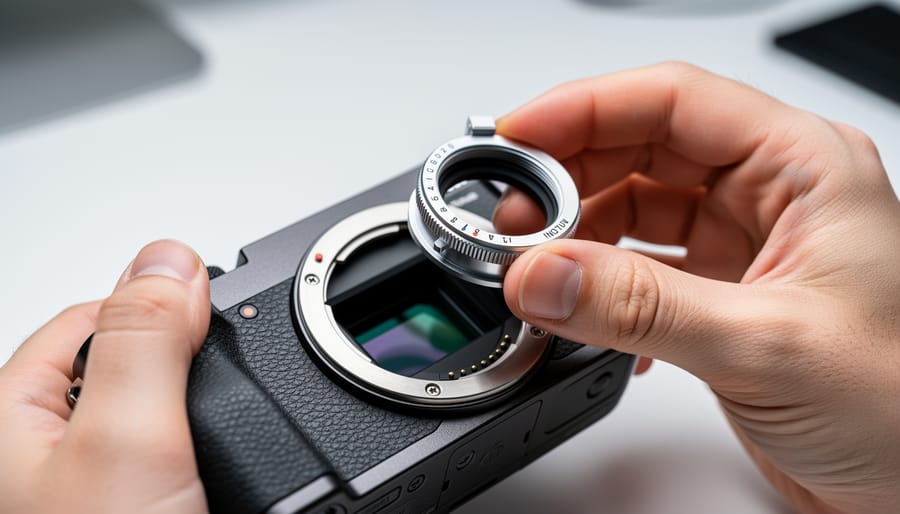
Autofocus Compatibility: The Critical Consideration
Autofocus compatibility matters more than any other adapter feature because it fundamentally determines how you’ll use your lenses. Adapters fall into two categories: manual-only adapters that disable all autofocus functionality, and electronic adapters that maintain communication between lens and camera to preserve autofocus. The difference comes down to whether the adapter includes electronic contacts and the necessary firmware to translate signals between different lens and camera systems.
Manual adapters work well for vintage lenses that never had autofocus or for deliberate manual shooting, but they turn modern autofocus lenses into manual-only optics. Electronic adapters attempt to maintain autofocus, but here’s where things get complicated. Native autofocus, when you mount a lens directly on its intended camera body, is fast and reliable because the manufacturer optimized every aspect of that communication. Adapted autofocus introduces an intermediary that translates signals between systems, which almost always results in slower focus speeds, reduced accuracy in low light, and less reliable subject tracking.
When evaluating adapter specifications, look for details about phase-detection versus contrast-detection support, maximum aperture for autofocus functionality (many adapters lose AF capability at narrow apertures), and specific lens compatibility lists. Some combinations work flawlessly while others struggle. For instance, getting Nikon lenses autofocus on Canon bodies requires adapters with sophisticated electronics and even then, performance varies dramatically by lens generation.
The performance gap shows up clearly in practice. Native autofocus might lock focus in 0.1 seconds while an adapted lens takes 0.4 seconds or longer. For portraits or landscapes, that difference barely matters. For sports, wildlife, or event photography, it’s the difference between nailing the shot and missing it entirely. If autofocus performance matters to your work, budget for premium adapters from manufacturers like Metabones, Sigma, or first-party options, and verify compatibility with your specific lens models before buying.

Build Quality and Precision
Build quality separates adapters that deliver professional results from those that introduce frustrating problems. The precision required is measured in microns, the flange distance (the exact spacing between lens mount and sensor) must match the original camera system’s specifications perfectly. Even a 0.1mm error can prevent your lens from achieving infinity focus or cause one side of your image to be sharp while the other is soft.
Quality adapters use machined brass or hardened aluminum with tight manufacturing tolerances, typically within ±0.02mm. Cheaper adapters often rely on looser-tolerance aluminum or even plastic internal components, which compress over time and shift alignment. This matters more than many photographers realize: a tilted focal plane, where the sensor and lens aren’t perfectly parallel, can’t be fixed in post-processing and ruins sharpness across the frame.
Look for adapters with metal lens mounting surfaces rather than plastic, as plastic tabs wear quickly and can leave your expensive lens wobbling on the adapter. The mount should click firmly into place with no play whatsoever. Any wiggle between adapter and camera or adapter and lens indicates poor tolerances that will compromise optical performance.
Reputable manufacturers publish their tolerance specifications and often provide serial numbers for quality control tracking. While you don’t need to spend hundreds on every adapter, going with established brands known for precision machining, rather than no-name alternatives saving $20, prevents the headache of troubleshooting mysterious sharpness issues you’ll eventually trace back to the adapter.
Electronic Communication and Features
Modern lens mount adapters with electronic contacts bridge the gap between your lens and camera body, enabling communication that goes far beyond just mounting the glass. The difference between an adapter with and without electronic communication dramatically affects your shooting experience, so understanding which features matter for your work is essential.
Electronic contacts on an adapter serve as the conduit for data exchange between lens and camera. When present, they can enable a range of functions that manual-only adapters simply can’t provide. Not all electronic adapters support the same features, though, the level of communication varies widely based on the adapter’s chipset and firmware.
Key electronic features to evaluate include:
- EXIF data recording, captures focal length, aperture, and lens model in image metadata
- Aperture control, allows changing aperture from the camera body rather than manually on the lens
- Image stabilization communication, enables lens-based stabilization to work with camera body settings
- Focus confirmation, provides focus peaking or confirmation indicators even without full autofocus
- Lens correction profiles, applies distortion, vignetting, and chromatic aberration corrections in-camera or during RAW processing
For most photographers, aperture control is non-negotiable. Manually adjusting aperture on the lens itself between shots is cumbersome and slows down your workflow, particularly in changing lighting conditions. Portrait and event photographers especially benefit from seamless aperture adjustments through the camera body.
Image stabilization compatibility matters most for telephoto work and video. If your adapted lens has optical stabilization, you want an adapter that communicates with it properly. Some adapters pass through stabilization data flawlessly, while others disable it entirely or cause erratic behavior.
EXIF data might seem secondary, but it becomes crucial for cataloging large image libraries and analyzing which focal lengths you actually use. For professional work, having complete metadata is part of maintaining organized archives.
Physical Design and Usability
An adapter’s physical design directly impacts your shooting experience, yet these practical considerations often get overlooked until you’re in the field struggling with a poorly balanced setup.
Size and weight matter more than you might expect. A chunky adapter adds bulk to your camera bag and shifts the balance point of your lens-camera combination. When you’re handholding for extended periods, even an extra 100 grams becomes noticeable. Conversely, an overly lightweight adapter might feel flimsy or fail to provide adequate support for heavier lenses.
Balance and handling change significantly with adapters. A well-designed adapter positions the lens at the right distance from the camera body, maintaining a natural balance point. Poorly designed adapters can make your setup front-heavy, causing hand fatigue and making it harder to achieve sharp handheld shots. This becomes especially problematic with telephoto lenses.
Pay attention to mounting and dismounting ease. Quality adapters feature smooth bayonet mechanisms that click securely into place without excessive force or wiggling. You want something you can attach confidently in changing conditions, not a fiddly connection that leaves you wondering if it’s properly seated.
For larger lenses, tripod collar compatibility is essential. Some adapters include integrated tripod mounts or Arca-Swiss plates, which prove invaluable when shooting with heavy glass. Without this feature, you’ll be mounting via the camera body, creating an unbalanced setup that stresses the lens mount.
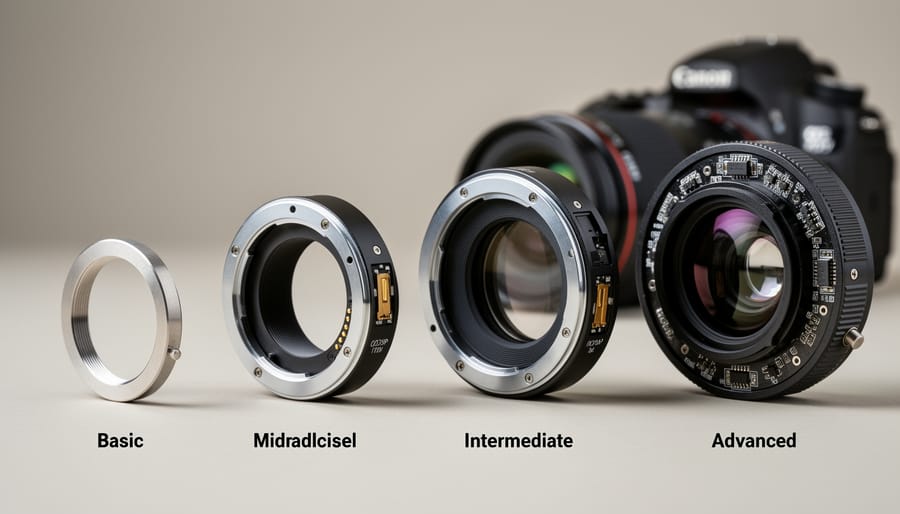
Types of Lens Mount Adapters Compared
Manual-Only Adapters
Manual-only adapters are the simplest and most affordable option. They’re essentially precision metal rings that physically connect your lens to a different camera body, with no electronic contacts to relay information between the two. You’ll find these most commonly called “dumb adapters” in photography circles.
These adapters shine when you’re mounting vintage manual-focus lenses, think classic Nikon F-mount glass, Pentax K-mount primes, or M42 screw-mount lenses from the film era. Since these older lenses never had electronic communication in the first place, you’re not losing any functionality. You’ll manually focus using the lens’s focus ring and adjust aperture using the physical aperture ring on the lens itself.
The advantages are straightforward: they’re inexpensive, lightweight, and completely reliable since there’s no electronics to fail. The trade-offs are equally clear. Your camera won’t recognize what lens is attached, so you’ll get no EXIF data recorded. There’s no autofocus, obviously. Image stabilization won’t work. And on most modern cameras, you’ll need to enable “shoot without lens” in your menu settings.
Manual-only adapters work best for deliberate, thoughtful photography where speed isn’t critical, landscapes, portraits, macro work, or creative projects where you’re already working methodically.
Electronic Adapters with Autofocus
Electronic adapters represent the most sophisticated category of mount adapters, maintaining full communication between your lens and camera body. These “smart” adapters feature electronic contacts that pass signals in both directions, enabling autofocus functionality, aperture control, and image stabilization, essentially preserving most of the features you’d get with a native lens.
The performance varies dramatically between manufacturers and specific combinations. High-quality electronic adapters from established brands like Metabones, Sigma MC-21, and Canon’s own EF-EOS R adapters can deliver autofocus speeds approaching native performance, often losing just 10-20% of AF speed in good light. Budget electronic adapters, conversely, frequently struggle with hunting, reduced accuracy, and compatibility issues with certain lens models.
Autofocus performance depends heavily on three factors: the adapter’s internal firmware sophistication, the specific lens you’re mounting, and your camera body’s processing power. Newer camera bodies with faster processors handle adapted lenses more capably. You’ll typically see the best results with recent lenses that have modern autofocus motors, older screw-drive AF lenses may not work at all or perform poorly even with electronic adapters.
Expect some trade-offs regardless of adapter quality. Continuous autofocus for video and subject tracking often takes the biggest hit, while single-point AF in static situations performs most reliably. Check manufacturer compatibility lists religiously before purchasing, as not all lenses work equally well even when technically supported.
Speed Boosters and Focal Reducers
Speed boosters and focal reducers contain optical elements that compress the image circle from a full-frame lens onto a smaller sensor, typically by a factor of 0.71x. This compression increases the effective aperture by approximately one stop and widens the field of view, essentially giving crop-sensor cameras more full-frame characteristics.
The practical benefits are significant: a 50mm f/1.8 lens becomes roughly a 35mm f/1.2 equivalent on APS-C. You gain both shallower depth of field and better low-light performance while reclaiming the wider field of view that crop sensors normally sacrifice.
Quality matters enormously with speed boosters because you’re adding glass to the optical path. Premium models from Metabones and Viltrox use sophisticated multi-element designs that maintain or even enhance edge sharpness. Cheaper alternatives often introduce vignetting, chromatic aberration, or softness in the corners.
Speed boosters work best when moving from larger to smaller mounts, Canon EF to Sony E, for example, since you need physical space for the optical elements. They’re particularly valuable for video shooters on crop-sensor cameras who want cinematic depth of field without stepping up to full-frame bodies. The trade-off is added weight, cost, and the inherent risk that any optical element introduces.
Tilt-Shift and Creative Adapters
Tilt-shift and creative adapters add optical movements typically found in specialized perspective-control lenses, giving you lens plane adjustments without investing in expensive dedicated glass. These adapters let you tilt the lens axis to control the plane of focus (creating miniature effects or achieving front-to-back sharpness at wide apertures) and shift it to correct converging lines in architecture or expand your compositional frame.
They’re primarily manual-only affairs. You’ll be focusing by hand and controlling aperture on the lens itself, which demands patience and usually a tripod. Architecture and product photographers find them invaluable for correcting verticals without distortion. Landscape shooters use tilt movements to extend depth of field across uneven terrain while keeping apertures open. Creative portraitists exploit selective focus planes for dreamy, unconventional looks.
The catch: optical quality varies wildly, and cheap examples introduce softness or vignetting. If you’re serious about this style of shooting, budget for reputable brands. Most photographers won’t need these specialized adapters, but for architectural work or experimental creative projects, they unlock techniques that would otherwise require much pricier dedicated lenses.
Common Mount Adapter Combinations and What to Expect
Most photographers gravitate toward a handful of adapter combinations that make practical and financial sense. Here’s what you can realistically expect from the most common setups.
Canon EF to Sony E-Mount
This remains one of the most popular combinations, driven by Sony’s mirrorless market dominance and the vast library of Canon EF glass. Electronic adapters from manufacturers like Metabones, Sigma, and Canon’s own MC-11 deliver surprisingly capable autofocus with newer lenses, particularly those with ring-type USM motors. Don’t expect native-mount speed or reliability with older lenses or in low light, but modern f/1.4 primes and L-series zooms often perform admirably. Video shooters particularly appreciate this combination for smooth focus transitions.
Nikon F to Z-Mount
Nikon’s FTZ adapter stands out for how well it maintains performance with F-mount lenses. Autofocus with AF-S and AF-P lenses is essentially indistinguishable from native operation, making this a seamless transition for Nikon shooters upgrading to mirrorless. The FTZ II’s more compact design suits smaller Z bodies better. Older screw-drive AF lenses become manual-focus only, which limits budget lens options but works fine for vintage glass.
M42 Screw Mount to Anything
The classic budget entry point for vintage lens exploration. M42 adapters are simple, inexpensive, and widely available for every modern mount. You’re working purely manual with these Pentax-era lenses, but that’s the point, Takumar and Zeiss Jena glass from the 1960s and 70s offers gorgeous rendering for a fraction of modern lens costs. Expect infinity focus issues with poorly made adapters, so stick with machined brass versions over cheap aluminum.
Leica M to Mirrorless
Popular among rangefinder enthusiasts adapting to Sony, Nikon Z, or Leica’s own SL system. Manual focus only, but the short flange distance of mirrorless cameras makes this combination optically sound without added glass. Focus peaking makes manual focusing surprisingly practical. Image quality stays excellent because there’s no optical compromise, just a precision spacer ring.
Canon EF to Canon RF
Canon’s official adapters maintain full functionality, including the impressive Control Ring variant that adds customizable control to EF lenses. Performance is genuinely native-equivalent, no compromises on autofocus speed or accuracy. This makes the RF system exceptionally practical for existing Canon shooters, effectively doubling available lens options overnight.
The pattern? Popular combinations earn that status through proven reliability and abundant lens options worth adapting.
Mistakes to Avoid When Buying Lens Mount Adapters
Choosing the wrong adapter can turn an exciting lens purchase into a frustrating experience. Here are the most common mistakes that lead to compatibility headaches and buyer’s regret:
- Assuming all adapters support autofocus, many are manual-only, and this isn’t always obvious from product listings
- Buying cheap no-name brands to save money, poor tolerances cause soft corners, focus issues, and potential damage to your camera mount
- Ignoring flange distance compatibility, adapting from a shorter flange distance to a longer one is physically impossible without optical elements
- Misunderstanding speed booster requirements, these only work when adapting full-frame lenses to crop sensors, not the reverse
- Overlooking electronic contact compatibility, just because an adapter fits doesn’t mean it communicates aperture control or image stabilization
The biggest trap? Believing that autofocus adapters deliver native-lens performance. Even quality electronic adapters introduce lag and accuracy compromises. If you’re shooting fast action or wildlife, test the adapter with your specific camera-lens combination before committing to critical work. What works fine for portraits might frustrate you during a football match.
Another common pitfall is mixing up adapter direction. A Canon EF to Sony E adapter lets you mount Canon lenses on Sony bodies, not the other way around. This sounds obvious, but rushed purchases lead to returns.
Don’t assume all adapters from the same manufacturer work identically, either. A brand’s manual adapter might be excellent while their autofocus version has terrible hunting and accuracy. Research the specific model, not just the brand reputation.
Watch for feature claims that sound too good. If a $40 adapter promises flawless autofocus performance that native lenses deliver, you’re likely looking at exaggerated marketing. Adapters with sophisticated electronics and high-precision machining cost more because the engineering is genuinely complex. Spending $200-400 on a quality electronic adapter makes sense if you’re using expensive glass; that adapter protects your investment and ensures usable results. Cheap adapters often perform worse than manual focus, and the frustration isn’t worth the savings. For workflows involving studio work with wireless tethering or video editing that relies on hardware acceleration adapter reliability becomes even more critical since technical problems compound.
Our Top Recommendations for 2026
Rather than simply listing adapters, we’ve organized our recommendations by what you’ll actually use them for. Your perfect adapter depends entirely on your shooting priorities.
For Best Autofocus Performance: Sigma MC-21 (Canon EF to L-Mount)
If autofocus speed and accuracy are non-negotiable, the Sigma MC-21 sets the standard. It delivers near-native AF performance when pairing Sigma Art lenses with L-mount cameras like the Panasonic S5 II or Sigma fp. Continuous autofocus tracks reliably for both stills and video, and face detection works without hesitation. The all-metal construction inspires confidence, and it maintains full electronic communication including image stabilization data. Yes, it’s pricier than generic alternatives, but the performance gap justifies the cost if you’re shooting action, events, or any situation where missed focus means missed shots.
For Budget Manual Adapting: K&F Concept Basic Adapters
When you’re adapting vintage glass without electronic needs, spending more buys you nothing extra. K&F Concept’s manual adapters consistently deliver proper infinity focus and tight lens mounting at a fraction of name-brand prices. We’ve used their M42-to-Sony E and Nikon F-to-Canon RF adapters extensively without issues. The brass construction holds up well, and the matte black finish prevents internal reflections. Just verify your specific mount combination has positive reviews, quality can vary slightly between different adapter types in their lineup.
For Video Work: Metabones Canon EF to Sony E T Smart Adapter
Video shooters need smooth, reliable electronic aperture control and accurate EXIF data for color grading workflows. The Metabones T Smart Adapter handles both flawlessly while maintaining usable continuous autofocus for gimbal work and tracking shots. The larger physical size might seem like a drawback, but it actually improves balance with heavier cine zooms. Firmware updates have steadily improved compatibility, and current versions work seamlessly with Canon’s IS-equipped lenses, critical for handheld video.
For Speed Boosting Full-Frame Glass: Metabones Speed Booster Ultra 0.71x
Micro Four Thirds shooters wanting shallower depth of field and an extra stop of light should look at the Speed Booster Ultra. The optical quality rivals dedicated native lenses, and the 0.71x reduction turns fast primes into light-gathering monsters. A Canon 50mm f/1.4 becomes a 35mm f/1.0 equivalent, useful for low-light event coverage and achieving subject separation on the smaller sensor. The added light also helps with noise performance in challenging conditions. It’s expensive, but the optical formula justifies the price if you’re committed to building a hybrid kit.
For Tilt-Shift Control: Fotodiox Pro TLT ROKR
Creative shooters wanting lens movements without buying dedicated tilt-shift glass can explore the Fotodiox Pro TLT ROKR. It offers 10 degrees of tilt in any direction, perfect for architectural correction or selective focus effects with regular lenses. Build quality feels substantial, and the rotation mechanism locks securely at any angle. Just remember you’re working fully manual, no autofocus or electronic aperture control. Best suited for deliberate, tripod-based work rather than spontaneous shooting.
Frequently Asked Questions
Can cheap adapters damage my camera or lens?
Low-quality adapters with poor machining tolerances can potentially cause issues, though outright damage is rare. The main risk comes from adapters that don’t maintain precise flange distances, these can prevent infinity focus or create stress on the lens mount during attachment. More concerning is that budget adapters with electronic contacts may lack proper voltage regulation, which theoretically could affect your camera’s electronics, though documented cases are uncommon. Stick with reputable manufacturers who specifically design for your camera-lens combination, and avoid unbranded adapters that claim to support “all cameras”, proper adapter design requires precise engineering for each mount pairing.
Why is autofocus slower with adapters than native lenses?
Adapted autofocus relies on translating focus commands between different lens and camera communication protocols, which introduces processing delays. Your camera is essentially sending instructions in one language, the adapter translates them, and the lens responds, each step adds latency. Additionally, many adapters use contrast-detection autofocus even on phase-detection camera bodies, which is inherently slower. Native lenses communicate directly with the camera body using optimized protocols and can take full advantage of on-sensor phase-detection points. The performance gap has narrowed with newer adapters, but even the best electronic adapters typically show 20-40% slower autofocus acquisition compared to native glass, with more noticeable delays in continuous autofocus for moving subjects.
Do lens mount adapters affect crop factor or focal length?
Standard adapters without optical elements don’t change focal length or crop factor, they simply allow the lens to mount at its designed distance from the sensor. Your 50mm lens remains a 50mm whether adapted or not, and crop factor is determined solely by your camera’s sensor size. However, speed boosters and focal reducers contain optical elements that deliberately change these characteristics, typically reducing focal length by 0.71x and opening the aperture by one stop, which also changes the effective crop factor. These specialty adapters are specifically designed to make full-frame lenses better suited to APS-C or Micro Four Thirds sensors by concentrating the image circle.
Will using an adapter void my camera warranty?
Using adapters typically doesn’t void warranties, as manufacturers generally cannot void coverage for using third-party accessories. However, if an adapter directly causes damage, say, a poorly machined adapter scratches your mount, that specific damage likely won’t be covered. Check your camera manufacturer’s warranty terms, but most major brands only void warranties for unauthorized repairs or modifications to the camera body itself.
Can I adapt any lens to any camera?
Not every combination is possible. You can only adapt lenses with a longer flange distance to cameras with a shorter flange distance, for example, Canon EF lenses (44mm flange distance) to Sony E-mount (18mm), but not the reverse. Mirrorless cameras with their short flange distances accept the widest range of adapted lenses, while DSLRs are much more limited in what they can adapt.
Do adapters reduce image quality?
Manual adapters without optical elements don’t affect image quality, they’re simply spacers maintaining the correct flange distance. Any quality issues stem from the lens itself or poor adapter tolerances causing alignment problems. Speed boosters contain glass elements and can introduce minimal optical degradation, though quality models are designed to minimize this.
These questions represent the most frequent concerns photographers have when first exploring adapters, and understanding these fundamentals helps set realistic expectations. The adapter market has matured significantly, with manufacturers now producing options that genuinely expand your lens compatibility without meaningful compromises, provided you choose quality products suited to your specific shooting requirements.
Choosing the right lens mount adapter comes down to honest assessment of your shooting style and priorities. If you rely on autofocus for work or fast-moving subjects, invest in a quality electronic adapter with proven AF performance, even if it costs more. Manual adapters work beautifully for deliberate, tripod-based shooting or vintage glass, but they demand different techniques and patience.
Don’t let budget alone drive your decision. A cheap adapter might save money upfront, but poor build quality leads to frustration with soft images, alignment issues, and wasted shooting opportunities. The adapter becomes part of your optical system, so treat it with the same consideration you’d give a lens purchase.
Once you’ve sorted compatibility and chosen quality over compromise, adapters open remarkable creative doors. You can revive beloved vintage glass, access focal lengths unavailable in your native mount, or experiment with character lenses that bring unique rendering to your images. Just as technical choices matter for RAW footage issues or understanding ACES color space in post-production, the right adapter choice elevates your entire photographic toolkit.

 By
By