 By
By 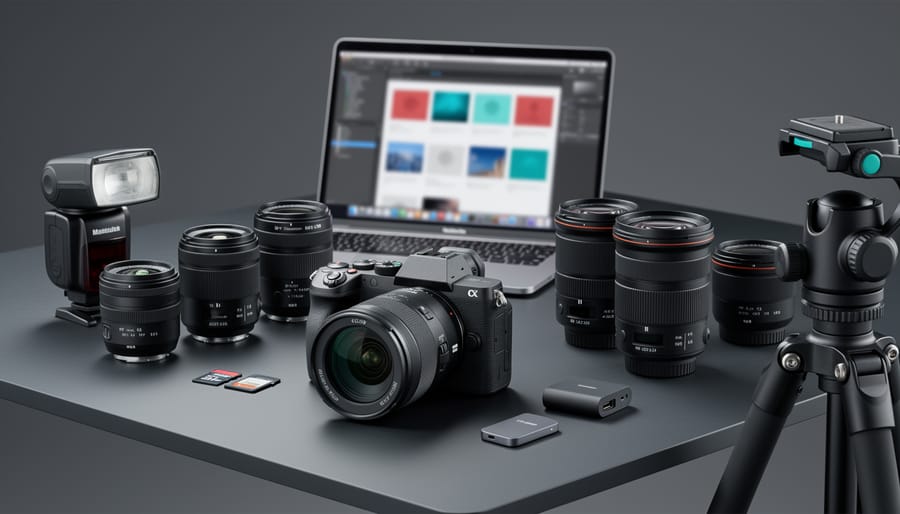
A professional photographer needs a comprehensive toolkit that extends far beyond a camera body and lens. The essential equipment includes a camera system suited to your specialty, multiple lenses covering key focal lengths, reliable lighting gear, sturdy support equipment, backup bodies, memory cards and storage solutions, computer hardware for editing, business tools like contracts and insurance, and often specialty items specific to your niche. Expect to invest anywhere from $8,000 to $25,000 for a complete professional setup in 2026, though this varies dramatically based on your photography focus.
The difference between hobbyist gear and professional equipment isn’t always about megapixels or brand prestige. It’s about reliability under pressure, redundancy when things fail (and they will), and tools that can withstand daily commercial use. When a wedding photographer’s camera dies during the ceremony or a product shooter’s flash won’t sync on set, that’s not just an inconvenience. It’s a business failure that costs clients, damages reputation, and loses income.
Understanding what separates pro gear from consumer equipment helps clarify why photographers charge what they do. That $3,000 camera body isn’t a luxury when it offers weather sealing for outdoor shoots, dual card slots that prevent catastrophic data loss, and build quality that survives 200,000+ shutter actuations. The investment protects both your business operations and your clients’ irreplaceable moments.
This guide breaks down the complete professional photography toolkit by category, explains why certain equipment choices matter for commercial work, and covers the often-overlooked aspects of gear ownership like maintenance schedules, insurance requirements, and realistic replacement cycles. Whether you’re transitioning from enthusiast to paid professional or simply want to understand the full scope of professional photography investment, you’ll find practical guidance grounded in real-world professional demands.
Essential Camera Bodies for Professional Work
When you’re choosing camera bodies for professional work, you’re not just buying a tool, you’re investing in reliability under pressure. The camera body is the foundation of everything you capture, and professionals need features that ensure they never miss a shot, never lose critical files, and can keep working in conditions that would stop a hobbyist cold.
Full-frame sensors (35mm) remain the gold standard for professional photography in 2026, offering superior low-light performance, shallower depth of field control, and better dynamic range than smaller formats. Medium format has become more accessible for commercial and fashion photographers who need maximum resolution and color depth, but it’s not essential for most professional work. What matters more than sensor size is sensor performance, you need clean files at ISO 3200 and beyond, because professional shoots don’t wait for perfect lighting.
Weather sealing isn’t optional; it’s a professional necessity. Weddings happen in rain, sports don’t stop for snow, and commercial shoots often involve dust, humidity, or spray. A weather-sealed body with matching sealed lenses lets you work through conditions that would force amateurs to pack up. Beyond environmental protection, this robust construction means your camera can handle the constant use and occasional bump that comes with professional work.
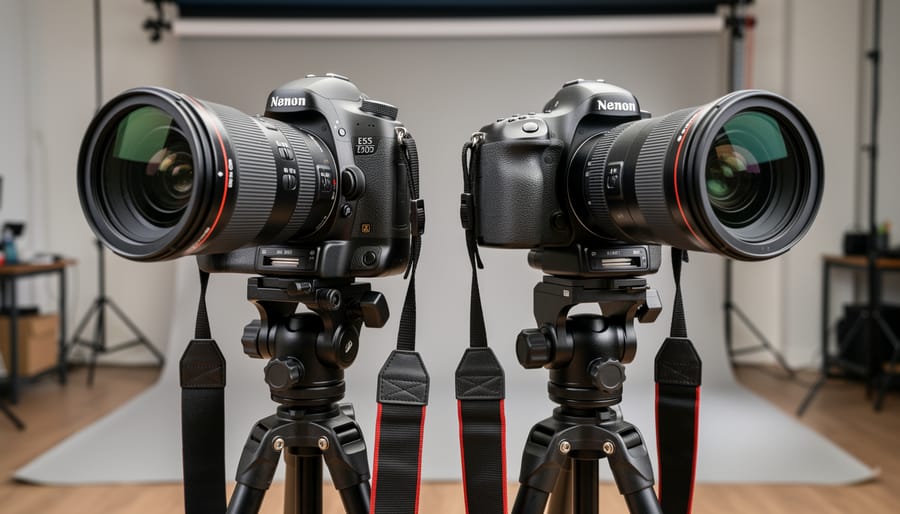
Shooting to two cards simultaneously (RAW to both or RAW to one, JPEG to the backup) gives you redundancy when clients are paying you to deliver. Single-slot cameras, regardless of how advanced they are otherwise, represent an unacceptable risk for paid work. This is the kind of gear that matters when your reputation is on the line.
Just as critical: you need a backup body. Not eventually, immediately. If your primary camera fails mid-wedding or during a commercial shoot, having an identical or very similar backup body saves the job. Many professionals shoot with two bodies throughout events anyway, each with different lenses attached for quick focal length changes.
Maintenance keeps these investments working. Sensor cleaning should be done regularly using proper swabs and solution designed for your sensor type, not improvised methods that risk scratches. Keep weather sealing gaskets clean and inspect them periodically. After shoots in harsh conditions, wipe down the body with a slightly damp microfiber cloth and check that all ports and doors seal properly. This proactive care prevents expensive repairs and extends your camera’s working life.
Professional-Grade Lenses: The Real Investment
Why Professional Lenses Cost What They Do
When you pick up a $2,000 professional lens next to its $400 consumer counterpart, you’ll notice the weight difference immediately. That heft comes from metal construction instead of plastic, internal gears made from brass rather than synthetic materials, and precision-ground glass elements that can take years to perfect in manufacturing.
Professional lenses deliver consistency that matters when clients are paying you. The autofocus hits sharp focus in low light when you’re shooting a dimly-lit wedding reception. The aperture blades hold their calibration through thousands of shots, so your f/2.8 stays f/2.8 for accurate exposure metering on a commercial shoot. Weather sealing keeps moisture out during an outdoor portrait session in unexpected rain.
The optical quality shows up in your deliverables. Edge-to-edge sharpness means you can crop freely without soft corners. Minimal chromatic aberration and distortion save hours of post-processing time. Better coatings reduce flare when shooting toward windows or in harsh sunlight, a common challenge in real estate or architectural photography.
You’re also paying for reliability. Professional lenses survive the daily rigors of paid work: constant lens swaps, temperature changes moving between locations, and the occasional bump against a doorframe while rushing to capture a moment.
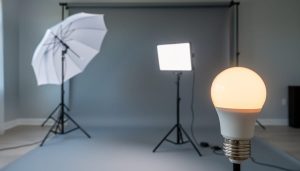
Lighting Equipment That Pays for Itself
Professional photographers need lighting equipment that delivers consistent results across diverse shooting conditions, making it one of the most valuable investments you’ll make. Unlike consumer-grade gear, professional lighting must be reliable enough to stake your reputation on, which is why understanding both the equipment and its proper care is essential.
Speedlights remain the workhorse of professional photography because they’re portable, battery-powered, and versatile enough for everything from wedding receptions to outdoor portraits. Pro-level speedlights like the Profoto A2 or Canon 600EX-RT offer wireless control, high-speed sync, and enough power to overpower daylight when needed. Keep spare batteries charged and stored at room temperature, and always carry backup units. Clean the flash tube cover with a microfiber cloth monthly to prevent dust buildup that reduces output.
Studio strobes deliver significantly more power than speedlights and are essential for commercial work, product photography, and controlled studio lighting setups. Brands like Profoto, Broncolor, and Elinchrom offer both pack-and-head systems and monolights. Battery-powered strobes like the Godox AD600 Pro bridge the gap between speedlights and studio strobes, giving you studio power on location. After each shoot, check flash tubes for cracks and clean cooling vents to prevent overheating.
Continuous lights have become increasingly important for hybrid photo-video professionals. LED panels offer daylight-balanced output, adjustable color temperature, and no recycling time between shots. The Aputure 600D Pro has become an industry standard, but even smaller panels like the Godox VL300 prove invaluable for product work and video content.
| Lighting Type | Best Uses | Portability | Key Maintenance |
|---|---|---|---|
| Speedlight | Events, outdoor portraits, travel | Excellent | Battery care, contact cleaning |
| Studio Strobe | Commercial, studio portraits | Limited to moderate | Flash tube checks, capacitor care |
| Continuous LED | Video, product, hybrid work | Good | LED panel cleaning, heat management |
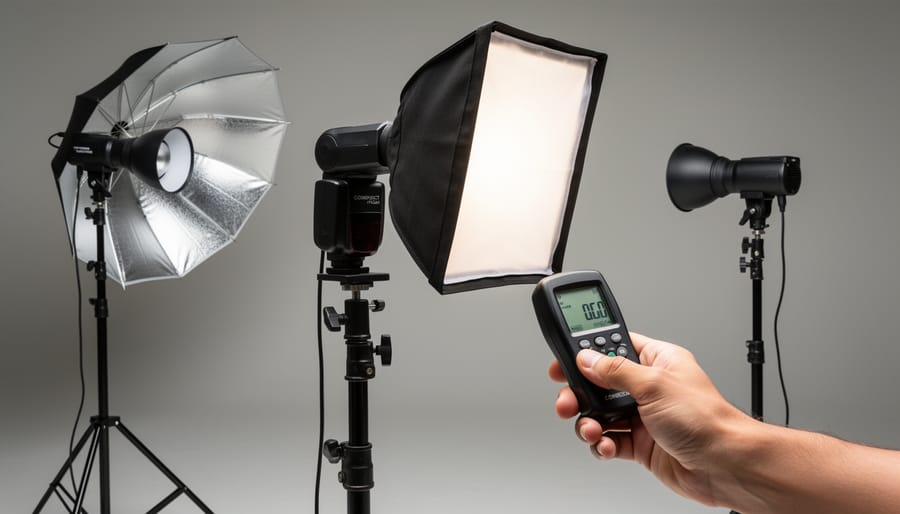
Modifiers shape your light quality and define your style. Softboxes, beauty dishes, umbrellas, and grids are non-negotiable for professional work. Quality modifiers from brands like Profoto or Westcott maintain their shape and reflective surfaces through hundreds of setups. Clean fabric modifiers with compressed air and spot-clean with damp cloths. Store them loosely folded to prevent permanent creases that create uneven light patterns.
A reliable light meter like the Sekonic L-858D ensures accurate exposure in complex lighting setups where your camera meter struggles. Calibrate it annually and store it in a protective case with the sensor covered. Professional lighting equipment earns its cost back quickly when it delivers consistent results that keep clients coming back.
Support Equipment: Tripods, Monopods, and Stabilization
A camera body and lens alone won’t keep you stable during critical shots, and in professional work, that instability translates directly to lost images and lost income. Support equipment separates the professional from the hobbyist by ensuring sharpness, consistency, and creative control when handheld shooting simply isn’t enough.
Professional-grade carbon fiber tripods form the foundation of this category. Carbon fiber costs significantly more than aluminum but weighs 30-40% less while offering superior vibration dampening, which matters when you’re hauling gear through a wedding venue or hiking to a landscape location. Choose tripods rated for at least 1.5 times your heaviest camera-lens combination’s weight, if your setup weighs 10 pounds, select a tripod with a 15-pound capacity minimum. That buffer accounts for lens torque during panning and the added weight of accessories like flash triggers or phone mounts.
For photographers shooting hybrid stills and video, fluid heads provide the smooth panning motion required for professional video work while still functioning adequately for static photography. Ball heads remain the choice for pure still photographers who need fast repositioning.
Monopods earn their place in sports, wildlife, and event photography where mobility matters more than absolute stability. A quality monopod with a swivel foot lets you track moving subjects while supporting telephoto lenses that would exhaust your arms after minutes of handheld shooting.
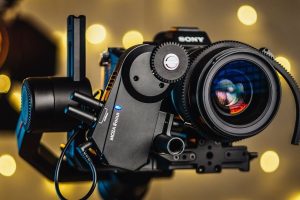
Gimbal stabilizers have become essential for photographers offering video services alongside stills. Three-axis gimbals compensate for walking motion and create professional-looking footage that handheld work can’t match.
Maintenance determines how long this equipment lasts. Clean leg joints and locking mechanisms after shoots in sand, salt water, or dusty environments by wiping them down and applying a thin silicone lubricant to moving parts. Inspect quick-release plates for wear every few months, a failing plate can drop thousands of dollars of gear. Store tripods slightly loose rather than cranked tight, which reduces stress on internal components and extends their working life.
Storage and Data Management Essentials
Professional photography generates massive amounts of data, and losing a client’s photos means losing far more than files, it’s your reputation and potential legal liability. Your storage and data workflow needs the same redundancy and reliability as your camera bodies.
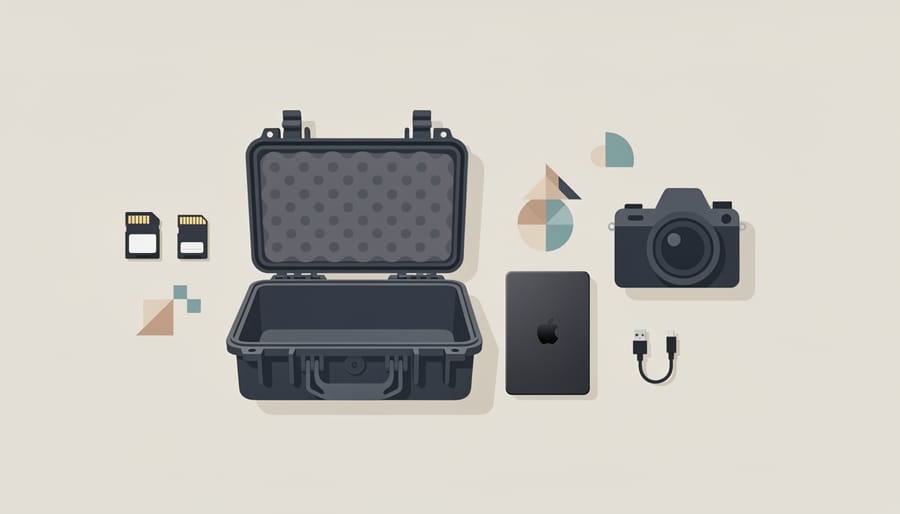
Memory cards are your first line of data capture, and professional-grade cards matter. Look for UHS-II or CFexpress Type B cards with write speeds matching your camera’s burst rate, usually 150MB/s minimum for high-resolution stills and 250MB/s or faster for 4K/8K video work. Capacity depends on your shooting style, but most pros carry multiple 64GB or 128GB cards rather than a few massive 512GB cards. Why? If a card fails mid-shoot, you lose less work. I rotate through cards during a session rather than filling one completely, spreading the risk.
Portable backup solutions are non-negotiable for field work. Rugged portable SSDs like the SanDisk Pro-G40 or Samsung T7 Shield offer fast transfer speeds and shock resistance. Many pros also carry a dedicated backup device like the Gnarbox or a laptop with portable drives to create that second copy before leaving the shoot location.
Your computer setup determines how efficiently you process work. A laptop for field work needs a color-accurate screen, 32GB RAM minimum for Lightroom and Photoshop, and fast SSD storage. Back at your studio or office, external hard drives complete your backup system, at least two sets of drives, with one stored separately from your main workspace.
Memory cards need careful handling: never remove them during camera operation, format them in-camera rather than on a computer, and store them in protective cases away from magnetic fields and extreme temperatures. Drives require less frequent maintenance, but keep them dust-free and avoid temperature extremes. Replace cards showing any errors immediately, and rotate backup drives every three to five years before they fail.
Professional Camera Bags and Transport Solutions
When you’re hauling thousands of dollars worth of gear to a wedding, a remote location shoot, or through airport security, your camera bag isn’t just storage, it’s armor for your business assets. Professional photographers need multiple bag solutions because no single bag works for every situation.
Rolling cases work best for studio moves or destination shoots where you’re packing substantial lighting gear and multiple camera bodies. Look for models with TSA-approved locks, reinforced corners, and wheels that can handle rough pavement. Think Photo or Pelican cases offer maximum protection but sacrifice accessibility during the shoot itself.
For active shooting days, weddings, events, street photography, a well-designed camera backpack distributes weight across both shoulders and keeps your hands free. Peak Design, Lowepro, and F-Stop make bags with customizable dividers that adjust as your kit changes. The ability to access your gear from the side or back without removing the pack matters when you’re working fast.
Shoulder bags and messenger-style carriers suit documentary work or corporate shoots where you need to move light and pull gear quickly. These work for a single body, two to three lenses, and minimal accessories.
Hard cases protect gear during shipping or when checking equipment on flights. Pelican cases with foam inserts are industry standard for a reason, they’re nearly indestructible.
Regular maintenance keeps bags functional. Vacuum out dust and debris monthly, spot-clean fabric with gentle detergent, and check zippers and buckles for wear. Apply waterproofing spray annually to fabric bags, and replace worn padding before it fails to protect your gear.
Maintenance and Care Equipment You Can’t Skip
Your camera body and lenses might be the stars of your professional kit, but the unglamorous maintenance gear is what keeps them performing when it matters most. A $3,000 lens becomes worthless if dust and grime degrade its optical quality, and sensor spots can ruin an entire wedding shoot if you can’t clean them in the field.
Start with a proper sensor cleaning kit that includes sensor swabs sized for your camera’s sensor format and Eclipse or similar sensor cleaning fluid. Rocket blowers are essential for removing loose particles before any wet cleaning, while sensor scopes or inspection lights help you verify whether cleaning is needed. Professional photographers typically keep both at home and in their field kits because sensor spots always appear at the worst possible moment.
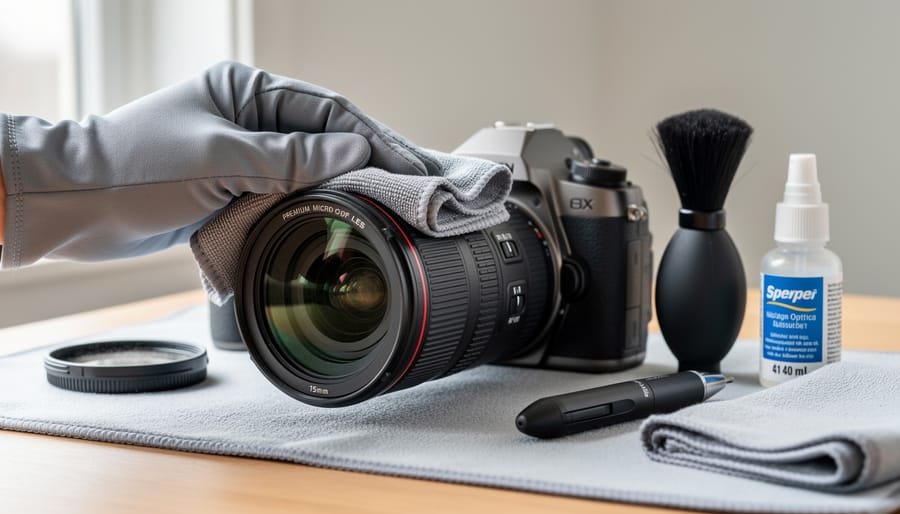
For lens maintenance, invest in quality microfiber cloths (multiple, so you always have clean ones), lens cleaning solution designed for coated optics, and lens pens for spot cleaning. Cheap tissues or random cloths can scratch coatings that cost hundreds of dollars to repair. Keep lens brushes for removing debris from mount contacts and crevices where grit accumulates.
Weather protection deserves equal attention. Rain covers for your camera and lenses, plastic bags and gaffer tape for emergency protection, and lens hoods (which double as physical shields) are non-negotiable for professionals who shoot in varied conditions. Silica gel packets in your camera bags prevent moisture damage during storage and when moving between temperature extremes, which matters more than most photographers realize until condensation ruins electronics.
Don’t overlook inspection tools like LED flashlights for checking gear before and after shoots, and small screwdrivers for tightening tripod plates and strap lugs. Cotton swabs and isopropyl alcohol handle contact cleaning, while canned air (used carefully) reaches tight spots brushes can’t.
The cost? Maybe $150 to $250 for a complete maintenance kit. Compare that to a single sensor cleaning service at $75, or lens element replacement at $500-plus, and the math becomes obvious. Professional photographers who maintain their gear properly extend its working life by years and avoid the nightmare scenario of equipment failing during a paid job.
Specialty Equipment Based on Your Photography Niche
While the core professional toolkit remains consistent across specialties, each photography niche demands specific equipment that directly impacts your ability to deliver what clients expect. Understanding these specialty requirements helps you invest strategically rather than accumulating gear you’ll rarely use.
Wedding photographers need redundancy above all else. Beyond the standard wedding gear kit professionals add wireless flash triggers for off-camera lighting, multiple speedlights for reception coverage, and audio recording equipment to sync video highlights. A second shooter kit with matching or compatible gear ensures consistent results across all angles.
Commercial and product photographers require controlled precision. A full tethering setup with high-resolution monitors lets clients approve shots in real-time. Macro lenses, focus rails for focus stacking, color checkers for accurate reproduction, and calibrated monitors become non-negotiable. Many maintain dedicated product photography tables and sweep stands for seamless backgrounds.
Sports and wildlife photographers prioritize reach and speed. Super-telephoto lenses (400mm, 500mm, 600mm) represent the bulk of investment, often with teleconverters to extend range. Monopods provide mobile support, while gimbal heads enable smooth tracking. Weather protection matters more here than anywhere else, with rain covers and sealed bodies handling harsh conditions.
Studio portrait photographers build around lighting control. A complete studio strobe system with multiple heads, softboxes, beauty dishes, reflectors, and various modifiers creates their signature look. Backdrop systems, C-stands, grip equipment, and tethering setups round out the investment. Many add hair lights, accent lights, and specialized modifiers for specific portrait styles.
| Photography Niche | Specialty Equipment Priority | Typical Additional Investment |
|---|---|---|
| Wedding | Redundancy gear, wireless triggers, audio equipment | $3,000-$6,000 |
| Commercial/Product | Tethering setup, macro lenses, color checkers, product tables | $4,000-$8,000 |
| Sports/Wildlife | Super-telephoto lenses, monopods, weather protection | $8,000-$15,000+ |
| Studio Portrait | Complete strobe system, modifiers, backdrops, grip equipment | $5,000-$10,000 |
The specialty equipment you need depends entirely on the work you’re booking. Start with your most frequent paid jobs and build from there, renting specialty items until the rental costs justify ownership. Your niche dictates where the real money goes beyond the universal professional basics.
The Hidden Costs: Insurance, Calibration, and Professional Services
Owning ten thousand dollars in camera gear means nothing if it’s stolen from your car or water-damaged on a beach shoot. Equipment insurance isn’t optional for professionals, it’s a business necessity that costs roughly $500-$1,500 annually depending on your total gear value and coverage limits. Homeowner’s policies rarely cover business equipment adequately, and a single theft or accident can wipe out years of investment. The peace of mind alone makes it worthwhile when you’re shooting expensive destination weddings or carrying $30,000 in equipment through airports.
Beyond insurance, professional photographers face ongoing calibration and service costs that amateurs never consider. A properly calibrated monitor is essential for accurate color grading, expect to spend $150-$300 annually on calibration tools or services. Printer calibration and ICC profile generation add another layer if you offer prints. I learned this the hard way after delivering wedding photos that looked perfect on my screen but printed with a noticeable magenta cast.
Regular equipment servicing keeps gear performing at professional standards. Camera bodies need sensor cleaning, shutter count checks, and occasional repairs that manufacturers recommend every 12-18 months of heavy use, typically costing $150-$400 per service. Lenses require optical alignment checks if dropped or heavily used.
Then there’s technology depreciation. Professional camera bodies lose roughly 30-40% of their value in three years. You’ll likely upgrade major equipment every 3-5 years to stay competitive, which means budgeting $2,000-$5,000 annually for replacements. Some photographers rent pro gear for specialty shoots rather than buying everything, but core equipment needs proper coverage. Smart professionals protect their gear financially and physically, treating these hidden costs as normal business expenses rather than unexpected surprises.
The gap between amateur and professional photography equipment isn’t about megapixels or brand names, it’s about whether your gear will work when you need it most. Professional equipment earns its premium through consistent performance under pressure, redundancy when something fails, and longevity when properly maintained.
You can’t build a sustainable photography business on gear that might let you down during a once-in-a-lifetime wedding moment or a client’s product launch. That’s why professionals invest in weather-sealed bodies, backup cameras, dual card slots, and lenses built to survive years of heavy use. These aren’t luxury features; they’re business insurance.
But buying professional equipment is only half the equation. A $3,000 lens becomes worthless if mold develops from poor storage or if sensor dust ruins every image. Budget for sensor cleaning kits, proper storage solutions, equipment insurance, and regular professional servicing. These ongoing costs protect your initial investment and keep you working when others are sidelined by preventable equipment failures.
Start by identifying what your specific professional work actually demands. A wedding photographer’s essential kit looks completely different from a product photographer’s studio setup. Buy what you’ll use regularly and what solves real problems in your workflow, not what sounds impressive.
Build your professional kit strategically over time, prioritizing reliability and redundancy in the equipment categories that matter most for your specialty. And remember: the most expensive gear in the world won’t save you if you haven’t maintained it properly or if you’re missing the backup camera when your primary body fails mid-shoot.


 By
By