 By
By 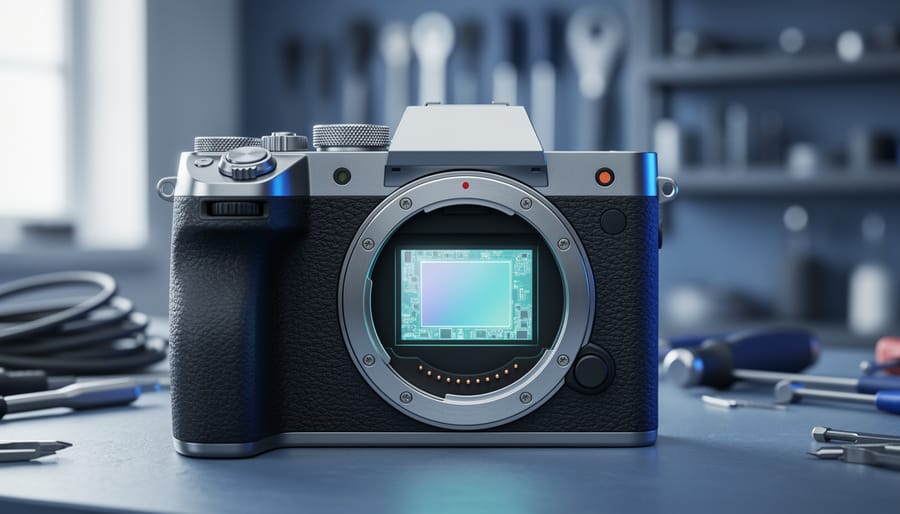
An electronic image sensor is a semiconductor device that converts light entering a camera lens into electrical signals, which are then processed to create digital photographs. This small chip, typically measuring just a few centimeters across, has replaced traditional film as the recording medium in virtually every camera made today, from smartphones to professional cinema equipment.
Understanding how image sensors work matters because this technology directly affects every photograph you take. The sensor’s size, resolution, and design influence image quality, low-light performance, depth of field, and even the physical dimensions of your camera body. When photographers debate full-frame versus crop sensors, megapixel counts, or sensor readout speeds, they’re ultimately discussing how different sensor characteristics translate into real-world shooting capabilities.
The image sensor sits at the heart of digital photography’s technical foundation. Light passes through your lens and strikes millions of tiny photosites on the sensor surface. Each photosite captures information about the light hitting it, recording brightness and, through various technologies, color data. This raw information becomes the digital file you view, edit, and share.
Two dominant sensor technologies compete in 2026: CCD (charge-coupled device) and CMOS (complementary metal-oxide-semiconductor). Each uses different methods to read the electrical charge created by incoming photons, resulting in distinct performance profiles that matter for different shooting scenarios. Beyond this fundamental split, manufacturers have developed variations like backside-illuminated sensors, stacked sensors, and global shutters, each addressing specific photographic challenges.
This article breaks down what you need to know about electronic image sensors, explaining not just the engineering principles but how sensor characteristics affect your photography decisions and results.
What an Electronic Image Sensor Really Is
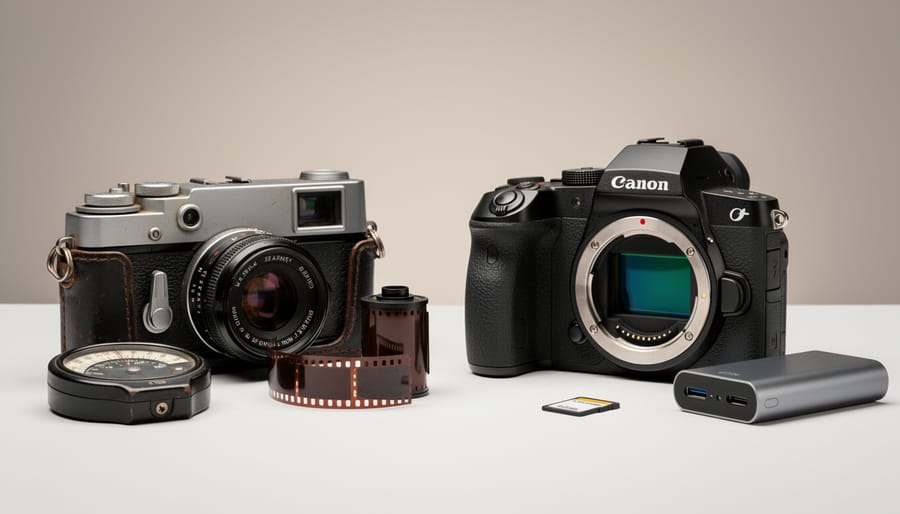
Think of film for a moment. When you pressed the shutter on a film camera, light streamed through the lens and hit a strip of celluloid coated with light-sensitive chemicals. Those chemicals changed when exposed to light, creating a latent image you’d later develop in a darkroom. An electronic image sensor does fundamentally the same job, but instead of chemicals, it uses millions of tiny light-sensitive elements arranged in a grid.
At its core, an electronic image sensor is a semiconductor device that converts incoming light into electrical signals your camera can process into a digital photograph. It sits where film once lived, right behind the lens, at the focal plane, waiting to capture whatever light the lens focuses onto it. When photons strike the sensor’s surface, each tiny light-detecting element generates an electrical charge proportional to the brightness of the light hitting it. Your camera reads these charges, converts them to digital values, and assembles them into the image you see on your screen.
To understand how this works, it helps to know a few key terms:
- Pixel
- The smallest unit of a digital image. Each pixel represents a single point of color and brightness information in your final photograph.
- Photosite
- An individual light-capturing location on the sensor surface. One photosite typically corresponds to one pixel in the final image.
- Photodiode
- The actual light-sensitive component at each photosite that converts photons into electrical charge through the photoelectric effect.
- Analog-to-Digital Conversion
- The process of translating the continuous electrical charges from photosites into discrete numerical values the camera’s processor can work with.
- Light Sensitivity
- How readily the sensor responds to incoming light. Higher sensitivity means the sensor can capture images in darker conditions without requiring longer exposures.
The beauty of this digital approach is speed and flexibility. Where film required chemical processing and could only be “set” to one sensitivity per roll, a sensor gives you instant feedback and lets you adjust sensitivity frame by frame. You’re working with the same physics of light, but the sensor translates that light into data you can immediately view, adjust, and share. The sensor’s job is simple in concept, turn light into numbers, but the engineering behind that transformation is what makes modern digital photography possible.
How Electronic Image Sensors Capture Light

The Role of the Bayer Filter and Color Information
Here’s the honest truth about digital sensors: they’re colorblind. Each photosite on the sensor detects only the intensity of light hitting it, not its color. To capture color images, most sensors rely on a clever solution called a Bayer filter mosaic a grid of tiny red, green, and blue filters placed directly over the photosites.
The pattern dedicates 50% of pixels to green (matching our eyes’ sensitivity), 25% to red, and 25% to blue. When light passes through your lens, each photosite receives only one color channel. Your 24-megapixel sensor actually captures roughly 12 million green values, 6 million red, and 6 million blue.
The camera’s processor then performs demosaicing, an interpolation process that examines neighboring pixels to calculate the missing color information for each photosite. It essentially makes educated guesses to reconstruct full RGB data for every pixel, creating the complete color image you see. This happens so quickly and effectively that you never notice the intermediate step.
There are alternatives. Foveon sensors, used in some Sigma cameras, stack three photosite layers that each capture a different color wavelength at the same location. This eliminates interpolation but comes with different trade-offs in processing speed and high-ISO performance. Monochrome sensors skip color filters entirely, dedicating every photosite to luminance only, which explains why black and white specialized cameras often show superior detail and light sensitivity.
Main Types of Electronic Image Sensors
CCD (Charge-Coupled Device) Sensors
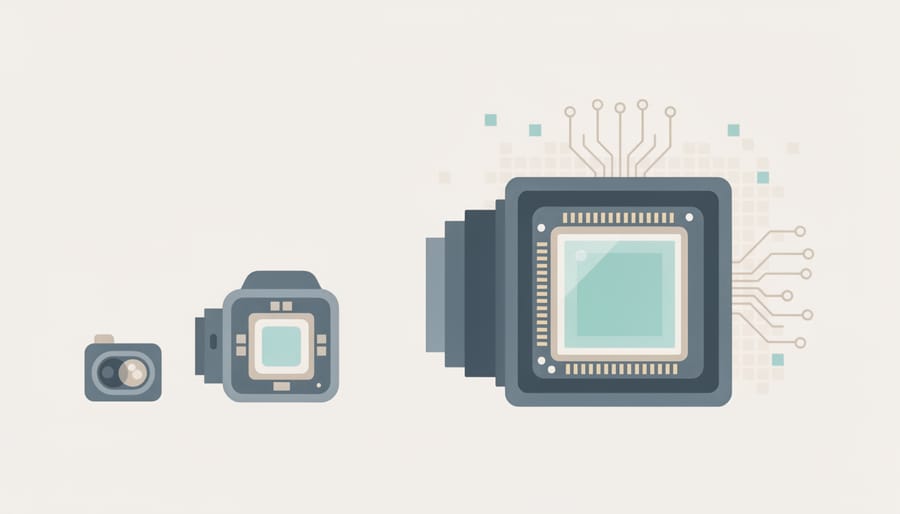
CCD (Charge-Coupled Device) sensors were the first practical solution for digital imaging in consumer cameras. CCD sensor technology works by converting light into electrical charge at each photosite, then moving those charges sequentially across the sensor chip in a coordinated, bucket-brigade fashion. Each row of pixels shifts its charge transferred horizontally to a readout register, where the charges are converted to voltage one pixel at a time before amplification.
This sequential readout process gave CCDs a significant advantage in the early digital era: uniform signal processing across the entire sensor meant consistent image quality, low noise, and excellent color fidelity. The single amplifier path reduced variations between pixels, delivering images with smooth tonal gradations and minimal fixed-pattern noise. Through the late 1990s and 2000s, CCDs dominated everything from point-and-shoot cameras to high-end DSLRs and medium format backs.
But CCDs had drawbacks. The sequential readout was relatively slow, limiting continuous shooting speeds and draining more battery power than modern alternatives. Manufacturing costs stayed high because CCDs required specialized production processes. As CMOS technology improved and addressed its early shortcomings, the industry shifted decisively toward CMOS by the mid-2010s. Today, you’ll rarely find a new consumer or professional camera using a CCD.
CCDs haven’t disappeared entirely. They’re still valued in scientific imaging, astronomy, and industrial applications where their uniform readout and exceptional linearity matter more than speed or power efficiency. Medical imaging devices and certain high-precision measurement systems continue using CCD arrays. For most photographers in 2026, though, CCDs represent a historical milestone rather than a current choice.
CMOS (Complementary Metal-Oxide-Semiconductor) Sensors
CMOS sensors represent the technology powering virtually every modern camera you’ll encounter today, from the phone in your pocket to professional medium format systems. The key innovation that sets CMOS apart lies in its architecture: each pixel has its own dedicated amplifier and readout circuitry built directly into the sensor itself.
This design allows the camera to read data from multiple pixels simultaneously rather than transferring charges sequentially like CCDs. Think of it as the difference between everyone in a crowd shouting at once versus forming an orderly single-file line. The parallel readout means CMOS sensors can capture and process image data dramatically faster, enabling higher frame rates for both stills and video.
Speed isn’t the only advantage. Because each pixel can be addressed independently, CMOS sensors consume significantly less power than CCDs. Your camera battery lasts longer, and the sensor generates less heat during operation. This matters especially for video work or long shooting sessions where heat buildup can introduce noise.
Modern CMOS designs also integrate additional processing circuitry directly onto the sensor chip. This allows for features like on-sensor phase detection autofocus, where certain pixels are dedicated to measuring focus rather than just capturing light. The result is faster, more accurate autofocus without adding bulk to the camera body.
The manufacturing process for CMOS sensors uses standard semiconductor fabrication techniques similar to computer chips. This made production more cost-effective and scalable, which explains why CMOS technology could spread from high-end cameras down to budget models and smartphones within a relatively short timeframe.
Early CMOS sensors struggled with image quality compared to CCDs, particularly in dynamic range and noise performance. By 2026, those gaps have closed completely. Advances like back-illuminated designs, stacked architectures, and improved pixel engineering mean CMOS sensors now deliver exceptional image quality while maintaining their speed and efficiency advantages. That combination of performance, versatility, and economics is why CMOS has become the universal choice across the entire camera market.
Specialized Sensor Variants
Beyond the basic CCD and CMOS divide, modern sensors incorporate specialized designs that push performance boundaries in specific ways. These variants matter because they directly address real-world shooting challenges, from capturing clean images in dimly lit rooms to freezing fast action without distortion.
Back-illuminated (BSI) sensors flip the traditional design by placing the light-sensitive photodiodes above the wiring and circuitry, rather than below. This seemingly simple change allows more light to reach each photosite, resulting in noticeably better high-ISO performance and improved dynamic range. If you’ve marveled at how well a recent smartphone or mirrorless camera handles low light, BSI architecture likely deserves much of the credit.
Stacked sensors take this further by layering components vertically, placing the pixel array on one chip and the processing circuitry on another chip beneath it, then bonding them together. This architecture enables dramatically faster readout speeds, supporting features like blackout-free shooting at 30 frames per second, 8K video recording, and real-time subject tracking that would overwhelm traditional sensor designs.
The rolling shutter versus global shutter distinction addresses how quickly the sensor reads data. Most CMOS sensors use rolling shutter, scanning the image line by line from top to bottom. This works fine for everyday photography but causes “jello effect” distortion when panning quickly or photographing fast-moving subjects like propellers. Global shutter sensors capture the entire frame simultaneously, eliminating this distortion entirely, a significant advantage for sports, wildlife, and video work, though the technology currently involves trade-offs in noise performance.
Key specialized sensor technologies include:
- BSI (Back-Illuminated) sensors, enhanced light gathering for superior low-light performance and less noise
- Stacked sensors, ultrafast readout enabling high-speed continuous shooting and advanced video capabilities
- Global shutter, simultaneous capture across the entire frame, eliminating motion distortion
- Quad Bayer/Tetracell designs, pixel-binning technology that switches between high resolution and improved light sensitivity
- Multi-layer sensors, experimental designs capturing different wavelengths at different depths for potentially superior color accuracy
Emerging technologies like 3D sensing cameras and organic sensors promise new capabilities, from precise depth mapping to expanded dynamic range approaching what our eyes can see. For now, understanding whether your camera uses BSI or stacked technology helps explain its performance strengths and informs realistic expectations for different shooting conditions.
Key Sensor Characteristics That Affect Your Photos
Several sensor specifications directly impact the images you capture, and understanding them helps you make smarter choices about gear and shooting technique.
Sensor size creates the most visible differences in your photography. Full-frame sensors (36×24mm) deliver shallower depth of field at equivalent framing, better low-light performance, and more detail, but require larger, heavier lenses. APS-C sensors (roughly 24×16mm) offer a good balance of image quality and portability with a 1.5x or 1.6x crop factor that effectively extends lens reach. Micro Four Thirds sensors (17×13mm) enable compact camera systems ideal for travel and video work, though with trade-offs in background blur and high-ISO noise. The sensor magic happens when you match size to your shooting style rather than chasing the largest option.
Resolution matters differently depending on your output. A 24-megapixel sensor handles most photography needs beautifully, from large prints to web use. Higher counts like 45 or 61 megapixels benefit landscape photographers who crop heavily or print billboard-sized, but demand more from lenses, produce larger files, and can amplify camera shake. Modern 4K camera sensors demonstrate that 8 megapixels suffice for video, proving that context matters more than raw numbers.
Pixel size affects light-gathering ability. Larger individual pixels (achieved through bigger sensors or lower resolution) typically capture more light, producing cleaner high-ISO images and greater dynamic range. A full-frame 24MP sensor has larger pixels than an APS-C 24MP sensor, explaining part of its low-light advantage. However, modern processing can partially offset smaller pixel disadvantages.
Dynamic range determines how much detail you retain from shadows to highlights in a single exposure. Sensors capturing 13-14 stops let you recover underexposed areas or tame bright skies in post-processing, essential for landscape and architectural work. Budget sensors offering 10-11 stops require more careful exposure.
ISO performance and read speed complete the picture. Native ISO range shows where a sensor performs cleanly without amplifying noise excessively. Faster read speeds enable quick continuous shooting, reduce rolling shutter distortion in video, and improve autofocus responsiveness. A sensor reading at 20fps transforms sports and wildlife photography compared to one managing 5fps, regardless of megapixel count.
Where Electronic Image Sensors Are Used Today
Electronic image sensors have become so fundamental to modern life that most of us interact with them dozens of times a day without giving them a second thought. While photographers naturally think of DSLRs and mirrorless cameras first, these tiny light-capturing components power an enormous range of devices across industries. Your smartphone camera relies on a sophisticated CMOS sensor, often several of them for different focal lengths, that’s manufactured to tolerances rivaling professional camera sensors from just a decade ago. Action cameras like GoPros pack rugged sensors into waterproof housings small enough to mount on helmets or drones, capturing high-resolution video in conditions that would destroy a traditional camera.
The applications extend far beyond recreational photography:
- Security and surveillance cameras use specialized sensors optimized for low-light performance and continuous operation
- Medical imaging equipment employs high-sensitivity sensors in endoscopes, digital X-ray systems, and diagnostic microscopes
- Automotive systems integrate multiple sensors for backup cameras, lane-departure warnings, adaptive cruise control, and autonomous driving features
- Industrial quality control relies on machine vision sensors to inspect products at speeds no human could match
- Scientific instruments use specialized sensors, including infrared sensor arrays, for astronomy, microscopy, spectroscopy, and research applications
- Drones depend on lightweight, power-efficient sensors for aerial photography, surveying, and mapping
What’s particularly striking is how sensor technology continues to evolve across these diverse applications. A smartphone manufacturer’s breakthrough in noise reduction at high ISOs eventually finds its way into professional camera bodies. Automotive sensors developed for night vision influence security camera design. This cross-pollination means camera sensor technologies advance faster now than at any point in photographic history, with innovations in one field accelerating progress across the entire landscape of electronic imaging.
What This Means for Your Photography
Understanding your camera’s sensor won’t make you a better photographer overnight, but it will sharpen your gear decisions and help you work within your equipment’s strengths. The key is matching sensor characteristics to your actual shooting needs rather than chasing specs.
Sensor size matters most when you’re shooting in challenging light or need shallower depth of field. A full-frame sensor gives you roughly a one-stop advantage in low-light performance compared to APS-C, and about two stops over Micro Four Thirds. If you regularly shoot concerts, weddings, or astrophotography where you’re pushing ISO 6400 and above, that difference becomes tangible in your final images. But for daytime landscapes or studio work with controlled lighting, a smaller sensor rarely holds you back.
The resolution versus low-light trade-off is real. Pack more megapixels onto the same sensor size and you get smaller photosites that capture fewer photons per pixel. A 24-megapixel full-frame sensor typically handles high ISOs cleaner than a 61-megapixel sensor of the same size. Ask yourself: do you print large or crop heavily? Then resolution helps. Do you shoot events, sports, or wildlife in marginal light? Prioritize larger pixels and better ISO performance over sheer megapixel count.
Understanding your sensor’s dynamic range helps you expose more deliberately. If you know your camera captures 14 stops, you can confidently underexpose a bright scene by a stop or two, protecting highlights while trusting you’ll recover shadow detail in post. Photographers who grasp this routinely salvage shots that others would blow out.
Readout speed affects more than you might think. A fast sensor with minimal rolling shutter lets you shoot fast-moving subjects with electronic shutter and no distortion. It enables higher frame rates for sports and wildlife, faster autofocus scanning, and better video performance. If you’ve ever seen wavy verticals when panning or jello effect in video, you’ve encountered rolling shutter limitations.
The practical upshot: study how you shoot before upgrading. A wildlife photographer benefits more from faster readout and decent resolution than from maximum megapixels. A landscape shooter can tolerate slower performance for higher resolution and dynamic range. And if you’re shooting portraits with controlled light, nearly any modern sensor delivers excellent results once you’ve nailed composition and lighting.
Electronic image sensors have fundamentally reshaped photography, bridging the gap between the chemical magic of film and the digital precision we rely on today. They’ve made photography more accessible, more immediate, and more versatile than ever, powering everything from your smartphone to medium format studio cameras. Understanding how these sensors work and what their specifications mean gives you a real advantage when choosing gear or troubleshooting image quality issues.
That said, the sensor is just one piece of the puzzle. A photographer with an older APS-C camera and a clear vision will consistently outshoot someone with the latest full-frame sensor who doesn’t understand light, composition, or storytelling. The best sensor in the world won’t rescue poor technique or a lack of creative direction.
What’s more important, megapixels or sensor size?
Sensor size typically has a bigger impact on image quality, particularly for low-light performance and depth of field control. Megapixels matter mainly if you’re printing large or cropping heavily.
Can a smaller sensor take professional photos?
Absolutely. Many professional photographers use Micro Four Thirds and APS-C systems for commercial work. Skill, lighting, and vision matter far more than sensor size for most applications.
Do I need a full-frame sensor?
Only if your work specifically demands it, extreme low-light shooting, ultra-shallow depth of field, or maximum resolution. Most photographers will never hit the limits of modern APS-C or Micro Four Thirds sensors.
How long do electronic image sensors last?
Sensors have no moving parts and typically outlast other camera components. You’ll likely upgrade for features or performance long before a sensor fails from normal use.
Use your knowledge of sensors to make informed decisions, but don’t let spec sheets dictate your photography. The camera you have with you, the light you find, and the moment you capture will always matter more than the technical specifications of the silicon inside your gear.




 By
By