 By
By 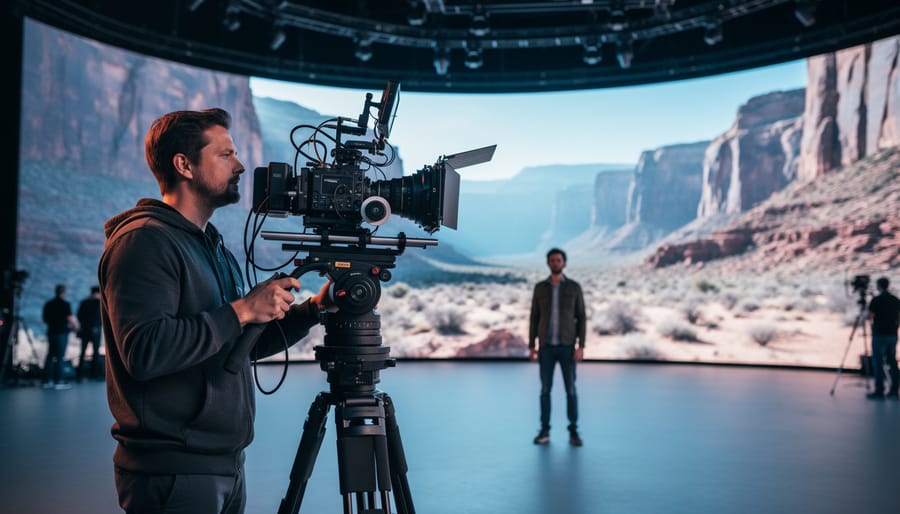
Virtual reality has moved from science fiction novelty to essential production tool, fundamentally changing how photographers and cinematographers approach their craft. LED volume stages—massive curved screens displaying real-time virtual environments—now replace green screens on major film sets, allowing directors of photography to light scenes naturally while actors interact with believable surroundings. The Mandalorian popularized this approach, but the technology has become accessible enough that mid-tier production studios are building their own volumes.
Real-time rendering engines like Unreal Engine and Unity have eliminated the wait between capture and visualization. Cinematographers can now scout virtual locations, test lighting setups, and preview complex shots before committing resources to physical production. This shift saves production companies thousands of dollars in location fees and setup time while expanding creative possibilities exponentially.
Extended reality (XR) technologies—encompassing VR, augmented reality (AR), and mixed reality (MR)—are converging into unified workflows. Photographers working in commercial and editorial spaces are discovering that XR skills translate directly into higher-paying opportunities. Product photographers use AR to let clients visualize items in real environments. Architectural photographers create immersive walkthroughs that command premium rates.
The barrier to entry continues dropping. Consumer headsets now offer professional-grade displays, and software subscriptions cost less than traditional camera lens rentals. Understanding these trends isn’t about chasing technology—it’s about recognizing which tools solve real problems in your photography business and which ones remain gimmicks.
What Virtual Production and XR Actually Mean for Visual Creators
The LED Wall Revolution: From The Mandalorian to Your Studio
If you’ve watched The Mandalorian, you’ve witnessed LED wall technology in action without even realizing it. Those sweeping desert landscapes and alien skies? Most weren’t filmed on location or against green screens. Instead, they were displayed on massive LED walls surrounding the actors, creating what’s known as an LED volume stage.
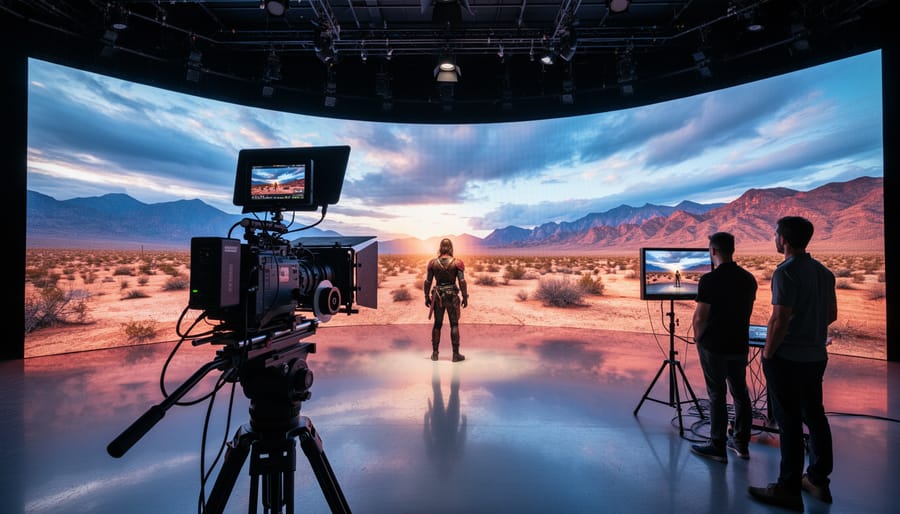
Here’s how it works: Instead of placing your subject in front of a flat green screen, you surround them with curved LED panels displaying a digital environment. These panels show photorealistic backgrounds that respond in real-time to camera movements, creating accurate perspective shifts and natural reflections. The LED walls emit actual light onto your subject, eliminating the need for extensive post-production lighting adjustments that plague green screen work.
Why does this matter for photographers and smaller productions? The technology is rapidly becoming more accessible. While building a Mandalorian-scale volume isn’t realistic for most studios, smaller LED setups are entering the market at decreasing price points. Even a single 10-foot LED wall can transform product photography or portrait sessions.
The benefits are substantial. First, you see the final result while shooting, not weeks later in post-production. Second, subjects interact more naturally with their environment when they can actually see it rather than imagining it against green fabric. Third, reflective surfaces like cars, jewelry, or eyeglasses display the actual background instead of green spill that requires tedious cleanup.
Several rental studios now offer LED volume access by the hour, making this technology available without the investment of ownership. For photographers shooting commercial work, automotive photography, or high-end portraits, this represents a genuine alternative to traditional location shoots, offering weather independence and unlimited creative control.
Real-Time Rendering Engines Enter the Photography World
Game engines are no longer just for gamers. Unreal Engine and Unity, the powerhouses behind countless video games and interactive experiences, are revolutionizing how photographers and visual creators approach their craft. These real-time rendering engines are bridging the gap between imagination and execution in ways that would have seemed like science fiction just a few years ago.
Think of it this way: instead of arriving on location and hoping the light cooperates, you can now preview your entire shoot in a virtual environment beforehand. Real-time rendering engines let you build complete digital sets, position virtual lighting rigs, and experiment with camera angles before you even pack your gear. This isn’t just about saving time, it’s about expanding creative possibilities.
Photographers working in commercial and product photography have been early adopters of this technology. Using Unreal Engine, you can create photorealistic virtual sets that would be prohibitively expensive or physically impossible to build. Want to photograph a watch floating in space? Or showcase a product in a mid-century modern room that exists only in your computer? These engines make it possible with stunning realism.
Unity offers similar capabilities with a slightly gentler learning curve for beginners. Both platforms integrate increasingly well with traditional photography workflows, especially as camera manufacturers release firmware updates that improve connectivity with virtual production tools.
The practical applications extend beyond pre-visualization. Some photographers are using these engines to create hybrid images, blending real photography with virtual elements seamlessly. Others use them for client presentations, showing exactly what the final image will look like before the shutter clicks.
While there’s definitely a learning curve, free versions of both engines make experimentation accessible to anyone willing to invest the time.
VR Cameras and 360-Degree Capture: What’s Changed in 2024-2025
Consumer-Level VR Cameras Worth Considering
The VR camera landscape has transformed dramatically, placing powerful 360-degree capture within reach of photographers at virtually every budget level. Today’s consumer-friendly options deliver professional-looking results without requiring specialized technical knowledge or massive investments.
The Insta360 X3 stands out as a versatile workhorse for photographers venturing into immersive content. This pocket-sized camera captures 5.7K 360-degree video and offers impressive stabilization that essentially eliminates the need for gimbals. Real estate photographers have embraced it for virtual property tours, allowing potential buyers to explore spaces remotely with remarkable clarity. The camera’s ability to reframe footage after shooting gives you creative flexibility that traditional cameras simply can’t match.
For those seeking higher resolution, the Ricoh Theta Z1 deserves attention. With its dual 1-inch sensors, it produces 23-megapixel stills that maintain quality even when viewers zoom into details. Tourism businesses have found this particularly valuable for showcasing destinations, as the image quality holds up across various display platforms.
The GoPro Max bridges the gap between action cameras and VR capture, making it ideal for commercial photographers who need durability alongside immersive capabilities. Wedding photographers have successfully used it to capture ceremony spaces, giving couples a unique way to revisit their special day.
What makes these cameras genuinely accessible isn’t just their price points ranging from 400 to 1000 dollars, but their companion apps that handle much of the technical heavy lifting. The software automatically stitches footage, corrects distortions, and exports files ready for social media or professional platforms, meaning you can focus on composition and storytelling rather than complex post-processing workflows.
Professional-Grade Spatial Capture Systems
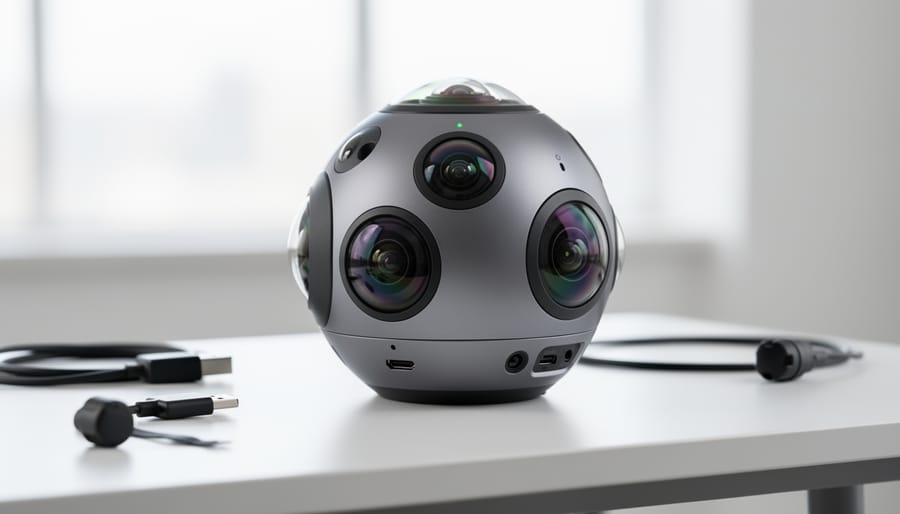
Professional-grade spatial capture is where VR photography gets serious. We’re talking about multi-camera rigs that simultaneously record from dozens of angles, creating truly immersive 360-degree environments. Systems like the Insta360 Titan or Nokia OZO can cost anywhere from $10,000 to well over $50,000, positioning them firmly in the professional investment category.
Volumetric capture takes things even further by recording three-dimensional space itself, not just images. These systems use multiple cameras combined with depth sensors to create environments viewers can actually move through, rather than just look around. Think of it as the difference between a panoramic photo and a 3D-scanned space you can walk inside. This advanced imaging technology requires significant processing power and specialized software to stitch together all that data.
So when does this investment make sense? If you’re shooting real estate for luxury properties, creating content for automotive showrooms, or working with architectural firms, these systems can provide a genuine competitive advantage. The same applies if you’re producing training simulations, museum exhibitions, or commercial VR experiences. The key is having clients who value true spatial immersion and can budget accordingly.
For most photographers, however, starting with prosumer options and building client demand first makes more financial sense. Test the waters, understand the workflow, then scale up when projects justify the expense.
How XR Headsets Are Becoming Essential Tools for Photographers
Virtual Editing Bays and Immersive Review Workflows
Virtual reality isn’t just changing how we shoot—it’s revolutionizing how we review and edit our work. Photographers working with 360-degree and immersive content are discovering that VR headsets offer a dramatically better way to evaluate their images than traditional flat monitors.
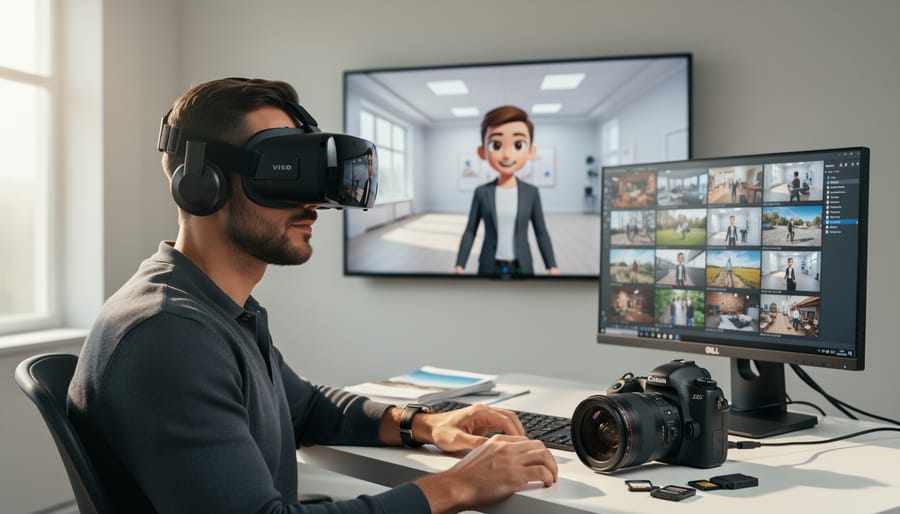
Think about it: when you’re reviewing a 360-degree panorama on a regular screen, you’re only seeing a small slice at a time. Put on a VR headset like the Meta Quest 3 or Apple Vision Pro, and suddenly you’re inside your image, able to look around naturally and spot composition issues, stitching errors, or distracting elements you’d never notice otherwise. This immersive review process has become essential for real estate photographers, virtual tour creators, and anyone producing content for VR platforms.
Beyond reviewing, photographers are building virtual editing bays—customizable workspaces where you can arrange multiple virtual monitors around you, accessing your entire workflow without physical screen limitations. Adobe and other software companies are developing VR-native applications that let you manipulate images using hand gestures and spatial controls.
The collaboration potential is equally exciting. Clients can now join you in a shared virtual space to review portfolios or provide feedback on 360-degree shoots in real-time, regardless of location. This eliminates the challenges of storing and sharing massive VR files back and forth. While these workflows require investment in both hardware and learning curves, early adopters report significant efficiency gains and improved client communication.
Pre-Visualization and Virtual Location Scouting
Virtual location scouting has traditionally meant hopping on planes, driving hours to remote sites, and hoping the weather cooperates when you arrive. VR technology is changing that equation dramatically, offering photographers powerful new ways to prepare for shoots without leaving their studio.
Modern VR platforms now allow you to explore potential shooting locations in immersive 360-degree environments. Some services use high-resolution photogrammetry (a technique that creates 3D models from photographs) to recreate real-world locations digitally. You can walk through these virtual spaces, test different angles, and even simulate lighting conditions at various times of day. For commercial photographers working with clients across different cities or countries, this capability is genuinely transformative.
The planning advantages extend beyond just seeing a space. Specialized pre-visualization software lets you position virtual cameras, arrange subjects, and block out entire scenes before anyone sets foot on location. This means you can work with clients to finalize compositions, identify potential challenges like awkward shadows or limited shooting angles, and determine exactly what equipment you’ll need. One wedding photographer I spoke with recently used VR to show couples their ceremony setup options, allowing them to virtually stand at the altar and see what their guests would experience.
The cost savings can be substantial. Instead of multiple reconnaissance trips, you make one informed visit with everything planned. While professional VR scouting services do charge fees, they’re typically far less than travel expenses, especially for destination shoots. Even hobbyist photographers can access basic VR location tools through various apps and online platforms, making this technology increasingly democratized.
The Mixed Reality Studio: Where Physical and Digital Photography Merge
AR Viewfinders and Shot Composition Tools
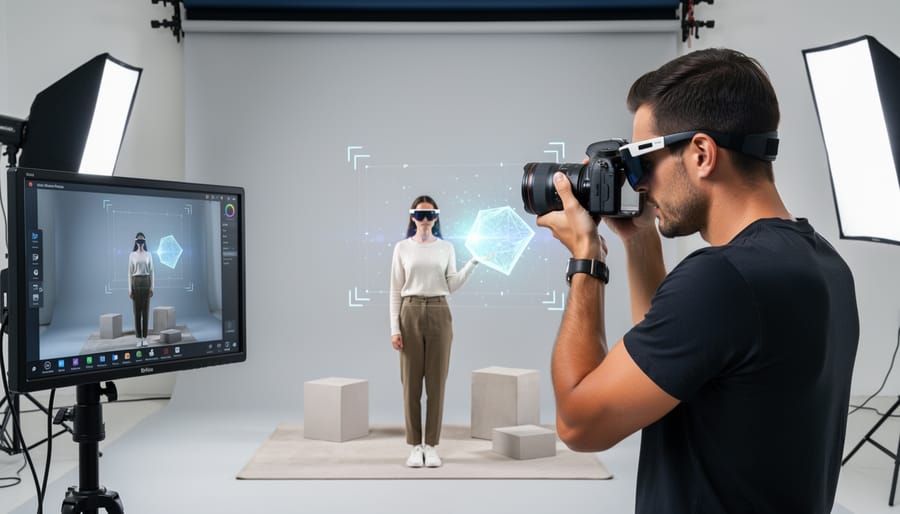
Augmented reality viewfinders are transforming how photographers visualize and compose shots before capturing them. These innovative tools use your smartphone or tablet screen as a window into a mixed reality environment, overlaying digital elements onto your live camera view. Think of them as advanced composition aids that let you see exactly how virtual objects, effects, or backgrounds will integrate with your real-world scene.
Apps like Artemis Pro and Cadrage Director’s Viewfinder have evolved beyond simple framing tools to incorporate AR capabilities. You can now preview how different lenses will affect your composition, place virtual talent or props in your scene, and even simulate lighting conditions. This technology is particularly valuable for pre-production planning, allowing you to scout locations and visualize complex setups without expensive test shoots.
For commercial photographers, AR viewfinders solve a common challenge: showing clients what the final composite image will look like. Instead of asking them to imagine a product floating beside a model or visualizing how CGI elements will blend with practical shots, you can display it in real-time. This immediate visualization streamlines approvals and reduces costly reshoots.
The practical advantage is clear: these tools bridge the gap between imagination and execution, making virtual production techniques accessible without requiring expensive dedicated hardware or extensive technical training.
Virtual Backgrounds and In-Camera Effects
One of the most exciting developments in virtual production is the ability to capture subjects against virtual backgrounds while achieving realistic lighting interaction—all without touching a single green screen. This technology, often called in-camera visual effects or ICVFX, uses LED walls displaying virtual environments that actually light your subject naturally. Instead of adding backgrounds in post-production, you’re photographing what you see on set.
Think of it this way: when you photograph someone in front of a massive LED screen showing a sunset beach scene, the warm golden light from that display actually illuminates your subject’s face and clothing, creating authentic reflections and color spill. This eliminates the artificial look that sometimes plagues green screen composites.
Real-world examples include automotive photography, where car manufacturers now shoot vehicles against photorealistic virtual locations, capturing proper reflections on glossy surfaces in-camera. Portrait photographers are experimenting with smaller LED setups to create dynamic backgrounds that respond to camera movements through parallax tracking.
The entry barrier is dropping too. While major studios use warehouse-sized LED volumes, companies now offer portable LED panels specifically designed for photographers, bringing this technology within reach of serious enthusiasts. The key advantage? You see your final image immediately, allowing for real-time creative decisions rather than hoping your composite works later.
What This Means for Working Photographers Right Now
Low-Cost Entry Points to Experiment With
You don’t need to break the bank to start experimenting with VR and immersive photography. Several accessible entry points let you test the waters before investing in new gear.
On the hardware front, consider starting with a smartphone-based 360-degree camera like the Insta360 GO 3 or Ricoh Theta SC2, both priced under $400. These compact devices connect directly to your phone and produce surprisingly good results for social media and client presentations. For viewing VR content, even a basic Meta Quest 2 headset (often available used for around $200) provides an excellent introduction to immersive experiences without the complexity of PC-tethered systems.
Software-wise, many powerful tools offer free versions. Adobe Premiere Pro includes basic 360-degree video editing capabilities if you already have a Creative Cloud subscription. For dedicated VR editing, try Insta360 Studio (free) or the trial version of Mistika VR. Google’s free Jump Inspector helps stitch and preview 360 content effectively.
Learning resources abound online. YouTube channels like Hugh Hou and Creator Up offer practical tutorials specifically for photographers transitioning to VR. Coursera and LinkedIn Learning provide structured courses on immersive content creation, often with free trial periods. Join communities like the VR Photography Facebook group where professionals share techniques and troubleshoot challenges together. These low-risk experiments help you understand whether VR fits your creative vision before committing to professional-grade equipment.
New Revenue Streams in Virtual Production
The virtual production revolution has opened doors to lucrative opportunities that didn’t exist just a few years ago. If you’re a photographer wondering how to monetize these emerging technologies, you’re in the right place.
One of the most accessible entry points is 360-degree content creation for real estate, tourism, and event documentation. Businesses increasingly need immersive virtual tours, and the equipment barrier has lowered significantly. A quality 360-degree camera and basic stitching software can get you started capturing everything from property listings to museum exhibitions. These projects typically command premium rates because they offer something traditional photography cannot.
Virtual production studios are hungry for high-quality HDRI (High Dynamic Range Imaging) environments and photogrammetry assets. Your photography skills translate beautifully here. Studios need realistic digital backdrops for LED wall productions, and photographers who understand lighting and composition have a distinct advantage. Companies like Netflix and Disney regularly outsource these assets, creating a growing freelance market.
The XR (Extended Reality) space presents another frontier. Brands need product photographers who can capture items for AR try-on experiences and virtual showrooms. Fashion retailers, furniture companies, and automotive brands are investing heavily in these experiences, requiring photographers who understand both traditional capture techniques and the technical requirements for 3D rendering pipelines.
Concert and sports venues are also exploring virtual attendance experiences, needing specialists who can capture and deliver immersive content in real-time. While this requires more technical expertise, it represents a high-value niche with limited competition and substantial growth potential as virtual ticketing becomes mainstream.
The convergence of VR, XR, and virtual production represents one of the most significant shifts in visual storytelling since the transition to digital photography. As we’ve explored throughout this article, these technologies are no longer futuristic concepts but accessible tools reshaping how photographers approach their craft. From LED volume stages making blockbuster techniques available to indie creators, to AI-powered workflows streamlining post-production, the landscape is evolving rapidly.
For photographers considering where to invest their energy and resources, the message is clear: experimentation is key. You don’t need a Hollywood budget to start exploring these technologies. Consumer-level VR headsets, affordable 3D scanning apps, and accessible virtual production software provide entry points for curious creatives. The same disruption transforming the evolving camera industry is opening doors for those willing to learn new skills.
History consistently shows that early adopters gain competitive advantages in emerging markets. The photographers who embraced digital cameras in the 1990s, or mirrorless systems in the 2010s, positioned themselves ahead of peers who waited. Virtual production and XR technologies offer similar opportunities today.
Stay informed by following industry publications, attending workshops, and connecting with communities already working in these spaces. Start small, perhaps with a single VR photography project or experimenting with photogrammetry. The technical barriers continue lowering while creative possibilities expand. Your willingness to explore these tools now could define your professional trajectory for the next decade.


 By
By