 By
By 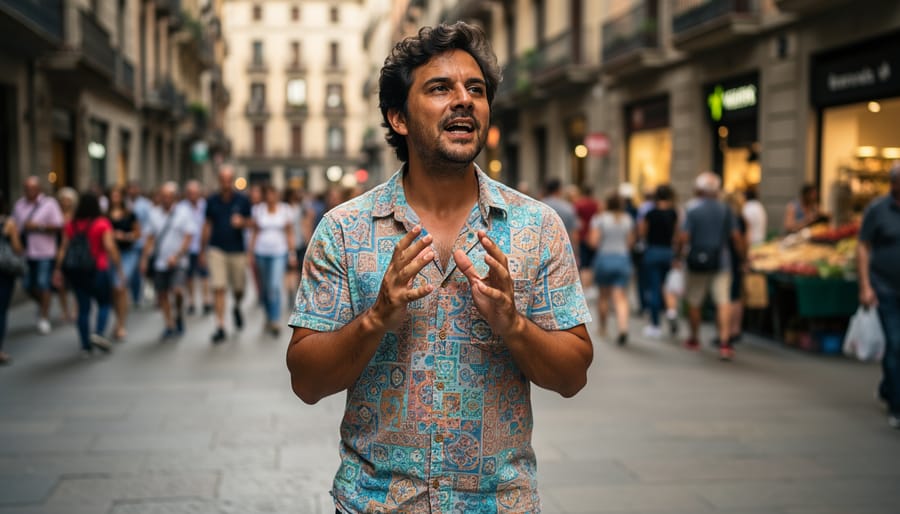
You’ve just photographed a street performer in Barcelona, and the images are stunning. A magazine wants to feature them, but there’s a problem: you don’t have a signed model release. Without it, you could face legal action, lose the licensing opportunity, and leave thousands of dollars on the table.
A model release is a legal document where the person photographed grants you permission to use their likeness commercially. Think of it as a contract that protects both you and your subject. When someone signs this document, they’re saying, “Yes, you can use my image for commercial purposes.” Without it, publishing that photo in an advertisement, selling it to a stock agency, or using it to promote a product could land you in serious legal trouble.
The confusion often starts because not every photo requires a model release. Snap a picture of your friend at dinner and post it on Instagram? You’re probably fine. Use that same image to sell a restaurant’s meal delivery service? Now you need that signature. The line between personal use and commercial use isn’t always obvious, but crossing it without proper documentation can be expensive.
Here’s what catches many photographers off guard: editorial use often doesn’t require a model release, but commercial use almost always does. That distinction matters because stock agencies, advertising clients, and businesses need assurance they won’t face lawsuits for using your images. Just as you need to understand property rights when photographing buildings, understanding model releases protects your ability to monetize photos of people.
The stakes are real. Photographers have been sued for unauthorized commercial use of someone’s likeness, with settlements reaching tens of thousands of dollars. Meanwhile, having properly executed releases opens doors to lucrative stock sales, editorial assignments, and commercial work.
What Is a Model Release? Breaking Down the Basics
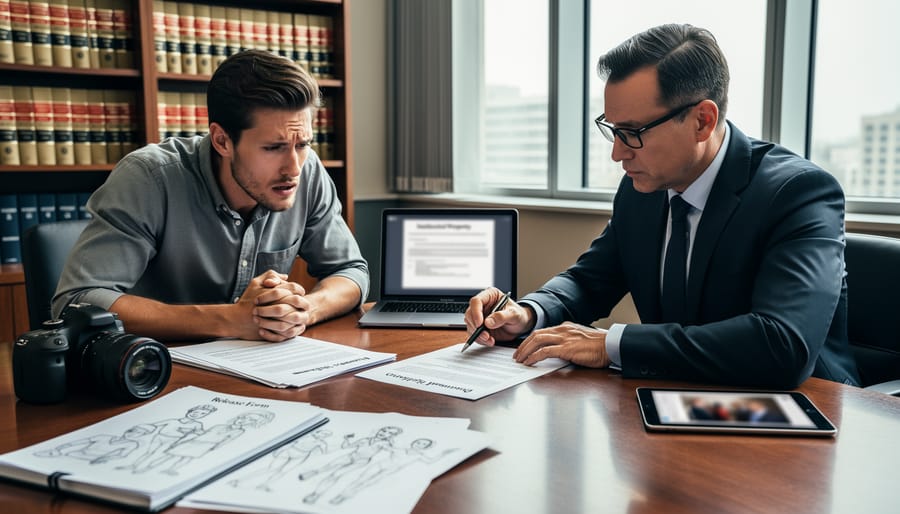
A model release is a legal document that gives you, the photographer, permission to use someone’s image for specific purposes. Think of it as a contract between you and the person you’ve photographed, where they’re saying “Yes, you can publish, sell, or otherwise use these photos of me.”
Here’s what often trips up photographers: taking a photo and using a photo are two entirely different things from a legal standpoint.
When you snap a picture of someone, you own the copyright to that photograph. That’s your intellectual property as the creator. But the person in the photo has something called “personality rights” or “right of publicity”, essentially, they control how their face and likeness can be used for commercial purposes.
Let’s say you photograph a friend at a coffee shop. You’re perfectly within your rights to take that photo. You can even show it in an art gallery or post it on your personal Instagram as part of your portfolio. But if a coffee brand wants to license that image for their advertising campaign, or if you want to sell it as stock photography, you now need that friend’s explicit permission. That’s where the model release comes in.
The release typically specifies what you can do with the images, sell them, modify them, use them in advertising, or license them to third parties. It protects you from future legal claims if the model later decides they don’t want their face associated with your work or a brand that licenses it.
Without this document, you might have a beautiful photograph that you legally can’t use for anything beyond personal artistic expression. With it, you have the freedom to turn your creative work into a business asset.
When You Actually Need a Model Release (And When You Don’t)
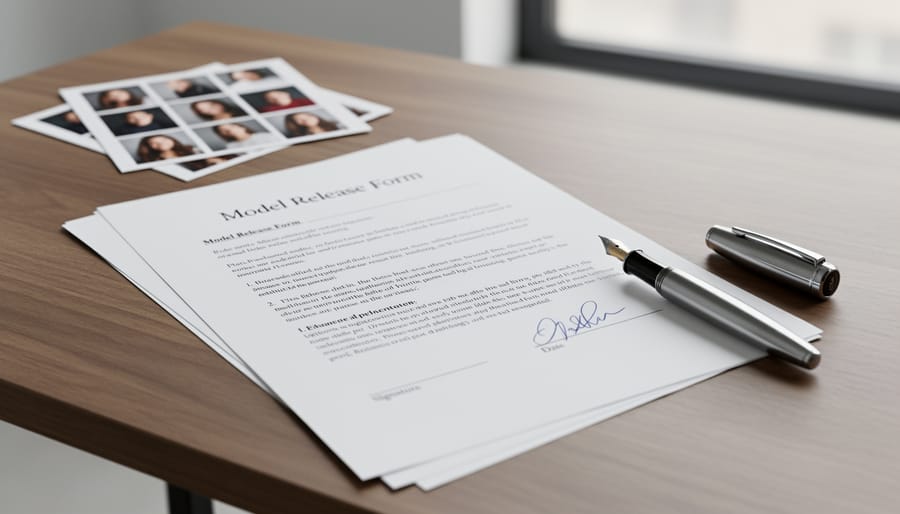
Commercial Use: Where Model Releases Are Essential
When you’re using a photograph to sell something or promote a product, service, or brand, you’re in commercial territory, and that means you absolutely need a model release. The key distinction here is simple: if money is changing hands because of the image itself, or if the image is being used to generate revenue, you need written permission from anyone recognizable in the photo.
Stock photography is perhaps the most obvious example. Sites like Shutterstock, Adobe Stock, and Getty Images require model releases for any image containing recognizable people before they’ll accept it. Without that signed release, your image won’t pass their review process, and you won’t earn a cent from potential sales.
Selling prints at art fairs or through your website also counts as commercial use. Even if you took a stunning portrait of a stranger on the street, you can’t legally sell prints of their face without their consent. The same applies if you’re licensing your images to businesses for use in their marketing materials, websites, or advertisements.
Product promotion is another major category. If you photograph someone holding a coffee mug and that image ends up in a café’s Instagram ad or on their menu, it’s commercial use. Similarly, if a fitness brand wants to use your gym photos in their next campaign, every person in those shots needs to have signed a release. Without it, you’re exposing yourself, and potentially your client, to legal action.
Editorial Use: The Exception to the Rule
Editorial photography operates under different rules because it serves the public interest. When you’re documenting newsworthy events, creating educational materials, or producing documentary work, First Amendment protections typically allow you to publish images without model releases, even for commercial publications.
News photography is the clearest example. If you photograph a protest, political rally, or breaking news event and sell those images to newspapers or news websites, you don’t need releases from the people in your shots. The same protection extends to documentary projects that comment on social issues or cultural phenomena.
Educational use also falls under this umbrella. Textbook publishers, academic journals, and instructional materials can usually feature recognizable people without releases when the images illustrate concepts or provide information rather than promote products.
Here’s the critical boundary: editorial protection disappears the moment your image implies endorsement. You can photograph someone at a farmers market for a story about local food trends without a release. But you cannot use that same photo to advertise the farmers market itself, promote a specific vendor, or sell it as stock photography for a grocery chain’s marketing campaign.
The context of publication matters more than your original intent when shooting. An image that’s perfectly legal in a magazine article about urban life becomes a liability if used in an advertisement without proper releases.
The Gray Areas Photographers Often Misunderstand
Street photography presents one of the trickiest situations. You can photograph strangers in public without permission, but using those images commercially requires a release. Posting a compelling street portrait to your portfolio website sits in murky territory, technically promotional for your business, which leans commercial. Many photographers assume “personal use” covers portfolio work, but if you’re attracting clients through it, courts might disagree.
Social media adds another layer of confusion. Sharing a photo on Instagram feels casual, but if your account promotes your photography services, that image becomes marketing material. Even without direct payment, you’re using someone’s likeness to build your brand. A travel blogger posting candid market scenes crosses into commercial territory when the blog generates income through ads or sponsorships.
Public spaces don’t grant automatic commercial rights either. You can photograph that busker in the subway for news or documentary purposes, but selling prints of them requires their consent. The location being public affects whether you needed permission to take the photo, not whether you need a release to profit from it. That distinction catches countless photographers off guard.
What Makes a Model Release Legally Valid
A model release isn’t just a formality, it’s a contract, and like any contract, certain elements must be present for it to hold up legally. Skip any of these components, and you might find yourself with a document that offers little more protection than a handshake agreement.
At its core, a valid model release must clearly identify who’s involved and what they’re agreeing to. Think of it as answering the journalist’s essential questions: who, what, where, when, and under what terms. The difference between a robust release and a useless piece of paper often comes down to specificity.
Here’s what every legally sound model release needs:
- Clear identification of all parties, the photographer or company acquiring rights and the model granting them, with full legal names
- Description of the images or photo session covered by the agreement, including date and location when possible
- Explicit scope of usage rights being granted, specifying whether use is unrestricted or limited to certain purposes
- Compensation details, even if the shoot is unpaid (stating “no compensation” or “trade for portfolio images” counts)
- Signatures and dates from both photographer and model, proving mutual agreement at a specific point in time
- Minor consent provisions when applicable, with parent or legal guardian signature for anyone under 18
The identification section matters more than you might think. “John Smith” isn’t enough if there are ten John Smiths in your city. Include addresses or other identifying information to eliminate ambiguity about who signed the release.
When describing usage rights, vague language like “promotional purposes” creates problems. Does that mean social media? Print ads? Billboards? The more specific you are, the better protected you’ll be. Some photographers grant themselves perpetual, worldwide rights for any purpose. Others limit use to specific campaigns or timeframes. Neither approach is inherently wrong, but the release must state it clearly.
The compensation clause protects both parties. If you’re paying a model, spell out the amount and payment terms. For unpaid shoots, explicitly state that, “in exchange for portfolio-quality images” or “no monetary compensation provided” works fine. This prevents future disputes about whether payment was promised.
Interestingly, as photography evolves to include AI image rights and manipulated imagery, some photographers now include clauses addressing how images may be digitally altered or combined with other elements. While not legally required everywhere, this added specificity can prevent headaches down the road.
Finally, both parties must actually sign the document. A release sitting in your inbox waiting for signatures offers zero protection. Get those signatures before you leave the shoot, or at minimum, before you use any images publicly.
The Real Consequences of Not Having a Model Release
The moment you hit “publish” on an image without a proper model release, you’re rolling the dice with your finances and professional reputation. While not every unauthorized use ends in legal action, the consequences when someone does take issue can be swift and expensive.
The most direct financial hit comes through lawsuits. If someone recognizes themselves in your commercial work without having signed a release, they can sue for unauthorized use of their likeness. Settlement amounts vary wildly, from a few thousand dollars for smaller infractions to six-figure sums when the image generates substantial revenue or causes demonstrable harm. One wedding photographer learned this the hard way after selling prints featuring guests to a stock photography site. A guest who appeared prominently in several images filed suit, and the photographer settled for $15,000 plus legal fees.
Beyond the initial settlement, there’s the compounding cost of legal representation. Even if you believe you’re in the right, defending yourself requires attorneys who specialize in intellectual property and privacy law. These fees add up quickly, often exceeding the actual settlement amount. Your images might also be excluded as court evidence if proper documentation wasn’t maintained from the start.
The damage extends beyond your bank account. Clients who discover you’ve exposed them to legal liability by using images without proper releases will likely terminate contracts and warn others in their network. Stock photography agencies will suspend or permanently ban your account if they receive complaints about missing releases. In today’s connected world, word spreads fast, especially negative word.
Your creative work itself becomes worthless without a release. That stunning portrait you captured? You can’t license it, sell prints, or feature it in advertising campaigns. The image sits unused on your hard drive while competitors with proper paperwork land lucrative opportunities.
Insurance companies scrutinize claims involving missing releases too. Many photographer liability policies contain exclusions for “knowing violations,” meaning if you proceeded without a release when you should have known better, your coverage might not protect you.
How to Get a Model Release: Practical Steps for Every Situation
Professional Shoots: Setting Up Releases Beforehand
For professional photography shoots, make model releases part of your pre-shoot routine, not an afterthought. Send the release to your subject at least 24 hours before the session, ideally when you confirm the booking. This gives them time to review it without pressure and ask questions.
When you explain the release, keep it simple: “This document confirms I can use the photos we create today for [specific purposes like my portfolio, stock photography, or client advertising].” Be specific about intended use rather than requesting blanket rights, which can make people uncomfortable.
Have two copies ready on shoot day, one for them, one for your records. Present it at the beginning while everyone’s relaxed, not when they’re ready to leave. If you’re shooting outdoors with equipment like drones, mention that the release covers all images from the session, and remind subjects about relevant regulations like drone legal rules that apply to the shoot location.
Always treat the release as a professional standard, like bringing your camera. When it’s routine rather than awkward, subjects sign without hesitation. Store signed releases systematically with corresponding shoot files so you can locate them instantly if needed years later.
Working with Minors: Special Requirements and Parent/Guardian Consent
When photographing anyone under 18, you’re entering territory with stricter legal requirements. Minors can’t sign binding contracts themselves, which means you’ll need a parent or legal guardian to sign the model release on their behalf.
Here’s what makes this tricky: the definition of “legal guardian” varies. A grandparent, aunt, or teacher supervising a child doesn’t automatically have authority to sign releases. You need the person who holds legal custody, typically a parent. If you’re shooting at a school event or summer camp, ask for written authorization from parents beforehand rather than relying on staff signatures.
Age thresholds differ by location too. While 18 is standard in most U.S. states, some jurisdictions set it at 19 or allow emancipated minors to sign their own releases. California, for example, has specific entertainment industry laws that create different rules for child performers.
Always verify the signer’s relationship to the child and keep documentation proving they had authority to consent. If both parents share custody, getting signatures from both provides extra protection, especially for commercial projects with significant exposure or compensation involved.
Digital Model Releases: Modern Solutions for On-the-Go Photographers
Gone are the days when forgotten paper release forms meant lost opportunities or awkward follow-up emails. Digital model release apps have transformed how photographers handle permissions, letting you capture signatures right after a shoot using just your smartphone or tablet.
Apps like Easy Release, Releases, and ShootProof allow models to sign directly on your device’s screen with their finger or a stylus. The app timestamps the signature, records GPS location data, and instantly generates a PDF copy emailed to both parties. This creates a stronger legal record than paper forms while eliminating the risk of losing physical documents.
Most platforms store releases in the cloud, so you can access them years later when licensing an image. Many integrate with photography workflow software, automatically matching releases to specific photo sessions. Some even offer facial recognition features that link signed releases to the actual images of that person.
The practical advantage becomes obvious during spontaneous shoots. When you capture an unexpected moment with someone willing to sign a release, you can handle everything on the spot rather than exchanging contact information and hoping they respond later. Digital releases turn permission into a seamless part of your shooting process rather than administrative homework.
Common Model Release Mistakes (And How to Avoid Them)
Even experienced photographers slip up with model releases. These mistakes can turn what should be simple legal protection into confusing disputes or missed opportunities. Here’s what goes wrong most often and how to fix it.
**Using Vague or Incomplete Language**
The biggest error is thinking a handshake agreement or verbal “sure, go ahead” counts as permission. It doesn’t. Neither do releases with fuzzy phrases like “for general purposes” or “limited use.” These terms mean nothing in court because they’re open to interpretation. Your release needs to spell out exactly what you can do with the images, advertising, social media, stock licensing, whatever applies. Be specific about the scope of use, duration (perpetual is standard for most commercial work), and territory (worldwide versus specific regions). If you’re shooting for a brand campaign, state that. Vague releases leave room for models to claim they didn’t understand what they were agreeing to.
**Forgetting to Include Payment Terms**
Whether you’re paying the model or they’re modeling for free affects the release language. Many photographers skip this detail entirely, which creates confusion later. If it’s a paid shoot, note the compensation amount. For trade-for-portfolio arrangements, state that clearly, “in exchange for digital images” works. This prevents models from claiming they never received what was promised or that the agreement wasn’t valid because consideration wasn’t documented.
**Not Keeping Organized Records**
You shot 500 images last month across a dozen sessions. Can you match every model release to the corresponding photos? Most photographers can’t. This becomes a nightmare when a client wants to license an image and you can’t prove you have the release. Create a simple filing system, digital folders work fine, that links each signed release to the shoot date, model name, and image files. Some photographers add the release form number to their image metadata. Just like understanding trademark symbols such as the ® symbol helps protect brand identity, systematic record-keeping protects your usage rights.
**Using One-Size-Fits-All Templates Without Customization**
Downloaded a free template? Great start, but don’t use it blindly. Standard templates often don’t account for your specific situation, shooting in multiple states, working with agency-represented models, or dealing with sensitive subject matter. Review every template against your actual needs and adjust accordingly. A wedding photographer’s release looks different from a commercial fashion photographer’s release, which differs from a street photographer’s documentary release.
Keep copies of every signed release indefinitely. Storage is cheap; lawsuits aren’t.
Where to Find and How to Use Model Release Templates
Finding a solid model release template doesn’t mean you need to hire a lawyer from scratch. Plenty of reliable sources offer templates that cover the essentials, and knowing where to look saves you time and potential headaches.
Start with established photography organizations. The American Society of Media Photographers (ASMP) provides well-vetted templates that have stood up to legal scrutiny. Stock photography platforms like Adobe Stock and Shutterstock also offer free downloadable releases designed specifically for photographers. These templates work because they’ve been tested through thousands of real transactions.
When you’re evaluating any template, look for these key components: clear language identifying both parties, specific rights being granted, compensation terms (even if it’s zero dollars), and a space for dates and signatures. The best templates also include a checkbox section covering different usage types so you can specify exactly what rights you’re securing.
Free templates work fine for straightforward situations. You can find them on photography blogs, legal aid websites, and professional photography associations. Paid templates from legal services like LegalZoom typically offer more comprehensive language and sometimes include consultation services, which makes sense if you’re shooting high-value commercial work or need customization for unusual situations.
Customizing a template is simpler than it sounds. Don’t rewrite the legal framework, but do tailor the usage rights section to match your actual needs. If you only shoot for your portfolio, say that. If you license images internationally, make sure geographic rights are clearly stated. Add project-specific details in the description field, like the shoot date, location, or campaign name.
Save your customized template as a master document, then create copies for individual shoots. Keep both digital and printed versions handy, because you never know when you’ll need to get a signature on the spot.
Frequently Asked Questions About Model Releases
Is verbal consent enough, or do I need a written model release?
Verbal consent might give you permission to take a photo, but it’s nearly impossible to prove in court. For any commercial use, you need a written, signed model release to protect yourself legally.
What about photographing crowds at public events?
If individuals aren’t identifiable or they’re incidental to the scene, you typically don’t need releases for editorial use. However, if you’re singling out recognizable people for commercial purposes, you’ll need their consent regardless of the public setting.
Do I need a property release if a person appears in front of a recognizable building?
It depends on how prominently the building features and your intended use. If the building is merely background context, you’re generally safe. If the building is the focal point and you’re using the image commercially, you may need both a model release for the person and a property release for the building.
Are model releases from one country valid in another?
Generally yes, but laws vary significantly between countries. A release signed in the US should hold up internationally, but different jurisdictions have different privacy laws and age requirements for consent.
Can I use someone’s image if they signed a release years ago?
As long as the release doesn’t specify an expiration date and covers the type of use you’re planning, older releases remain valid. However, it’s good practice to specify duration in your releases to avoid ambiguity.
What if someone changes their mind after signing a release?
Once someone signs a valid model release, they can’t simply revoke it because they’ve changed their mind. The release is a binding legal agreement, which is exactly why it’s crucial to be transparent about how you’ll use the images before anyone signs.
Do I need a new release if I want to use the same photo for a different project?
That depends entirely on how the original release was written. If it granted broad usage rights, you’re covered. If it specified a particular campaign or limited use, you’ll need additional permission for new applications.
These questions represent the real-world situations photographers find themselves in after they understand the basics. Notice how many of them revolve around the gap between theory and practice: you know you need releases for commercial work, but what about that gray area where you’re not sure if someone’s recognizable enough to matter? Or when the setting itself might require permission?
The international question deserves extra attention if you’re selling stock photography or working with global clients. Different countries have wildly different approaches to privacy and publicity rights. Germany, for instance, has stricter privacy laws than the US, while some countries have virtually no model release requirements at all. If you’re licensing images internationally, consider having your releases reviewed by a lawyer familiar with the primary markets where you’ll be selling.
Here’s something many photographers don’t think about until it’s too late: keep your signed releases organized and easily accessible. Scanning physical releases and storing them with cloud backups means you’ll have them when you need to prove you have permission, whether that’s tomorrow or five years from now. Some photographers name their image files to correspond with their release files, making it simple to match photos with the paperwork that protects them.
Model releases aren’t just another form to file away. They’re your safety net in an industry where a single image can make or break your business. Think of them as professional insurance that costs nothing but saves everything.
The photographers who thrive long-term aren’t necessarily the most talented. They’re the ones who treat their craft like a business, and that means protecting themselves and their subjects from day one. Getting a model release should feel as natural as adjusting your exposure settings or backing up your memory cards. It’s part of the job.
Here’s the good news: once you build model releases into your workflow, they become automatic. You’ll spend less time worrying about whether you can legally use an image and more time actually creating. Your clients and models will respect your professionalism. Your legal exposure drops to nearly zero. And you’ll sleep better knowing that stunning shot you captured can actually generate income without risk.
Start today. Download a template, customize it for your needs, and get your next subject to sign it. Do it for the shoot after that. And the one after that. Before long, you’ll wonder why it ever felt like an extra step. Your future self, facing opportunities instead of lawsuits, will thank you.

 By
By