 By
By 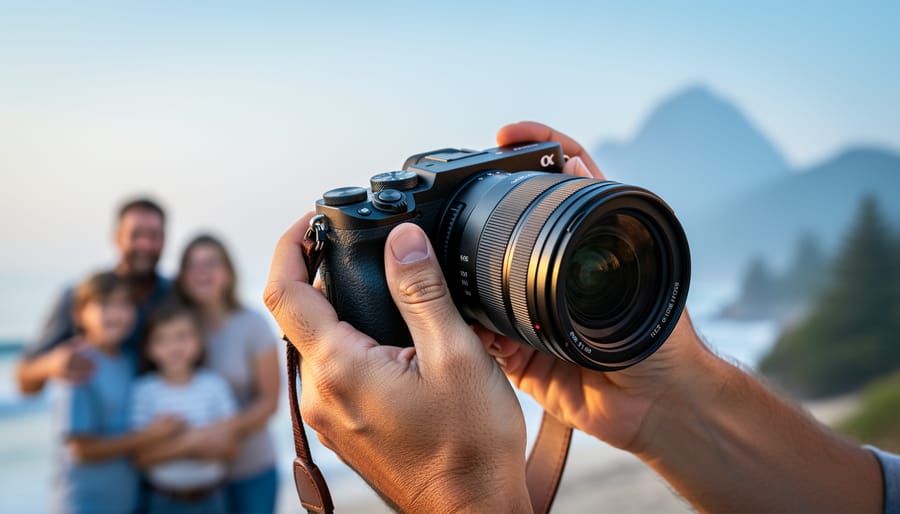
Choosing the right camera starts with understanding what you’ll actually shoot and how much control you need. If you’re capturing family moments and travel, a capable mirrorless camera like the Canon EOS R10 Mirrorless Camera RF-S18-45 Mm F4.5-6.3 is STM Lens Kit offers the sweet spot of image quality and portability without overwhelming you with features. Professional photographers shooting weddings or commercial work will gravitate toward the Canon EOS R5 Full-Frame Mirrorless Camera with 8K Video for its larger sensor and advanced capabilities. The real trick isn’t finding the “best” camera on the market, it’s matching sensor size, lens ecosystem, and control layout to your shooting style and growth trajectory.
Most buyers get stuck comparing megapixels and specs without considering what actually matters: how the camera feels in your hands during a three-hour shoot, whether you’ll realistically edit raw files or stick with JPEGs, and if you’ll outgrow your choice in six months or six years. A content creator filming daily vlogs has completely different needs than a landscape photographer who takes ten carefully composed shots per outing. The Sony Alpha A6100 Mirrorless Camera proves you don’t need to spend a fortune for excellent autofocus and video quality, while the DJI Osmo Pocket 3 Creator Combo reimagines what a camera can be for run-and-gun situations.
This guide breaks down the decision framework that cuts through marketing hype. You’ll learn which camera types excel at what tasks, which features justify higher budgets, and how to avoid the expensive mistakes that leave cameras collecting dust in closets. Whether you’re upgrading from a smartphone or replacing a trusty DSLR like the Canon EOS 6D 20.2 MP CMOS Digital SLR Camera with 3.0-Inch LCD (Body the principles remain the same: identify your constraints, match them to real-world performance, and buy the system you’ll actually use.
What Matters Most: Key Factors in Camera Selection
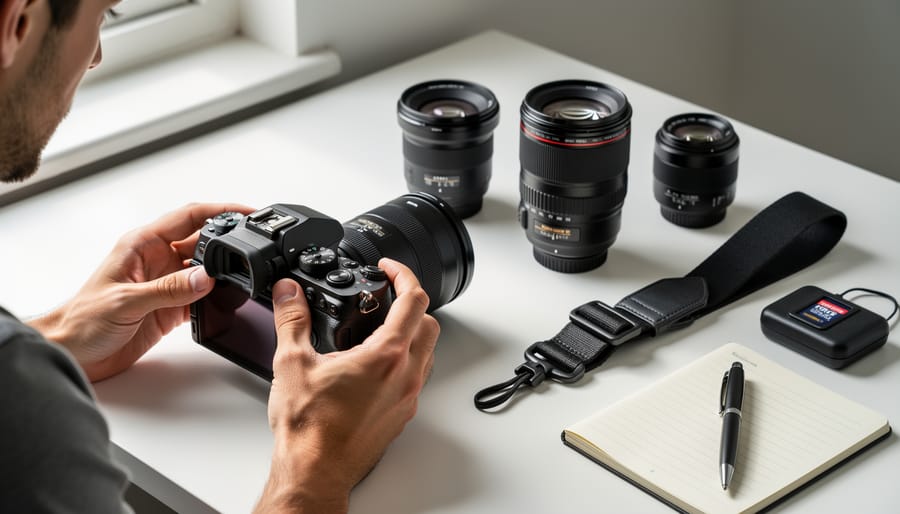
Before you compare camera types or set a budget, you need to understand the core factors that separate a camera you’ll love from one that gathers dust. These fundamentals apply whether you’re considering a $500 entry-level body or a $4,000 professional rig, and getting them right matters more than chasing the latest model year.
Sensor Size and Image Quality
Sensor size determines how much light your camera captures and directly affects image quality, especially in challenging conditions. Full-frame sensors excel in low light and deliver shallower depth of field for portraits, which is why professionals like the photographer behind Finding the Universe chose the Canon EOS R5 for travel work. APS-C sensors offer a practical middle ground with smaller, lighter bodies and lenses while still delivering excellent quality for most situations. DPReview’s pick for best camera under $1000 in 2026, the Canon EOS R10, uses an APS-C sensor that proves you don’t need full-frame to get professional results.
Shooting Speed and Performance
If you photograph your kids’ soccer games or wildlife, burst rate and autofocus speed become critical. A camera shooting 10 frames per second with reliable subject tracking will capture moments a 5fps body misses. For landscapes or studio portraits where nothing moves quickly, these specs matter far less than dynamic range and resolution.
Video Capabilities
Video features have become standard across camera categories, but capabilities vary wildly. If you plan to shoot video seriously, look for 4K recording at 60fps or higher, good autofocus during video, and clean HDMI output. Content creators often prioritize these features over still image specs.
Lens Ecosystem and Availability
Your camera body is just the beginning. Canon and Sony offer extensive lens lineups with options at every price point, while smaller systems may limit your choices as your skills grow. Consider whether specialty lenses for your photography style (like fast telephoto zooms for sports or tilt-shift for architecture) exist in the system you’re considering.
Ergonomics and Handling
A camera with perfect specs on paper means nothing if it feels awkward in your hands. Button placement, grip depth, menu logic, and viewfinder quality affect whether you’ll actually want to carry and use the camera. Handle cameras in person when possible, because what works for someone else may frustrate you daily.
Budget and Total System Cost
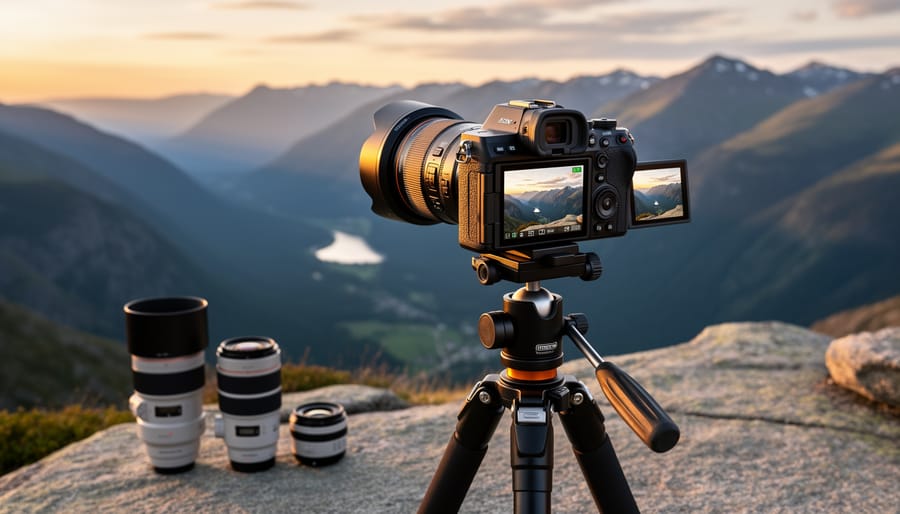
That $1,200 body becomes a $3,000 investment once you add quality lenses, memory cards, batteries, and a capable tripod. Plan for the complete kit rather than just the body price, and remember that lenses often outlast bodies as you upgrade over the years.
Camera Types Compared: Finding Your Format
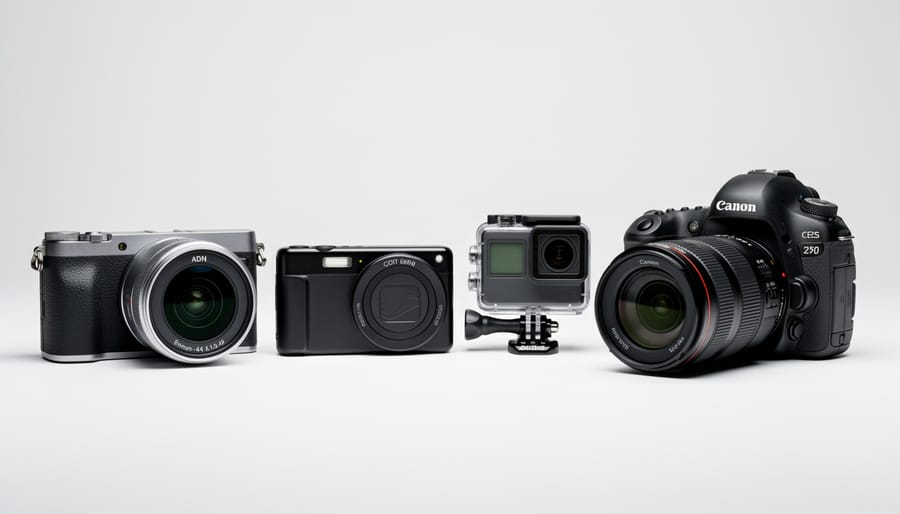
DSLR Cameras: The Proven Workhorses
DSLRs have been the backbone of professional photography for decades, and they’re far from obsolete. At their core, these cameras use a mirror mechanism to reflect light from the lens up into an optical viewfinder, giving you a direct, lag-free view of your scene. That mirror flips up when you press the shutter, allowing light to hit the sensor.
The optical viewfinder remains a genuine advantage. You see exactly what the lens sees without any electronic processing, with zero battery drain and no blackout lag in bright sunlight. Many photographers still prefer this direct connection to their subject, especially for action and wildlife work.
Battery life is where DSLRs shine brightest in 2026. While mirrorless cameras typically manage 300-500 shots per charge, DSLRs routinely deliver 800-1,200 shots or more. If you’re shooting all day without access to power, that difference matters.
The lens ecosystem is arguably the most compelling reason to consider a DSLR now. Decades of production mean you have access to an enormous range of high-quality glass at every price point, including abundant used options. Canon’s EF mount and Nikon’s F mount libraries are particularly deep.
DSLRs remain relevant for photographers who value proven reliability, exceptional battery performance, and access to mature lens systems. They’re often excellent value on the used market, though new production has slowed considerably as manufacturers focus on mirrorless development.
Mirrorless Cameras: The Modern Standard
Mirrorless cameras have become the go-to choice for most photographers in 2026, and for good reason. Unlike DSLRs that use mirrors and optical viewfinders, mirrorless bodies route light directly to the sensor, showing you exactly what the final image will look like through an electronic viewfinder. This means you see exposure, white balance, and depth of field in real time before you press the shutter, which eliminates guesswork and speeds up learning.
The physical benefits are immediate. Without the mirror box, manufacturers can design lighter, more compact bodies that still house professional-grade sensors. You get full-frame or APS-C image quality in a package that won’t wreck your back on a full-day shoot. Modern autofocus systems in mirrorless cameras track subjects across the entire frame using on-sensor phase detection, locking onto eyes, faces, and even specific animals with accuracy that older DSLRs simply can’t match.
Video performance separates mirrorless from the rest. Most current models shoot 4K at high frame rates with advanced stabilization, flip-out screens, and microphone inputs that make them viable for serious content creation. The Canon EOS R5, for example, offers 8K recording, which is why it’s become a favorite among travel and landscape photographers who need both stills and video capability. Whether you’re an enthusiast upgrading from a smartphone or a professional building a new kit, mirrorless delivers the features that matter most today.
Compact and Vlogging Cameras: Portability First
Compact cameras and vlogging-specific models fill a distinct niche: they trade interchangeable lenses and some image quality for true pocketability and specialized features. A fixed-lens compact like the Ricoh GR series or Sony RX100 line slips into a jacket pocket yet delivers far better low-light performance and manual control than any smartphone. For travel photographers who want a capable backup or don’t want to carry a full kit on every outing, these cameras offer genuine optical zoom, larger sensors than phones, and dedicated controls that speed up shooting.
Vlogging cameras take portability a step further by optimizing for video first. The DJI Osmo Pocket 3, for example, pairs a 1-inch sensor with a built-in gimbal for stabilized 4K footage at up to 120fps, all in a device you can hold in one hand. These tools prioritize flip-out screens, excellent autofocus for face tracking, and built-in microphones or hot shoes for external audio. They’re ideal for content creators who shoot handheld, need instant setup, and value smooth footage over still image flexibility.
Consider these cameras when convenience outweighs lens choice and you’re willing to accept a fixed focal range in exchange for gear that disappears into your daily routine.
Your Smartphone: Already in Your Pocket
Modern smartphones in 2026 deliver genuinely impressive image quality that can handle most everyday photography needs. Computational photography features like night mode, portrait effects, and HDR processing produce clean, sharp images straight out of the device, often surpassing what you’d get from an entry-level point-and-shoot camera. The convenience factor matters too: your phone is already with you, it syncs photos instantly to the cloud, and it eliminates the need to carry extra gear.
The smartphone vs camera debate comes down to control and limitations. Smartphones struggle in situations where dedicated cameras shine: low light without computational tricks, fast action requiring quick burst rates and tracking autofocus, distant subjects needing optical zoom reach, and creative work where you want full manual control over aperture, shutter speed, and depth of field. If you’re shooting casual snapshots, social media content, or documenting daily life, your smartphone is likely enough. When image quality under challenging conditions, creative flexibility, or interchangeable lenses become priorities, that’s when investing in a dedicated camera makes sense.
Matching Camera to Photography Style
The camera that’s perfect for a landscape photographer will frustrate a sports shooter, and vice versa. Your shooting style should drive your camera choice more than any spec sheet or review score.
Landscape and Travel Photography
Resolution matters here. You want detail for large prints and the ability to crop without losing quality. Full-frame sensors excel in these scenarios, capturing wider dynamic range in high-contrast scenes like sunlit mountains against deep shadows. Weather sealing becomes critical when you’re shooting in unpredictable conditions, and a robust IBIS vs OIS system helps with handheld shots at slower shutter speeds during golden hour. Travel photographers like the Finding the Universe author chose the Canon EOS R5 specifically for its combination of high resolution, reliable autofocus, and weather-resistant build that handles diverse conditions from Icelandic storms to desert heat.
For lens selection prioritize a quality wide-angle zoom (16-35mm equivalent) for sweeping vistas and a versatile midrange zoom (24-70mm or 24-105mm) that covers most travel situations without constant lens changes.
Portrait and Studio Work
Shallow depth of field defines portrait photography, making full-frame or larger sensors advantageous for that creamy background blur. Look for cameras with accurate, face-detect autofocus that can track eyes even when your subject moves. Studio shooters need reliable flash sync capabilities and ideally a camera that can tether to a computer for instant client review. Ergonomics count during long sessions: comfortable grip, intuitive controls, and an articulating screen for low or high-angle shots.
A fast prime lens (85mm f/1.8 or 50mm f/1.4) should be your first purchase after the camera body. The extra light-gathering ability and subject isolation they provide is irreplaceable.
Wildlife and Sports
Speed is everything. You need continuous autofocus that locks onto moving subjects and maintains focus through bursts of 10+ frames per second. Reach matters too, meaning either a crop sensor that extends your telephoto range or the budget for expensive long lenses. Buffer depth determines how many shots you can fire before the camera chokes, and dual card slots provide insurance when you can’t reshoot a once-in-a-lifetime moment.
Battery life becomes crucial when you’re in the field all day. Mirrorless cameras have improved dramatically, but DSLRs still edge them out for sheer shot count per charge.
Street and Documentary
Inconspicuous size wins here. A loud shutter or bulky body breaks the moment you’re trying to capture. Silent electronic shutters, compact form factors, and fast prime lenses that perform well in available light let you work without drawing attention. Weather sealing helps in unpredictable environments, and dual card slots offer peace of mind when documenting unrepeatable events.
Quick autofocus matters, but many street photographers still prefer manual focus with focus peaking for precise control over their compositions.
Video and Content Creation
- Overheating protection and unlimited recording time for long takes
- Clean HDMI output for external monitors and recorders
- In-body stabilization or excellent optical stabilization for handheld work
- High frame rate options (120fps minimum) for smooth slow-motion
- Quality audio inputs with headphone monitoring
- Articulating touchscreen for vlogging and awkward angles
Content creators benefit from hybrid cameras that balance video features with still image quality. The DJI Osmo Pocket 3, though specialized, demonstrates how video-first design can solve real problems for creators who prioritize smooth footage and portability over traditional camera capabilities.
Your photography style isn’t fixed forever, but matching your first camera to your primary interests ensures you’ll actually enjoy using it rather than fighting its limitations.
Budget Considerations: Getting the Most Value
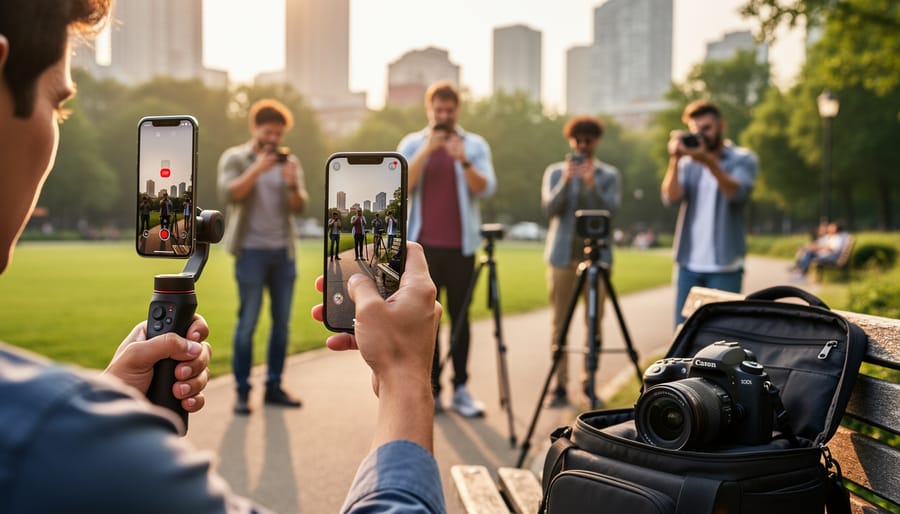
Your camera budget isn’t just the sticker price on the body. When you’re comparing options across price ranges, factor in the full ecosystem you’ll need to actually shoot: lenses, memory cards, extra batteries, a camera bag, and maybe a tripod or external storage. A $700 camera body becomes a $1,200 investment once you’ve added a decent lens and the essentials.
Under $1,000, you’ll find capable entry-level mirrorless and DSLR options with APS-C sensors. DPReview highlights the Canon EOS R10 as the best camera under $1,000 in 2026, and it’s a solid example of what this tier delivers: strong autofocus, 4K video, and room to grow. At this level, kit bundles (body plus an 18-45mm or similar lens) offer real value because you can start shooting immediately without hunting for compatible glass. Buying body-only saves money upfront but leaves you unable to take a single photo until you add a lens, which often costs $300 to $600 on its own.
Between $1,000 and $2,500, you move into advanced APS-C and entry-level full-frame territory. These cameras offer better build quality, faster processors, dual card slots, and weather sealing. Lenses in this range also get sharper and faster, but they jump in price, a quality zoom or prime can cost as much as the body. This is where the total cost of ownership compounds: you’re not just paying more for the camera, you’re committing to a pricier lens ecosystem.
Above $2,500, you’re in professional full-frame systems like the Canon EOS R5, which offers 45MP, 8K video, and the performance working photographers rely on. These bodies justify their cost if you’re earning income from your work or need the durability and feature set for demanding projects. But expect to spend another $2,000 to $5,000 on lenses to match the body’s capabilities.
If you’re just starting out, a kit purchase beats body-only almost every time. The bundled lens may not be the sharpest in the catalog, but it’s affordable, lightweight, and versatile enough to help you learn what focal lengths and features you actually need before investing in premium glass. Summer guides from sources like PhotoBohemian feature the latest tested models, giving you current options at every price point as manufacturers refresh their lineups.
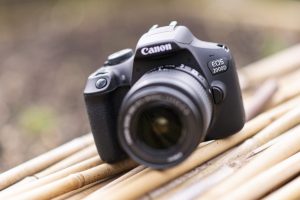
Canon EOS R10 Mirrorless Camera RF-S18-45 Mm F4.5-6.3 is STM Lens Kit

The Canon EOS R10 with the RF-S 18-45mm kit lens stands out as DPReview’s pick for best camera under $1000 in 2026, and it’s easy to see why. This APS-C mirrorless camera packs a 24.2-megapixel CMOS sensor into a compact body that won’t intimidate newcomers, yet delivers image quality and features that leave room to grow as your skills develop.
What makes this kit particularly smart for beginners and content creators is its genuine hybrid capability. The 4K video recording handles vlogging and YouTube content without compromise, while the still image performance is more than capable for photography learning and client work. You’re not sacrificing one discipline for the other, which matters when you’re still figuring out where your interests lie.
The bundled RF-S 18-45mm lens is a real advantage here. Canon designed this kit lens specifically for the R10’s APS-C sensor, giving you a versatile 29-72mm equivalent focal range that covers everything from group shots to street photography. Yes, you’ll eventually want additional lenses as you specialize, but this starter glass is genuinely usable rather than something you’ll immediately replace. The STM motor provides smooth, near-silent autofocus that works well for both stills and video.
Canon’s mirrorless autofocus system in this body is reliable and intuitive, tracking subjects with confidence that takes the technical burden off you while you’re learning composition and exposure. The electronic viewfinder and articulating LCD screen give you flexibility for different shooting angles, particularly useful for vlogging setups.
With a perfect 5 out of 5 rating from 375 customer reviews, the R10 kit has clearly resonated with photographers making their first serious camera purchase. It’s the rare entry-level option that doesn’t feel like a compromise.
Sony Alpha A6100 Mirrorless Camera

The Sony Alpha A6100 punches well above its weight as a bridge between smartphone convenience and serious creative control. If you’ve been pushing your phone’s camera to its limits and find yourself frustrated by autofocus lag or low-light noise, this compact APS-C mirrorless body answers those pain points without demanding a massive leap in size or learning curve.
What sets the A6100 apart is Sony’s real-time tracking autofocus, borrowed from the company’s professional cameras. It locks onto and follows subjects with a tenacity you simply won’t find in entry-level competitors, making it a natural fit for photographing kids, pets, or street scenes where the decisive moment won’t wait for you to nail focus manually. Pair that with 11 fps continuous shooting and you’ve got a small camera that doesn’t miss action shots.
Video shooters will appreciate clean 4K recording at 30p with full pixel readout and no crop, a feature that typically pushes cameras into higher price brackets. The flip-up screen makes vlogging straightforward, though there’s no in-body stabilization, so you’ll want steady hands or a gimbal for walking shots.
Sony’s E-mount lens ecosystem deserves consideration here. You’re buying into a system with dozens of native lenses ranging from affordable primes to professional zooms, plus third-party support from Sigma and Tamron that often delivers exceptional value. Start with a kit zoom and you can grow into fast portrait glass or compact travel lenses as your skills and needs evolve.
The camera has earned a 4.6 out of 5 rating from 217 customers, with owners consistently praising the autofocus and image quality while noting the single card slot and modest battery life as trade-offs at this price point.
Canon EOS 6D 20.2 MP CMOS Digital SLR Camera with 3.0-Inch LCD (Body

The Canon EOS 6D represents a different path in 2026: the full-frame DSLR for photographers who value optical viewfinders, proven reliability, and access to decades of Canon EF glass. While the mirrorless world dominates headlines, this camera still delivers the fundamentals that made it a workhorse for professionals over the years.
The 20.2-megapixel full-frame CMOS sensor excels in low-light situations, offering clean files at higher ISOs that smaller sensors struggle to match. Professionals valued this capability for years, including travel photographers who shot dual 6D bodies before eventually upgrading to newer systems. The optical viewfinder provides a direct, lag-free view without battery drain, and the solid build quality inspires confidence during long shooting days.
What makes the 6D compelling now is its position as remaining stock or a used option. The camera itself hasn’t changed, but your access to Canon’s massive EF lens ecosystem has. From affordable primes to professional zooms, every EF lens ever made works natively on this body without adapters or compatibility concerns. That library represents real value if you already own EF glass or plan to buy used wisely from the healthy secondhand market.
The trade-offs are real. You’re getting an older autofocus system with fewer points, slower burst rates than modern mirrorless, and no 4K video. But for landscape work, studio portraits, or any shooting where speed isn’t critical, the 6D still produces excellent images. The 4.6 out of 5 rating from 602 customer reviews reflects that solid performance.
Consider this camera if you prefer DSLRs, shoot primarily stills, and want full-frame quality without the latest-generation price tag.
Canon EOS R5 Full-Frame Mirrorless Camera with 8K Video

The Canon EOS R5 represents the flagship end of the mirrorless spectrum, built for photographers who need professional-grade performance and aren’t willing to compromise. With its 45-megapixel full-frame CMOS sensor and DIGIC X image processor, this camera delivers the resolution and dynamic range that working professionals and serious enthusiasts demand for commercial work, large prints, and high-stakes assignments.
What sets the R5 apart is its versatility. The 8K video recording capability makes it a genuine hybrid tool for photographers who also produce video content, while the dual memory card slots provide the redundancy that professionals require when losing footage isn’t an option. Shoot at up to 12 fps with the mechanical shutter, or push to 20 fps in electronic mode when capturing fast action.
The DIGIC X processor doesn’t just handle those massive file sizes, it powers the R5’s sophisticated autofocus system with deep learning-based subject tracking. Whether you’re shooting portraits, wildlife, or action sports, the camera anticipates movement and maintains focus with remarkable tenacity. This processing power also enables features like in-body image stabilization that works in concert with stabilized RF lenses, giving you up to 8 stops of shake correction for handheld shooting in challenging light.
Travel and landscape photographers have gravitated toward the R5 because it combines high resolution for detailed scenery with enough speed and autofocus performance to handle wildlife encounters on the same trip. The Finding the Universe author currently shoots with this model, having upgraded from a pair of Canon 6D bodies, and that choice reflects the R5’s strength as an all-rounder for serious location work.
This isn’t a camera for everyone. It’s built for photographers who already understand what they need and can justify the investment through regular use. With a 4.6 out of 5 rating from 735 customer reviews and currently limited stock availability, demand remains strong years after launch, which speaks to its staying power as a professional workhorse.
DJI Osmo Pocket 3 Creator Combo

The DJI Osmo Pocket 3 Creator Combo sits in a category of its own, it’s not a camera you’d compare to a DSLR or mirrorless body, but rather a purpose-built tool for video creators who need smooth footage and extreme portability above all else. Its 1-inch CMOS sensor delivers respectable image quality for video, and the 4K/120fps capability gives you room to slow things down in post-production. But the real selling point is the built-in three-axis gimbal stabilization, which keeps your footage steady whether you’re walking through a crowded market or tracking action at a skate park.
The Creator Combo sweetens the deal considerably. You get the DJI Mic system included, which solves one of the biggest headaches in solo content creation: capturing clean audio while you move. The bundled tripod stand doubles as a grip, giving you flexibility for handheld work or static setups without buying extra accessories. During Prime Day 2026, this camera sold out on Amazon, a testament to how much demand exists for compact vlogging tools that actually work.
This isn’t the camera for serious still photography or low-light landscapes. The sensor is smaller than what you’ll find in mirrorless cameras like the Canon EOS R10 or Sony Alpha A6100, and you can’t swap lenses. But if your priority is creating polished video content for YouTube or social platforms, and you need something you can slip into a jacket pocket, the Osmo Pocket 3 deserves serious consideration. Its 4.5 out of 5 rating from 6,684 customers reflects strong real-world satisfaction from creators who’ve put it to work.
Canon EOS R5 II
The Canon EOS R5 II represents Canon’s refinement of an already excellent flagship platform. While the original R5 set a high bar for professional mirrorless cameras, the second generation addresses the real-world feedback from working photographers who pushed the first model to its limits over several years of field use.
The most significant upgrade lies in the autofocus system. Canon has enhanced subject detection and tracking accuracy, particularly for erratic movement like birds in flight or athletes changing direction suddenly. The processing power bump from the new DIGIC processor also means faster buffer clearing and more responsive menu navigation, which matters when you’re racing against changing light or fleeting moments.
Video shooters get meaningful improvements too. Canon has addressed the original R5’s thermal limitations that sometimes forced recording stops during extended 8K sessions. The R5 II handles heat dissipation better, allowing longer continuous recording times without overheating warnings. Enhanced video autofocus and improved rolling shutter performance make it more capable for hybrid shooters who split time between stills and motion work.
Ergonomic tweaks are subtle but thoughtful. The grip feels slightly more substantial, and Canon has repositioned some controls based on user feedback. The electronic viewfinder refresh rate has improved, reducing lag in fast-action scenarios.
Is the upgrade worth it? If you already own an R5 and it meets your needs, the improvements are evolutionary rather than revolutionary. Your current camera remains highly capable. But if you’re maxing out the original’s capabilities, shooting extended video regularly, or upgrading from an older system and already committed to RF lenses, the R5 II delivers the most advanced performance Canon currently offers in this format.
Common Mistakes to Avoid When Buying a Camera
I’ve been there, standing in the camera aisle or scrolling through endless comparison charts, feeling my brain start to melt. The truth is, most of us make at least one of these mistakes when buying our first serious camera (or even our second or third). Here’s what to watch out for, because these pitfalls have tripped up countless photographers before you.
- Overspending on features you’ll never touch: That 8K video sounds amazing, but if you’re shooting family portraits and landscapes, you’re paying for specs you won’t use.
- Buying body-only when you actually need glass: Saving $150 by skipping the kit lens seems smart until you realize a comparable third-party lens costs $400, and you can’t shoot anything without one.
- Ignoring the total system cost: The camera body is just the beginning, lenses, memory cards, a decent bag, batteries, and maybe a tripod can easily double your initial budget.
- Choosing based on megapixels alone: A 45MP sensor won’t magically make you a better photographer, and unless you’re printing billboard-sized images, 20-24MP is plenty for most work.
- Not holding the camera before buying: Ergonomics matter enormously. A camera that feels awkward in your hands will stay in the bag, no matter how good the specs look on paper.
- Buying outdated models without understanding why they’re cheap: Sometimes last year’s flagship is a brilliant deal; other times you’re getting tech that’s truly obsolete with no lens roadmap or firmware support ahead.
- Falling for marketing buzzwords over real-world performance: Terms like “revolutionary autofocus” or “game-changing dynamic range” sound compelling, but actual user reviews and comparison tests tell you what the camera really delivers.
The megapixel trap deserves special attention because it’s so persistent. Camera makers love to advertise resolution because bigger numbers sound better, but image quality depends far more on sensor size, lens quality, and your technique. A 24MP full-frame sensor will outperform a 32MP smartphone sensor every single time, and unless you’re regularly making prints larger than 16×20 inches, you won’t see meaningful differences between 24MP and 45MP in practical use.
The body-only versus kit decision trips people up because enthusiasts often dismiss kit lenses as cheap garbage. Sometimes they’re right, but modern kit lenses have improved dramatically. The RF-S 18-45mm that ships with the Canon EOS R10, for example, is genuinely useful and costs considerably less bundled than purchased separately. You can always upgrade lenses later when you know what focal lengths you actually use.
Recommendations by Use Case
If you’re a beginner stepping up from a smartphone the Canon EOS R10 stands out as the best option under $1000 in 2026. Its mirrorless design with APS-C sensor delivers excellent image quality without overwhelming complexity, and the included kit lens gets you shooting immediately. The fast autofocus and 4K video make it perfect for learning both stills and content creation.
Travel photographers who need versatility should consider the Canon EOS R5, the current choice of experienced travel shooters who’ve tested cameras for years. Its 45MP sensor captures stunning landscapes, the weather sealing handles diverse conditions, and the combination of image quality and portability suits everything from cityscapes to wildlife encounters.
For video-first creators and vloggers the DJI Osmo Pocket 3 Creator Combo solves the stabilization problem that plagues handheld shooting. The built-in gimbal, compact form factor, and 4K/120fps capability mean you can capture smooth footage without lugging a full camera rig, ideal for travel vlogs, event coverage, or run-and-gun documentary work.
Budget-conscious enthusiasts willing to explore the used market should look at full-frame DSLRs like the Canon 6D, which professionals relied on for years before mirrorless took over. You gain exceptional low-light performance and access to affordable used lenses, trading the latest autofocus technology for proven reliability and outstanding image quality at a fraction of new mirrorless prices.
Frequently Asked Questions
Choosing a camera raises the same questions for almost everyone, from first-time buyers to seasoned photographers upgrading their kit. Here are straightforward answers to help you cut through the confusion and make a decision that fits your actual needs.
Is mirrorless better than DSLR?
Mirrorless cameras offer advantages like compact size, advanced autofocus, and superior video features, which is why they’ve become the industry standard. DSLRs still deliver excellent image quality with longer battery life and optical viewfinders some photographers prefer, but most manufacturers have shifted development focus to mirrorless systems.
How many megapixels do I really need?
For most photographers, 20-24 megapixels provides more than enough resolution for prints up to poster size and heavy cropping. Higher megapixel counts like 45MP benefit professionals who need massive prints or extreme cropping flexibility, but they also demand more storage space and processing power without improving image quality in normal shooting scenarios.
Should I buy new or used?
Used cameras offer exceptional value if you’re budget-conscious, especially for proven models with strong track records. Buy from reputable dealers who offer warranties, check shutter counts if disclosed, and understand that you’re missing out on the latest autofocus and video features but gaining a camera that’s already proven its reliability.
What matters more: the camera body or lenses?
Lenses have a bigger impact on image quality than the camera body and typically last through multiple body upgrades. A great lens on a modest body will outperform a mediocre lens on a flagship camera, which is why investing in quality glass early pays dividends for years.
Do I need full-frame or is APS-C enough?
APS-C sensors deliver excellent image quality for most photography and cost significantly less while keeping your overall system lighter and more portable. Full-frame becomes worth it when you need superior low-light performance, shallower depth of field control, or you’re shooting professionally and want every possible quality advantage.
When should I just use my smartphone?
Smartphones handle everyday photography brilliantly and keep improving with computational photography that rivals dedicated cameras in good light. Consider a dedicated camera when you need interchangeable lenses for creative control, better low-light performance, faster autofocus for action, or you’re serious enough about photography that the investment will get regular use.
How important is video capability if I mainly shoot photos?
Even if stills are your priority, decent video features add versatility you’ll appreciate when opportunities arise. You don’t need 8K recording unless you’re a professional content creator, but having 4K capability at reasonable frame rates future-proofs your investment and keeps options open.
What’s a realistic total budget for getting started?
Plan to spend roughly 40-60% of your budget on the camera body and the rest on lenses, memory cards, and a camera bag. A complete entry-level setup runs $800-1200, while serious enthusiasts should budget $2000-3500 to get a capable body plus one or two quality lenses that will grow with their skills.
These questions come up repeatedly because camera marketing makes simple decisions feel complicated. Trust that the fundamentals haven’t changed: sensor size affects image quality and low-light performance, lens quality matters more than megapixels, and the format you’ll actually enjoy using beats the one with the most impressive spec sheet. If you’re torn between options, the camera you can afford today that gets you shooting is better than the perfect camera you’re still saving for next year.
Choosing the right camera isn’t about finding the single “best” model on the market, it’s about matching a tool to your actual needs, budget, and how you’ll grow as a photographer. The specs that look impressive on paper matter far less than whether the camera feels right in your hands and supports the kind of work you’ll actually do.
Before you buy, think honestly about what you’ll shoot most often. A lightweight travel setup matters more than megapixel count if you’re hiking with your gear. Fast autofocus trumps resolution if you’re chasing kids or pets. Don’t forget the ecosystem: lenses, batteries, memory cards, and future upgrade paths all add up, so choose a system you can build on over time.
The best camera is the one you’ll use. A simpler model you understand beats a feature-packed body that stays home because it’s too intimidating or too heavy.
Ready to dig deeper? Explore Out of Focus’s Camera Guides and Reviews for hands-on testing insights and detailed comparisons. Resources like PhotoBohemian’s decade of testing experience and side-by-side tables can help you cut through the marketing noise and find what actually works.
Full transparency: this article contains affiliate links. We may be paid a commission if you make a purchase. As an Amazon Associate I earn from qualifying purchases.



 By
By